Chandrayaan-3 successfully undertakes lunar flybysby Ajey Lele
|
| For ISRO, these two flyby events have provided valuable insights and experience of mission planning, operations, and flight dynamics perspectives. |
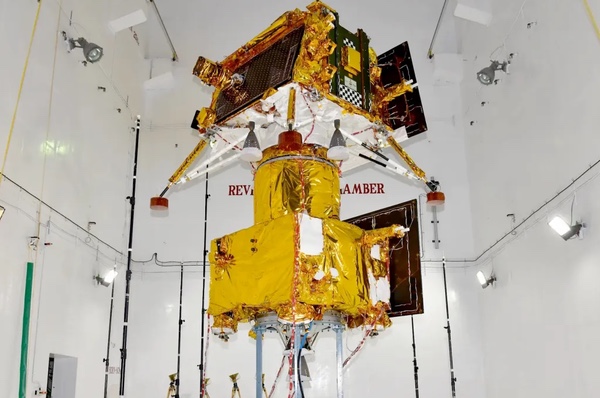
This mission consisted of Vikram, a lunar lander, and Pragyan, a lunar rover, and orbiting propulsion module. On August 17, 2023, the Vikram lander separated from the propulsion module to begin landing operations. The propulsion module had carried the lander and rover configuration to a 100-kilometer lunar orbit. This module is a box-like structure with a large solar panel. Initially, the life of this propulsion module was expected to be around six months but, even after two years, it is still functional and had recently done two lunar flybys.
According to ISRO, a few months after the successful landing of Vikram and Pragyan on lunar surface, the propulsion module was relocated to a high-altitude Earth-bound orbit by executing trans-Earth injection (TEI) maneuvers in October 2023. Since then, this propulsion module was revolving in this orbit under the influence of both lunar and terrestrial gravity fields. This interplay of gravity fields had led this spacecraft to enter the Moon’s sphere of influence (SOI), where the Moon's gravitation dominates the motion, on November 4. On November 6, the first lunar flyby event took place outside the visibility of the Indian Deep Space Network (IDSN) at a distance of 3,740 kilometers from the Moon’s surface. The second flyby event was visible from the IDSN, coming within 4,537 kilometers of the lunar surface on November 11. It is believed that the propulsion module must have exited the Moon’s SOI on November 14.
The flyby event trajectory was monitored very closely from ISRO Telemetry, Tracking and Command Network (ISTRAC). Special care was taken to monitor the propulsion module’s trajectory and close proximities to any other space objects. The overall performance of the module was normal during the flyby. For ISRO, these two flyby events have provided valuable insights and experience of mission planning, operations, and flight dynamics perspectives. It has also improved ISRO’s understanding of the effects of disturbance torques. Since torques acting on a spacecraft can alter its attitude in space, understanding these effects is essential for maintaining spacecraft stability.
Major space players like the US, Russia/USSR, and China have undertaken lunar flyby missions. Since 1958, more than 35 lunar flyby missions (including failures) have occurred. In the past, such missions have been used to undertake studies like lunar radiation environment and lunar photography experiments.
It is important to note that India’s investments in its Moon program are yielding significant results even today. On October 18, ISRO announced an important assessment made by their scientists based on the observations received from Chandrayaan-2 spacecraft. This mission, which was launched in 2019, had observed effects on the Moon of a coronal mass ejection (CME) from the Sun in May 2024. This information, which details how solar phenomena can temporarily alter the lunar environment, is important from the point of view of planning human missions to Moon.
| These missions are keeping India’s scientific footprint active on the Moon and prove India’s technological maturity in the era when some major programs for the Moon are in making. |
The basic job for the propulsion module of Chandrayaan-3 was to carry the lander and rover to a low lunar orbit. However, ISRO was ready to consider the propulsion module as more than just a courier. Since it was to go so close to the lunar surface, ISRO put sensors on it for observations. One, the Spectro-polarimetry of Habitable Planet Earth (SHAPE), took spectral and polarimetric measurements of Earth from the lunar orbit in the near-infrared radiation (NIR) wavelength range (1–1.7 microns). Scientists are studying the findings from SHAPE and these inputs would have much relevance in future exoplanet research and search for extraterrestrial life.
When Chandrayaan-3 was active on the lunar surface, ISRO conducted an experiment known as the “Hop Experiment.” During this test, the Vikram lander fired its engines to perform a brief hop on September 3, 2023. In simple terms, the lander successfully lifted off and moved to a new location about 40 centimeters away. This achievement is expected to support ISRO’s planning for its next mission, Chandrayaan-4, which aims to bring lunar samples back to Earth.
Even today the Chandrayaan-2 and Chandrayaan-3 missions are still providing valuable data about the lunar surface, and the insights gained from these ongoing observations will help ISRO plan its future missions to the Moon. These missions are keeping India’s scientific footprint active on the Moon and prove India’s technological maturity in the era when some major programs for the Moon are in making. These missions are together positioning the country for a major role in the future lunar economy and global Moon governance.
Note: we are now moderating comments. There will be a delay in posting comments and no guarantee that all submitted comments will be posted.