Our best energy and effortsby Robert G. Oler
|
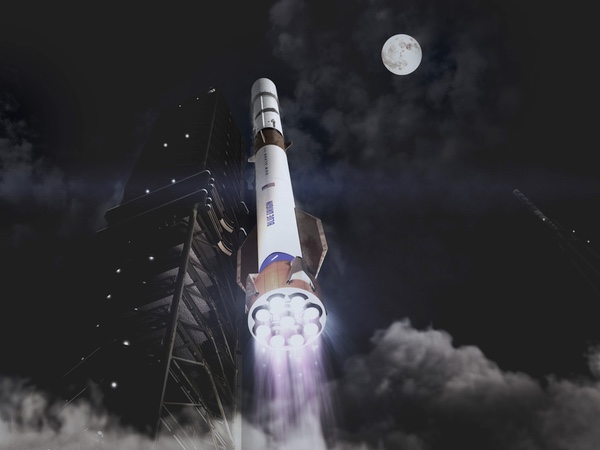
| Going to the Moon this decade requires a lander, not a test program. |
Start by recognizing what is possible before the end of this decade. Blue Origin’s New Glenn seems to have completed the most successful test campaign since Saturn V. Saturn flew twice before it headed off to the Moon for its debut with humans. New Glenn will likely hurl a payload to the Moon on the third try but, imitating Saturn, on the second it confirmed its entire operational portfolio, including first stage recovery.
New Glenn’s cost, reusability, and flight rate need to be verified. However, Blue Origin now has a product, not a test project.
The Space Launch System (SLS) and Orion exist. That alone makes them the foundation of the return to the lunar environment. What is needed: a lander.
SpaceX has a test program in Starship, a product is aspirational. The program is extensive and continues, but it is encountering major difficulties at all levels. There is no realistic date for operational status. The current plan calls for SpaceX to have one uncrewed flight of its still unbuilt lander to “human rate” it. For a program that has completed few of its test aims in one flight it is hard to imagine prompt success on such a grand scale.
Going to the Moon this decade requires a lander, not a test program. If the NASA administrator will not make the choice, Congress must. The SpaceX lander contract should be terminated. When Starship is successful, the product can be evaluated.
“The best of our efforts” require a phased approach. Phase 1 should be an interim capability using parts that are available in the near term. Our organization will be judged by producing a modern Lunar Module (LM) that will allow interchangeable and cooperative human and robotic exploration of key areas of the Moon. This focus will be to explore and confirm the location of a crewed base.
Blue Origin has demonstrated solid engineering management and execution capability with New Glenn. This will likely transfer seamlessly to an effort to meld the soon-to-fly Mark 1 lander with a limited, but safe, human capability. This interoperability will allow unprecedented capabilities and cost reduction. Blue Origin’s contract for a lunar lander should be at once expanded to include an interim lander.
The result should be a system capable of multiple lunar landings. Success will produce confidence in a variety of abilities not currently available. All the ancillary learned skills (such as on orbit refueling) will have commercial applications and expand commercial capabilities.
Phase 1 will also start the process to replace SLS. Technically competent, the rocket costs too much, flies too infrequently, and is untethered from commercial opportunities or potential. Vehicle costs will always be fully on the federal purse, and will grow.
SLS procurement should cease at the fifth Block 1 vehicle. It is very unlikely the return can occur during 2028 or on the third flight. A Phase 1 lander operational date should be by the start of 2029 and the fourth or fifth flight.
All upgrading of SLS or its infrastructure should cease. No avenue exists to increase the flight rate or lower cost of this vehicle. The proposed capabilities do not have value equal with the cost. All upgrade money should go to Phase 2.
Phase 2 of a lunar effort begins at once with a competition to human-rate one of the heavy lift vehicles flying or in development, such as New Glenn 9x4 or a Falcon Heavy, to replace SLS. Orion has unique capabilities for Earth-Moon flight.
Using commercial lift, changes in the architecture, such as Earth orbit rendezvous, might be necessary and that will require changes in Orion. These changes include embracing reusability. The results in Phase 1 will have produced confidence in other areas of change.
It is absurd to have as a goal a reusable lunar lander when Orion is not. With reusability and vehicle procurement the capsule should sustain a flight rate of at least two per year, perhaps three.
| Which is more important? Free people returning to the Moon before the communist People’s Republic of China, hence proving a superior system? Or, preserving a strategy that is driven primarily by the needs of rival aerospace groups as well as NASA’s internal institutional requirements to access federal dollars? |
This commercial contract should have reasonable but firm dates for first operation capability, performance, and cost. Two separate launch providers are a luxury that is costly and unneeded. Saturn V did not have a backup. If an issue develops in the system that is chosen, the contract should spell out how it will be addressed.
All the elements of the Gateway station should be launched commercially. The goal of future Western efforts in space should be a base on the Moon, but also a solid transportation system beyond Earth orbit. Gateway is the key to this. However, it needs evolution to a more robust concept including capabilities such as artificial gravity potential, such as was envisioned for the Nautilus concept.
This is not possible with the $2-billion-a-year, 18-month launch interval of SLS or the $2-billion single-use Orion capsule eating up funds. Two billion dollars spent on New Glenn 9x4 at $200 million per launch will put far more payload and infrastructure in the lunar area. Gateway should be thought of as the test version of interplanetary ships.
Appearing from this phased approach will be not only a solid relationship between commercial and government efforts, but a spin-off of the capabilities gained to other non-government sponsored commercial efforts. Aerobraking, fuel transfer, and massive communication structures are all possible. They need a catalyst.
The challenge is not the technology but will. Which is more important? Free people returning to the Moon before the communist People’s Republic of China, hence proving a superior system? Or, preserving a strategy that is driven primarily by the needs of rival aerospace groups as well as NASA’s internal institutional requirements to access federal dollars?
That is the choice which should be on the minds of various congressional committees and even inquired of the prospective NASA administrator. What we once did, we can do again, only better, but as JFK said, we need to organize. The judgment and course of history awaits.
Note: we are now moderating comments. There will be a delay in posting comments and no guarantee that all submitted comments will be posted.