A big win for European spaceby Jeff Foust
|

| While other nations scale up space investments, one official said, “Europe risks falling behind, not because of lack of expertise but because of insufficient and fragmented investment.” |
The production of the book showed the lengths ESA was going to make its case for a larger budget. Every three years, the ministers representing ESA’s 23 full member states, along with several associate and cooperating nations, meet to decide on funding levels for agency programs. At the previous ministerial, in Paris in November 2022, ESA sought €18.5 billion and got its members to agree to €16.9 billion (see “For ESA, a good enough budget”, The Space Review, November 28, 2022).
At that 2022 ministerial, ESA was already seeing the effects of geopolitical forces, as Russia’s invasion of Ukraine earlier that year ended cooperation between the agencies except for the International Space Station. Europe lost access to Russia’s Soyuz rocket that was launching from French Guiana, a precursor to the “launcher crisis” that, for a time, deprived Europe of independent access to space. It also upended the Rosalind Franklin rover mission to Mars, which was to launch on a Russian rocket using a Russian landing platform.
Those forces only grew since the Paris ministerial. In the last year, uncertainty about the relationship with the United States under the Trump administration, including proposed major cuts to NASA that would affect cooperation with Europe in science and exploration programs, led ESA to enhance cooperation with other countries while seeking to build up its own capabilities.
“We have a paradigm shift,” said Alberto Maulu, manager for technologies at the Luxembourg Space Agency, during a panel at Space Tech Expo Europe, a conference held a week before the ministerial in the same convention center in Bremen. “Resilience, security, European independence is now what’s driving at the institutional level and also at the commercial level.”
“Europe seems to be losing ground,” with its share of the global space economy shrinking, said Craig Brown, investment director at the UK Space Agency, during the same panel. The ministerial, he argued, “is perhaps an opportunity for us to think about how we do things differently.”
There was the perception that Europe was falling behind the United States, China, and others in space. ESA officials and others would routinely compare the much larger amount of government space spending in the US versus Europe, using that as an argument that Europe should up its game.
“Other global actors, such as the United States, China and India, but also Japan and Russia, are scaling up their investments, including in dual-use space capabilities,” one official, speaking on background, said a couple weeks before the ministerial. “Meanwhile, Europe risks falling behind, not because of lack of expertise but because of insufficient and fragmented investment.”
The ministerial, that official concluded, was a “decision point” for Europe’s future in space.
ESA spent the better part of two years developing its package of programs for the ministerial. About 20% of its budget is for “mandatory” activities, primarily science, where members contribute based on the sizes of their economies. But the rest consists of optional programs that countries can choose to fund, or not fund, with the expectation that their contributions would result in a proportional share of contracts to their nations’ companies—the “georeturn” principle.
| “When Europe unites, Europe succeeds,” Aschbacher concluded. |
ESA director general Josef Aschbacher formally presented the agency’s proposal, with a total value of €22.254 billion ($25.8 billion), as the ministerial formally started last Wednesday. It was time for Europe to come together on space and increase investment on ESA programs rather than just increase spending on national-level programs, as some countries have done.
“We face a perfect storm, a perfect storm that demands courageous decisions,” he said. “Do we truly believe that these crises are only temporary disruptions, and do we really want to retreat to narrow, exclusively national solutions that may feel simpler but leave us all weaker?”
“When Europe unites, Europe succeeds,” he concluded.
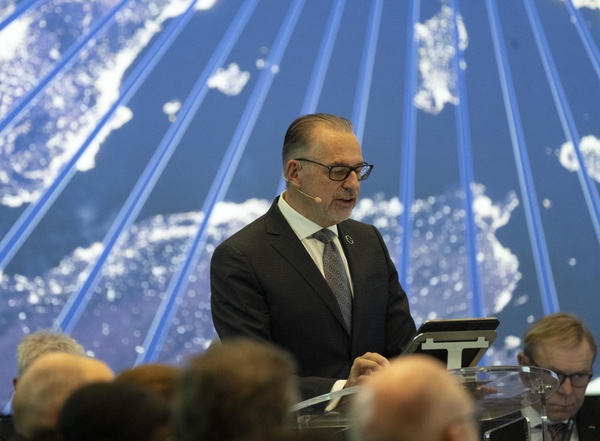 Josef Aschbacher, ESA’s director general, presents his proposed budget at the ministerial conference November 26. (credit: ESA/S. Corvaja) |
Security focus
Much of the package involved funding of ongoing programs in space transportation, navigation, Earth observation, and more. But there were some new efforts, like programs in ESA’s human and robotic exploration department to develop a lunar cargo lander, Argonaut, that could support later Artemis missions while giving ESA an opportunity to barter those services for seats on Artemis landing missions.
ESA also requested funding for the European Launcher Challenge, a program to promote the development of new launch vehicles. In a break with its traditional georeturn approach, ESA “preselected” five companies in the summer—Isar Aerospace, MaiaSpace, Orbex, PLD Space, and Rocket Factory Augsburg—earlier in the year, allowing countries to decide which companies to support.
But perhaps the biggest change in ESA’s proposal was the addition of a new effort called European Resilience from Space (ERS), which marked the civil agency’s move into defense and security. ESA announced earlier this year that its member states asked the agency to develop a proposal for ERS to develop space capabilities that could serve civil and defense needs.
The heart of ERS is starting work on a constellation of optical and radar imaging satellites for surveillance. The goal is a constellation that can provide a revisit time of about 30 minutes, far better than existing European national systems can provide. Production of the constellation would come in a second phase, funded by ESA and the European Commission starting in 2028, but the request for the 2025 ESA ministerial would support development of prototypes that could launch by 2028.
| “The ministerial should be about strategic autonomy,” Wachowicz said. “It should be more security driven.” |
ERS would also include funding to advance a low Earth orbit navigation satellite constellation intended to augment the existing Galileo system in medium Earth orbit. It would also support IRIS², the European secure connectivity constellation.
ERS stemmed from European concerns about Russia as well as a desire to reduce reliance on American systems. “Poland will advocate for a European approach to space security that treats satellites, launch capabilities and ground systems as critical assets,” said Marta Wachowicz, president of the Polish space agency POLSA, during the Space Tech Expo Europe panel.
“The ministerial should be about strategic autonomy,” she said. “It should be more security driven.”
ERS raised some issues within Europe about the role ESA, a civil space agency, should be playing in defense programs. The ESA Convention, the 50-year-old document that forms the foundation of the agency, states that ESA will work on space programs for “exclusively peaceful purposes.”
“We are a space agency, and space, as you know, is dual use by nature,” Aschbacher told reporters the day before the ministerial. He noted that many ESA programs, from launch vehicles to navigation satellites, have applications for defense as well as civil and commercial uses.
“We had a very deep discussion with our member states,” he said, “to clarify exactly the role of ESA and how much ESA can or cannot work in the defense domain. This was a very profound discussion and a very profound deliberation.”
Renato Krpoun, chair of the ESA Council, confirmed that ESA members concluded that the agency could be involved in defense activities, but “nothing aggressive.”
Whatever ESA develops, he said, will be operated by someone else, either the European Commission or national governments. “ESA is not the agency that will operate these systems. We can prepare it, but we should not operate it.”
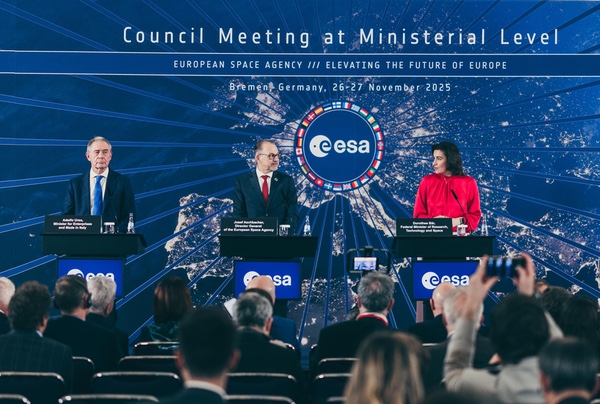 Aschbacher (center) discusses the outcome of the ministerial November 27 with Italian minister Adolfo Urso (left) and German minister Dorothee Bär. (credit: ESA/Ph. Servent) |
“Outstanding” outcome
After Aschbacher gave his speech about the agency’s proposal at the ministerial Wednesday, the ministers representing ESA’s members got to give brief opening statements.
Most stated their intent to support the package, at least broadly, and back up those words euros. Spain’s science minister, Diana Morant, said her country would increase its 2022 contribution by 50% in 2025, citing “how strategically important space is and the importance of our work through ESA.”
| “We have to evolve. Europe has to undergo significant reform,” said Baptiste. “It has to give up its pipe dreams, starting with georeturn.” |
Canada—not a full ESA member but instead a “cooperating state” that has worked on ESA programs for decades—offered an even bigger increase. Lisa Campbell, president of the Canadian Space Agency, confirmed comments a week earlier from the country’s industry minister, Mélanie Joly, that the country would make a massive increase in spending on ESA programs.
Canada, which provided €98 million in 2022, was now committing €407.7 million. “This investment will enable our country to contribute to important ESA missions directly benefiting Canadian industry and allowing it to grow and diversify,” Campbell said.
A couple countries, though, said they wanted to increase their spending but could not fully commit to it at the ministerial. The Dutch minister of economic affairs, Vincent Karremans, said the Netherlands planned to increase its ESA spending by 25%, or €110 million, but since the country currently has a “caretaker government” it could not formally commit to that increase until as late as the end of January.
Belgium also asked for an extension for its contribution. “Belgium has decided to make a particular and an exceptional budget effort in the context of this ministerial council. However, I do require a bit more time to make that additional contribution official,” said Vanessa Matz, minister of modernization of the public administration.
The closest thing to criticism came from France. “We have to evolve. Europe has to undergo significant reform,” said Philippe Baptiste, the country’s minister of higher education, research, and space. “It has to give up its pipe dreams, starting with georeturn.”
Once all the countries, and several observers like the European Commission, completed their opening statements, the ministerial went into closed-door negotiations. That featured several rounds where member states could subscribe to the various optional programs, with negotiations between the rounds,
Aschbacher, talking to reporters at the end of the day Wednesday, offered few specifics about the negotiations but sounded upbeat. “There are some countries who are putting a little more in the beginning, and some others a bit less at the beginning,” he said of the ongoing subscriptions.
“The mood is very positive,” he added. “There is a very good spirit, and I think we are on a very good track. But I don’t want to speculate on what comes out tomorrow.”
Those discussions continued until early Thursday afternoon, when ESA discussed the results. Out of a request of €22.254 billion, ESA members provided €22.067 billion.
Aschbacher, who told reporters just before the ministerial that anything “above 20 billion will be considered a good success,” declared victory.
“This is quite outstanding,” he said at a press conference where ESA announced the results. “It’s the first time, according to my recollection of years in ESA, that we have reached almost the level that the director general has proposed to the member states. This has never happened before.”
| “I think this message of Europe needing to catch up and to step up and literally elevate the future of Europe through space has been taken by our ministers very seriously,” Aschbacher said. |
While ESA got 99% of its topline budget request, the results varied among various programs. Some, such as in space transportation and navigation, were oversubscribed, getting more money than requested. That include the European Launcher Challenge, where ESA had requested less than €500 million but ended up securing more than €900 million. All five companies would get significant funding in the form of launch contracts or awards to fund development of larger vehicles.
Science, a mandatory program, also got an increase that will exceed the rate of inflation for the first time in several years. “We are leveling up with the science program,” Aschbacher said, saying it would support missions in development as well as new concepts, like a lander mission to Saturn’s moon Enceladus—an icy world with a subsurface ocean—that requires preparatory work now even though the mission will not launch until the 2040s.
However, human and robotic exploration, which includes programs ranging from the International Space Station to Mars Sample Return, fell short of its goal by about 20%, with just under €3 billion committed.
It wasn’t clear why member states did not support exploration as enthusiastically as it did other programs, and Aschbacher said it was too early to say what specific programs might be affected. ESA said later that programs like Argonaut and an initiative to develop European cargo spacecraft were funded.
Just before the press conference, Aschbacher stood outside the main meeting room for the ministerial with the ministers representing France, Germany, and Italy. He announced that astronauts from those three countries would get ESA’s three current seats on Artemis missions to the lunar Gateway, with a German astronaut going first.
One question mark at the end of the ministerial was the funding for ERS. In the budget proposal released Wednesday, ESA said it was seeking €1.35 billion for ERS, but the funding results it released at the press conference did not mention how much funding the agency secured for ERS.
Aschbacher said that the numbers presented had folded ERS funding into ESA’s existing budget lines for Earth observation, navigation, and communications. However, he and other officials said members had provided significant funding for ERS, including an oversubscription for initial phases of the work on the imaging constellation.
Despite the uncertainties on some programs, Aschbacher said he was pleased with what came out of the ministerial, as ESA members delivered on the call for unity in space. “I think this message of Europe needing to catch up and to step up and literally elevate the future of Europe through space has been taken by our ministers very seriously.”
Note: we are now moderating comments. There will be a delay in posting comments and no guarantee that all submitted comments will be posted.