“Sovereign capacity” of private and public space programsby Alexander Wallace Watson
|
| The sovereign capacity of space operations is the sum of economic, legal, and political leverage a space program has over its supply chain. |
Major space powers are increasingly keen to maximize their sovereign capacity of space technology and operations.[1] Geopolitical tensions have led states to reduce their trade dependencies on critical industries, including space, to ensure that they maintain autonomy in crisis scenarios, such as pandemics and wars.
Does “sovereign capacity” apply to the private sector?
The concept of sovereign capacity can be applied to a private space program’s leverage over its supply chain, often determined by its purchasing power, lobbying power, and negotiating hand. Private companies’ capacity to influence the economic, political, and legal landscape of an industry is an age-old phenomenon,[2] and continues today.
Large commercial companies, such as SpaceX, negotiate with government organizations (to secure authorizations, contracts, and partnerships) as well as with other private companies across vertical and horizontal supply chains. NASA is highly dependent on SpaceX for launch, giving the private company immense leverage over US space policy including in areas such as budgeting and resourcing,[3] procurement and licensing,[4] trade negotiations,[5] and industry regulations.[6]
Other private companies, such as Lockheed Martin, Northrop Grumman, and Boeing have significant strategic leverage over the US space program, primarily through their control over key technologies and supply chains for both civil and military space operations. Likewise in Europe, private companies such as ArianeGroup, Airbus, Thales, Leonardo, and Rolls-Royce command strategic leverage over European space supply chains.
Strengthening sovereign capacity
A space program’s sovereign capacity can be strengthened through a range of industrial and trade strategies. The following methods are used to alter the negotiating relationship of public and private space programs.
Strategic control of domestic industry
The most obvious way to achieve sovereign capacity would be to incorporate an entire space program within government. However, due to the benefits of commercialization, governments fund private sector technology instead, and sustain a collaborative ecosystem to foster commercial space enterprise.
Governments can act as a primary customer and investor to stimulate growth and retain leverage over the supply chain. This can be done through public procurement, targeted funding, grants, subsidies, tax-incentives, clustering, public-private partnerships, and technology transfers.
A government can retain a “golden share” in a privatized company it has funded. This share gives the government certain powers, such as over the appointment of board members and the ability to block a foreign takeover. The UK government, for example, holds golden shares in key defense and aerospace companies like Rolls-Royce.
| In cases of mutual trust, sovereignty can be “pooled” together to advance capabilities through technology transfers and cooperation |
Governments can acquire specific rights of access or licenses in private companies in exchange for investment or contract awards. For instance, a government might secure a non-exclusive license to use a company’s technology, ensuring it can access a critical capability even if the company's status changes.
Sometimes, governments can use a patented invention without the patent holder’s permission, often in return for “reasonable compensation” as determined by the court. This is referred to as “Crown use” and is a legal tool found in the patent laws of many countries.[7]
This ensures that the state can always access a critical technology for national defense or other government uses, even if it is owned by a private entity. In joint ventures, collaborating parties might specify that each retains rights to the intellectual property it contributes, whereas jointly created intellectual property is either shared or licensed on pre-agreed terms.
Liability sharing agreements in public-private partnerships can be used to clarify and improve the risk landscape for private enterprise. For example, US commercial space launch law has a three-tiered liability system: it requires private companies to carry insurance, indemnifies them up to a certain amount (approximately $2.9 billion), above which all remaining liability is reassigned back to the private company.[8] This final tier ensures that the company remains ultimately responsible.
Coordination of international partnerships
In reality, all states (even North Korea) depend on international trade to fill gaps in the domestic supply chain and ultimately reduce costs. This incurs a trade dependency that can reduce a state’s sovereign capacity. However, in cases of mutual trust, sovereignty can be “pooled” together to advance capabilities through technology transfers and cooperation (e.g. AUKUS). Therefore, licensing exports of space technology to bilateral, plurilateral, and multilateral partners can allow for cooperative advances in capability.
The Artemis Accords[9] are a US-led plurilateral framework that serves as a non-binding set of principles for peaceful and transparent space exploration. By signing them, countries signal their political alignment to the US and its allies, and commitment to a shared set of norms governing space, making it easier for allies to collaborate and form trusted supply chains with each other.
International bodies (e.g. International Telecommunication Union, United Nations) play a vital role in enhancing or pooling sovereign capacity. By providing a clear and stable regulatory environment, these agencies attract private investment and foster a co-operative space industry.
Post-transfer controls of sensitive exports
Space trade agreements can include trade-technical conditions of licensing and oversight that ensure sensitive technology remains controlled even after it has been licensed or sold. These conditions typically work by obligating the recipient to comply with specific operational, security, and reporting requirements, such as restricting access to authorized personnel, permitting on-site inspections, preventing re-export, or relying on the exporter for maintenance and updates.
Such obligations are a critical part of negotiations, as they directly shape the recipient’s sovereignty and long-term technological autonomy. They function as instruments of control and leverage, ensuring that a partnership is not merely a commercial transaction but a sustained strategic and geopolitical relationship. These post-transfer conditions illustrate the shift in export control from a focus on the point of sale to an approach centered on technology-lifecycle management.
- Technology Safeguards Agreements are a type of bilateral agreement designed to protect sensitive technology by establishing a legally enforceable framework to ensure that exported space technology is protected when used by foreign countries. This includes provisions for physical security, monitoring access, and preventing unauthorized transfers to third parties. This gives the exporting state legal leverage over its technology while allowing the importer to utilize the technology.
- End-user assurances are contractual provisions that require the importer of space technology to certify its final use and destination. They are a common feature of export controls to prevent the re-export or diversion of dual-use technologies to undesirable end users. They require the end user to agree to strict conditions, sometimes including on-site inspections and verification by the exporting country.
- Remote disabling and data access is the most direct method of maintaining control of an asset post-sale. A contract might include a clause that allows the exporting nation to remotely disable certain functionalities of the hardware or software in a crisis situation. This is often framed as a security feature to protect the system from misuse but is also a powerful behavioral deterrent. Additionally, the exporter may require real-time access to operational data, diagnostics, and performance logs. This ensures the exporting nation maintains an intelligence advantage over the importer and can monitor the item’s use.
- The exporting nation can also retain ownership of all intellectual property, including patents and source code. The importing country would be granted only a limited license to operate the technology. This means the recipient cannot independently modify, upgrade, or adapt the system for their own needs, nor can they integrate it with unapproved, third-party systems. This is sometimes called a “black box” system, where the internal workings of a technology are sealed and can only be serviced by the authorized manufacturer.
- Maintenance monopolies can mandate that all maintenance, repairs, and software updates be performed exclusively by the exporting country's approved companies or facilities. This is a subtle but important form of retained control. It prevents the importing country developing its own maintenance expertise or reverse-engineering the technology. It also ensures a long-term commercial revenue stream for the exporter and allows them to cut off support if political relations worsen.
Forgoing sovereign capacity
Many space programs forgo their sovereign capacity by importing, leasing, or buying licenses to third-party technology. This is primarily to reduce capital expenditure. Certain areas of space technology involve high startup costs, such as launching capabilities or advanced avionics. Many countries continue to outsource launching to the USA, China, Russia, and India, rather than develop domestic launch capabilities.
For example, the estimated cost of developing an indigenous heavy-lift launch system exceeds $10–15 billion with a lead time of 7 to 12 years, whereas purchasing launch services on the international market can reduce upfront costs to $60–100 million per mission.[10] Similarly, building high-resolution Warth observation satellites can require unit costs of $200–400 million, compared with commercial data subscriptions that range from $20,000 to $1 million annually, depending on the frequency of imaging.[11]
As a result, while the United States, China, Russia, and Europe maintain vertically integrated capabilities, many medium powers (including UAE, Brazil, and South Korea) have opted to combine sovereign investment in selective technologies with outsourcing of other operational capabilities, like launching. This dual model reflects a balance between strategic autonomy and fiscal prudence.
Case study: European launch outsourcing
In the 2010s, Russia’s Soyuz was a dominant launch vehicle for international customers, including NASA, ESA, and commercial operators. Indeed from 2011 until 2020, after the US Space Shuttle program ended and before SpaceX’s Crew Dragon became operational, the Soyuz was the sole means of transporting astronauts to the ISS at a cost of $50–80 million per astronaut. For satellite deployment, the Soyuz offered reliable medium-lift capacity at approximately $50–60 million per launch.[12]
| Sovereign capacity ensures leverage over a space program’s supply chain, achieved through a variety of legal, economic, and political tools. |
In 2022, during the Ukraine conflict, Russia suspended launch services for European customers. In February 2022, Roscosmos announced it was suspending cooperation with European partners for launches from the Guiana Space Center, pulling its personnel from the site in response to Western sanctions.[13] In March 2022, Roscosmos issued conditions that OneWeb satellites would only be launched by Roscosmos from Baikonur, Kazakhstan, if the the United Kingdom government divest itself from the company and provide end-use assurances that the satellites would not be used for military purposes; the UK’s business secretary publicly refused to sell the government’s stake and so Roscosmos ultimately suspended their launch.
This action forced European satellite operators to seek alternatives. The Indian Space Research Organisation (ISRO) stepped in as a cost-effective alternative to Soyuz. It launched 36 OneWeb satellites on its LVM3 rocket in March 2023, a year after the Soyuz contract was terminated. The LVM3 has a launch cost of approximately $48 million, while the smaller and even more economical PSLV is priced at $18–28 million per launch. Additionally, European customers have turned to US providers, with many missions flying with SpaceX.[14]
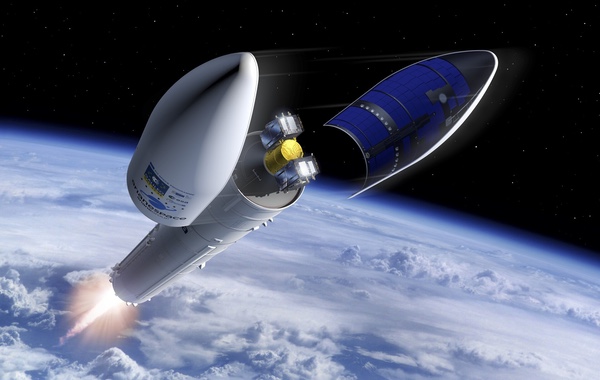
Europe’s response was slow, leaving it without a sovereign launch capability for some time. However, the new Ariane 6 finally made its first commercial flight in March 2025.[15] The successful launch has restored Europe’s sovereign access to space.
Conclusion
In an era of rising geopolitical competition, the pursuit of sovereign capacity has become a central objective for states and private enterprises. Sovereign capacity ensures leverage over a space program’s supply chain, achieved through a variety of legal, economic, and political tools. While some programs may aim for complete autonomy through vertically integrated public programs, the reality nearly always involves a more nuanced strategy.
Ultimately, the ability to maintain a robust space program involves a sophisticated and dynamic commercial and legal apparatus, whether deployed through government agencies or the private sector.
References- The strategic edge of sovereign space launch | Feature from King's College London; EU Space Strategy for Security and Defence - European Commission; Priorities for Strengthening the UK's Sovereign Space Capability - GOV.UK
- See the East India Company; Will SpaceX Control Mars Like the British East India Company Controlled the Indian Subcontinent?
- SpaceX Contracts DOGE, New York Times
- Trump likely to axe space council after SpaceX lobbying, sources say | Reuters
- Elon Musk's SpaceX asks US to address foreign trade barriers | Reuters
- SpaceX Wins Earlier-Than-Expected Approval to Fly Fifth Starship - Bloomberg
- For example, Patents Act 1977, s 55
- Commercial Space Launch Competitiveness Act of 2015, 51 U.S.C. §§ 50905, 50914–50915
- Artemis Accords - NASA
- NASA’s Space Launch System | Baker Institute; The Space Review: The new era of heavy launch
- Key trends in earth observation and how they are driving commercialization & democratization - Geospatial World; POLISH EARTH OBSERVATION SATELLITE CONSTELLATION; New Earth Observation Business Models: From Price‑Per‑Kilometer to Insights‑as‑a‑Service - Geoawesome
- To cheaply go: How falling launch costs fueled a thriving economy in orbit; Russian launch service provider reveals cost of Soyuz-2.1 rocket launch - Science & Space - TASS
- Russia suspends cooperation with Europe on space launches from French Guiana | Reuters
- ISRO Launches 36 OneWeb Satellites, SpaceNews
- With Ariane 6, Arianespace successfully launches Metop-SGA1 satellite
Note: we are now moderating comments. There will be a delay in posting comments and no guarantee that all submitted comments will be posted.