See you on the other side: What Jim Lovell’s Apollo 8 mission taught a divided worldby Kathleen Bangs
|
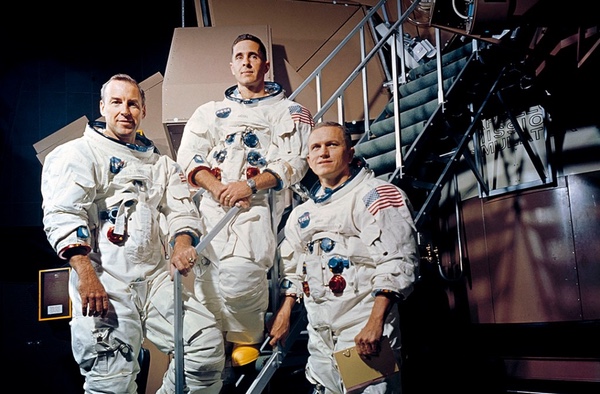
| But as we enter 2026, it’s his December 1968 Apollo 8 mission that offers a perspective to reconsider. |
But then, at the very end of that turbulent year, three men climbed onto a Saturn V rocket and left Earth’s noise behind. Apollo 8—with Frank Borman, Jim Lovell, and Bill Anders on board—was the first crewed mission to orbit the Moon and view a world no one had ever seen up close. Their destination was audacious. But what grabbed the human heart wasn’t the distance. It was the silence.
The far side of the Moon
On Christmas Eve 1968, Apollo 8 slipped behind the far side of the Moon. Minutes before they disappeared behind the lunar limb, Mission Control called: “Apollo 8, one minute to LOS (Loss of Signal). All systems Go. Safe journey, guys.”
Jim Lovell’s voice crackled back with a line that still tightens the chest: “We’ll see you on the other side.”
The Moon physically blocked all radio signals.
Ground controllers stared at their screens. By some estimates, one-quarter of Earth’s population—the largest broadcast audience in history—listened, watched, and waited. For the first time, three men were completely severed from their species, 400,000 kilometers from home, executing a maneuver that had never been attempted.
Thirty-seven minutes and thirty-two seconds passed in silence.
When the radio’s carrier tone finally returned right on schedule, Apollo 8 was in lunar orbit. Humans had done it. But the astronauts weren’t safe yet. After 20 sleepless hours and ten orbits around the Moon, they’d have to perform the Trans-Earth Injection—an engine burn on the far side—to push them back home. If that burn failed, there could be no rescue mission. They’d be permanently stranded in lunar orbit until their life support ran out.
Earthrise: The photograph that changed the scale
Among Apollo 8’s many tasks was to photograph the Moon’s surface: that gray, cratered, lifeless landscape. But during their fourth orbit, they looked up from their lunar mapping and saw something so stunning they momentarily forgot the Moon.
Earth. Rising above the Moon’s horizon.
A frantic scramble ensued. Bill Anders adjusted his Hasselblad camera—Lovell reportedly calling out to grab the color film—and captured the shot before the moment passed. The photograph, Earthrise, became one of humanity’s most iconic images.
Our planet appeared as a brilliant blue and white marble against the black void of the universe. “It was the most beautiful, heart-catching sight of my life,” Anders said later, describing Earth as looking “like a Christmas tree ornament, very fragile.”
They had traveled a 400,000 kilometers to explore the Moon, and the most important thing they discovered was Earth.
Jim Lovell had his own way of expressing the revelation. Looking through his window, he realized: “I could put my thumb up and completely hide the Earth. Everything I ever knew was behind my thumb.”
| The lesson of Apollo 8 is simpler and more practical: sometimes you have to travel far to gain perspective on the reality of what you already have. |
From lunar orbit, there were no visible borders. No wars. No riots. No political divisions. Just one small, shared world. When the astronauts returned to Earth, they received thousands of telegrams. One stood out: “Thank you, Apollo 8. You saved 1968.”
The Earthrise photograph didn’t fix humanity’s problems, yet it did change the scale of how people saw the world. Newspapers ran it on front pages. People taped it to walls. For a brief moment, the map receded and Earth returned to being what it actually is—one shared lifeboat in space.
What Lovell left us
Most people know Jim Lovell for Apollo 13. “Houston, we’ve had a problem,” became his most famous line, delivered with characteristic understatement after an explosion on the way to the Moon. The mission became a Hollywood blockbuster, a story of survival and teamwork against impossible odds.
But Apollo 8 was about perspective.
I met Jim Lovell twice over the years: once at an aviation trade show in Florida, once at a dinner honoring pilots in New York. He signed my copy of Lost Moon. I put that book away carefully, not knowing exactly who I was saving it for. Until my grandson was born. That inscribed book is a handoff—a tangible connection for a new generation as those Apollo missions recede.
Honoring Lovell’s legacy doesn’t require grand gestures or Kumbaya sentiment. The lesson of Apollo 8 is simpler and more practical: sometimes you have to travel far to gain perspective on the reality of what you already have.
Maybe the simplest tribute we can offer in this new year is to recover that moment of listening, when a billion people waited together in silence, hoping to hear voices return from the void. What if we gave each other that same patient attention? Not to agree, but simply to hear? It won’t fix everything. It might, however, change the scale of our disagreements—and in that change there is hope.
As we enter 2026 without Jim Lovell, we carry forward what Apollo 8 gave us: we’re all on this mission, together.
See you on the other side, Commander.
Note: we are now moderating comments. There will be a delay in posting comments and no guarantee that all submitted comments will be posted.