Buck Rogers in the 20th centuryby Dwayne A. Day
|
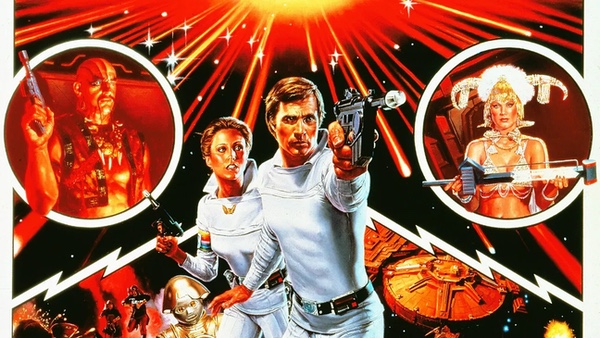
| The show did not last, and indeed, the character of Buck Rogers has not made it out of the 20th century. This wasn’t Gil Gerard’s fault. He was a better actor than the show deserved. |
For boys of a certain age, Buck Rogers in the Twenty-Fifth Century was important, but also frustrating. If you grew up in the 1970s and were interested in science fiction, by the time the show premiered in September 1979, you had almost certainly watched endless reruns of Star Trek, and the short-lived, promising, but depressing 1978 series Battlestar Galactica. You had certainly been energized by Star Wars, which hit theaters in 1977. Buck Rogers looked like an exciting and interesting science fiction show until you watched a few episodes and realized that it certainly wasn’t Star Trek, it was schlock.
The show was based upon the science fiction adventure hero and feature comic strip created by Philip Francis Nowlan. The strip first appeared in American newspapers in January 1929 and later led to books, a radio program, a serial film, a 1950–1951 television series, and other media. The strip continued until 1967. Buck Rogers also inspired Flash Gordon, a comic strip that ran from 1934 to 2003 and was more commercially successful and culturally significant.
In the original strip, Buck was a former pilot working as a mine inspector who falls victim to a mysterious gas underground and emerges 500 years later. The theme of a contemporary man who wakes up in the far future was later used by other authors and writers. Star Trek creator Gene Roddenberry based two failed TV shows of the early 1970s on the concept. Woody Allen’s movie Sleeper has the same premise. There was also the animated series Futurama, where 20th-century delivery boy Philip J. Fry is cryogenically frozen for a thousand years, unfrozen, and becomes… a delivery boy (but in the future!)
After the smash success of Star Wars in 1977 (which George Lucas made because he could not get the rights to Flash Gordon), many studios and producers sought to capitalize on the new interest in science fiction adventure. Hollywood mega-producer Glen Larson created Battlestar Galactica, and then Buck Rogers, which started as a television movie that debuted theatrically in March 1979. The NBC network commissioned a weekly series, which premiered on September 20, 1979.
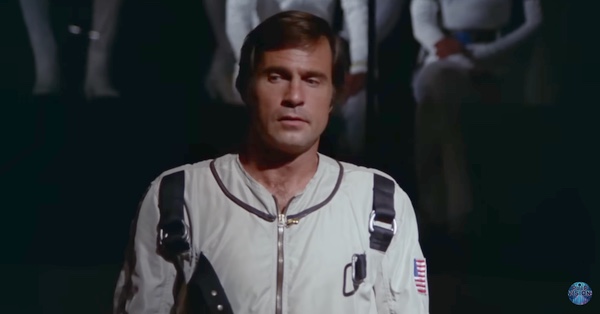 Buck was played by Gil Gerard, who died in December at the age of 82. Gerard played a NASA astronaut launched into space in the 1980s and frozen for 504 years. When he returned to Earth, he warned the Earthlings of a dangerous enemy. He was ignored. (credit: Universal Studios) |
Lost in space, for awhile
The premise of the show was that Captain William “Buck” Rogers, no longer a mine inspector but instead a NASA astronaut, is launched into space aboard Ranger 3, “the last of America’s deep space probes,” when he encounters an unexpected space phenomenon and is frozen for 504 years. His shuttle is discovered drifting in space in 2491 by the alien flagship Draconia, which is heading to Earth for treaty negotiations, led by the lovely but dangerous Princess Ardala.
Buck eventually returns to Earth, discovering that it was devastated by nuclear war soon after he left and is only partially rebuilt, 500 years later. He warns the Earthlings, particularly Earth Defense Forces leader Colonel Wilma Deering (played by former model Erin Gray) that the Draconia is equipped with fighters and is planning an attack, but the only one who believes him is a short robot named Twiki. Ultimately, he defends the Earth and joins the Earth Defense Force, becoming a sort of special agent who helps protect Earth, while also teaching the stuffy Earthlings to loosen up and enjoy disco music.
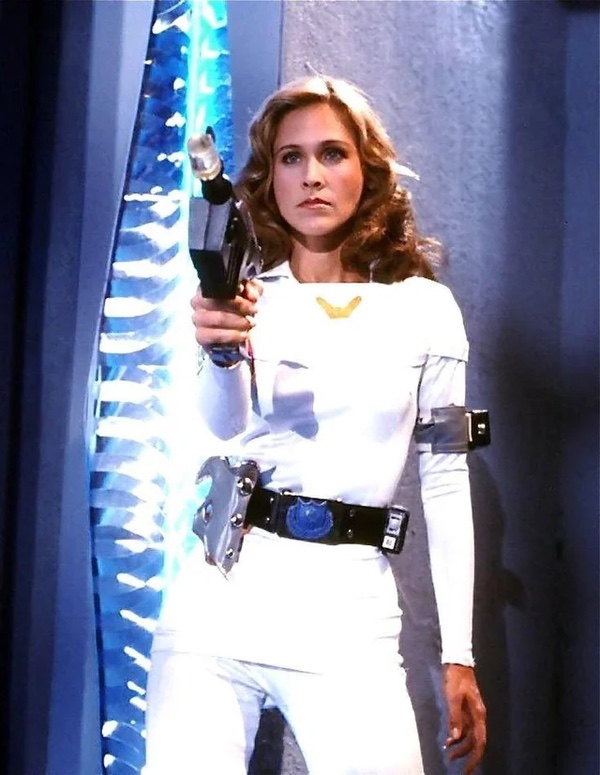 Colonel Wilma Deering was the head of the Earth Defense Force. She was played by Erin Gray. The character was inconsistently written--highly competent and in control one moment, a damsel in distress the next. But she knew how to use a blaster. (credit: Universal Studios) |
Science fiction writer Harlan Ellison famously called producer Glen Larson “Glen Larceny” because of his reputation for creating TV shows that borrowed concepts from successful movies. 20th Century Fox sued Larson for allegedly ripping-off Star Wars with Battlestar Galactica. Later Larson created Automan inspired by Tron. Larson’s greatest success was probably Magnum, P.I., although he was a writer, producer, and creator for numerous other shows, such as Knight Rider, and the long gone, but ripe for remake, 1979 TV series BJ and the Bear, about a trucker and his chimpanzee companion (obviously inspired by the 1978 movie Every Which Way But Loose, about a trucker and his orangutan companion).
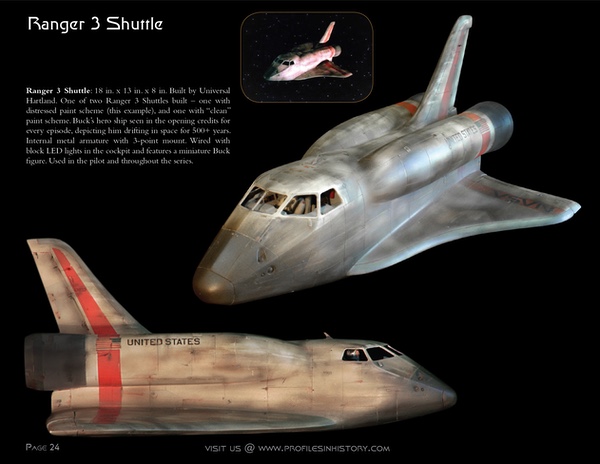 The show had some good model-work, and decent special effects for the time. That made it expensive. This is Buck's NASA spacecraft, Ranger 3, when it was up for auction. (credit: profilesinhistory.com) |
“We don’t want it good, we want it Tuesday”
Buck Rogers was never ambitious or very smart. The show was often chasing whatever was popular at the time. It put women characters in skimpy, skintight outfits, but also had Gerard appear shirtless on numerous locations, providing a bit of beefcake for the women in the audience. Wilma Deering’s character was never consistent, going from hard-nosed and extremely competent one minute, to damsel-in-distress or weeping captive the next. After appearing in the pilot movie, Erin Gray was reluctant to continue for the series and was going to be replaced by actress Juanin Clay until she changed her mind. Unfortunately for Gray, the Wilma Deering character was never well written, although it helped her career. Clay got a guest spot as a consolation prize.
Ratings began sagging during the first season, critical reaction was poor, and the show’s cost was high, all leading to a substantial revamp for the second season.
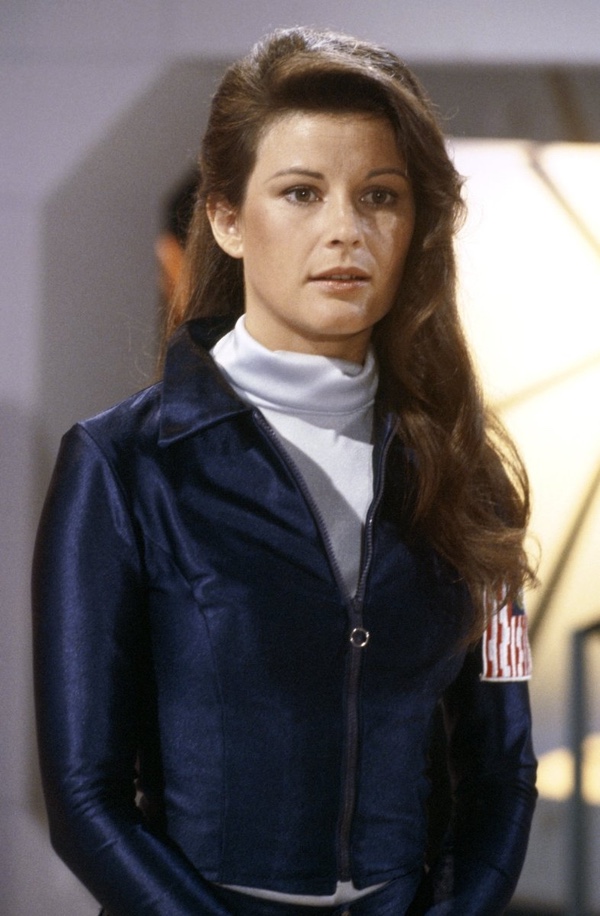 Actress Juanin Clay almost took over the Wilma Deering part when Erin Gray was unsure if she wanted to continue the role. Clay later appeared in a guest role. The show sought to portray women military officers as competent and in charge, but some fans complained. (credit: Universal Studios) |
The behind-the-scenes drama making Buck Rogers was in many ways more interesting than what made it to screen. In the late 1970s, Universal Television was a production machine, churning out television episodes like sausages. The people who worked there had numerous mottos for the studio, such as “Universal: we don’t want it good, we want it Tuesday.”
A couple of the show’s writers wrote a humorous exposé of what it was like to work on Buck Rogers, and Universal Studios, which was not exactly a friendly atmosphere. At one point they were told to include a dog in an episode because it had been adopted by the staff of a tabloid newspaper that would give the show free publicity. They also recounted how they had been chased by a Teamster driving one of the studio tour trams—filled with bewildered tourists—because the two writers were in the same golf cart, and studio rules required that if two people were riding in the same vehicle, they required a Teamsters driver.
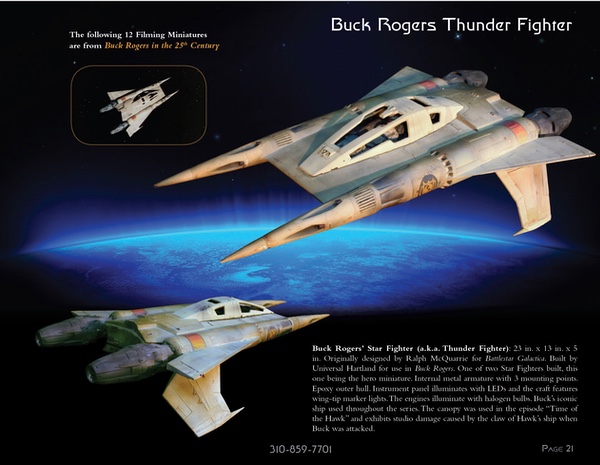 The Earth Defense Force flew the Thunder Fighter. The design was originally developed for the 1978 television series Battlestar Galactica, but was not used. It was recycled for Buck Rogers. Pilot visibility was a bit of a problem. (credit: profilesinhistory.com) |
Other stories abounded, like the writer who learned he had been fired when a producer arrived to show his replacement the office he would be working in. Such mistreatment was not only reserved for lowly writers: veteran actor Tim O’Connor, who played Dr. Huer in the first season, learned that he was fired while appearing at a press conference for the second season, where somebody announced that he would not be returning to the show. He handled it professionally, unlike his bosses. As some people grimly joked, the studio motto could have been “Universal: we dare you to make a TV show here.”
Gil Gerard developed a reputation for being difficult during production. He didn’t like all the smart-aleck dialogue and rewrote many of his lines. He also reportedly demanded a different ending to an episode that had Wilma rescuing Buck, something that Gerard apparently believed was emasculating. Erin Gray mostly kept quiet about Gerard’s actions, but did come to his defense about one early incident, noting that during filming of the pilot movie Gerard pointed out that the extras in Earth Defense Force uniforms were all male, and filming stopped until some female actors could be found to better represent what was supposed to be a more egalitarian post-apocalyptic future.
At least some of Gerard’s complaints were about making the show better, not just serving his ego, but his biggest objection was the tone of the show: he wanted it to be more serious and less camp, but the producers and the network had decided they wanted schlock. Wisecracking robots, princesses wearing sequined bikinis, and villains chewing scenery were part of the show’s DNA.
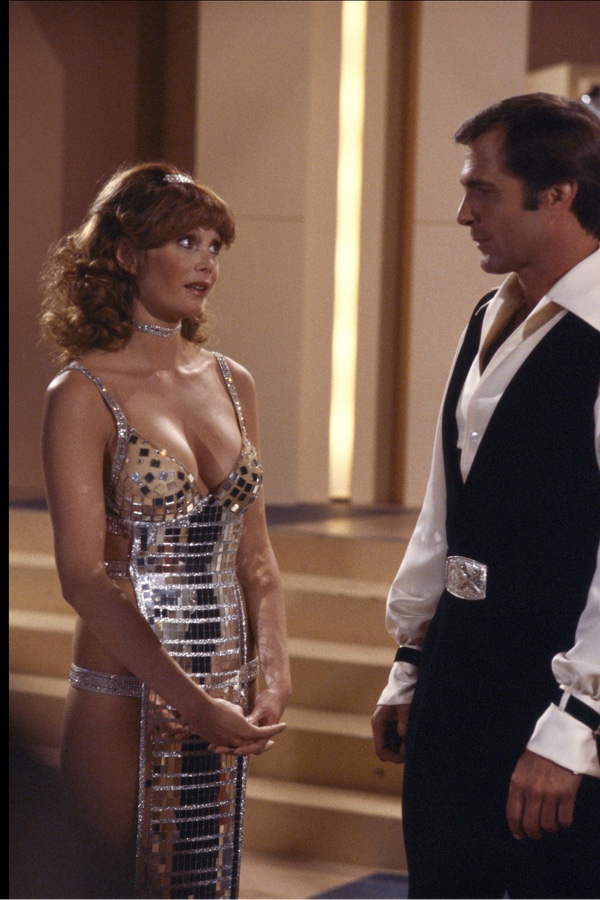 Although the show was schlocky, the costuming was unique. Note the large collars on Buck's shirt in this scene. (credit: Universal Studios) |
In summer 1980, going into the second season, Gerard committed a cardinal sin in Hollywood, giving a brutal interview to Starlog magazine about his problems with the show. The interview appeared in the November issue and annoyed many of the cast and crew. He complained about the quality of the scripts and blasted the network for interfering with the show, stating that he would have been happy if they were canceled after the first season. He was unhappy with the producers and the writers, some of whom he named, and even the guest stars, who he did not name. He claimed that he had rewritten many of the scripts, saving them from being completely terrible. He did express happiness with the new direction of the second season.
By the time the interview appeared in print, the second season had already started, and although the tone was more serious, the stories were still terrible. Rather than set on Earth, Buck was now on a mission to find the “lost tribes” of Earth who had left after the devastation of the war—Buck went from being James Bond to being James T. Kirk. Wilma Deering was demoted and Erin Gray gave up her skintight spandex for an outfit that made her look like she should be wearing roller skates and serving hamburgers at a drive-in joint. The show added an arrogant robot and a doddering old scientist (two character types that audiences enjoy.) Buck’s new boss was Admiral Asimov, played by an actor with the charm of a block of wood. Buck was now joined by a partner named Hawk who looked like a hawk and flew a spaceship that resembled a hawk (fortunately for us, he was not named Richard.)
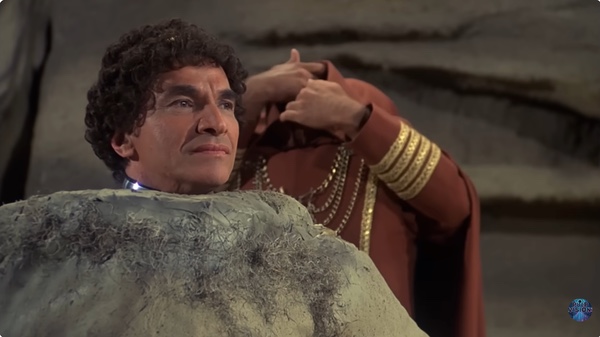 Mark Leonard portrayed a noble Romulan Commander as well as Spock's uptight father in the original Star Trek. In the second season of Buck Rogers, he played an alien who could remove his head. (credit: Universal Studios) |
Living up to his reputation, Glen Larson was making the show more like Star Trek. It did not work, because Larson simply didn’t have Star Trek’s vision. One episode featured a group of little people who had magical powers, such as the ability to remove Wilma’s clothes. There was also Mark Leonard, who had memorably played a noble Romulan commander as well as Spock’s estranged father in Star Trek 13 years earlier. This time he was cast as an alien who for unknown reasons was able to remove his head. The show was canceled halfway through the season.
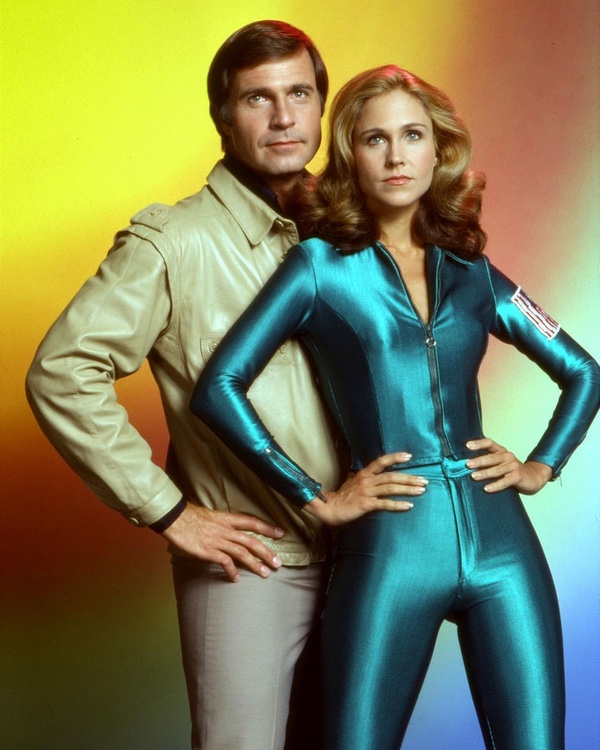 For the first season, Buck was often teamed up with Wilma. He was sort of a James Bond in space, and she was his connection to Earth. One wise move by the producers was to keep their relationship professional. (credit: Universal Studios) |
No bucks, and no Buck Rogers
Buck Rogers in the Twenty-Fifth Century was not a good show. For most young boys who watched it at the time, it was a mixed bag. Many remembered that Erin Gray, in her skintight outfits, helped them through puberty. I was a bit too young for that. I liked the spaceships and the fact that Buck was a NASA astronaut. But for me, I think it was more of a learning experience. I had grown up on constant Star Trek reruns in the 1970s and developed a deep respect and reverence for the show. It undoubtedly fueled my interest in spaceflight and NASA. I eagerly looked forward to the debut of Space 1999 in 1976, only to be disappointed that it was so dull and depressing, and British—traveling through the universe on a dying Moon. At the time, every boy wanted to be Captain Kirk, and none wanted to be Commander Koenig of Moonbase Alpha. Similarly, Battlestar Galactica was interesting, and far more ambitious than it was ever given credit for (and considering its Mormon origins, definitely not a rip-off of Star Wars), but it was also at times somber when it was not campy.
| Living up to his reputation, Glen Larson was making the show more like Star Trek. It did not work, because Larson simply didn’t have Star Trek’s vision. |
Buck Rogers at first promised to be what those of us gorged on Star Trek reruns had been waiting for—a show about an action hero in space. But it quickly proved itself stupid. We didn’t want disco music or space vampires with huge collars, nor did we want an annoying useless robot sidekick who waddled around making quips, and we certainly did not want Gary Coleman as the Cosmic Whiz Kid. Glen Larson overcorrected for the critics who said that Battlestar Galactica was too dark and serious, and created something that was barely above a Saturday morning kids’ TV show. But kids don’t like being pandered to and talked down to, and that’s what Buck Rogers did. For me it was part of my growing up and learning that adults didn’t have all the answers, were not always smart, did not always know what they were doing, and could produce stupid and lame entertainment.
It was a shame, because whereas Steve Austin had been the TV astronaut hero of the 1970s, Buck Rogers could have been the TV astronaut hero of the 1980s. Instead, Gil Gerard’s on-screen charisma was wasted, and he apparently burned so many bridges that he failed to achieve leading man status, unlike contemporaries like Lee Majors and superstar Tom Selleck. Anybody who might have thought about hiring Gerard for their show simply needed to look at his Starlog interview and concluded that he would be nothing but trouble.
Somewhat ironically, another science fiction show debuted in the United States at the same time as Buck Rogers that didn’t speak down to kids, even though it was intended to be a kids show. Star Blazers premiered on local television in San Francisco a little over a week after Buck Rogers, and eventually showed on many local stations throughout the United States. It was a Japanese cartoon known as Space Battleship Yamato that had aired in Japan several years earlier, and had been recut for American television. It was serialized and dealt with a heavy subject—the extinction of all life on Earth—and showed major characters dying and survivors facing loss. Even the villains were depicted as being somewhat noble. The show obviously influenced Star Wars. Star Blazers, even dumbed-down for American audiences, assumed that kids could handle more mature stories. If you were a boy who watched it in the early 1980s, it demonstrated that sophisticated serialized storytelling was possible for a science fiction show. Space Battleship Yamato is still going in Japan, although the new incarnations have not made it back across the Pacific.
Buck Rogers, however, has not endured.
It has been 45 years since the last live action Buck Rogers, and the vast majority of the public has never even heard the name. There have been numerous efforts in the 2000s to bring the character back to the movie screen and television, all going nowhere. The legal rights to the character and franchise have been in never-ending dispute, and when rights are split like that, investors are wary of starting a project that could be damaged by somebody holding other parts of the intellectual property. We are unlikely to see Colonel Buck Rogers, astronaut—or mine inspector—anytime soon. But Gil Gerard’s onscreen charm is sadly missed.
Note: we are now moderating comments. There will be a delay in posting comments and no guarantee that all submitted comments will be posted.