Houston deserves a Space Shuttle, but not like thisby Maxwell Zhu
|
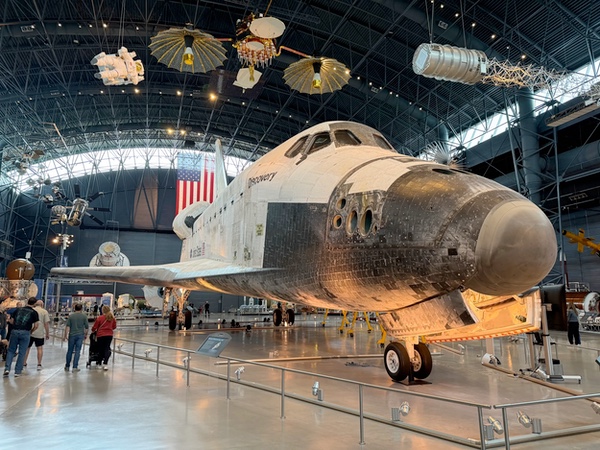
| Cornyn and Cruz have spearheaded a campaign to bring the shuttle to Houston, even if it means divesting our national collection of one of its crown jewels. |
If you ask the Texas congressional delegation, this is a long-overdue homecoming. They have a point. For decades, the US human spaceflight program has revolved around Houston’s Johnson Space Center (JSC). There is no Space Shuttle program without Houston: JSC Mission Control managed all 135 space shuttle missions from 1981 to 2011, and all the astronauts trained and lived in Houston, including the crew lost in the Challenger and Columbia accidents. When NASA began choosing where to display the shuttles after their retirement, Houston seemed like a lock.
But in April 2011, after a three-year-long process, NASA announced that Discovery would go to the Smithsonian in Washington DC, Atlantis to the Kennedy Space Center in Florida, and Endeavour to the California Science Center in Los Angeles. Despite its indispensable contribution to the shuttle program, Houston wouldn’t even receive the test shuttle—Enterprise was headed to New York.
Texas erupted. Elected officials, regional newspapers, business leaders, and local citizens flooded the airwaves with press releases, op-eds, and letters to the editor, all claiming foul play. Houston mayor Annise Parker decried the “political calculations that have prevailed in the final decision.” Senator Cornyn went further and accused NASA of partisan favoritism, declaring that “political favors trumped common sense and fairness in the selection of the final locations.”
An investigation by NASA’s Inspector General office failed to corroborate these charges. “NASA complied with federal law and was not improperly influenced by political considerations” in omitting Houston, the report found. Moreover, NASA was “legally not required to and did not consider a location’s ties to the Space Shuttle Program,” instead only considering their ties to the “human spaceflight program [emphases added]”.
Where Houston had really fallen short was number of visitors. As NASA Administrator Charles Bolden told the investigators, even though he “would have loved to place an Orbiter in Texas,” he “could not ignore that Space Center Houston had relatively low attendance.” Buttressed by the inspector general’s findings, NASA maintained that no additional actions were warranted. And regardless, NASA had already transferred ownership of the shuttles. Translation: tough luck Houston; now move on.
Move on they did, until this April when Senators Cornyn and Cruz reignited this firestorm. More than a decade after Discovery’s relocation, they introduced the Bring the Space Shuttle Home Act. This bill would move Discovery from the Smithsonian’s National Air and Space Museum in northern Virginia to a non-profit entity in Houston near the NASA Johnson Space Center.
This initial salvo failed: the bill never passed out of committee, and thus it never came up for a Senate vote. Changing tactics, Cruz and Cornyn tacked on a provision to the mammoth One Big Beautiful Bill (OBBB), the Trump administration’s signature legislation. To pass the OBBB, Republicans used a special procedure called reconciliation to sidestep the Senate’s typically bipartisan process. But reconciliation came with its own challenges: Cruz and Cornyn couldn’t simply insert their original bill verbatim because reconciliation forbade overly specific earmarks.
| There’s no good way to move a retired shuttle, at least not without causing “irreparable damage,” according to the Smithsonian. |
Therefore, they included equivocal language. They required NASA to first identify a vessel that “has flown into space” and “has carried astronauts,” transfer this vehicle to Johnson Space Center (JSC), and finally place it on “on public exhibition at a non-profit entity not more than 5 miles from” JSC. But the Senate’s nonpartisan referee rejected this gambit because only Cruz and Cornyn’s desired destination—Space Center Houston—would be eligible under this wording. So, the Texas senators tried again, allowing NASA to choose any “field center… involved in the administration of the Commercial Crew Program,” not just JSC. The Senate parliamentarian again ruled against them, ruling that even at face value, the provision could only apply to JSC and Space Center Houston. Finally, they revised the language to exhibit the vehicle “at an entity within the Metropolitan Statistical Area where such center is located.” The third time was the charm.
In theory, when President Trump signed the bill into law, NASA was free to choose any vehicle, any center, and any non-profit. In August, acting NASA administrator Sean Duffy confirmed that a decision had been made, but refused to elaborate—only for Cornyn to remove any doubt by publicly thanking Duffy for relocating Discovery to Space Center Houston. After nearly 15 years, Discovery was finally coming to Texas.
Houston deserves a Space Shuttle, but not like this. For starters, there’s no good way to move a retired shuttle, at least not without causing “irreparable damage,” according to the Smithsonian. Safely transporting them to their current locations 15 years ago already proved to be a major engineering challenge and downright risky. For example, when the space shuttle Enterprise was being ferried from John F. Kennedy International Airport to Manhattan’s Intrepid Sea, Air, and Space Museum less than 30 kilometers away, it was damaged when a sudden weather change caused the wingtip to scrape the pier.
Now, Discovery must travel more than 2,000 kilometers to reach Houston. To fly the shuttle out the same way it flew it in, NASA would have to reactivate the now-defunct Boeing 747s custom engineered to handle the spacecraft, then un-retire the previous cadre of technical specialists who know how to safely operate it.
If air travel is a no-go, NASA will move to plan B: by land and by sea. But both NASA and the Smithsonian agree that Plan B requires dismantling Discovery, which will cause irreversible historical and scientific damage. Space shuttles were not designed to be disassembled and rebuilt, certainly not 15 years after their last flight.
Disassembly only solves part of the problem. Experts are still strategizing, but they’re worried that the deconstructed parts will need to sail down high-salinity waterways that will corrode the decades-old metal, pass through narrow passageways that have already damaged previous shuttles, and ride on thoroughfares designed to support sedans, not spacecraft. In the worst-case scenario, only parts of Discovery will make it to Houston.
To minimize this risk, the Smithsonian estimates total transportation costs will hit $150 million, with another $325 million needed to construct a permanent display. This year’s legislation appropriated only $85 million, leaving this project hundreds of millions of dollars short. Congress may eventually commit to the full cost, but the final number will likely balloon further considering that nearly every step of this transfer is so unprecedented and so untested that the liability costs—and even how these costs would be determined—remain unknown.
Cornyn has pushed back against these claims, arguing that the Smithsonian is wildly overstating the concerns. He insists that these risks can be mitigated far more cheaply based on estimates from “experienced private-sector logistics firms.” But even if Cornyn is right, what’s the best-case scenario for the public? As part of the evaluation process that awarded Discovery to the Smithsonian, NASA “emphasized above all other considerations…where the most people would have the opportunity to view them.” Today, both the National Air and Space Museum and Space Center Houston draw around 1.2 million annual visitors.
| Generations of public officials and private donors have entrusted priceless cultural artifacts to the Smithsonian believing that this independent organization is shielded from the intrigue and idiosyncrasies of everyday DC politics. Now, Cornyn and Cruz’s maneuvering might have broken that aegis. |
However, the Smithsonian doesn’t charge an entry fee, only a parking fee of $15, whereas Space Center Houston charges a family of four more than $150 for general admission, with an extra $10 for parking. Therefore, in the best-case scenario where the Discovery arrives at Houston unscathed, the average American family would be forced to pay ten times more to add this exhibit to their road trip. Every year, over a million visitors would be forced to pay for an experience they could currently enjoy for free. And all that’s needed to make it happen is $475 million of taxpayer dollars.
The Smithsonian isn’t taking this lying down. After the bill passed, they reaffirmed that Discovery belonged to the Smithsonian because when NASA transferred ownership to the Smithsonian in 2011, Congress lost the legal authority to compel the Smithsonian to relinquish their stewardship. They correctly point out that the Smithsonian is not a government agency, but rather a public trust charged with preserving many of our nation’s most iconic cultural, historical, and scientific artifacts. In an interview with Scientific American, Matthew Hersch, an associate professor of history of science at Harvard University, described it more bluntly: “The removal of Discovery from the Smithsonian Institution would be a theft, by the federal government, of a $2-billion artifact from a private museum that owns it.”
Legally, it’s probably murkier than that. Technically, the legislation doesn’t require the Smithsonian to transfer Discovery’s property title to NASA or Space Center Houston because Cornyn and Cruz stripped such a requirement from the final version, perhaps anticipating a legal challenge. Nor is there any precedent for such a transfer in the Smithsonian’s 179-year history. Without clear legislative language or judicial rulings in either direction, it’s difficult to conclude that Discovery’s transfer is definitively illegal.
But practically, the damage is done. Generations of public officials and private donors have entrusted priceless cultural artifacts to the Smithsonian believing that this independent organization is shielded from the intrigue and idiosyncrasies of everyday DC politics. Now, Cornyn and Cruz’s maneuvering might have broken that aegis, which bodes poorly for both the Smithsonian’s current collection and the generosity of future donors. If Kansas’s tourism numbers are a little low, what’s to stop Senator Jerry Moran from shipping Dorothy’s ruby slippers to Topeka? If Muhammad Ali had known Congress could transfer Smithsonian artifacts to a private entity, would he ever have entrusted it with his prized gloves and robe?
Cornyn and Cruz remain undeterred. When the Smithsonian raised its concerns to Congress, Cornyn decried the Smithsonian’s attempts to “generate public resistance” and “obstruct” Discovery’s transfer. A month later, they urged the Department of Justice to investigate the Smithsonian for illegally lobbying Congress and thus violating the Anti-Lobbying Act.
Ultimately, it’s not national politics but Texas politics that will likely seal Discovery’s fate. The move’s main sponsor, John Cornyn, is currently fighting for his political life thanks to a fierce primary challenge. When Cornyn successfully pushed the bill through in June, he was trailing Texas Attorney General Ken Paxton by 20 points, a shocking and existential deficit for a four-term incumbent senator. He’s now clawed his way back to a tie, perhaps bolstered by media coverage of him securing a shuttle for Houston.
Having taken this victory lap, Cornyn is unlikely to reverse course, no matter the national pushback. In fact, Cornyn and Cruz will likely allocate even more funding if Congress pursues an OBBB sequel early next year, ahead of Cornyn’s March 2026 primary election. The House of Representatives may pass another bipartisan amendment prohibiting Discovery’s transfer, but it’s likely that this block would once again be stripped out in the final version. Senate Democrats, Virginia citizens, and the space community will continue to protest, but without any political leverage, their pleas will likely fall on deaf ears. In a reversal from 2011, Cruz and Cornyn have the high ground, and they know it. So, for now, Discovery is headed to Houston.
Note: we are now moderating comments. There will be a delay in posting comments and no guarantee that all submitted comments will be posted.