Innovative, affordable, and expeditedby Robert Oler
|
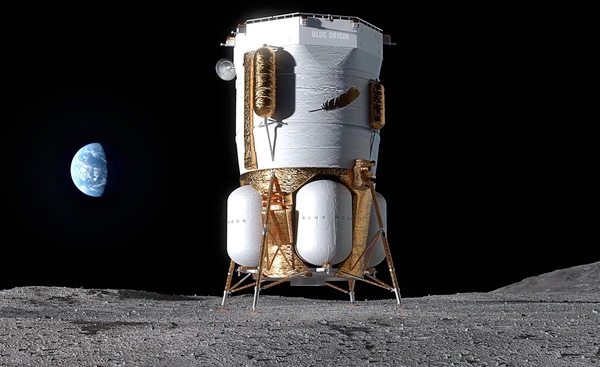
| The time for studies is over; it is time to act. It should decide now to shift course and place the bet with Blue Origin and its Blue Moon Mark 1 lander. |
As are most goals, the lunar effort is heavily success oriented. Unique to Artemis is that most of the heavy lifting for success is accomplished on the initial lunar landing. That first landing will be the first time some of the vehicles will be crewed and will have worked together; a first time test for the entire cycle. On the surface, it will be the first time using the new spacesuits. From a threat and error standpoint, the plan is risky, even if it becomes possible.
Artemis 2 reduces risk for the Orion system only. Prime among them is testing if the mitigations for the heat shield threats found on the first flight work. Artemis 3 will test an entirely new method of putting the heat shield together. The Starship lander has so many “test points” it is hard to rate them.
How can NASA level the odds? The time for studies is over; it is time to act. It should decide now to shift course and place the bet with Blue Origin and its Blue Moon Mark 1 lander. As any good pilot knows, overcoming inertia needs a leader.
Blue Origin will attempt an uncrewed Blue Moon Mk1 lunar landing early this year. The Mk1 initial effort might succeed, but the second attempt is more likely. If there is a first-time failure, solid engineering will dictate about six to ten months for success on the second.
Take the bet! Assume the basic vehicle reaches maturity in 2026. Issue a federal contract for a version using the payload capability to carry humans.
The long pole in this tent is putting everything needed into a three-ton shoe. This is a challenge that, with the original Lunar Module ascent stage and the dry mass of the Cygnus cargo containers as a guide, clever engineering can conquer. If Blue Origin takes the contract, the architecture should be their business.
Absent an early appearance by Blue Origin’s upgraded New Glenn 9x4 rocket, it is likely three Mk1 landers will be needed for the initial landing attempt: a vehicle to take the crew to the Moon, a similar one to return them to the halo orbit and Orion, and a straight lander version for a science package with a rover. In the crew variant, there are four prime issues: the crew interface to the fly-by-wire control, life support (ECLSS) including cabin de/repress for EVA, the ability for precision landing, and both fuel and oxidizer boil off coupled with a lunar restart.
The first two can be mitigated through simulation, but should be proven. The remainder must be proven. How to do it? Imitate Apollo.
Fast forward to mid-2027. This year should have proven the basic design of a Mk1 lander, including at least one—maybe two—successful landings. The first Mk1 crew version, the MK LM, should fly uncrewed and land on the Moon. To test precision landing, it should aim for one of the early Mk1 landers.
On that mission, the ECLSS system can be stressed through automated processes and landing techniques verified. This would also prove fuel and oxidizer boiloff and the ability to relight the engine after a lunar landing. The vehicle will demonstrate a full scale thermal and power verification. In other words, a dress rehearsal like Apollo 10.
Next is Apollo 9 redux. The first MK LM flies to low Earth orbit and then docks with one of the space station’s crew vehicles that brings the crew up.
Starliner should have proven itself in the uncrewed version; it is not needed for space station resupply and could be easily used. The EVA suits can be tested. A public relations bonus would be to have the stack fly formation with ISS. If there are problems, the spacecraft can go to the station.
Low Earth orbit demonstration of human capability allows a full-up mission to land on the Moon. For two years, errors in design have been found and the technical unknowns have been mitigated. Blue Origin will need to build and launch two MK LM’s within a short time of each other, and once the vehicles are in position, most of the risk will have been mitigated.
| Success will ensure the “Isaacman brand” of innovative, affordable, and expedited remains as both a goal and a challenge as he walks into history. |
During 2027, the federal government should commit to buying at least two or three MK landers to check out sites of interest for human landing. The human landing needs to be as successful as possible to stimulate public interest and accelerate the goal of a new generation of lunar exploration. These landers can carry a wide suite of experiments and robotic tools for long-term exploration including the potential to be useful in a visit by the first human crew.
The launch of a third cargo lander depends on where the landing is going to take place. If it is at one of the earlier robotic landings, perhaps it will not be needed.
Artemis 2 flies in early 2026, so the lunar attempt would come either late in 2027 or early in 2028. The surprise, if the mass would allow it, would be to put three people on the landing. Smart robots, including a rover that is capable of remote operations, would complement the crew and make lunar exploration a 24-hour activity.
When the crew departs, the remaining vehicles would form a mini hub for continued robotic exploration of the chosen area. Serving as a training ground for future lunar exploration, it would be a legacy that would work in the future.
Such success would reinvigorate US and allied space efforts. The effort serves as a demonstration that NASA overseeing the modification of commercial equipment is an innovative, affordable, and expedited methodology that works. The stage would be set for future lunar exploration with new, sounder methods of procurement.
The force multiplier the administrator brings is his business and flight experience to create an appropriate oversight procedure. Isaacman has the magic of politics, finding the money, and motivating the workforce that made him successful in business and aviation. He is capable of motivating others to follow. That is the role of leadership by the person or pilot in command.
Better, cheaper, faster has proved a mirage. Success will ensure the “Isaacman brand” of innovative, affordable, and expedited remains as both a goal and a challenge as he walks into history. Take charge of the agency and advance a bold agenda of reform. Return America and its allies to the Moon, and this time to stay.
Note: we are now moderating comments. There will be a delay in posting comments and no guarantee that all submitted comments will be posted.