The Isaacman era begins at NASAby Jeff Foust
|
| “The agency needs a permanent, Senate-confirmed leader,” Moran said, expressing support for Isaacman. |
Except almost none of them had anything to say about it. Over that time, senators took to the floor to discuss topics ranging from the national debt to military recruitment. An exception was Sen. Jerry Moran (R-KS), who chairs the appropriations subcommittee that funds NASA as well as the space subcommittee of the Senate Commerce Committee.
“The agency needs a permanent, Senate-confirmed leader,” Moran said, expressing support for Isaacman. “I’m confident he will provide the leadership NASA needs to sustain and advance America’s leadership in space.”
Earlier in the day, Sen. Maria Cantwell (D-WA), ranking member of the full Senate Commerce Committee, also offered her endorsement. “I do believe Mr. Isaacman is capable of successfully navigating the challenges facing the agency,” she said. “I am optimistic that Mr. Isaacman will bring a steady hand and clear vision to NASA.” But she and Moran were the only two senators to say anything on the floor about the nomination.
After the time for debate expired, senators trickled onto the floor to cast their votes. The final vote was the same as the cloture vote earlier in the day: 67–30, with 16 Democrats joining 51 Republicans in confirming Isaacman, while all 30 no votes came from Democrats.
Less than 24 hours after the vote, Isaacman had been sworn in as NASA administrator. While his two predecessors as Senate-confirmed administrators were sworn in by the vice president—Jim Bridenstine by Vice President Mike Pence and Bill Nelson by Vice President Kamala Harris—Isaacman was sworn in by a federal judge at the Eisenhower Executive Office Building, a ceremony NASA announced only after the fact.
After a long, tumultuous process, Isaacman was finally on the job at NASA. So now what?
Faster, faster
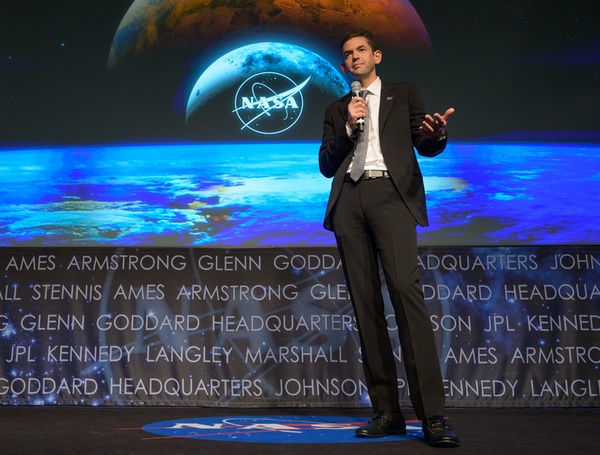
A day after being sworn in, Isaacman attended a town hall meeting at NASA Headquarters, a chance to introduce himself to the agency’s workforce, although they knew him perhaps better than he knew them.
“Between two hearings, a few podcasts, a document that circulated a little wider than expected,” he said, “there should really be no mystery as to how I’m thinking about things.”
The document was “Project Athena,” a 62-page report he prepared during his first confirmation process last spring that leaked ahead of his second confirmation effort this fall. It outlined his views on potential changes to the agency, right down to a draft of a speech he planned to give on his first day on the job. At his second confirmation hearing in early December, he called it a “draft document” subject to change, while at the same time stating he stood behind the document.
| “We’ll look for every opportunity to pull forward the Artemis program to the limits that physics and safety afford, while increasing the flight cadence across the architecture,” Isaacman said. |
Just hours into the job, Isaacman unsurprisingly offered few specifics about what he would do at NASA, including changes to policies or programs. That did not deter employees at the town hall from asking questions on a wide range of issues, including very niche topics, like one who asked about the use of AI and holography at the agency. (“That certainly sounds like the right direction,” Isaacman responded to that question. “I mean, almost every good space sci-fi movie I’ve seen incorporated both AI and holographs.”)
“There is an awful lot to learn,” he said. “There are volumes of materials on my desk right now to get through.”
If he couldn’t offer details, though, he could offer a theme or philosophy for his leadership of the agency. It was clear at the town hall that his vision for the agency was one that moved faster than it does today.
“We cannot achieve our objectives the way they’ve been done in recent years,” he said. “We must do all we can to minimize the bureaucratic drag that can slow us down.”
That ranged from working to “reduce the time to science” for science missions to finding ways to speed up the Artemis lunar exploration campaign. “We’ll look for every opportunity to pull forward the Artemis program to the limits that physics and safety afford, while increasing the flight cadence across the architecture,” he said.
Isaacman arrives at NASA just a few weeks, or at most a few months, before the first crewed Artemis mission, the Artemis 2 circumlunar flight. Even though the mission marks the first time in more than half a century humans have traveled beyond low Earth orbit, the preparations for the mission have flown largely below the public’s radar, with only modest promotion from NASA since a series of media briefings in September.
“Artemis II is the first step in America’s grand return to the Moon, and we will be very transparent about technical readiness and timelines after rollout,” he said on social media Sunday, just after NASA announced the rollout of SLS/Orion was expected in the next two weeks. Asked why NASA couldn’t be transparent about that now, he responded, “Because I want more data to ensure we set proper expectations.”
Isaacman said at the town hall that Artemis 2 was his immediate priority. “Making sure we concentrate a lot of our resources, rightfully, in that direction is most appropriate,” he said. He deferred details on how to speed up later Artemis missions.
“There is an awful lot to learn,” he said. “There are volumes of materials on my desk right now to get through.”
The China factor
While Isaacman appeared predisposed to push the agency to move quickly on general principles, it was clear, particularly when it came to Artemis, that he was looking over his shoulder.
“We want to have as many opportunities to achieve our objectives before our great rival as possible,” he said at the town hall, his oblique way of referring to China.
“We have a great competitor that is moving at absolutely impressive speeds, and it’s unsettling to consider the implications if we fail to maintain our technological, scientific, or economic edge in space,” he also said at the town hall. “And the clock is running.”
| “In my view, it is one of the most significant commitments to America’s space program by any administration since the Kennedy era,” Isaacman said of the executive order. |
That running clock was reset a day earlier, just after Isaacman was sworn in. The White House released what effectively was a national space policy, through an executive order titled “Ensuring American Space Superiority.” (One reason for Isaacman’s low-profile swearing in was so that he could attend a ceremony in the Oval Office where President Trump signed the order.)
The order covers a wide range of civil, commercial, and national security space topics, with a particular emphasis on acquisition reform: it makes clear a preference for alternative contracting mechanisms, from fixed-price contracts to other transaction authority, and reviews of programs at least 30% over budget or schedule.
In civil space, the order reaffirms plans to return humans to the Moon, but with a new deadline: 2028. NASA had been working to a 2027 launch of Artemis 3, the first crewed landing of the Artemis program, but it had been increasingly clear that would be hard to achieve given slips in Artemis 2 and the status of development of key elements needed for Artemis 3, notably the Starship lunar lander and spacesuits by Axiom Space.
The order also included a provision for “establishing initial elements of a permanent lunar outpost by 2030,” but didn’t spell out what those initial elements might be, or even what is meant by “permanent”: a continuous, thus permanent, human presence, or simply habitats and other infrastructure that could be occupied from time to time, like NASA’s plans for the lunar Gateway orbiting the Moon.
Isaacman, at both the town hall and in several media interviews right after being sworn in, praised the executive order. “In my view, it is one of the most significant commitments to America’s space program by any administration since the Kennedy era,” he said at the town hall, but didn't elaborate on why that is the case. After all, several policies in previous administrations laid out plans to return humans to the Moon, none of which they achieved.
Relief and anticipation
Much of the space community celebrated Isaacman’s Senate confirmation, in part because of the hope he will reshape the agency but also likely in part relief that the confirmation process was finally over.
“After nearly a year of historic disruptions to the agency’s workforce, facilities, and budget, Mr. Isaacman has the opportunity to stabilize and reinvigorate the US space program,” said The Planetary Society, a sentiment shared by other groups and companies after the December 17 vote.
| “After nearly a year of historic disruptions to the agency’s workforce, facilities, and budget, Mr. Isaacman has the opportunity to stabilize and reinvigorate the US space program,” said The Planetary Society. |
“In this era of renewed global competition, we share Mr. Isaacman’s sense of urgency and commitment to ensuring the United States leads the way, not just in reaching the Moon ahead of China, but in building a foundation for future exploration,” said Allen Cutler, president and CEO of the Coalition for Deep Space Exploration, an industry group representing many companies working on Artemis, in a statement.
Even critics were willing to give Isaacman something approaching the benefit of the doubt. At a press conference two days before the Senate vote, Sen. Chris Van Hollen (D-MD) said he had met twice with Isaacman during the confirmation process, pressing him on issues such as concerns about the Goddard Space Flight Center amid building closures and consolidations there.
“A lot of what he told me,” Van Hollen said, “was a positive vision for the space program, including a recognition that you can’t have a space program without fundamental research, space science.” Still, Van Hollen was one of the 30 senators who voted against Isaacman’s confirmation.
Positive visions are one thing, but turning those visions into action is another. We will soon start to see what stamp Isaacman will place on NASA in terms of exploration, science, and other areas—or, at least, what he will want to do as he runs into potential conflicts with Congress, industry, and the White House. As one roller coaster ride ends, another begins.
Note: we are now moderating comments. There will be a delay in posting comments and no guarantee that all submitted comments will be posted.