Building empires in the sky: Effectuating off-Earth territorial expansion using existing legal frameworksby Camisha L. Simmons
|
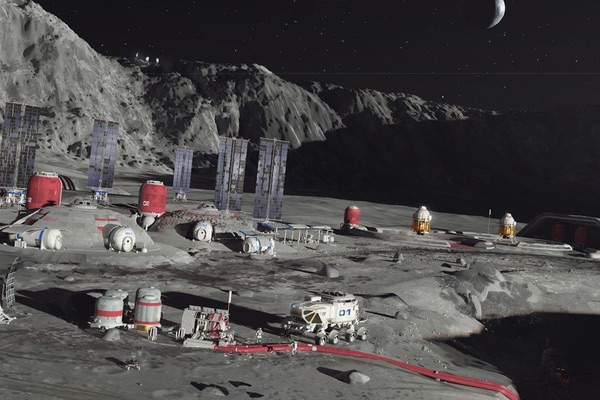
| It’s possible for actors in outer space to exercise some of the rights of ownership without being recognized as the legal owner of certain property in space. |
The US aims to establish the initial elements of a permanent lunar base and a nuclear reactor on the Moon by 2030.[1] Additionally, commercial actors in the space industry desire to build data centers in orbit, while others have their sights on settling in outer space and building floating orbital space settlements and/or land-based habitats off Earth.
But how will these pursuits be accomplished using existing legal frameworks? There are publications addressing off-Earth settlement by humans.[2] But publications that look at space settlement and commercialization through the lens of how off-Earth territorial expansion may occur under existing law, legal frameworks and principles are scant. This article provides an overview of how governments and private actors may effectuate off-Earth territorial expansion under existing law, legal frameworks, and principles.[3]
Ownership: What does it mean to “own” property?
A key issue is the question of what property and/or resources in outer space may be owned. Under US law, to “own” refers to possessing a bundle of certain legal rights with respect to the subject property.[4] In the US, an ownership interest in property typically grants the owner the legal “right to possess, the right to use and develop, the right to exclude, the right to convey, and the right to profit from property.”[5] As discussed here, it’s possible for actors in outer space to exercise some of the rights of ownership without being recognized as the legal owner of certain property in space.
Nation states’ rights to off-Earth territory and resources under current international law and principles
The Outer Space Treaty
The US and more than 100 other nation states are parties to the 1967 Treaty on Principles Governing the Activities of States in the Exploration and Use of Outer Space, Including the Moon and Other Celestial Bodies (the “Outer Space Treaty”). The treaty states that none of the parties to it may engage in national appropriation of outer space “by claim of sovereignty, by means of use or occupation, or by any other means.”[6] Many interpret this prohibition against national appropriation to mean nation states may not assert ownership rights over unextracted land and other natural resources in outer space.
The parties to the treaty agree that “there shall be free access to all areas of celestial bodies.”[7] They also agree to conduct their activities in outer space “with due regard to the corresponding interests of all other States Parties to the Treaty.”[8] And they pledge that if they believe that a planned activity or experiment will result in “harmful interference with activities of other States Parties… they shall undertake appropriate international consultations before proceeding with any such activity or experiment.”[9] (emphasis added)
What it means to allow free access, exercise due regard, and avoid harmful interference is not explained in the treaty. To ensure free access to all, it is likely that, in some instances, those operating in and possessing certain areas in outer space must grant others limited rights of way or easements across the territory they are operating in and possessing, unless national security risks preclude the granting of such access.
Furthermore, though the nation states may not assert full ownership rights over outer space, they may exercise the rights to possess, use, and develop, and exclude others. Nation states’ ability to exercise the right to convey (transfer ownership) and the right to generate revenue and profit from the property and/or resources off-Earth is not spelled out.
The Artemis Accords
In 2020, the US launched the Artemis Accords, a non-binding set of principles designed to facilitate civil space exploration.[10] The Artemis Accords allow possession, use, development, and exclusion rights. Section 10 of the Artemis Accords allows for the utilization and extraction of space resources and declares “that the extraction of space resources does not inherently constitute national appropriation under Article II of the Outer Space Treaty, and that contracts and other legal instruments relating to space resources should be consistent with that Treaty.”[11] The Artemis Accords are silent as to what is a “space resource” and whether parties to the Accords may sell and generate revenue and/or profit from the space resources that are extracted.[12]
| Any party’s activity in outer space is a temporary right to use the land in outer space for various purposes. This arrangement is akin to a leasehold estate on Earth. It’s most akin to a ground lease. |
Section 11 of the Artemis Accords allows the signatories to create an exclusion zone, an area of operation dubbed a “safety zone” to ensure that there is no harmful interference with their operations in the area.[13] The safety zones are intended to “be temporary, ending when the relevant operation ceases.”[14] The signatories likewise must respect the principle of due regard when engaging in activity in outer space.[15] It accordingly appears that the Artemis Accords allow the signatories to exercise many of the rights of ownership, albeit their right to possess the land or area of operation is temporary. And their right to sell and transfer ownership of space resources is not explicit.
The right to possess and stake a claim to territory in space: some open questions
For possessors of territory in outer space, both governments and private actors, there is the open question of whether you need human presence to assert a possessory and/or ownership stake or claim territory off-Earth in outer space. Will robotic, AI, and/or other non-human presence suffice? Can you stake a claim to territory in space “sight unseen” like some real estate transactions are conducted on Earth? Future claims to territory off-Earth likely will require, as a first step, an answer to some or all these questions.
Moreover, for governments that are signatories to the Outer Space Treaty and the Artemis Accords that do possess territory in outer space for various purposes, the right to possess and exclude others seems to have an expiration date. So, when does the right to possess and exclude others from claimed territory expire for governments and State actors?
The right to possess, use, develop, profit from and exclude: Maintaining a leasehold estate in property in the context of exploration and production of natural resources
Let’s suppose for the purposes of the analysis in this article that all members of the human species own the land in situ in outer space communally. Humanity as an undivided collective whole is the owner of land in outer space. Thus, no person or legal entity may stake an individual claim of ownership. All humans together are the landowners in outer space. Considering this supposition, any party’s activity in outer space is a temporary right to use the land in outer space for various purposes. This arrangement is akin to a leasehold estate on Earth. It’s most akin to a ground lease.[16] But it also has similarities to an exploration and production lease in the oil and gas industry.[17]
In the oil and gas industry, the owner of the land and/or mineral estate underneath the land grants the oil and gas exploration and production (“E&P”) company that explores and drills for oil and gas a temporary right or license to explore for and extract oil and gas from underneath the land. This arrangement is evidenced by a lease agreement. The landowner and/or mineral estate[18] owner is the lessor. The E&P company exploring for and extracting oil and/or gas is the lessee.
A typical oil and gas lease contains a habendum clause. The habendum clause sets forth the duration of the lease.[19] Under the habendum clause of the lease, the lessee is typically granted a fixed “primary term” and an additional “secondary term.”[20] Extension of the lease into the secondary term is usually conditioned upon the lessee’s actual production of oil and gas.[21]
As an example, a habendum clause may provide that the “lease shall remain in force for a term of three years from the date hereof, and as long thereafter as oil or gas is produced from said land.” In this example, the primary term of the lease is three years. The lease will be extended after the primary term indefinitely for so long as oil and/or gas is being produced from the leased property. Under Texas law, the term “produced” under the habendum clause is understood to mean “production in paying quantities.”[22]
| Though governments that are party to the Outer Space Treaty may not claim full ownership of the territory they possess in outer space, private individuals and non-governmental organizations operating in outer space may attempt to assert a claim of ownership under US and other law. |
If production (extraction) of natural resources has commenced under a lease and the lease is extended into the “secondary term,” a lease may still automatically terminate if actual “production in paying quantities” ceases.[23] Applicable state law provides guidance as to how to determine whether a lease is producing natural resources (oil and/or gas) in paying quantities. With respect to oil and gas leases covering mineral estates in Texas, for example, “production in paying quantities” is determined utilizing a two-prong test.[24] The first prong of the test, the “mathematical test,” requires that operating expenses exceed operating costs over a reasonable period of time: “[i]f a well pays a profit, even small, over operating expenses, it produces in paying quantities, though it may never repay its costs, and the enterprise as a whole may prove unprofitable.”[25]
If, under the mathematical test, operating revenue does not exceed operating costs over a reasonable period of time, then a “prudent operator” analysis is required.[26] Though the wells under a lease are not operating at a profit, a lessee may still retain its interest in an oil and gas lease if given all the relevant circumstances, “a reasonably prudent operator would, for the purpose of making a profit and not merely for speculation,” continue to operate the producing wells.[27]
Further, under Texas law, if there is a temporary cessation of production of resources, the lease doesn’t automatically terminate.[28] If production of the natural resources is stopped, the operator and producer must resume production within a “reasonable time.”[29]
The provisions in lease agreements, however, may vary. Parties may choose to alter the typical leasing rules and arrangements by agreement. Some leases are drafted to include “savings provisions” that keep the lease from terminating so long as there are continuous operations on the premises. What constitutes “continuous operations” will be set forth in the lease agreement.
Accordingly, for those operations where parties operating in outer space are possessing a territory (area of operation) for the purpose of extracting and/or producing natural resources and/or energy in the area of operation, then one may argue they can continuously operate in the area so long as they are actively extracting and/or producing the resources and/or energy at a commercial profit. For instance, if they are mining for helium-3 on the Moon, as soon as production of helium-3 in the area is no longer profitable, their ability to maintain exclusivity in the designated area of operation would cease. For operation of a nuclear reactor, the party building and operating the nuclear reactor would need to continue producing energy profitably to maintain exclusive possession of the territory. However, some may insist alternatively that they may exclusively possess the territory so long as they have “continuous operations” in the area. And, if they are operating in the area for scientific or purposes other than a profit motive, a “continuous operations” standard and analysis would also likely need to apply to determine how long they may operate in the area to the exclusion of others.
Private property rights: Claiming ownership of territory under US statutory law and the doctrine of adverse possession
Governments that seek operations and claim territory in outer space will likely be viewed as temporary lessees of territory in outer space. Once a government’s operations cease, the territory will revert to the communal owner, humankind. Private individuals and non-governmental organizations, however, may have different use and ownership rights to land and other resources in outer space.
The right to own property is recognized as a human right
The Outer Space Treaty does not address the right of individuals and non-governmental entities to own property in outer space. Further, the right to own property is recognized as a human right. Article 17 of the United Nations’ Declaration of Human Rights provides that “[e]veryone has the right to own property alone as well as in association with others” and “[n]o one shall be arbitrarily deprived of his property.”[30]
The US 2015 space resources ownership law
The US has extended this universal human right to own property to the off-Earth activities of US citizens. In 2015, the US codified the right of US citizens to own property in outer space under the Commercial Space Launch Competitiveness Act (the “2015 Space Act” or “Act”).[31] The 2015 Space Act grants private US citizens (individuals and non-governmental entities), and not the US government itself, the right to “possess, own, transport, use, and sell” an asteroid resource or other space resource that U.S. citizens obtain when engaging in commercial recovery of space resources.[32]
Under the Act, an asteroid resource is defined as “a space resource found on or within a single asteroid.”[33] The Act defines a “space resource” as “an abiotic resource in situ in outer space.”[34] Abiotic is anything that is non-living.[35] Therefore, land, a non-living resource, falls within the definition of space resource under the 2015 Space Act. Water and minerals are specifically listed as space resources in the Act.[36] Though the law provides for ownership of non-living resources in space, the law needs further clarification. There is a question as to whether US citizens may own undeveloped and unextracted resources, such as land, in situ or only the resources they extract.[37]
Though governments that are party to the Outer Space Treaty may not claim full ownership of the territory they possess in outer space, private individuals and non-governmental organizations operating in outer space may attempt to assert a claim of ownership under US and other law regarding private ownership of space resources.
Staking a claim of ownership through adverse possession
Once private individuals and non-governmental organizations have developed and continuously possessed a certain area of operation, including the land, in outer space, they could argue that they now own it. This is allowed on Earth. Many US states allow a claim of ownership of land under the state’s doctrine of adverse possession. For example, in Texas, if someone has openly cultivated, used, and enjoyed property and staked a claim to the property that is adverse and hostile to its legal owner for at least ten years, that person could bring suit to be declared the owner of the property. What is required to successfully win on such a claim is explained by a Texas court:
Our legislature defined adverse possession as “an actual and visible appropriation of real property, commenced and continued under a claim of right that is inconsistent with and is hostile to the claim of another person.” Satisfying this definition normally requires proof of six elements. They consist of 1) visible appropriation and possession of the disputed property, 2) that is open and notorious, 3) that is peaceable, 4) that is made under a claim of right, 5) that is adverse and hostile to the claim of the owner, and 6) that is consistent and continuous for the duration of the statutory period. In other words, the evidence must show possession was actual, visible, continuous, notorious, distinct, hostile, and of such a character as to illustrate an unmistakable assertion of ownership by the occupant.[38]
Other states have their own variation of what is required to claim ownership or territory via adverse possession. As commercial actors across the globe expand operations off-Earth, they may use a legal theory similar to the doctrine of adverse possession to stake a claim of ownership to territory in which they have developed and maintained continuous operations for a lengthy period of time.
Conclusion
As discussed in this article, the next seismic territorial expansion will soon occur off-Earth in outer space. The most recent communicated US space policy is geared for permanent and continuous presence in outer space. The Outer Space Treaty, Artemis Accords, 2015 Space Act, and US exploration and production and property law provide rules, principles and frameworks that supply the foundation and/or legal theories and doctrines that could support territorial expansion off-Earth. “Who” or “what” migrates off-Earth and how the law, rules, principles, and frameworks will apply, be utilized, or evolve to effectuate off-Earth territorial expansion, however, is yet to be seen.
Endnotes
- See Executive Order, Ensuring American Space Superiority (Dec. 18, 2025).
- The National Space Society (NSS) has numerous space settlement publications available on its website. See NSS, Space Settlement Library.
- The author acknowledges that there are alternative ways to apply existing law to territorial expansion beyond planet Earth.
- See, e.g., Krause v. Titleserv, Inc., 402 F.3d 119, 122 (2d Cir. 2005).
- See, e.g., Oakbrook Land Holdings, LLC v. Commr. of Internal Revenue, 28 F.4th 700, 730 (6th Cir. 2022), cert. denied, 143 S. Ct. 626 (2023).
- See Outer Space Treaty, Art. II.
- See id., Art. I.
- See id., Art. IX (emphasis added).
- See id. (emphasis added).
- See The Artemis Accords: Principles for Cooperation in the Civil Exploration and Use of the Moon, Mars, Comets, and Asteroids for Peaceful Purposes.
- See id. Section 10.
- The UN’s current draft principles regarding space resources likewise does not address this issue. See United Nations, Initial draft set of recommended principles for space resource activities.
- See Artemis Accords, Section 11.
- See id.
- See id.
- A ground lease is typically a long-term lease, under which the tenant may install improvements on the property and maintain ownership of those improvements until the expiration of the lease, at which point title to both the land and the improvements reverts to the landowner. Ground leases are usually entered into by a landowner and a developer, allowing the developer to install improvements and operate the property for the production of income. See, e.g., Cmmw. Land Title Ins. Co. v. D.C., 343 A.3d 914, 917 (D.C. App. 2025) (internal citations and quotation marks omitted).
- Except, under an oil and gas lease, the landowner and/or mineral estate owner typically is paid a royalty from the profits generated from the production of oil and gas on the property. A fee sharing/royalty payment from production of non-living resources for production of resources under the high seas beyond any one nation’s jurisdiction is contemplated under the United Nations Convention on the Law of the Sea (UNCLOS). See UNCLOS, art. 82 & Annex III art. 13. The US has signed but not ratified this international law.
- The mineral estate is comprised of five severable rights or attributes: (1) the right to develop; (2) the right to lease—which is also known as the executive interest; (3) the right to receive bonus payments; (4) the right to receive royalty payments; and (5) the right to receive delay rentals. Each attribute is an independent property right, may be severed into a separate interest, and may be separately conveyed or reserved by the owner. See, e.g., WTX Fund, LLC v. Brown, 595 S.W.3d 285, 294 (Tex. App.--El Paso 2020) (internal citations omitted).
- See, e.g., Andarko Petroleum Corp. v. Thompson, 94 S.W.3d 550, 554 (Tex. 2002).
- See, e.g., id.
- See, e.g., id.
- See, e.g., id.
- See, e.g., id. (noting “a typical Texas lease that lasts ‘as long as oil or gas is produced’ automatically terminates if actual production permanently ceases during the secondary term.”) (citation omitted). See also Sun Operating Ltd. P’Ship v. Murphy Oil Corp., 182 F.3d 914 (5th Cir. 1999) (noting “it is the well-known standard in the oil and gas industry that ‘termination’ usually occurs upon cessation of production in paying quantities.”) (citation omitted).
- See, e.g., Clifton v. Koontz, 325 S.W.2d 684, 690 (Tex. 1959).
- See, e.g., Garcia v. King, 164 S.W. 2d 509, 511 (Tex. 1942).
- See, e.g., Koontz, 325 S.W.2d at 690-91.
- Id. at 691. Pennsylvania courts, similar to Texas, utilize a two-prong test. See, e.g., T.W. Phillips Gas and Oil Co. v. Jedlicka, 42 A.3d 261, 268 (Pa. 2012). Unlike Texas and Pennsylvania, Kansas courts appear to only utilize the objective mathematical test to determine whether there is production in paying quantities. See, e.g., Reese Enter., Inc. v. Lawson, 553 P.2d 885, 895-97 (Kan. 1976). See also Texaco, Inc. v. Fox, 618 P.2d 844 (Kan. 1980). North Dakota also appears to only utilize the mathematical test. See, e.g., Tank v. Citation Oil & Gas Corp., 848 N.W.2d 691, 696 (N.D. 2014). Other states may take a slightly different approach to determining whether there is “production in paying quantities.”
- See, e.g., Cobb v. Nat. Gas Pipeline Co. of Am., 897 F.2d 1307, 1309 (5th Cir. 1990).
- See id.
- See Universal Declaration of Human Rights.
- See 51 U.S.C. §§ 51301-51303.
- See id. § 51303. Luxembourg, the United Arab Emirates, Japan and India have similarly followed the US in enacting law and/or establishing policy regarding ownership of space resources. See Law of July 20th 2017 on the Exploration and Use of Space Resources, Luxembourg Space Agency; On the Regulation of the Space Sector, ch. 3, art. 18 (Fed. L. No. 12), Dec. 12, 2019 (U.A.E.): Space Resources Act Enacted, U.S. Library of Cong.; Indian Space Policy – 2023.
- See id. §51301(1).
- See id. §51301(2)(A).
- See, e.g., Cambridge Dictionary, (defining “abiotic” as “relating to things in the environment that are not living”).
- See 51 U.S.C. §51301(2)(B).
- See Camisha L. Simmons, US space resources law needs clarification by Congress, The Space Review, Mar. 3, 2025.
- Riddle v. Smith, No. 07-18-00016-CV, 2018 WL 4356496, at *2 (Tex. App.--Amarillo Sept. 6, 2018) (internal citations omitted).
Note: we are now moderating comments. There will be a delay in posting comments and no guarantee that all submitted comments will be posted.