Prescriptions for space medicineby Jeff Foust
|
| “In this particular incident, the medical incident was sufficient enough that we were concerned about the astronaut. We would like to complete that workup, and the best way to complete that workup is on the ground,” said Polk. |
The first public sign of any problem came late Wednesday afternoon, when NASA issued a brief statement that a spacewalk planned at the station the next day by astronauts Zena Cardman and Mike Fincke had been postponed. “The agency is monitoring a medical concern with a crew member that arose Wednesday afternoon aboard the orbital complex,” the agency stated. Medical privacy constraints kept the agency from providing any additional details, including who was involved or the specific medical concern.
That announcement alone was not alarming. Minor medical issues have taken place on the station over the years. “There’s a host of different things that we’ve treated on orbit,” J.D. Polk, NASA’s chief health and medical officer, said at a later briefing, citing things like toothaches and earaches. “Things that you see commonly on the ground over a six-month period in an urgent care can happen in space as well.”
People who monitor the live audio feeds from the ISS noted that one of the station’s astronauts, JAXA’s Kimiya Yui, has asked for a private medical conference with a flight surgeon. Such conferences, which allow astronauts to discuss medical issues confidentially, are not uncommon, and there was no sign if Yui was requesting the conference on his own behalf or for a crewmate. Later in the day, the public audio feeds were turned off.
Overnight, the issue came more serious. “Safely conducting our missions is our highest priority, and we are actively evaluating all options, including the possibility of an earlier end to Crew-11’s mission,” NASA said in a statement issued just after midnight EST on Thursday. The agency provided no other information on what it now called a “medical situation” on the station other to say that the crewmember in question was stable.
Behind the scenes, there were discussions about what to do about the astronaut their medical situation. That culminated in a briefing held about 24 hours after NASA’s initial announcement.
“I have come to the decision that it is in the best interest of our astronauts to return Crew-11 ahead of their planned departure,” Isaacman said at the briefing, flanked by Polk and associate administrator Amit Kshatriya.
As with earlier statements, Isaacman and others declined to go into specifics other than stating that it involved one of the four Crew-11 members: Cardman, Fincke, Yui, and Russian cosmonaut Oleg Platonov. The four arrived at the station on a Crew Dragon in early August and were scheduled to return no earlier than the latter half of February, after the arrival of a replacement crew on Crew-12.
Officials did state that the medical situation was not related to preparations for the spacewalk or any other “injury in pursuit of operations,” as Polk put it. He suggested that, whatever it was, it took place suddenly. “The crew is highly trained and came to the aid of their colleague right away,” he said.
It was also, he indicated, more of a precautionary measure than an urgent issue. “We have a very robust suite of medical hardware on board the International Space Station, but we don’t have the complete amount of hardware that I would have in an emergency department, for example, to complete a workup of a patient,” he said.
“In this particular incident, the medical incident was sufficient enough that we were concerned about the astronaut. We would like to complete that workup, and the best way to complete that workup is on the ground, where we have the full suite of medical testing hardware,” he said.
He and others emphasized that this was not an emergency evacuation, where the spacecraft would depart the station and return to Earth within hours, likely without the traditional ground support equipment used for Crew Dragon splashdowns. But staying on the station through the planned end of the mission in February created “lingering risk,” he concluded. “Always, we err on the side of the astronaut’s health and welfare.”
| “This was a deliberate decision to allow the right medical evaluations to happen on the ground, where the full range of diagnostic capability exists. It’s the right call, even if it’s a bit bittersweet,” wrote Fincke. |
At the briefing, Isaacman said only that Crew Dragon would return in the “coming days.” On Friday, NASA provided a more specific time: the spacecraft will undock from the station around 5pm EST Wednesday, splashing down off the California coast at 3:40am EST Thursday.
That return will not involve any changes in reentry and recovery procedures. “This is the first time we’ve done a controlled medical evacuation from the vehicle,” said Kshatriya. “However, the procedures that we’re using to prepare for that are nominal procedures.”
“What’s important for us is the whole crew, and we don’t want to do anything, given the nature of the condition, that would put any additional risk on the crew by diverging from our normal processes,” he said of Crew-11’s “controlled and expedited return.”
While NASA leadership discussed the decision to return Crew-11 early and various implications at the briefing, one set of voices was missing: the crewmembers themselves. That cone of silence only lifted early Sunday, when Fincke posted on LinkedIn about the incident and decision to come home early.
“First and foremost, we are all OK. Everyone on board is stable, safe, and well cared for,” he wrote. “This was a deliberate decision to allow the right medical evaluations to happen on the ground, where the full range of diagnostic capability exists. It’s the right call, even if it’s a bit bittersweet.”
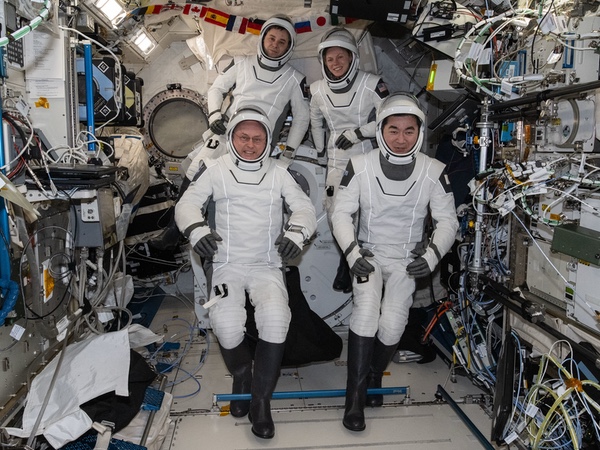
His post included a photo of the four members of Crew-11, wearing their Crew Dragon suits as part of preparations for their return. The photo offered no evidence of any medical conditions any of them might be suffering.
The four were smiling, cupping their hands into a heart shape. The photo, he wrote, was a sign of them performing “a normal, methodical step in getting ready to come home, and a reminder that this decision was made calmly and carefully, with people at the center.”
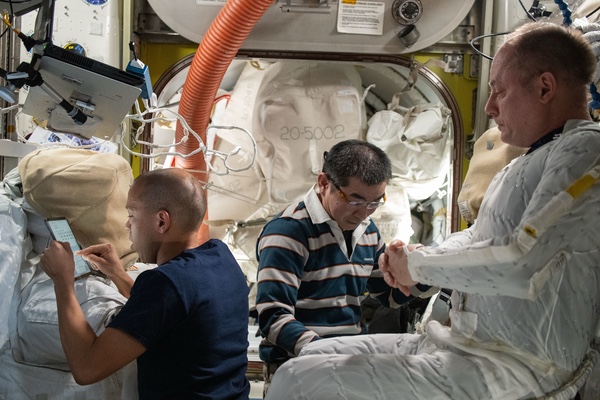 NASA astronaut Chris Williams (left) and JAXA astronaut Kimiya Yui work with NASA astronau Mike Fincke (right) on spacewalk preparations before the medical incident cancelled the spacewalk. Williams will be the only NASA astronaut on the ISS for several weeks after Crew-11 departs. (credit: NASA) |
Lessons for the future
The medical incident and NASA’s response has an immediate near-term effect by reducing the crew on the ISS from seven to three people. Remaining on the station once Crew-11 departs will be Roscosmos cosmonauts Sergey Kud-Sverchkov and Sergey Mikaev and NASA astronaut Chris Williams. They arrived on the station in November on a Soyuz spacecraft.
NASA said they are looking into moving up the Crew-12 launch, currently scheduled for February 15, to shorten the time the station only has a three-person crew. That could push it close to the current Artemis 2 launch period of February 6 to 11, although Isaacman claimed at the briefing that the two missions would be “totally separate campaigns” with no need to deconflict. (NASA had, in fact, moved up the Crew-12 launch last November, from late March to mid-February, to avoid potential conflicts with another Artemis 2 launch period in early April.)
Having a three-person crew for several weeks should not be a constraint to ISS operations, said Kshatriya, given that the station has in the past had three people on board for longer periods. He noted, though, that the spacewalk that was planned for last week, as well as another originally planned for this week, would be deferred indefinitely given the limited crew, including a single US astronaut.
“Chris is trained to do every task we would ask him to do on the vehicle,” he said. “He will have thousands of people looking over his shoulder, like our crews do all the time, to help ensure they continue groundbreaking science.”
Russian cosmonauts, he added, had previously been trained to “higher levels” to operate systems on the US segment of the station, but that training had been reduced in recent years as the US segment crew to four astronauts.
| “We will absolutely learn from this situation as well to see if that informs our future on-orbit operations,” Isaacman said. |
The incident is the first time that NASA has cut short a crewed mission because of a medical issue. Polk indicated that was somewhat surprising. “We’ve had many models, Monte Carlo analysis models, that have said that we should have had a medical evacuation approximately every three years in that 25-year history” of crews on the ISS, he said. He didn’t attribute that lack of evacuations to good training and preparations or simply good luck (or, maybe, inaccurate models.)
At least for the ISS evacuation is an option. For upcoming missions to the Moon, and longer-term missions to Mars, getting an ailing astronaut back to Earth is something that will take anywhere from a week or two to potentially years. For example, on Artemis 2, once Orion leaves Earth orbit a day after launch, it will be on a free-return trajectory that will bring it back to Earth more than a week later.
Asked at the briefing what medical capabilities he would like to see for future exploration missions, Isaacman offered few specifics. “We will absolutely learn from this situation as well to see if that informs our future on-orbit operations,” he said.
That included whether future missions needed a dedicated medical officer: none of the people on ISS are doctors, although Williams has worked as an emergency medical technician. “All of our astronauts go through extensive medical training,” Isaacman said. “I don’t think that if one our astronauts on board was a medical doctor, it would have changed anything.”
While this incident is the first medical situation on a NASA-led mission to require an early return, it is not the first medical issue on a recent spaceflight. When Crew-8 returned to Earth in October 2024 after nearly eight months on the station, the three NASA astronauts and one Roscosmos cosmonaut initially appeared to be good conditions. But hours after their return, NASA announced the four had been transported to a Florida hospital for additional evaluations “out of an abundance of caution.” One of the four remained in the hospital overnight before being discharged.
The agency again cited medical privacy issues for not disclosing what prompted the evaluations and who was kept in the hospital overnight. At a press conference a couple weeks after their return, the three NASA astronauts declined to go into details about what happened.
“Spaceflight is still something we don’t fully understand. We’re finding things we don’t expect sometimes, and this was one of those times,” said astronaut Michael Barratt, a doctor, stating that medical privacy kept him from discussions more about the incident.
“Space medicine is my passion,” he added. “In the fullness of time, we will allow this to come out and be documented. For now, medical privacy is very important to us.” NASA has yet to publicly release additional details about the incident.
Note: we are now moderating comments. There will be a delay in posting comments and no guarantee that all submitted comments will be posted.