Liftoff for European launch startupsby Jeff Foust
|
| “We set out to gather data primarily, and that is something that we have successfully achieved,” Isar CEO Daniel Metzler said after the first Spectrum launch. |
RFA is one of several European companies working to develop new launch vehicles intended to provide dedicated launches of small satellites and ensure European access to space, an issue highlighted by the “launcher crisis” a couple years ago when no European launch vehicles were in service that is now being further emphasized by geopolitics (see “The long recovery from a launcher crisis”, The Space Review, July 7, 2025).
In July, the European Space Agency picked RFA and four other companies—Isar Aerospace, MaiaSpace, Orbex, and PLD Space—as “preselected challengers” for its European Launcher Challenge, a program to support those companies through launch contracts and funding to develop upgraded vehicles . It would be up to ESA’s member states to decide which companies to fund, and at what levels, at the agency’s ministerial conference in late November in Bremen, Germany.
At the time, ESA officials expected member states to provide about €400 million (US$465 million) in funding: enough to fully fund two of the companies, perhaps, with partial support for one or two others. Instead, ESA members loosened their purse strings and provided more than €900 million, enough to fully fund all—or nearly all—of the five companies. Now it’s time for the companies to deliver.
First (and second) to the pad
So far, only one of the five companies participating in the European Launcher Challenge has attempted an orbital launch. Last March, Isar Aerospace performed the first launch of Spectrum from Andøya Spaceport in northern Norway. However, the vehicle malfunctioned shortly after liftoff, plummeting into waters adjacent to the launch pad less than a minute after liftoff (see “Europe’s launch challenge”, The Space Review, March 31, 2025.)
That launch was billed as a test flight by the Munich-based company, with no customer payloads on board. “We set out to gather data primarily, and that is something that we have successfully achieved,” Isar CEO Daniel Metzler said at a briefing a few hours after that launch.
Nearly six months later, the company was ready to explain what went wrong. At a briefing held on the sidelines of the World Space Business Week conference in Paris in mid-September, company executives said the main problem was a loss of attitude control of the rocket, which the company blamed on bending modes of the rocket at liftoff that had not been properly modeled. A second issue was a vent valve on the rocket that was left open, reducing pressures in a propellant tank; that was not directly linked to the failure but would have been an issue if the flight continued.
“This flight test for Spectrum was a fully successful story for the company,” argued Alexandre Dalloneau, vice president of mission and launch operations at Isar, at that briefing, collecting essential data for vehicle development.
Just as importantly, he added, was that it showed the vehicle’s flight termination system worked. “That’s a huge criterion for us to come back on the pad because we can guarantee a safe system if something goes wrong.”
At the time, the company said it was planning a second Spectrum launch near the end of the year or early in 2026. Last Friday, the company announced a launch date for that second launch: no earlier than this Wednesday, January 21, at 9 pm local time (3 pm EST) from Andøya.
This mission, unlike the first, will carry customer payloads: five cubesats from European companies and universities, selected as part of an ESA program, along with a hosted payload that will remain attached to the rocket.
However, Isar still considers this mission, called “Onward and Upward,” to be a test flight. “We want to push our systems yet again to the limit to see what works and what needs further refining,” Metzler said on a call with reporters January 19 about the launch.
The goal of the launch is to deliver those cubesats into a 500-kilometer polar orbit. “We’re a rocket company. Obviously, your goal is always to get to orbit,” he said. But for this flight, success is also collecting data about the vehicle for as long as it flies, through max-Q or maximum dynamic pressure on the first stage, stage separation, and second stage insertion into orbit.
| “We’re a rocket company. Obviously, your goal is always to get to orbit,” Metzler said. |
“For us, the goal is actually to make progress overall,” he said. “We want to test more systems. Testing more systems we will do with anything basically more than 30 seconds. Even up to that point we will test more systems. Anything that pushes further than flight one is good for us.”
He said there is strong demand for Spectrum, with the vehicle sold out through 2028. He did not disclose how many launches that includes, but noted the company is planning three to four Spectrum flights this year and scaling up from there, with the long-term goal of producing as many as 40 rockets a year.
While there is interest in Spectrum worldwide, Metzler cited strong European demand, including from governments. That included not just the European Launcher Challenge, where Isar secured more than €205 million at the ministerial, but also the German government, which plans to spend €35 billion on military space programs over the next five years.
“Europe has finally realized how important launch is,” he said. “It’s a good sign for Europe, and we’re there to deliver.”
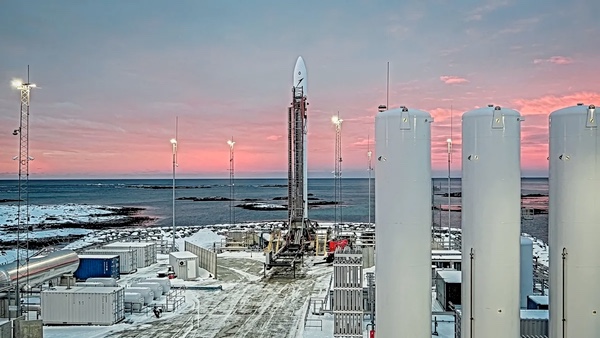
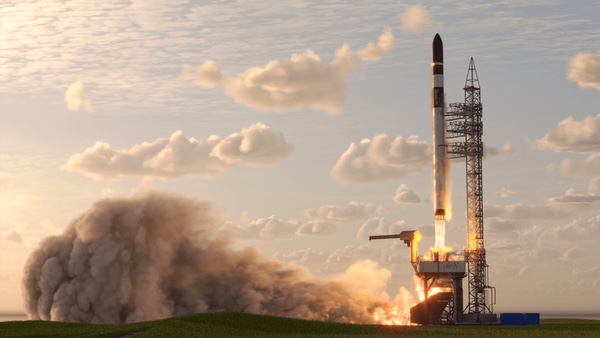 The RFA ONE rocket will launch from SaxaVord Spaceport in the Shetland Islands. (credit: RFA) |
RFA’s automotive approach
For a time, it appeared that RFA would be the first of those European startups to attempt an orbital launch. In 2024, the company was testing its first RFA ONE rocket at SaxaVord Spaceport in the Shetland Islands, and by August it appeared the company was only weeks away from a first launch.
Then disaster hit. During a static-fire test of the first stage, one of the engines in the booster had a fire in an oxygen pump, which spread to other engines. The fire engulfed the entire stage, which exploded.
The company has been working to incorporate lessons learned from that incident as it builds a new first stage. (The upper stages of the rocket for that first launch were not installed on the first stage for that static fire test, and have been in storage.) The company had hoped to launch in 2025, but by November it was clear that would not happen.
“We are now working towards the first launch. This will not happen this year but next year,” said Indulis Kalnins, CEO of RFA, during a panel at Space Tech Expo Europe in November. Kalnins, a former executive with German aerospace company OHB, which owns a majority stake in RFA, took over as CEO in April.
He suggested he was focused on trying to mature the company as it moved into operations of RFA ONE. “We have a young team. We have over 300 people from 40 nations, and all of them are motivated,” he said. “But we need to grow up. We need to go into industrialization. We need to build rockets in serial production.”
| “We have a young team. We have over 300 people from 40 nations, and all of them are motivated,” Kalnins said. “But we need to grow up.” |
On a visit to RFA’s factory in Augsburg a few days after the conference, the new first stage, featuring engine and other improvements, was on the factory floor. The company has not announced a date for shipping the stage to SaxaVord for testing, or a launch date. However, the company already has a launch license from the UK Civil Aviation Authority.
The company is, as Kalnins stated, already thinking about how to ramp up production of the rocket as well as improve performance. One notable aspect of its approach is that it has eschewed the vertical integration that some companies, like SpaceX, has pursued. Instead, it has cast a wide net for suppliers, seeking to have multiple sources for major components.
Brieschenk said that included looking to the automotive industry for suppliers of some components rather than traditional aerospace ones. The approach they use, he said, involves looking for off-the-shelf components that come closest to meet their needs, then asking the suppliers if they can modify them to meet RFA’s requirements.
The result, he said, is a component that might cost twice as much as the off-the-shelf item. But, he added, that is still far cheaper than what a traditional aerospace supplier can offer.
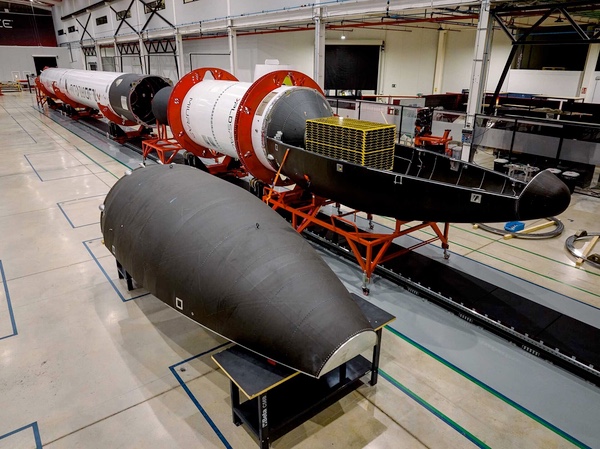 The first qualification model of PLD Space’s Miura 5 rocket. (credit: PLD Space) |
Engines and launch pads
Isar Aerospace is, for now, the only one of the European launch startups to have attempted an orbital launch, but another company has flown higher. In October 2023, PLD Space launched its Miura 1 suborbital rocket from a Spanish military base. The rocket reached a peak altitude of 46 kilometers on the flight, which the company declared a success.
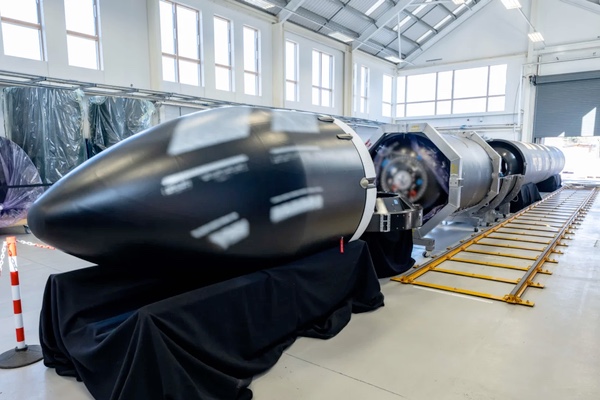
The company has moved on to Miura 5, its orbital launch vehicle. On a November visit to its facility in an industrial park in Elche, Spain, near the coastal city of Alicante, a qualification model of Miura 5 was on the factory floor. That vehicle, not intended for flight, will instead be used for testing such as a wet dress rehearsal. Elsewhere in the factory, technicians were working on a second qualification model as well as hardware for the first flight model.
One key driver for getting Miura 5 ready for its first launch is qualification of the vehicle’s engines, said Raúl Torres, co-founder and CEO of PLD Space, in an interview last fall. “That will go through the first quarter” of 2026, he said.
| “I think it's easier to do this in the US, because there are a lot of US rocket companies and people can jump from one to the other,” Torres said. “In Europe, there are not so many rocket companies.” |
The other key factor is development of the launch site for Miura 5 in French Guiana. The company announced last June an agreement with the French space agency CNES to operate from a launch site there formerly used by the Diamant rocket. CNES is converting that pad into a multi-user facility for small launch vehicles, with PLD Space the first to formally sign on to use the site.
Building the launch site, he said, was just as difficult as building the rocket. “We’re in the middle of the jungle at a site that is humid, with a lot of water,” he said. “Doing the foundations for that is quite tricky, so it’s going to take more time than expected.”
The company is still aiming for a first launch in 2026 of Miura 5. It is also planning to ramp up work on Miura Next, a family of larger launch vehicles.
The company has grown to more than 400 employees, but Torres said one challenge has been attracting talent. “I think it's easier to do this in the US, because there are a lot of US rocket companies and people can jump from one to the other,” he said. “In Europe, there are not so many rocket companies. The mindset is different. You want to stay in your country, close to your family.”
As a result, he estimated more three-quarters of the company's employees come from outside the space industry. “So, you need to teach, and that takes time,” he said. “It’s quite hard finding people with previous experience in rocket science.”
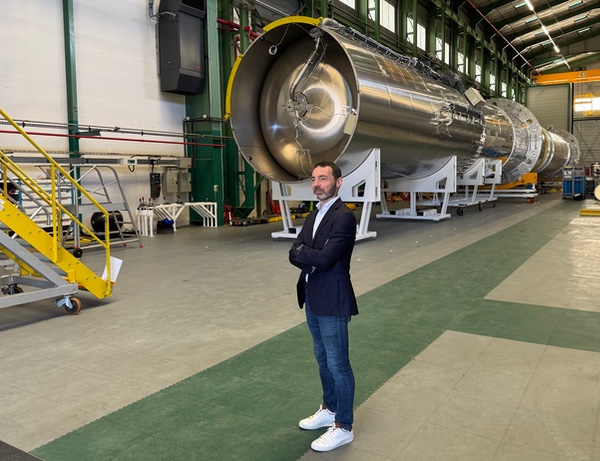 MaiaSpace CEO Yohann Leroy poses with a prototype of the company’s launcher at its factor in Vernon, France, in September. (credit: J. Foust) |
A different kind of launch startup
Many European launch startups are just that: companies with entrepreneurial roots that bootstrapped themselves and raised venture capital. MaiaSpace, by contrast, was spun out of ArianeGroup, the aerospace and defense giant that is the prime contractor for the Ariane 6 as well as for French ballistic missiles.
Those ties have given the company an advantage, at least among French launch startups. Others, like HyPrSpace and Latitude, expected MaiaSpace to be a shoo-in for the European Launcher Challenge because the French government planned to back just a single company in the program, picking the one with ties to the aerospace establishment.
MaiaSpace still considers itself a startup. Most of the company’s engineers work in an office near Paris, but the company’s factory is west of Paris in Vernon, part of a larger ArianeGroup facility there. MaiaSpace is working on a new factory in Vernon set to begin operations in 2027, with a goal of producing 20 vehicles a year by the early 2030s.
“The European Launcher Challenge is important for us,” said Yohann Leroy, CEO of MaiaSpace, during a visit to the Vernon factory in September. “Public support is essential.”
Notably, while the European Launcher Challenge allowed companies to seek funding for launch contracts as well as development of enhanced launch versions, MaiaSpace was interested in only the former. “We want to stay within our logic, which is that we fund the development with private money,” he said. “We prefer public money to come as a result of the services we provide.”
That development has been initially supported by a €125 million investment from ArianeGroup. That, though, is just a downpayment on the overall development cost of MaiaSpace’s launcher.
| “We want to stay within our logic, which is that we fund the development with private money,” Leroy said. “We prefer public money to come as a result of the services we provide.” |
“It’s a high single digit of hundreds of millions of euros for a project of our size,” he said, a figure that covers development costs as well as operating losses in the early years of operations of the vehicle.
During the September visit, he said he was expecting another capital infusion of potentially several hundred million euros from ArianeGroup by the end of the year. “We are not like a standard startup who gets money from financial investors,” he said. “We get money from a strategic investor, which is ArianeGroup.”
Neither ArianeGroup nor MaiaSpace have announced that additional investment, but MaiaSpace achieved another milestone last week. Paris-based satellite operator Eutelsat said it signed a multi-launch agreement with MaiaSpace to deploy some of its 440 OneWeb replenishment satellites being built by Airbus Defence and Space. The companies did not disclose terms of the deal but said those launches could begin as soon as 2027.
“This agreement with an experienced and renowned satellite operator confirms that Maia is well-suited for deploying or replenishing satellite broadband constellations,” Leroy said in a statement.
 Orbex released this image in November of hardware for its Prime launch vehicle, although the company did not clarify if this was flight or test hardware. (credit: Orbex) |
Odd one out?
At the ESA ministerial, MaiaSpace secured €184.2 million, slightly more than the €169 million it sought, almost all from France. Germany, which provided most of the funding Isar Aerospace received, also provided nearly all the €190.5 million RFA received. Spain fully funded PLD Space at €169 million.
Then there is Orbex, the fifth pre-selected challenger. The company, based on Scotland with engine development facilities in Denmark, has been working for several years on its Prime small launcher. In 2018, it won funding from the UK Space Agency as part of plans to establish a launch site in northern Scotland.
Development of Prime, though, had fallen years behind schedule. In December 2024, the company announced it was halting plans to develop that spaceport and would instead use SaxaVord Spaceport, with plans for a first launch there in 2025. But 2025 came and went without a launch, and with few updates on vehicle progress.
While the United Kingdom was expected to be the champion and lead funder for Orbex through the European Launcher Challenge, much like France, Germany, and Spain did for their companies, the British government appeared to hedge its bets. While the government committed €144 million overall to the European Launcher Challenge, it provided only €21.7 million to Orbex. It assigned €10 million to RFA, which launches from SaxaVord, but the remaining €112.3 million was unallocated.
| “To get an anchor tenant in the European Space Agency for a European launch company is absolutely essential,” Bone said. |
“We are working with multiple partners to ensure this funding delivers our requirements for assured access to space and benefits U.K. taxpayers,” a UK Space Agency spokesperson said in early December. “Allocations to specific operators will be set out in due course.”
Orbex, like the other companies, had been banking on getting European Launcher Challenge funding for launch contracts and vehicle development. “From an Orbex perspective, ELC was very welcome,” John Bone, Orbex’s chief commercial officer, said at Space Tech Expo Europe in November. “To get an anchor tenant in the European Space Agency for a European launch company is absolutely essential.”
After the ministerial, the company said little about the UK’s decision not to immediately allocate more funding to it. “The most important thing is to see continued state backing for our industry, and we are delighted that remains in place,” the company stated, adding it was “digesting the details” from the ministerial.
The UK government will soon have to decide what to do with its unallocated ELC funds. At a press conference earlier this month, Toni Tolker-Nielsen, ESA’s director of space transportation, said the UK needed to assign its unallocated funds to a program before ESA could start awarding contracts to the companies.
“There’s no contracts without the UK taking a decision to allocate this money to a specific project,” he said. “That should happen in the coming two to three months.”
How many survive
As the ELC companies move forward on their vehicles, one overriding question remains: how many will survive? Even those that overcome technical and financial obstacles still need to find sufficient demand to close their business cases.
That has proven difficult in the United States, where small launch vehicle startups found it difficult to compete with the low prices of SpaceX rideshare missions and the high launch cadence of Rocket Lab’s Electron. Most have either moved to larger vehicles, like Relativity Space abandoning the Terran 1 for the larger Terran R, or have pivoted to other markets, like ABL Space Systems’ move to missile defense. Others have gone out of business.
There is similar skepticism in Europe. “I believe the market is not large enough for more than a maximum of two players to survive in Europe,” MaiaSpace’s Leroy said in September.
He added he expected MaiaSpace to be one of those companies because of the higher performance of its rocket, which can place up to four tons into orbit. “I believe having a few hundred kilograms of performance makes no sense. You cannot build a profitable business.”
Isar’s Metzler, though, thinks there is larger demand in Europe for small launch vehicles, driven in part by an increase in European military and other government spending and a desire to develop sovereign capabilities.
“Launch is the smallest common denominator in the space industry,” he noted. “Everything you put up there and operate there has to go through launch.”
“We could sell every rocket almost 20 times based on customer demand,” he added. “I can’t follow anyone saying there’s going to be too many rockets, especially out of Europe.”
Note: we are now moderating comments. There will be a delay in posting comments and no guarantee that all submitted comments will be posted.