Kazakhstan’s space strategy: can its high-tech assets propel it to Eurasia’s new broker?by Zhaslan Madiyev, Olaf J. Groth, and A.B. Sinchev
|
| These scenarios help clarify the choices Kazakhstan faces as it seeks to translate its technological potential into lasting economic and geopolitical value. |
Beyond outer space governance, Kazakhstan made historic decisions that reinforced its reputation as a trusted global partner by voluntarily renouncing its inherited nuclear arsenal and acceding to the key arms control treaties, including the Treaty on the Non-Proliferation of Nuclear Weapons,[5] the Comprehensive Nuclear-Test-Ban Treaty,[6] the Biological Weapons Convention,[7] and the Chemical Weapons Convention.[8]
Since the late 1990s, Kazakhstan has also expressed its intention to join the Missile Technology Control Regime (MTCR). While it already observes the MTCR guidelines as a unilateral adherent, full membership requires consensus among participating states, a process that remains under review. In parallel, the country continues to modernize its export control and non-proliferation systems to align with international standards.
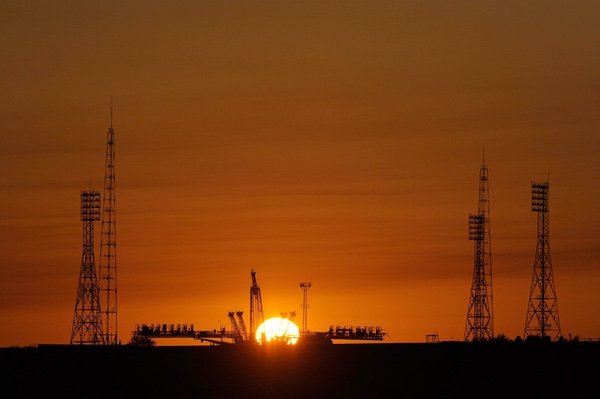
Within this framework, limited sovereign launch capability has been shaped by legal and institutional factors, leading to a long-term lease arrangement with the Russian Federation over the Baikonur Cosmodrome, one of the world’s most advanced and enduring launch facilities. Despite limited direct operational control, Baikonur continues to serve as Kazakhstan’s primary strategic space asset, offering future opportunities for deeper national participation and diversification.
The decisions taken today will define Kazakhstan’s trajectory for decades to come. Within our Disruption Futures framework, we outline four possible pathways, each illustrating how the country’s space infrastructure and allied innovation capacities could either be strategically mobilized or left underutilized. These scenarios are not predictions, but instruments for foresight: they help clarify the choices Kazakhstan faces as it seeks to translate its technological potential into lasting economic and geopolitical value.
A. Eurasia’s new space broker
Partner to all, master of its fate: innovation, agility, and integration
Kazakhstan emerges as a multilateral anchor in Eurasia, balancing global partnerships through strategic alignment and innovation leadership. By reducing dependence on extractives and leading in green hydrogen, synthetic materials, and deeptech, it attracts diversified investment and trust. Flexible trade, capital access, and diplomatic agility reinforce its credibility as both a mediator and a hub for technology cooperation across regions.
Throughout this process, Kazakhstan maintains a posture of balance and respect toward all its partners, ensuring that new initiatives strengthen rather than strain existing frameworks of cooperation. Building on its long-standing collaboration with Russia, the country expands effective partnerships with western space tech venture studios and incubators, NASA, SpaceX, Virgin Galactic, Blue Origin, and Silicon Valley startups. Joint ventures with Germany, UAE, South Korea, Japan, Australia, and Canada accelerate R&D in space robotics, microgravity materials, and AI-powered Earth observation, making Kazakhstan a critical supplier of tech and talent to lunar, Martian, and asteroid missions.
Crucially, Kazakhstan’s actions remain grounded in multilateralism and transparency, ensuring that cooperation frameworks evolve inclusively and in line with established partnerships. Space-enabled climate services and secure satellite data corridors cement its reputation as a tech-savvy, neutral node in the Eurasian innovation web. Instead of merely hosting launches, Kazakhstan codes, builds, and leads: its engineers, data scientists, and roboticists embedded at the core of global missions and supply chains, contributing to a shared and stable future for the region.
B. Peripheral space player
Stability in a dependent framework: order without autonomy
Kazakhstan maintains global integration through regulatory compliance, yet its strategic autonomy remains limited. Fiscal constraints and delayed reforms reinforce reliance on external financing, technology, and governance models. While technically stable, much of the innovation activity is externally led, resulting in modest domestic value creation. Investment flows narrow, and the national innovation agenda risks becoming subordinated to external priorities.
| The window to become an active broker of Eurasian space cooperation and high-tech value creation is narrow, because established space entrepreneurship ecosystems are increasingly driven by digital legacy startups with much shorter product and partnering cycles. |
Within this environment, Kazakhstan’s space assets operate primarily as platforms for foreign missions and joint programs. International companies, including agencies and private space tech enterprises from Russia, the United States, Europe, and Asia, utilize local integration facilities for launches, assembly, and testing, but most intellectual property, data, and value creation remain abroad. German, Korean, and Canadian ventures maintain advanced laboratories in Astana, yet local researchers participate mainly as contractors rather than full partners.
While investment and technology continue to flow in, they do so with limited knowledge transfer and retention. Kazakhstan functions as a shared resource and operational hub, but not yet as an autonomous innovation power.
C. Pawn in the great space game
Exploited vulnerability: caught between powers
In this trajectory, Kazakhstan faces growing exposure to external pressures within an increasingly fragmented global order. Slow reforms, short-term arrangements, and overreliance on external credit weaken institutional resilience and constrain long-term planning. What was once connective infrastructure risks turning into contested ground for influence and access.
Kazakhstan’s space, robotics, and AI infrastructure becomes divided among competing foreign actors. Baikonur’s manifest is split: Chinese, Russian, and UAE projects take precedence, while American and allied ventures participate through limited or indirect joint arrangements. As uncertainty grows, companies such as SpaceX, Blue Origin, and German and Japanese robotics firms redirect higher-value R&D activities abroad, reducing local opportunities for scaling and innovation. Over time, the country’s infrastructure is viewed less as a co-creation platform and more as a transit or testing space. Satellites are launched, materials processed, and data exchanged, but knowledge retention and brand differentiation decline. The challenge in this scenario is not external pressure alone, but the erosion of confidence and coordination within domestic institutions—conditions that leave Kazakhstan reactive rather than strategic in shaping its technological future.
D. Opportunistic space maverick
Prospering at a price: strategic agility in a fractured order
Kazakhstan emerges as a hyper-networked pivot state: strategically agile yet stretched. By hosting multiple global blocs through innovation enclaves and regulatory arbitrage, it becomes the “deeptech-innovation Switzerland” of Eurasia. Financial inflows surge, but governance capacity is tested by overlapping legal frameworks and competing policy priorities. Strategic ambiguity brings visibility, but at the cost of institutional coherence and domestic trust.
In this scenario, Kazakhstan’s deeptech infrastructure becomes a “sandbox” for regional and global space-technology partners. Agencies and companies such as NASA, SpaceX, Virgin Galactic, and Blue Origin set up local partnerships, while robotics, AI, and materials startups from Silicon Valley, Berlin, Seoul, Dubai, and Tokyo operate innovation enclaves in Astana and Baikonur. Talent and capital flow in and out, but fragmented oversight and parallel governance cause IP disputes and uneven economic benefits. Kazakhstan becomes Eurasia’s primary testbed for frontier technologies: a country highly visible on the global stage, but challenged in consolidating a unified innovation ecosystem. The key tradeoff lies between openness and coherence: the capacity to attract diverse partners without diluting long-term strategic direction or national identity.
Six steps: leveraging global partnerships and high-tech assets to become Eurasia’s new space broker
The time to act is now. According to a collaborative report by McKinsey and the World Economic Forum, the global space economy is projected to grow from $630 billion to $1.8 trillion by 2035, driven by reduced costs, expanding satellite connectivity, and the commercialization of low Earth orbit.[9] Companies like SpaceX and its Starlink constellation have emerged as “game changers,” reshaping both the economics and geopolitics of space access. Meanwhile, Kazakhstan, with its established satellite programs, integration and testing facilities, skilled engineering base, and access to the Baikonur Cosmodrome, is well positioned to leverage this new frontier. But the window to become an active broker of Eurasian space cooperation and high-tech value creation is narrow, because established space entrepreneurship ecosystems are increasingly driven by digital legacy startups with much shorter product and partnering cycles.
1. Embrace full multilateralism and tech standard-setting
As a first step, Kazakhstan should accelerate MTCR accession and join global alliances not just in classic space policy but in space tech, AI, robotics, and advanced materials, actively seeking partnerships with NASA, SpaceX, Virgin Galactic, Blue Origin, and Silicon Valley (NASA Ames Research Center), as well as with Germany’s DLR Institute of Space Systems, UAE’s Mohammed bin Rashid Space Centre, South Korea’s Korea Aerospace Research Institute, Japan’s JAXA Tsukuba Space Center, Australia’s CSIRO Space and Astronomy division, and Canada’s MDA Space. The objective is to position Kazakhstan as an active contributor to international standards and best practices in the evolving space economy.
2. Build a deeptech, space, and AI innovation hub
Kazakhstan should transform its existing Baikonur assets as a kernel for entrepreneurial venturing, such as integration facilities and university research centers. Develop a similar roadmap for those becoming available to Astana in the coming decades. Both will give Kazakhstan the value-add leverage to evolve into Eurasia’s preeminent launchpad for robotics, microgravity materials science, and AI-enabled space systems that will be desirable for global partnerships. Co-develop next-generation space vehicles, planetary robotics, and data analytics platforms with leading international agencies and companies. Such partnerships should be guided by inclusivity, transparency, and mutual benefit - ensuring that Kazakhstan’s growing engagement complements existing cooperation arrangements and promotes broader regional stability. Lessons from historic international space collaboration can inform the development of these frameworks, emphasizing trust-building, shared standards, and sustainable innovation practices.
3. Make Kazakhstan Eurasia’s talent and R&D gateway
Expand scholarship and research exchange with innovation powerhouses in the US, Europe, Asia, and elsewhere. Launch joint space-tech and AI accelerator programs with Silicon Valley (Plug and Play Tech Center) and allied countries. Attract top students and scientists through “innovation visas,” co-mentorship, and high-profile missions involving NASA, JAXA, DLR, and CSA.These talent flows should be managed transparently and inclusively, engaging regional partners, including Russia, as active participants in shared upskilling and capacity-building efforts.
4. Anchor digital and trade corridors with advanced tech
Integrate AI and robotics into supply chain management, smart infrastructure, and resource monitoring, demonstrating the practical value of Kazakhstan’s space and materials science sectors. Use satellite-enabled, blockchain-secured data flows to serve as Eurasia’s neutral “trusted data corridor” between continents, leveraging secure protocols from various organizations. Blockchain and AI-enabled conditional data access, watermarking and forensics technologies will be of foundational importance in particular for collaboration with China, Ukraine and Russia.
5. Mediate and broker tech partnerships in a multipolar world
Offer Kazakhstan as neutral territory for global standards-setting and testing. Convene summits for dual-use tech with NASA, ESA, UAE’s Mohammed bin Rashid Space Centre, Germany’s DLR, South Korea’s KARI, and Japan’s JAXA, among others. Champion responsible AI, IP protection, and space security frameworks, always clarifying Kazakhstan’s position as a “bridge” and not a wedge. However, it is of paramount importance to safeguard the reciprocal value-add in these relationships, such that sustained skill and capability building in and for Kazakhstan and wider Central Asia can be tracked.
6. Build institutional depth, resilience, and governance for tech-driven social trust
Professionalize national agencies overseeing space, AI, and robotics. Develop transparent, accountable frameworks for the stewardship of tech assets and IP, as well as for and socially and environmentally sustainable critical minerals extraction and processing and energy supply, modeled on best practices from other agencies. Cultivate public trust in tech policy, ensuring equitable access to tech-driven prosperity and preventing the social fragmentation seen in the Maverick scenario. This will require transparent governance frameworks and accountability measures with international verification and certification measures. But this in turn will have a return in invested time and budgets, because international investors prize good governance and rule of law as a matter of derisking portfolios.
The stakes and the opportunity
| The new Kazakh space era demands a deftness that is both diplomatic and technical. |
At the threshold of a new era, Kazakh engineers and policymakers look toward the Baikonur launch pads, recognizing that the country stands at a decisive intersection between legacy and future. The world’s new “space race” is as much about legal agility, institutional depth, and cross-cultural trust as about rockets and satellites. If Kazakhstan can translate its unique mix of assets—geography, infrastructure, credibility—into innovation leadership and diplomatic brokerage, it will not only shape its own future, but also help define Eurasia’s role in the global order.
Yet this path requires balance and precision. Kazakhstan’s ascent must continue to emphasize cooperation, transparency, and mutual benefit, reinforcing trust among all its partners. The new Kazakh space era demands a deftness that is both diplomatic and technical.
The window is closing. But the launchpad is ready.
References
- Law of the Republic of Kazakhstan dated May 15, 1997 No. 104-1 On the Accession of the Republic of Kazakhstan to the Treaty on Principles Governing the Activities of States in the Exploration and Use of Outer Space, including the Moon and Other Celestial Bodies.
- Law of the Republic of Kazakhstan dated May 15, 1997 No. 106-1 On the Accession of the Republic of Kazakhstan to the Agreement on the Rescue of Astronauts, the Return of Astronauts, and the Return of Objects Launched into Outer Space.
- Law of the Republic of Kazakhstan dated May 15, 1997 No. 107-I On the Accession of the Republic of Kazakhstan to the Convention on International Liability for Damage Caused by Space Objects.
- Law of the Republic of Kazakhstan dated May 15, 1997 No. 108-1 On the Accession of the Republic of Kazakhstan to the Convention on Registration of Objects Launched into Outer Space.
- Resolution of the Supreme Council of the Republic of Kazakhstan dated December 13, 1993 No. 2593-XII On the Accession to the Treaty on the Non-Proliferation of Nuclear Weapons.
- Law of the Republic of Kazakhstan dated April 12, 2007 No. 243-III On the Ratification of the Agreement between the Government of the Republic of Kazakhstan and the Preparatory Commission for the Comprehensive Nuclear-Test-Ban Treaty Organization.
- Law of the Republic of Kazakhstan dated May 7, 2007 No. 245-III On the Ratification of the Convention on the Prohibition of the Development, Production and Stockpiling of Bacteriological (Biological) and Toxin Weapons and on Their Destruction.
- Law of the Republic of Kazakhstan dated June 24, 1999 No. 398-I On the Ratification of the Convention on the Prohibition of the Development, Production, Stockpiling and Use of Chemical Weapons and on Their Destruction.
- McKinsey & Company and World Economic Forum (2023). Space: The $1.8 trillion opportunity for global economic growth. Retrieved from Space: The $1.8 trillion opportunity for global economic growth | McKinsey
Note: we are now moderating comments. There will be a delay in posting comments and no guarantee that all submitted comments will be posted.