Inching towards launchby Jeff Foust
|
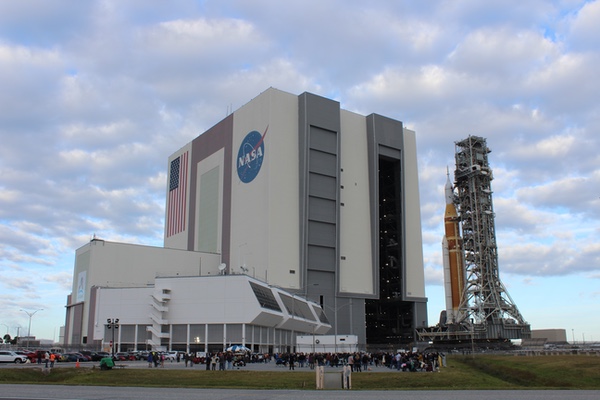
| “This one feels a lot different,” Honeycutt said of Artemis 2 preparations. “Taking the crew around the Moon, this is going to be our first step toward a sustained lunar presence.” |
Shortly after 7 am, they got to see what they came for. Emerging slowly from the VAB was a crawler-transporter carrying a mobile launch platform. Mounted on the platform was the Space Launch System rocket and Orion spacecraft, named Integrity by its crew, making their way, oh so leisurely, to Launch Complex 39B.
The rollout marked the beginning of the final phase of preparations for Artemis 2, the first crewed mission of the Artemis lunar exploration campaign. As soon as early February, a crew of three Americans and one Canadian will launch on that vehicle, going around the Moon on the first human flight beyond low Earth orbit since Apollo 17 in 1972.
Despite the historic nature of the flight, Artemis 2 has made its way towards launch largely out of the spotlight. In late September, NASA held two days of briefings to discuss the mission and host interviews with the crew (see “The present and future of NASA human spaceflight,” The Space Review, September 29, 2025). A six-week government shutdown that started October 1 put communications about the mission on hold, which resumed only at a trickle once the shutdown ended.
With the rollout, NASA held its first briefing since September about the mission. “These are the kind of days that we live for,” John Honeycutt, Artemis 2 mission management team (MMT) chair, said at the January 16 briefing. “The rocket and the spacecraft Orion, Integrity, is getting ready to go to the pad.”
This was not the first rollout of SLS/Orion: there were several for the Artemis 1 mission as it moved back and forth between the pad and VAB for wet dress rehearsals and multiple launch attempts before finally launching in November 2022.
“This one feels a lot different,” he said, because Artemis 2 will carry astronauts. “Taking the crew around the Moon, this is going to be our first step toward a sustained lunar presence.”
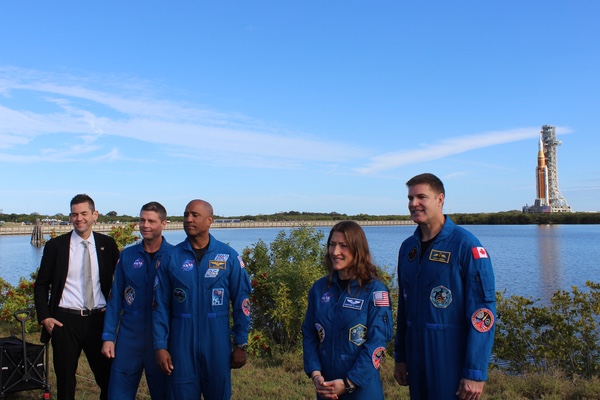 NASA administrator Jared Isaacman and the Artemis 2 crew of Reid Wiseman, Victor Glover, Christina Koch, and Jeremy Hansen at the Kennedy Space Center during the rollout. (credit: J. Foust) |
However, while NASA was rolling the rocket out to the pad, there was still a lot of work ahead before the vehicle would be ready for a first launch attempt. Once at the pad, NASA planned various prep work, checkouts, and tests. Then would come the wet dress rehearsal, where the SLS was loaded with liquid oxygen and liquid hydrogen propellants and taken through a practice countdown stopping at T-29 seconds.
At the briefing, NASA was vague about when the wet dress rehearsal would take place but acknowledged it could be as late as February 2. That would appear to make it difficult to be ready to launch when the next launch opportunity opened on the night of February 6, or even by the time that launch period closed early on February 11.
That’s especially the case given the challenges NASA faced on Artemis 1, when the agency had to hold three wet dress rehearsals between April and June, and even after that scrubbed the first two launch attempts for the mission in late summer because of issues like propellant leaks. Why should anyone feel like Artemis 2 could really lift off in February?
| If there are no major issues during the wet dress rehearsal, Blackwell-Thompson argued, “there are opportunities within February that could be achievable.” |
Charlie Blackwell-Thompson, Artemis launch director, said at the briefing that the experience from Artemis 1 gave them confidence. “Why do we think we’ll be successful in Artemis 2? It’s the lessons that we learned,” she said. “Artemis 1 was a test flight, and we learned a lot in that campaign getting to launch.”
There are some new things on Artemis 2, including changes based on the Artemis 1 experience, but she said she believed engineers had tested those in advance of the rollout. “I believe that we’ll be ready for wet dress.”
If the wet dress does go perfectly, others argued that they would be ready to launch in a matter of days. Lakiesha Hawkins, acting deputy associate administrator for exploration, told reporters the day of the rollout that the agency would need at least a couple days to review data from the wet dress rehearsal, but could be able to launch soon thereafter.
“We have put ourselves in a position, though, that if things go well, we’ll be able to move forward and do what we call ‘roll and go,’” she said, or “move right into a posture to be able to launch.”
Blackwell-Thompson said at the briefing she thought a February launch remained feasible. If there are no major issues during the wet dress rehearsal, she argued, “there are opportunities within February that could be achievable.”
NASA has studiously avoided setting an official launch date for Artemis 2. Only a week before the rollout did it officially publish the launch periods for Artemis 2 for the coming months. Besides the early February window, there is one March 6 to 11 and another April 1 through 6. (The next window appears to open April 30, but the calendar NASA released only goes through April.)
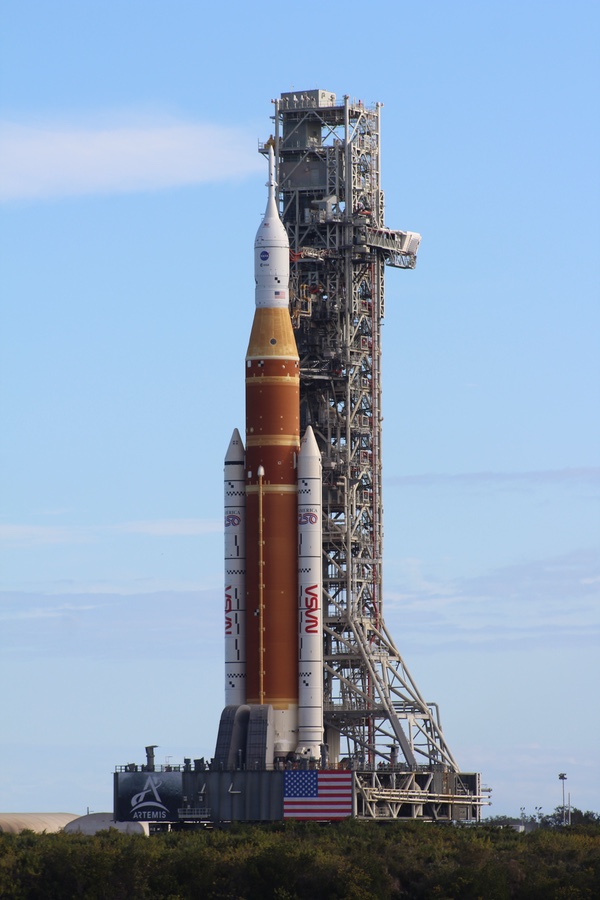 Artemis 2 makes it way to the pad. (credit: J. Foust) |
“We have zero intention of communicating an actual launch date until we get through wet dress,” NASA administrator Jared Isaacman said at a briefing at KSC the morning of the rollout, with the rocket’s slow roll to the pad serving as a backdrop to him and the four Artemis 2 astronauts.
“We are continuing on with our Artemis 2 preparation campaign. I think we've held schedule pretty well getting to rollout today,” he said, when asked if a February launch was realistic. “That’s our first window, and if everything is tracking accordingly—I know the team is prepared, this crew is prepared—we’ll take it.”
“We like that answer,” Reid Wiseman, the astronaut commanding Artemis 2, added.
He and the other astronauts—Victor Glover, Christina Koch, and Jeremy Hansen—discussed their final planning for the mission, including preparing their families for a mission that, while at 10 days is a small fraction of a stay on the International Space Station, has risks and challenges, such as communications that will not necessarily be as frequent, or as high bandwidth, as in low Earth orbit.
“I really have to make sure he knows that it’s not like the International Space Station where we can just make a phone call,” Koch said of discussions with her husband about Artemis 2. “So, he’s not going to be able to call me and ask where something is in the house. He’s going to have to find it.”
Those discussions are more serious, too. “Those are tough talks, but you have to have those talks so they can be tough,” Glover said of preparing his family for the flight.
Their comments underlined the seriousness of the mission. But it also highlighted the potential clash the mission faces: schedule pressure versus spaceflight safety. NASA officials argued they were aware of those risks, which could be exacerbated by political pressures, such as the possibility that President Trump will want to attend the launch.
| “I just want you all to remember we are four human beings getting in this magnificent spacecraft,” Wiseman said, “and sometimes the simplest things put a huge smile on our face.” |
“Political pressure is, in my mind, one source of interest and enthusiasm around that mission,” Hawkins said. “One thing that the agency is very keenly focused on is making sure we do the right thing and the safe thing for the crew.”
Honeycutt said he was aware of, and would look to avoid, any “launch fever” for Artemis 2. “I think I’ve got a good eye for launch fever,” he said. “I’m not going to tell the agency we’re ready to go fly until we’re ready to go fly.”
He was emotional in his opening remarks at the briefing. “As chair of the MMT, I’ve got one job, and it’s the safe return of Reid, Victor, Christina and Jeremy,” he said. “I consider that a duty and a trust, and it’s one I intend to see through.”
There is no public evidence of launch fever so far. Instead, we see something of the opposite. NASA has provided only a couple updates on Artemis 2 since the January 17 rollout, including one on Friday where the agency said the astronauts had entered standard pre-launch quarantine, which at least preserves the option for a launch as soon as February 6. But NASA has not only not set a launch date, it has not disclosed exactly when the wet dress rehearsal will take place. (Late Monday, January 26, NASA announced it was working towards a wet dress rehearsal as soon as January 31.)
The public may not be excited about, or even aware of, the fact that four humans will be launching towards the Moon as soon as next month, but the crew certainly is. Wiseman recalled at the briefing the feeling of getting into Orion during a countdown rehearsal include the VAB in December and finding that the controls of the spacecraft were fully functional, unlike their simulator, including the one to dim the display.
“I was like, ‘Ike, look, the dim button works on the display.’ And he’s like, ‘no way,’ because in our sims, that button doesn't work,” he said, referring to Glover by his nickname.
“I just want you all to remember we are four human beings getting in this magnificent spacecraft,” he said, “and sometimes the simplest things put a huge smile on our face.”
Note: we are now moderating comments. There will be a delay in posting comments and no guarantee that all submitted comments will be posted.