Dragonship: China builds a nuclear-powered aircraft carrier while satellites watchby Dwayne A. Day
|
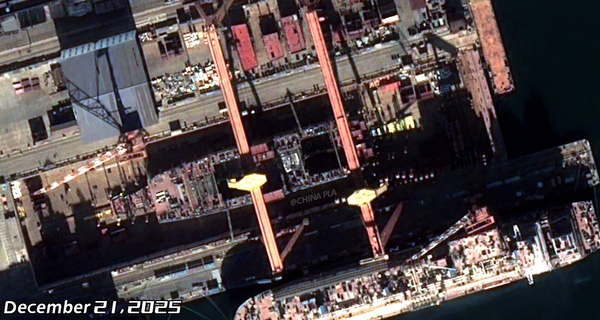
| Satellites are a primary source of information on China’s latest naval developments. |
But even as Fujian was formally entering service after an extended period of sea trials, another large carrier was taking shape in China. It too has been photographed by commercial reconnaissance satellites, and Western amateur analysts have been keeping tabs on the progress, trying to assess its size and capabilities. They soon saw indications that this ship, unlike its predecessors, will be nuclear-powered. Satellites are a primary source of information on China’s latest naval developments.
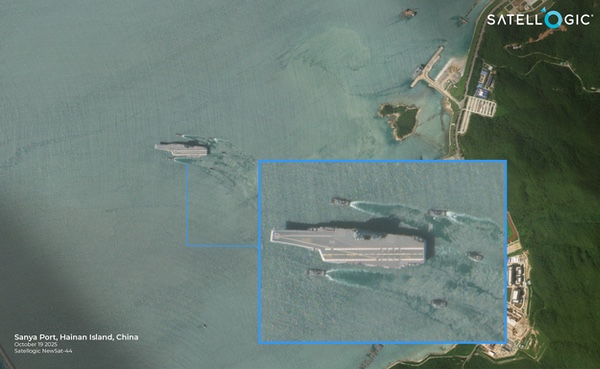 China’s second aircraft carrier, Shandong, leaving port. (credit: Satellogic) |
Fujian
China’s Navy has been growing rapidly over the past decade and a half. While the US Navy has struggled to begin construction of a new frigate—canceling a program that was underway for seven years—China has been launching modern destroyers, frigates, and even experimental vessels. In satellite photos, the scale of the construction program has sometimes been startling, with multiple warships under construction in China’s vast shipyards.
China currently operates three aircraft carriers, the Fujian, Shandong, and Liaoning. Liaoning was an incomplete Soviet-era hulk rusting away in a Ukrainian shipyard when China surreptitiously purchased it in the 1990s. The ship was extensively overhauled and modernized, and launched in 2012. In 2015, China launched Shandong, which was mostly based upon the same design as Liaoning. Both ships have limited aviation capabilities, primarily due to their lack of catapults, which requires their jet aircraft to take off under their own power, with limited fuel and weapons. (See “Carriers—and battleships—from space (part 3): The Mighty O and the Mighty Mo,” The Space Review, October 6, 2025; “Flattops from space: the once (and future?) meme of photographing aircraft carriers from orbit,” The Space Review, July 19, 2021; “Carriers from space (part 1),” The Space Review, July 15, 2024; “Carriers from space (part 2): Contemporary use of satellite imagery for open source intelligence,” The Space Review, August 12, 2024.)
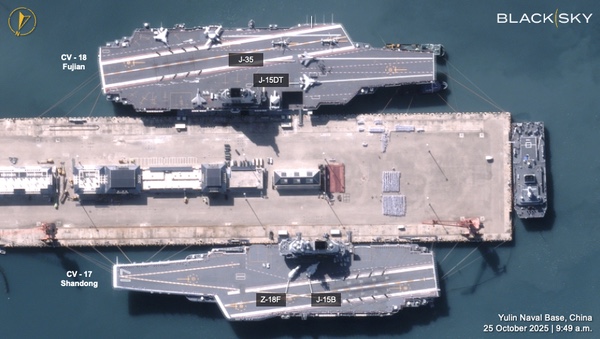 China’s second and third aircraft carriers in port. CV-18 Fujian (top) has only recently entered service. Note the differences in the flight deck compared to CV-17 Shandong. CV-16 Liaoning is similar to Shandong and was originally built for the Soviet Union. (credit: ImageSatInternational) |
In 2017, Western satellites began photographing a large ship under construction at the Jiangnan Shipyard. Because many observers of Chinese military programs expected China to begin work on a new aircraft carrier, they suspected that this new hull was a carrier from the start. They were rewarded within the year when it became clear that the ship was not a large cargo vessel (which would have had big open cargo holds), but a heavily compartmented military ship. Eventually, a flight deck was built on top of the hull, and over time, the flight deck was covered with ventilation hoses to pump air below decks. The observers noticed that the ship, unlike Liaoning and Shandong, had catapults, enabling it to launch bigger and heavier aircraft.
The ship was launched in 2022, and then went to sea for extensive trials, culminating with launching and recovering aircraft in 2025. In fall, a large stage structure was erected on its dock, clearly intended for the commissioning ceremony. Upon commissioning, the carrier was formally named Fujian.
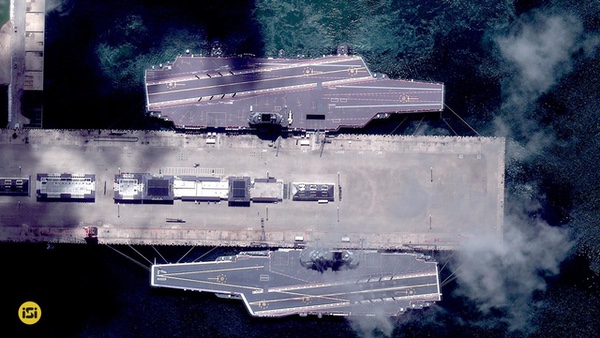 The proliferation of commercial imagery satellite companies has resulted in more and better images becoming available. Independent observers now monitor when ships go to sea and where they are operating. (credit: BlackSky) |
The Type 004
In May 2025, satellites photographed initial preparations for construction of a new large ship at the Dalian shipyard. Keel blocks were laid out on the floor in the shape of a very large hull. Rather than another conventionally powered carrier, there was speculation among military observers that China’s next carrier, euphemistically known as the Type 004, would be nuclear powered.
In August 2025, satellite photos revealed that the ship’s hull was under construction, with two large hull sections being built. By mid-October 2025, the two large hull sections were merged. Unlike for Fujian, the available satellite photos have been lower quality, possibly because the increasing cost of imagery has meant that fewer amateurs can afford it. There have been photos taken at a distance both from the ground and from commercial aircraft, but these too have been relatively poor quality. China does not release updates on its current naval ship production.
 The aircraft carrier USS John F. Kennedy, which recently went to sea on trials, is seen here under construction in 2017. The ship's two large box-like reactor compartments are clearly visible. (credit: US Navy) |
By November 2025, satellite and aerial photos revealed two large square structures in the two hull sections. Observers noted that these seemed similar to large structures seen in the construction of US Navy nuclear carriers and used to contain nuclear reactors. Although the evidence appears strong, only when the ship’s island is spotted will it be confirmed: if the island does not include exhaust ports, then the ship is nuclear-powered. Trained intelligence analysts looking at much higher quality photos certainly already know. In fact, for intelligence agencies, satellites may no longer be the best source of data on such subjects. The US National Security Agency, for example, is almost certainly doing everything possible to hack Chinese military databases and steal blueprints and other technical information. China, after all, has been doing that to the United States.
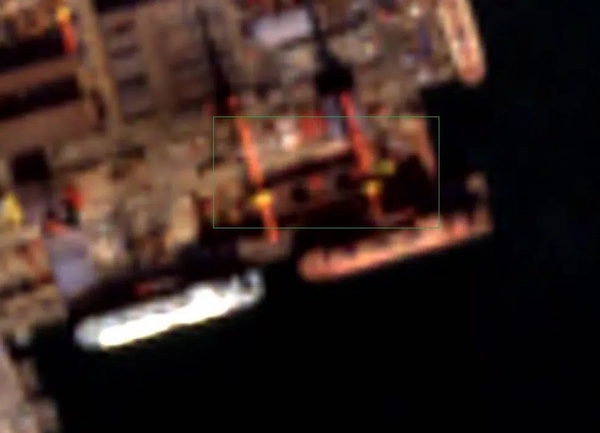 Landsat photo of China's fourth aircraft carrier, nicknamed the Type-004, under construction at the Dalian shipyard. To date, most of the satellite photos of the ship have been low quality. This may change as more satellite companies take interest in it. (credit: USGS) |
But for the general public, satellite photos remain the best source of information on this new large warship and the status of the rest of China’s fleet. China’s government has not clearly stated that it is building the ship, although there has been wide speculation about it within China, and models of a nuclear-powered aircraft carrier have been displayed. As the construction progresses, it is more likely that higher-quality satellite photos will be published in the US, as more organizations capable of affording the photos acquire and release them, and as the shape of this giant new vessel becomes more apparent.
Note: we are now moderating comments. There will be a delay in posting comments and no guarantee that all submitted comments will be posted.