Suborbital’s descending trajectoryby Jeff Foust
|
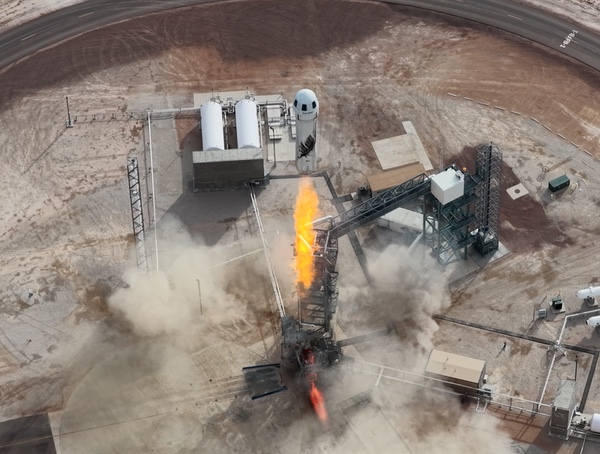
| “Wow! Wow! Wow!” Stiles said after landing. “Oh my gosh!” |
In West Texas, the company conducted the latest launch of its New Shepard suborbital vehicle. The NS-38 mission was a typical flight for the company, the tenth in less than 12 months for the program. The one thing that stood out at the time is that one of the six customers who was named to the flight fell ill.
He was replaced two days before the flight by a Blue Origin employee, Laura Stiles, who had worked on the program in various capacities and was now director of New Shepard launch operations. While Stiles was more familiar with the vehicle than almost anyone else, she still came away from the flight stunned.
“Wow! Wow! Wow!” she said on the Blue Origin webcast moments after stepping out of the capsule. “Oh my gosh!”
“To be able to do something like that with all of these amazing, amazing coworkers,” she said a few minutes later, “it’s going to take a long time to process what just happened.”
The same day that Stiles and the others on NS-38 got to experience a taste of space, another Blue Origin spacecraft emerged from a factory across the country in Florida. The first Blue Moon Mark 1 lander, called “Endurance” by the company, was trucked from the factory just outside the gates of the Kennedy Space Center to nearby Port Canaveral. There, it was loaded onto a ship to be transported to Houston.
In Houston, Endurance will undergo testing in a thermal vacuum chamber at the Johnson Space Center, one originally used for the Apollo program and, more recently, by the James Webb Space Telescope. Once those tests are complete—a process expected to take at least a few weeks—the lander will ship back to Florida for launch on a New Glenn rocket, bound for the south polar region of the Moon.
At the time, the two events appeared unrelated, other than to perhaps demonstrate that Blue Origin was big enough to carry out these activities simultaneously. Eight days later, though, their paths collided.
In a two-paragraph press release issued around mid-afternoon Friday, January 30, Blue Origin announced it was halting New Shepard flights for at least two years.
“Blue Origin today announced it will pause its New Shepard flights and shift resources to further accelerate development of the company's human lunar capabilities,” the company stated. “The decision reflects Blue Origin's commitment to the nation's goal of returning to the Moon and establishing a permanent, sustained lunar presence.”
| “First of all, it’s a good business,” Limp said last year. “There is an insatiable demand out there for human beings who grew up thinking about space and want to get to space.” |
The announcement took the space industry, and even many people inside Blue Origin, by surprise. The company had not hinted it was halting or scaling back New Shepard flights. “As we enter 2026, we're focused on continuing to deliver transformational experiences for our customers through the proven capability and reliability of New Shepard,” Phil Joyce, senior vice president for New Shepard at Blue Origin, said in a statement after NS-38.
Both he and Dave Limp, Blue Origin’s CEO, said in the last year that New Shepard was both useful for technology development and also a good business.
“New Shepard serves two really big purposes. The first is that it is a testbed for almost everything that we do,” Limp said at a conference last February. The other was the “profound experience” of spaceflight for customers. “I do believe New Shepard will be a very good business for us.”
He doubled down on those comments at another conference in May. “First of all, it’s a good business,” he said. “There is an insatiable demand out there for human beings who grew up thinking about space and want to get to space, but it’s still very hard to do right now.”
He added that even if the business case for New Shepard wasn’t good, “we would still fly New Shepard because it’s such a good testbed.”
The strongest case for New Shepard came from Joyce in a talk at the Global Spaceport Alliance’s International Spaceport Forum in Sydney, Australia, in late September. He announced there that Blue Origin planned to increase the New Shepard flight rate from less than once per month to “approximately weekly” over the next few years.
That would be accomplished, he said then, by adding more vehicles to the fleet, including versions with modifications intended to support higher flight rates. The company was also considering additional launch sites beyond West Texas for the vehicle.
That increase was driven by customer demand. “The demand is really strong,” Joyce said. “We’re continuing to see sales every week, every day.”
It was those customers, he added, that led the company to consider alternative launch sites. Blue Origin’s Launch Site One is in a remote area of West Texas, a long drive from the nearest major airport in El Paso. “A lot of our target customer base, ultrahigh-net-worth individuals, don’t want to spend a day and a half getting to the destination, so that’s a consideration,” Joyce said of potential spaceport locations.
So how did New Shepard go from a program that the company was planning to ramp up to one that it is halting? A key factor is something that took place a few weeks after Joyce spoke in Sydney, when NASA’s acting administrator at the time, Sean Duffy, expressed his displeasure with SpaceX’s development of the Starship lunar lander for Artemis and said he would be “opening that contract up” to competition (see “The (possibly) great lunar lander race”, The Space Review, November 3, 2025.)
NASA said it asked both Blue Origin and SpaceX, the two companies with Human Landing System (HLS) contracts, for “acceleration approaches” that could speed up a lunar landing. Both companies complied, but neither they nor NASA have disclosed details about those plans.
“They asked us, ‘Can you get to the Moon faster?’” Limp said in an interview in November. “My answer is, if the country wants it, yes.”
“We believe that we have a simplified architecture that closes. We believe we can do it very quickly,” he said of the new approach, details of which he did not disclose. “The reason we can do it very quickly is that it uses the pieces and parts that we’re already working on, but with simpler CONOPS and a simplified mission.”
While the push for an accelerated lunar landing program started under Duffy’s temporary leadership of NASA, it has continued since Jared Isaacman took over in December. In an interview Friday before the Blue Origin announcement, he said the agency was committed to helping both companies speed up their lander development.
“We are going to do everything we can to enable the acceleration plans that were submitted by both HLS providers,” he said. “We are willing to rethink a lot of our requirements in order to achieve the objective on time.”
| Virgin expected to begin test flights of the first Delta-class spaceplane in late 2025 and begin commercial service in 2026 but, like so many other aerospace programs, those schedules have slipped. |
Earlier last month at a briefing during the Artemis 2 rollout, Isaacman called both companies’ concepts “very good plans” that reduced technical risk. He added that the key for both companies will be to increase the flight rates of both Starship and New Glenn, since both companies are planning to use in-space propellant transfer for their landers.
“So, I’d say if we’re on track, we should be watching an awful lot of New Glenns and Starships launch in the years ahead,” he said.
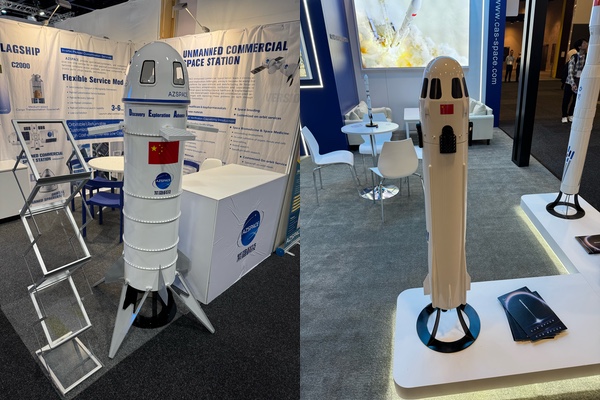 Two models of planned Chinese suborbital vehicles, each resembling New Shepard, on display in the exhibit hall at the International Astronautical Congress in Sydney last year. (credit: J. Foust) |
The relevance of suborbital
Blue Origin, in its statement, said that halting New Shepard flights would free up resources for its lunar work, but did not elaborate. Some employees working on New Shepard will move over to Blue Moon and related programs, particularly engineers and technicians. Less clear, though, will be what happens to those who has been working on things more specific to New Shepard, such as training, operations, and sales of tickets.
Since Friday afternoon, some Blue Origin employees who had been on the New Shepard program have posted on social media that they are looking for opportunities both inside and outside the company, but none said explicitly that they had been laid off.
Halting New Shepard flights for lunar work is ironic, since the suborbital vehicle is how the company got its start on lunar landers. As Christian Davenport recounted in his recent book Rocket Dreams, the company pitched a lunar lander to the first Trump administration’s NASA transition team based on its work landing the New Shepard booster: “We can land something like it on the Moon,” they said, a “completely off-script” statement since the company did not have a lunar lander in development. After the meeting, they did. (See “Review: Rocket Dreams”, The Space Review, September 22, 2025.)
Blue Origin’s statement made clear it was not formally cancelling New Shepard, only halting flights for at least two years. But that is long enough that the company will need to make a significant investment if it decides in 2028 or later to restart the program. Vehicles and equipment will need to be taken out of mothballs, production lines restarted, sales funnels reopened. The institutional knowledge about the vehicle, which is never fully captured in documentation, will need to be relearned as the people working on New Shepard disperse to other Blue Origin programs or leave the company.
Blue Origin’s departure, at least for now, leaves Virgin Galactic alone in the suborbital commercial human spaceflight market. And that company has not flown since June 2024, when the company retired its SpaceShipTwo vehicle, VSS Unity, to focus its resources, and its cash, on the improved Delta class of suborbital spaceplanes.
At the time, the company expected to begin test flights of the first Delta-class spaceplane in late 2025 and begin commercial service in 2026 but, like so many other aerospace programs, those schedules have slipped. In its latest earnings call in November, Virgin executives said test flights would now begin in the third quarter of 2026, followed by research flights in the fourth quarter. Flights with private astronauts—aka space tourists—might not begin until 2027.
“We feel good and confident in our Q3 start of flight test,” Michael Colglazier, CEO of Virgin Galactic, said in the earnings call. The company will likely update that schedule in its next earnings call in the next several weeks.
The company is unlikely to give up easily on suborbital spaceflight. Unlike Blue Origin, which has multiple programs—the company announced last month plans for its own broadband constellation, TeraWave, to serve enterprise customers—there is no Plan B for Virgin to fall back on. The technical and fiscal success of the Delta-class vehicles is essential to the company’s future, although executives say they are optimistic that, once the Delta vehicle start flying, they can do so profitably.
| When Peter Diamandis announced the X Prize almost 30 years ago, suborbital space tourism was a means to an end: reusable launch vehicles that could achieve the promise of low-cost access to space with high flight rates. |
The only other likely options for commercial human suborbital spaceflight for the foreseeable future are in China. In the exhibit hall at the International Astronautical Congress in Sydney last year, two Chinese companies just a few dozen meters apart showed off models of similar suborbital vehicles, both modeled on New Shepard but with design elements taken from SpaceX. AZSpace’s vehicle had a capsule that looked like New Shepard, with large windows, but its propulsion module included Falcon 9-like grid fins. A similar design by CAS Space also included grid fins, but with a capsule that looked a little more like a Crew Dragon.
A third Chinese company, InterstellOr, is also developing a suborbital vehicle whose capsule again looks like New Shepard, this time with aerodynamic fins on the side; its booster is like a Falcon 9, down to the design of the landing legs. The company announced last month it sold a ticket to a Chinese actor, Johnny Huang Jingyu, and a report stated it now has more than 20 confirmed customers that included “academicians, business executives, and silicon-based robots.” (The report didn’t explain why a robot would fly on such a vehicle.)
It’s quite possible that one or more of these ersatz New Shepards will fly before the real one returns to the skies. They may also find some degree of commercial success. However, it may only end up being a footnote in the development of the global space economy.
When Peter Diamandis announced the X Prize almost 30 years ago, suborbital space tourism was a means to an end. That end was reusable launch vehicles that could achieve the promise of low-cost access to space. That required a high flight rate, and he and others involved with the prize concluded that satellites alone would be insufficient: after all, at the time the largest satellite systems numbers in the dozens of spacecraft, and only the most ambitious systems, like Teledesic, proposed hundreds of satellites.
People, by contrast, represented a potentially much larger customer base: self-loading carbon-based payloads that come with their own money, as he used to quip. Only they could justify the high flight rates needed to make reusable vehicles economical, it seemed.
Today, that argument has been turned on its head. It is satellite constellations that feature thousands of satellites that are driving launch demand, including efforts to develop partially and fully reusable rockets. Just a few hours after Blue Origin announced it was suspending New Shepard flights, SpaceX filed an application with the FCC for a constellation of up to one million (yes, million) satellites to serve as orbital data centers for AI.
SpaceX bypassed the suborbital market, and others have followed. Even the Chinese companies that are developing New Shepard-like vehicles have ambitions for orbital vehicles, rather than being a pure-play suborbital company like Virgin Galactic. Suborbital space tourism was a means to an end, but the end has found other means.
Note: we are now moderating comments. There will be a delay in posting comments and no guarantee that all submitted comments will be posted.