The dominance of Cape Canaveral and Vandenbergby Jeff Foust
|
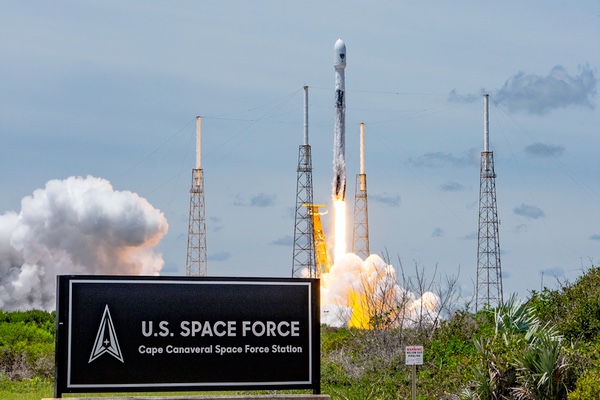
| When we’re looking at the analysis out there, in 2035, we’re seeing numbers upwards of 500 launches a year off the Space Coast,” said Chatman. |
In 2025, the Eastern Range lapped the field. There were 109 launches from KSC and the rechristened Cape Canaveral Space Force Station that year, more than double a goal that seven years earlier seemed difficult to achieve. That was largely achieved by SpaceX, which accounted for 101 of those launches with its workhorse Falcon 9, with Atlas 5, New Glenn, and Vulcan accounting for the rest.
Not long ago, that launch rate would have been considered impossible from the Space Coast: too much demand on spaceport infrastructure. But the leadership of the Eastern Range expects launch activity to continue to grow.
“When we’re looking at the analysis out there, in 2035, we’re seeing numbers upwards of 500 launches a year off the Space Coast,” said Col. Brian Chatman, commander of Space Launch Delta 45, the Space Force successor to the 45th Space Wing, during a panel discussion at the Space Mobility conference in Orlando January 27.
He said nearly $1 billion is going into spaceport infrastructure development at Cape Canaveral Space Force Station through the “Spaceport of the Future” initiative. The goal is to be able to accommodate that 500 or more launches a year as soon as 2030.
“We’re redoing the landscape from a launch base perspective to maximize efficiency out at the range, to maximize throughput,” he said, “to help partner with the launch service providers to meet the number of launches, the cadence they anticipate in the future.”
The same is true at the other major American spaceport, Vandenberg Space Force Base in California. Once a relatively quiet launch site, there were 71 launches there in 2025, a figure that includes both orbital launches and suborbital missile tests. Like the Eastern Range, the vast majority of those launches were by SpaceX: the only orbital launch attempt from Vandenberg last year not performed by SpaceX was a Firefly Alpha launch that failed to reach orbit.
“A busy year at Vandenberg,” recalled Col. Jim Horne, commander of Space Launch Delta 30, which oversees the Western Range, “used to be nine, ten launches a year.”
Speaking at the Space Mobility panel, he said Vandenberg now was where Cape Canaveral was two years ago. “A lot of the lessons we’ve learned from SLD 45 as they leaned into the capacity surge are really starting to pay off.”
Like the Cape, the Vandenberg is investing in infrastructure improvements to the tune of more than $800 million over five years. Much of that is going towards “retiring tech debt” that has accumulated over the years there. “We’re essentially modernizing the infrastructure we built in the first space race to get ready for the second space race.”
“We anticipate upwards of 150 to 200 launches over the next couple of years,” he said. “I think we’re pretty close to getting there.”
| “There is a provider that the way they get into our harbor is that they hired a surfer. He stands on the edge of the barge. He waits for the tides to optimize and says, “Ready, ready, go!’ And then the boat harbor guy guns it and they ride the wave into the harbor,” Horne said. |
Traditionally, the focus on spaceport infrastructure has been on the launch pads themselves, and there have been recent efforts to create new launch facilities. Last fall, the Department of the Air Force approved plans by SpaceX to convert the Cape’s Space Launch Complex 37, a former Delta 4 pad, into a Starship launch facility with two pads.
At the end of January, the FAA approved Starship launches from a pad under construction at KSC’s Launch Complex 39A, allowing up to 44 launches a year along with 44 landings each of the Super Heavy booster and Starship upper stage. SpaceX plans to use LC-39A almost exclusively for Falcon Heavy and Starship launches, with Falcon 9 launches, including crewed missions, flying from nearby SLC-40.
In December, Vandenberg issued a request for information about potential uses of Space Launch Complex 14, an undeveloped site on the south side of the base that the Space Force would like to offer to an operator of a heavy-lift or superheavy-lift launch vehicle, like Starship or New Glenn. At the same time, the Eastern Range is considering redeveloping Space Launch Complex 46, a rarely used pad, for large vehicles as well.
But the bottlenecks to that projected launch growth are not the launch sites themselves. On the panel, both Chatman and Horne discussed challenges ranging from roads to pipelines that pose the biggest potential challenges to growth.
“Today I’ve got one main artery to drive on and off Cape Canaveral Space Force Station,” said Chatman. “I need a booster transport lane. I need the ability to deconflict how men and women get to work day-to-day from how we transport upper stages and boosters back over to the processing facilities.”
Another issue, he said, is propellants. Methane is increasingly used by launch vehicles: New Glenn and Vulcan now, with Starship to follow. Right now, methane is brought to the launch sites by truck. “That’s thousands of trucks coming through my vehicle inspection stations each and every day,” he said.
“Things like a methane pipeline are things we didn’t account for two years ago when we laid in requirements for Spaceport of the Future,” he said, adding that he was working with Space Florida, the state’s space economic development agency, to help fund infrastructure upgrades like a pipeline.
Horne raised similar concerns about truck traffic at Vandenberg. “In the past we’ve said each to his own” about getting commodities to their pads,” he said. That truck traffic for bringing in those commodities affects roads as well as traffic on the base.
Then there’s the issue of Vandenberg’s modest harbor. “There is a provider that the way they get into our harbor is that they hired a surfer. He stands on the edge of the barge. He waits for the tides to optimize and says, “Ready, ready, go!’ And then the boat harbor guy guns it and they ride the wave into the harbor,” he said.
Improving the harbor is a priority, he said, with the goal of making it available 90% of the time versus 30% now. “We have to invest in our harbor in a way that makes it like any other normal port and opens up capacity,” he said.
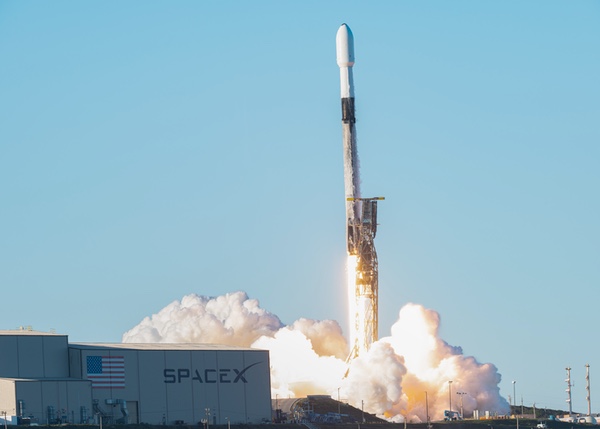 A Falcon 9 lifts off from Vandenberg Space Force Base in 2024. (credit: Airman 1st Class Olga Houtsma) |
Other spaceports
In 2025, the Eastern and Western Ranges accounted for all but one orbital launch from the United States. The exception was a single Rocket Lab Electron launch from the Mid-Atlantic Regional Spaceport on Wallops Island, Virginia. (Other sites hosted suborbital launches, such as New Shepard missions from Blue Origin’s West Texas facility and Starship test flights from Starbase in Texas.)
| “If there was a launch and something were to go wrong, we’re fortunate that all the folks underneath us are, probably, cows,” said Spaceport America’s Pallares. |
The perceived congestion at the Cape seemed to be an opportunity for other spaceports to attract customers. Rocket Lab decided to set up operations at Wallops for Electron and, soon, Neutron, avoiding the Cape, while Northrop Grumman has used that site for Antares launches. Northrop’s partnership with Firefly Aerospace will allow for Alpha and Eclipse launches from there.
But there are still far more spaceports than demand. The day before Space Mobility, the Global Spaceport Alliance gathered in the same convention center for its annual Spaceport Summit, attracting a record audience despite a winter storm that kept some people away.
Dozens of spaceports, most from the United States but some from Australia, Europe, Japan and Latin America, attended. Most of the spaceports had one thing in common: they had yet to host a launch.
One reason why is that many of the facilities are located inland, ruling out orbital launches—at least in the US—under current regulations. Some hope to be able to change that.
“I think the biggest value proposition for inland spaceports is being able to hold schedule,” said Francisco Pallares, director of business development for Spaceport America in New Mexico, during one conference panel. That facility, best known for hosting Virgin Galactic suborbital launches, has shown an interest in supporting orbital launches.
The lack of congestion today at inland launch sites, he argued, could provide customers with the schedule assurance that is harder to come by at major launch sites today. “They need the certainty that they will be able to launch.”
The maturation of launch vehicles starts to make inland orbital launch an option at some sites, like Spaceport America. “The companies can more easily approach this accuracy that is so necessary,” he said.
Spaceport America has 18,000 acres of land that is surrounded by much larger territory owned by the state of New Mexico and the Bureau of Land Management, as well as nearby White Sands Missile Range.
“If there was a launch and something were to go wrong, we’re fortunate that all the folks underneath us are, probably, cows,” he said.
Another panelist advocated for the opposite of inland launch: offshore launches from floating platforms. “A misconception that is associated with sea launch is that sea launch has to be very costly,” said Michael Anderson, CEO of Seagate Space, which is developing ships that can serve as mobile launch platforms.
That perception is rooted in the experience from Sea Launch, the multinational venture that, in the 1990s, converted an oil rig into a launch platform the Zenit-3SL rocket, along with a large ship that accompanies it to launches on the Equator in the Pacific Ocean.
The model he envisions is what China is doing today with barges that host launches of smaller vehicles, taking place not far offshore from Chinese cities. Seagate, he said, is working on a “very cost-efficient asset that actually provides more capability than attempts to retrofit assets built for a totally different purpose.”
| “There is availability at the major spaceports in the United States that is the ‘easy button,’” said Hoffman |
One advantage of ocean launch, he said, is there is no need to acquire large amounts of land for a launch site. The average launch pad, he said, requires about 1,000 acres of land; one for Starship might eventually support daily launches putting 100 to 150 tons each into orbit. He contrasted that to the Port of Miami, which covers 500 acres but handles 25,000 tons of cargo a day.
“Space has a space problem,” he concluded.
There are few signs, though, of a shift towards inland or ocean spaceports. “There is availability at the major spaceports in the United States that is the ‘easy button,’” said Eric Hoffman, a vice president at Booz Allen, during another panel at the spaceport summit. Companies can leverage government infrastructure at the Cape and Vandenberg. “It’s just easier.”
“The SpaceX’s and Blue Origin’s of the world have made their investments in those facilities,” said Mike Kuchler, senior manager at Deloitte. “You can’t recreate superheavy launch at a state or local spaceport and reach the same economies of scale.”
Both Hoffman and Kuchler urged new spaceports to find other niches rather than try to serve the same customers that the Cape and Vandenberg are supporting. One example they gave was Oklahoma’s announcement last year it would bring in Dawn Aerospace’s Aurora Mark 2 suborbital spaceplane to the state’s spaceport, a former air force base in Burns Flat. That vehicle is expected to start flying from that spaceport next year.
“For the other, newer spaceports, you have to focus on something that is a niche that isn’t necessarily being serviced,” Hoffman said.
Proponents of other spaceports have tried to make other arguments for diversifying launch beyond the Cape and Vandenberg, such as the risk those sites could be taken offline by a natural disaster or an attack. So far, those arguments have not been convincing. As long as the Eastern and Western Ranges remain the “easy button” for launch companies and can accommodate continued growth, other spaceports in the US will need to find another lane to race in.
Note: we are now moderating comments. There will be a delay in posting comments and no guarantee that all submitted comments will be posted.