All’s well that’s Roswellby Dwayne A. Day
|
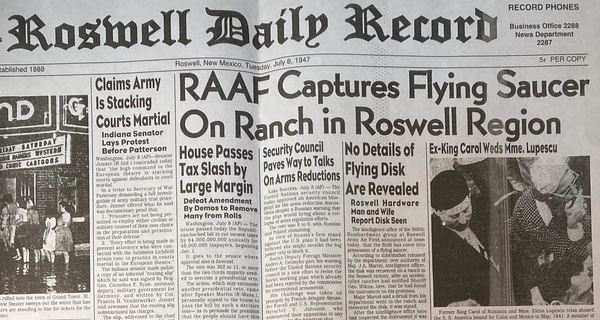 The infamous “flying saucer” headline in the local newspaper in 1947. |
The Roswell Incident
In 1947 there was a report of debris found by a rancher near Roswell, New Mexico. It was soon publicly reported that the Air Force had captured a “flying saucer.” Within a day or so, the military stated that the debris was actually from a “weather balloon.”
| In 1994, following political pressure from Congress, the Air Force announced that what had crashed at Roswell was not a weather balloon, but a different kind of balloon, from a top secret program. |
Despite the fact that Roswell has now been in the public consciousness for decades (there were even two fictionalized TV series about aliens set in Roswell), it was not until 1980 and the publication of the book The Roswell Incident that the event gained a mass audience. The book by Charles Berlitz and William L. Moore alleged that not only had the US government recovered debris from a flying saucer, but it may have recovered “alien bodies.” Sensational paranormal pseudoscientific stories were Berlitz’s bread and butter: he had previously written a book about the Bermuda Triangle (which unfortunately does not exist) and claimed that a US Navy ship had been involved in time travel experiments (which did not happen, but may still have not happened when time travel is invented, or not).
In 1994, following political pressure from Congress, the Air Force announced that what had crashed at Roswell was not a weather balloon, but a different kind of balloon, from a top secret program called Project Mogul. Mogul was an effort to fly microphones to very high altitudes to listen for the sound of nuclear explosions. Scientists believed that the sounds of such explosions could be trapped between layers of the atmosphere and would reverberate over long distances. In the late 1940s, the United States government was concerned that the Soviet Union might develop an A-bomb, and Mogul was designed to listen for the big boom. A big boom eventually happened when the first Soviet A-bomb was detonated in August 1949.
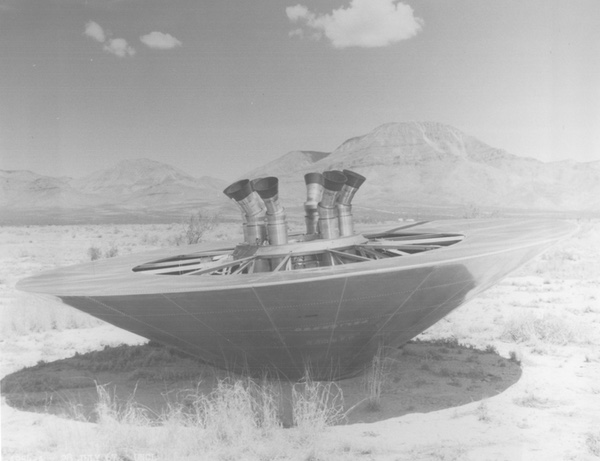
After the initial Air Force revelation about Project Mogul, in 1995 the Air Force published The Roswell Report – Fact vs. Fiction in the New Mexico Desert, a thick book that included documentation supporting the Project Mogul explanation for the Roswell incident. On June 24, 1997, the Air Force published The Roswell Report: Case Closed. This second report addressed the claims that bodies had been recovered in the desert, noting that the Air Force had conducted many tests in the desert involving instrumented dummies dropped from aircraft and later recovered on the ground. It also noted that NASA had performed drop tests of various reentry vehicles over the desert, and some of these had saucer shapes. These activities, conducted over many decades, often at an Air Force base at Roswell, could have contributed to the mythology of Roswell and aliens.
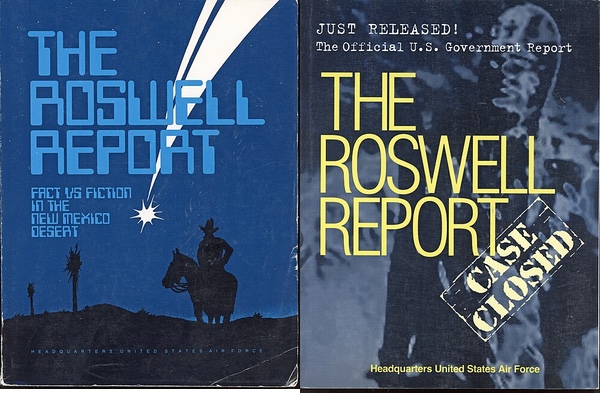 The two reports released by the US Air Force in 1995 and 1997 about what happened in Roswell. |
Case closed?
Of course, the tinfoil hat-wearing crowd was not convinced, and the term “case closed” only stirred up their bile. There was already a cottage industry of hucksters and grifters willing to take advantage of the true believers, and they had no interest in Air Force or NASA history that didn’t titillate the masses. They held their UFO conferences and sold energy crystals and fold-up pyramids to the faithful, and denounced the Air Force’s explanation for Roswell.
| The report shone a light on obscure areas of aerospace research that had been overlooked by many historians, like high-altitude drop tests. |
But setting aside the issue of extraterrestrials, the two Air Force reports of the mid-1990s were important contributions to historical scholarship, revealing new and declassified information and documents. Up to the time of the Air Force revelation about Project Mogul, that program had not been acknowledged or even hinted about. For example, historian Curtis Peebles had written a 1991 book The Moby Dick Project: Reconnaissance Balloons over Russia. Peebles shed considerable light on the subject of reconnaissance balloons but had been unaware of Project Mogul. Other historians had been digging into the history of aerial reconnaissance programs and had not uncovered Mogul. The information on Mogul had been sitting in government archives for decades until it was forced into the open. Certainly a few people in the government still knew about it, and some had probably seen the documents, but there was no reason for them to reveal the truth about what happened at Roswell until a government order to declassify and publish that information.
Similarly, although the information in the Case Closed report did not reveal any highly classified programs, it was revelatory. It shone a light on obscure areas of aerospace research that had been overlooked by many historians, like high-altitude drop tests. The report included photos of NASA Voyager-Mars and Viking aeroshells that had been tested in the desert. It also included photos of other unusual balloon-carried research payloads, including Discoverer satellite reentry vehicles. Very few people had ever paid attention to the history of aeromedical research and testing during the Cold War, but the report demonstrated that many such tests had been performed for decades.
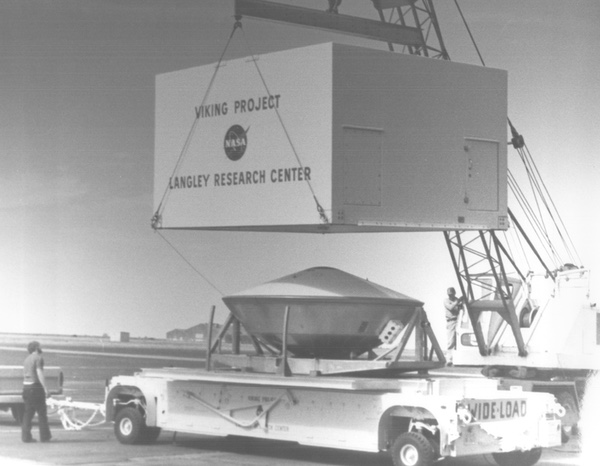 The Air Force reports on Roswell revealed testing NASA did of aeroshells for future Mars missions, like Viking. (credit: NASA) |
Sunshine days
The 1990s was an era of increased openness about Cold War era activities, sometimes resulting from presidential direction, sometimes from congressional direction, and sometimes at the initiative of senior government officials. The existence of the National Reconnaissance Office was revealed in 1992, and following executive order 12951 the CORONA reconnaissance satellite program was declassified in 1995. In a December 1993 press conference, Secretary of Energy Hazel O’Leary announced the largest declassification of information in the Department of Energy’s (DoE’s) history. That included acknowledging many nuclear tests, as well as nuclear weapons accidents during the Cold War. Additional major declassifications were announced at openness press conferences in June 1994 and February 1996. For example, in 1996 DoE released a complete inventory of US production, acquisition, use, and distribution of plutonium from 1944 to 1994.
The CIA began declassifying millions of pages of documents on Cold War operations. These included an official history of the U-2 reconnaissance program as well as (in coordination with the National Security Agency) revealing the Venona communications interceptions of the 1940s. CIA documents revealed details of what the US Intelligence Community knew about Soviet missile and space programs. One example was an early effort to “kidnap” a Soviet spacecraft during an international exhibition in the early 1960s to examine it. This author was the first to discover and report on the CIA operation after uncovering a newly declassified CIA publication in the National Archives. The CIA also created a declassification program that released millions of pages of documents as part of the CIA Records Search Tool (CREST). Much of our current understanding of intelligence collection about Soviet weapons systems is due to the work done for CREST. That effort was highly productive into the early 2000s, when it was curtailed and the number of documents being declassified annually dropped dramatically. As a result, we have very good understanding of many aspects of the Cold War up until the early 1970s, but after that the historical record is much thinner.
The 1990s were the beginning of a new era of revelations about historical American air and space programs. Certainly, much remained classified, but much more was revealed than in previous decades. The September 11, 2001, terrorist attacks were the beginning of the end of this period of openness. Government agencies retrenched, new bureaucracies and layers of secrecy were created, and new politicians and government leaders had far less interest in revealing past secrets. Whereas CORONA was declassified in 1995, the follow-on GAMBIT and HEXAGON reconnaissance satellite programs were considered for declassification in 1997, but this ultimately did not happen until 2011. Today, official government declassification efforts are underfunded, meager, and sporadic.
The truth is out there… and so are the lies
It has long been known that when the U-2 spy plane began flying in the mid-1950s it was regularly being reported as a flying saucer at high altitude, and the government did nothing to dispel those stories. But the government’s involvement goes beyond simply not correcting the false stories to creating its own false stories. In June 2025, The Wall Street Journal reported that the US government had actively used disinformation to conceal highly classified aerospace programs. (See “Pentagon Fueled UFO Mythology, Then Tried Coverup,” The Wall Street Journal, June 7, 2025, print edition.) As the government was investigating reports of unidentified aerial phenomena (the modern euphemism for UFOs), a retired Air Force colonel admitted that in the 1980s he had taken doctored photos of flying saucers to a bar in the Nevada desert and given them to a bartender to put up on the walls. This was to help obscure the fact that the Air Force was testing stealth aircraft nearby. Somebody who saw an F-117 flying in the dark might tell the story to somebody else who would say that it resembled the flying saucer photo in the bar. People would chase aliens instead of secret aircraft.
| Somebody who saw an F-117 flying in the dark might tell the story to somebody else who would say that it resembled the flying saucer photo in the bar. People would chase aliens instead of secret aircraft. |
Other officers who were assigned to a highly classified program office were shown a photo of what they were told was an alien craft, part of a project called Yankee Blue, and told that it had provided the government with antigravity technology. They were ordered to never mention it again. But this was actually a joke, a long-standing hazing ritual within the secretive community. In spring 2023, the Secretary of Defense sent out a memo ordering the practice to stop immediately, but by this time hundreds of people retired, and in the active duty military, believed the government had inherited technology from aliens. Distrust and misinformation was now firmly embedded into the secretive culture.
The Journal also recounted a disturbing story about a 1967 incident that had been reported as an alien “attack” on an ICBM command post in Montana by a glowing reddish-orange oval. What really occurred was a highly classified test of a system to determine if missile command complexes were vulnerable to Soviet electromagnetic pulse attacks. The test identified significant security vulnerabilities, and that information was so sensitive that it was highly classified for half a century, even though one Air Force officer in that command post believed it was aliens.
Some of my own research has hinted that misinformation was part of the fielding of the first operational near-real-time reconnaissance satellite in December 1976, the KH-11 KENNEN. A cryptic note in a declassified history indicates that the Soviet Union did not realize the satellite was capable of reconnaissance until summer of 1978. But I have also heard that an Air Force officer, possibly without official sanction, was deliberately spreading disinformation about American satellites during this period.
Two years ago, Peter Merlin published Dreamland: The Secret History of Area 51 (see “Review: Dreamland”, The Space Review, December 4, 2023.) It is an exhaustive history of secret projects developed at the Groom Lake airfield. But it also essentially stops by the early 1980s, even though the Groom Lake facilities expanded significantly in the following decade. What went on in those big new hangars? Throughout the 1980s there were rumors of other aircraft being tested there, and one retired test pilot confirmed that he flew something during the 1980s that remains classified. Maybe the story of the “Blackstar” air-launched spaceplane had some basis in truth (although I have my doubts: “Six blind men in a zoo: Aviation Week’s mythical Blackstar,” The Space Review, March 13, 2006). Maybe that colonel giving out photos of flying saucers to protect projects at Groom Lake was seeking to hide something other than the F-117 stealth fighter. Maybe we’ll now learn.
But probably not.
We’ll have to wait and see what, if anything, is declassified from this new order. So keep watching the skies, but don’t hold your breath while doing so.
Note: we are now moderating comments. There will be a delay in posting comments and no guarantee that all submitted comments will be posted.