Robert Goddard and the dawn of the rocket ageby Bruce McCandless III and Emily Carney
|
| Goddard may not have been the first person on the planet to see rockets as something other than dangerous toys or obsolete weapons, but he was apparently the first to start the greasy, tedious, occasionally dangerous work of constructing what he saw as the vehicle of the future. |
According to biographer David Clary, young Goddard loved books and read Verne’s From the Earth to the Moon and H. G. Wells’s Martian apocalyptic invasion thriller The War of the Worlds many times. He had an epiphany in 1899 when he climbed to the top of a cherry tree and became fascinated by the arc and expanse of the emptiness overhead. Other people have seen visions in the sky. The emperor Constantine reportedly saw a fiery cross in the heavens before an important battle in 312 CE. His forces won the battle, and Constantine converted to Christianity as a result. But for Goddard, the vision wasn’t in the sky. It was the sky. He began to wonder if human beings could travel beyond this azure barrier into the deep fantastic blue and possibly to other planets—specifically Mars, which many Americans believed at the time might be inhabited.
“I was a different boy when I descended the tree from when I ascended,” Goddard later wrote. “Existence at last seemed very purposive.”
Purposive indeed. Young Goddard never ceased thinking about the possibility of space travel. He eventually became convinced that the way into the cosmos was through rockets. He spent most of his adult life—an industrious, practical, and occasionally paranoid life—building the metal beasts. As a young man, he earned a Ph.D. in physics from Clark University, did research work at Princeton, and in 1914 returned to Worcester to join the faculty at Clark.
In addition to his intellectual accomplishments, he was also a tinkerer, unafraid of a skinned knuckle or two, comfortable though not particularly skillful with a blowtorch and a crescent wrench. This practicality helped. Robert Goddard may not have been the first person on the planet to see rockets as something other than dangerous toys or obsolete weapons, but he was apparently the first to start the greasy, tedious, occasionally dangerous work of constructing what he saw as the vehicle of the future. He built numerous rocket prototypes to test his ideas. Most of these early rockets died inglorious deaths. They blew up. They fell down. They smashed themselves into the earth. Nevertheless, Goddard persisted. We remember him not because he dreamed but because he built. And rebuilt. And rebuilt again. His rockets gradually got bigger, flew higher, and traveled more or less where they were pointed.
He was also careful to patent his work, which gives us a handy paper trail of his accomplishments. It’s a long trail, as he eventually earned 214 patents, some of which were awarded posthumously. On October 1, 1913, for example, Goddard filed a patent application for the “multistage rocket.” In an enterprise where every pound counts, it’s a key innovation that has helped to make orbital spaceflight the more or less commonplace proposition it is today.
On May 15, 1914, Goddard filed a patent application for a high-altitude rocket powered by a liquid—as opposed to solid, like gunpowder—using gasoline as a fuel and liquid nitrous oxide as the oxidant. This was another important development. Liquefying fuel and oxidants make them compact, and therefore easier, cheaper, and lighter for a rocket to carry—not because the substances are lighter, but because the tanks holding them can be smaller. Consumption of liquid fuel and its oxidant is also controllable. It can be increased or decreased, and even stopped, whereas combustion of a solid fuel like gunpowder is an all-or-nothing proposition; once the process starts, it continues until the fuel is depleted. Liquid propellants have therefore been the primary drivers of rockets from Goddard’s time to the present. Project Mercury’s Redstone rocket burned ethanol mixed with water. Apollo’s Saturn V consumed highly refined kerosene and liquid hydrogen. The SpaceX Starship burns a whole lot of liquid methane.
| Any player on the Sox could have thrown a baseball just as far, and considerably higher, than Goddard’s rocket. Most could probably have thrown Goddard’s rocket just as far. |
Based on the success of his early work, in January of 1917 Goddard received a grant of $5,000 over five years from the Smithsonian Institution to fund his research. It was a substantial sum, and it allowed him to upgrade his hardware and propellant options. He worked alone when he could, since few people understood his ideas and even fewer agreed with them. Rocketry wasn’t considered a legitimate academic pursuit in those days. It was more like a bad habit, akin to setting grass fires or playing the banjo. Nevertheless, the Smithsonian published Goddard’s thoughts in a 1919 monograph called A Method of Reaching Extreme Altitudes. The work, which contained notes on Goddard’s experiments with rocket engines and nozzle technology, was eagerly read by rocket enthusiasts abroad, including two Germans named Herman Oberth and Wernher von Braun.
The publication was less well received at home. The New York Times got wind of Goddard’s proposal to send a rocket to the Moon and ridiculed the professor in print. Summoning that peculiar blend of smugness and scientific error available only to newspaper editors, the Times announced that Goddard’s plan was foolish because a rocket in space wouldn’t have any atmosphere for its exhaust to push against. Nothing to push against, dammit! It was an embarrassing error on Goddard’s part, the newspaper said, indicating that the good doctor lacked basic information like that “ladled out daily in high schools.”
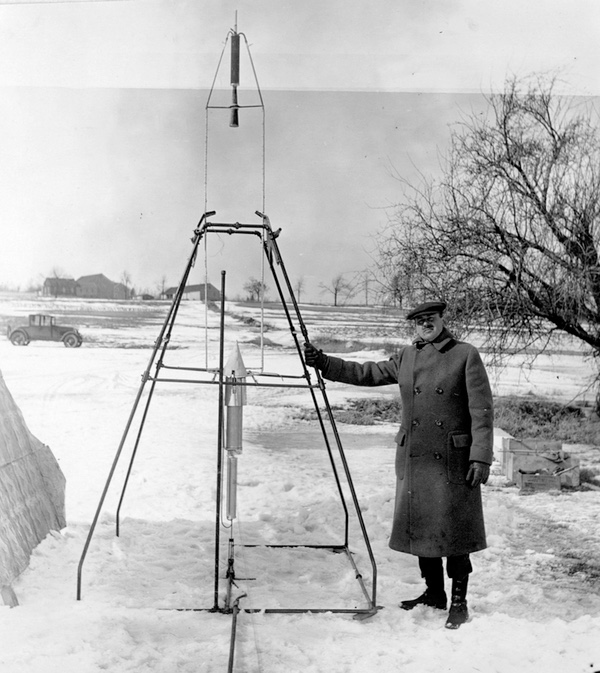
Nevertheless, on March 16, 1926, after years of trial, error, and a fair amount of exasperated headshaking from friends and colleagues, Goddard was able to launch a liquid-fueled rocket some 41 feet (12.5 meters) into the air. A famous photograph sets the scene. Goddard is standing in a snowy farmyard in Auburn, Massachusetts, next to what looks like playground equipment—a primitive jungle gym, perhaps. The reclusive tinkerer with the bottle-brush mustache has no conception of what a “global positioning system” might be. It hasn’t even been imagined yet. He can’t watch televised images from across the Atlantic Ocean in real time. He has no idea that huge oceans lie beneath the ice of Jupiter’s moon, Europa. Nevertheless, he’s proud of his, er, jungle gym. This is because the metal-tubed contraption is actually a liquid-fueled rocket, the first of its kind, and he’s prepared to ignite the more-or-less controlled explosion that will launch it. The sky is gun-barrel gray. Someone’s goat has gotten loose in the field across the creek, but no matter. The rocket is ignited, burns, shrieks skyward, and the world begins to change. For better. For worse. And forever.
Powered by a mixture of gasoline and liquid oxygen, the flight lasted 2.5 seconds and ended in a cabbage field 184 feet (56 meters) away from the launch site. By modern standards, it was a modest trajectory. The nearby Boston Red Sox baseball club fielded a sorry collection of misfits that season, a squad that included ham-and-eggers like Dud Lee, Boob Fowler, and Baby Doll Jackson. It was an organization still reeling from the colossal stupidity of selling a pug-nosed pitcher named Babe Ruth to the New York Yankees for a few bucks and a hot dog. Still, any player on the Sox could have thrown a baseball just as far, and considerably higher, than Goddard’s rocket. Most could probably have thrown Goddard’s rocket just as far. But the point was confirmation. Goddard had proven that a liquid-fueled rocket could work. The launch site is now a national historic landmark. In July 1969, as Apollo 11 neared the moon, the New York Times issued a formal retraction of its unkind words about Professor Goddard’s work. Apparently, rockets could fly in space. Who knew? The newspaper regretted the error.
Goddard contracted tuberculosis as a young man. Though he survived the ordeal, he bore traces of the disease for the rest of his life. Tall, bald, and stoop-shouldered, with a reedy voice and a gentle sense of humor, he was the prototypical absent-minded professor, beloved by family, friends, and many of his colleagues. The rest of the nation wasn’t quite sure what to think of him and his “moon rockets,” as the popular press delighted in calling Goddard’s temperamental metal canisters. Some revered him. The famous aviator Charles Lindbergh, for example, became a lifelong supporter. Others dismissed Goddard’s work as fanciful nonsense. “Oh yes,” Ray Bradbury wrote of his own childhood in the 1920s, “later on we were to remember that there were a few wild men like Professor Goddard stirring about. But no one gave him any mind. He was a blathering idiot, a fool, a nothing.”
| He was a peculiarly American figure, a constructive contrarian who, like Thomas Edison and the Wright brothers, believed he could rewrite the laws of possibility with the help of the right collection of rivets and wires and a suitable energy source. |
The “no one” here is hyperbole. In fact, Goddard was fussed over all his life by women who loved him—most prominently, his wife Esther. Perhaps as a result, he was self-directed and convinced of his own correctness. On the other hand, he was also a little more satisfied with his own ideas and ways of doing things than was completely productive. He could be stubborn and unsystematic, working on a second set of problems before he’d solved the first. In his later years, experimenting in New Mexico with the aid of funding from the Daniel and Florence Guggenheim Foundation, Goddard became increasingly secretive, worried that his ideas were being pirated by nosy militarists in Germany and admiring young amateurs at home. He was not particularly helpful to either group—to his credit in the first instance but hardly praiseworthy in the second.
Certainly he could be difficult, self-centered, occasionally distrustful. In these regards he was a peculiarly American figure, a constructive contrarian who, like Thomas Edison and the Wright brothers, believed he could rewrite the laws of possibility with the help of the right collection of rivets and wires and a suitable energy source. His insistence on following his own path eventually resulted in his work being eclipsed by younger engineers, with larger specialized teams and stronger financial backing. Yet Goddard was the first to fly a liquid-fueled rocket, to build a multistage launch vehicle, to incorporate gyroscopes for stability in flight, and to add a nozzle to his combustion chambers to increase thrust. He was a tireless innovator, and in 1960, the US government paid over to his widow and the Guggenheim Foundation a settlement of $1 million for infringement on Goddard’s patents in the nation’s development of military and civilian rocketry in the years after the Second World War. Newspapers that once might have referred to “moon-mad Goddard” now declared that the feds were paying off a debt related to “one of the costliest blunders in American history—disregarding concrete, patented plans to start building rockets… before the start of World War I.”
Goddard saw what few others could, and in pursuing his visions he pioneered a new science and invented a field of engineering. He was a spark that others used to kindle a fire. Remembering the night they met, Lindbergh put it beautifully: “Sitting in his home in Worcester, Massachusetts, in 1929, I listened to Robert Goddard outline his ideas for the future development of rockets—what might be practically expected, what might be eventually achieved. Thirty years later, watching a giant rocket rise above the Air Force test base at Cape Canaveral, I wondered whether he was dreaming then or I was dreaming now.”
A hundred years and thousands of rocket launches later, we’re all still dreaming. We can thank Robert Goddard for starting a little earlier than the rest of us.
Note: we are now moderating comments. There will be a delay in posting comments and no guarantee that all submitted comments will be posted.