Reforging Vulcanby Jeff Foust
|
| “We’ve had a couple of anomalies that we've worked through,” Elbon said before the launch. “Those are behind us now, and so the Vulcan rocket is ready to go.” |
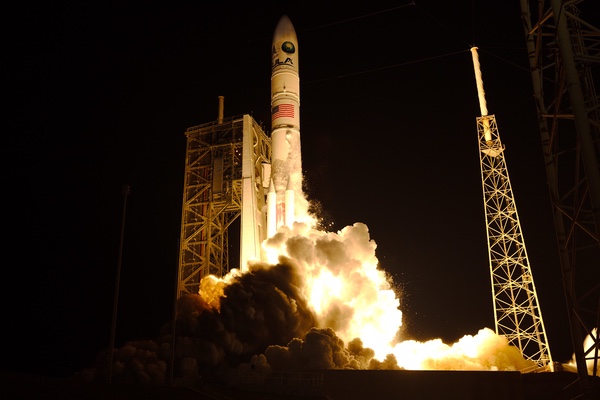
Exactly six months later, on February 12, their trajectories crossed again. This time the Vulcan launched from the Cape about seven and a half hours before the Ariane 6 lifted off from French Guiana. This was the fourth Vulcan launch and the first since August, but the sixth for the Ariane 6, which also launched missions in November and December.
In a call with reporters in January, Arianespace CEO David Cavaillolès said the company expected to perform seven to eight Ariane 6 launches in 2026, roughly double the four completed in 2025, working towards a peak launch rate of nine to ten missions a year by 2027.
“This is incredibly ambitious, and it will be incredibly difficult,” he said. “What we achieved last year gives us quite a lot of confidence.”
United Launch Alliance executives were similarly confident in a briefing two days before the Vulcan launch. They said they expected to perform 18 to 22 launches in 2026: two to four of the Atlas 5 and 16 to 18 of Vulcan.
However, the company made similar projections for 2025, announcing in 2024 it expected to perform 20 launches in 2025. That was scaled back to a dozen launches by March and nine by August. It ended the year with just six launches, five of the Atlas 5 and that sole Vulcan launch in August.
This year, though, would be different. “We’ve had a couple of anomalies that we've worked through,” John Elbon, acting CEO of ULA, said at the briefing. “Those are behind us now, and so the Vulcan rocket is ready to go.”
That was a reference primarily to the second Vulcan launch in October 2024, known as Cert-2. About half a minute after liftoff, the nozzle of one of the solid rocket boosters came off, reducing thrust from that booster. An investigation found that a manufacturing defect in one of the internal parts of the nozzle caused it to come off. ULA, working with booster manufacturer Northrop Grumman, made “appropriate corrective actions” to the booster, successfully demonstrated during a static-fire test last February at a Northrop site in Utah.
Elbon added the other issue involved design changes to the rocket’s payload fairing. “Those have been completed and actually incorporated in missions that flew near the end of last year,” he said.
“What we need to do is execute our launch activities at the Cape and at Vandenberg,” he concluded. “It's very achievable for us to get up to the rate that we need to get up to through this year.”
Two days later, it became clear that ULA would not be able to get up to that launch rate executives projected in the briefing. The Vulcan lifted off normally but about 65 seconds after liftoff, shortly after passing through max-Q or maximum dynamic pressure, there was a sudden shower of sparks—debris of some kind, presumably—that appeared to come from one of the solid rocket boosters. The booster intermittently emitted fainter flecks of material until it burned out as scheduled nearly 40 seconds later.
The incident did not appear to affect the rocket’s flight. “So far in the ascent phase of this mission, everything has been nominal,” one of the commentators on ULA’s launch webcast said a couple minutes later.
| “We will conduct a thorough investigation, identify root cause, and implement any corrective action necessary before the next Vulcan mission,” Wentz said. |
“We had an observation early during flight on one of the four solid rocket motors, the team is currently reviewing the data,” the company said in a social media post about an hour after liftoff. ULA also initially termed the loss of the nozzle on the Cert-2 launch as an “observation.”
Several hours later, after the Centaur upper stage successfully deployed its Space Force payload into geostationary orbit, the company acknowledged the seriousness of that observation.
“Early during flight, the team observed a significant performance anomaly on one of the four solid rocket motors,” Gary Wentz, vice president of Atlas and Vulcan program at ULA, said in a statement. “We will conduct a thorough investigation, identify root cause, and implement any corrective action necessary before the next Vulcan mission.”
The company has not provided any updates since the launch into that investigation, including any commonality with the incident on Cert-2. The Space Force said separately in late February it would not launch national security payloads on Vulcan until the investigation was complete and the cause of the anomaly corrected.
Neither ULA nor the Space Force have offered an estimate for how long the investigation will take. Ten months elapsed between Cert-2 and the next Vulcan launch, that August 2025 mission.
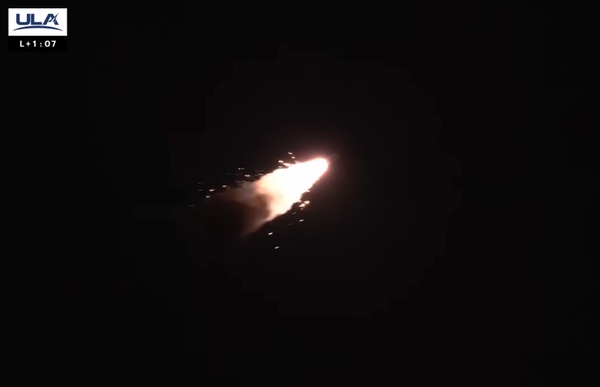 A shower of debris is seen in the plme of the Vulcan shortly after passing max-Q on its February 12 launch, linked to an issue with one of the four solid boosters. (credit: ULA webcast) |
Leadership changes
The latest issue with Vulcan comes amid the first change in leadership at United Launch Alliance in more than a decade.
On December 22, ULA announced that its president and CEO, Tory Bruno, had resigned from the company for another, unnamed opportunity. The announcement took the industry by surprise, and perhaps even ULA itself: earlier that day the company had published the latest episode of its podcast “The Burn Sequence” hosted by Bruno; the episode gave no indication that Bruno planned to leave the company he had led since 2014.
Four days later, Blue Origin announced it hired Bruno as its new president of national security, leading a new National Security Group at the company.
“We share a deep belief in supporting our nation with the best technology we can build,” Dave Limp, CEO of Blue Origin, said about hiring Bruno. “Tory brings unmatched experience, and I’m confident he’ll accelerate our ability to deliver on that mission.”
Bruno said at the time of the announcement that he felt he had accomplished all his goals at ULA and was looking for new opportunities. “I came to ULA to save it from closing back in 2017, field Vulcan, and put it on a solid path. Did that. My duty was complete,” he wrote in one social media post. “There is a new set of national security capabilities that need to be created ASAP. Blue is the best place for me to serve that mission.”
Since joining Blue Origin, Bruno has kept a relatively low profile, but did participate in a webinar last month by the National Space Society that discussed his time at ULA and his decision to move to Blue Origin.
He recalled he was “very happy” in a prior job at Lockheed Martin managing its missile work when he was asked to take over ULA. “I’ll be honest, I was a little reluctant at first,” he said of the ULA opportunity.
| “ULA has Vulcan in service,” Bruno said. “That meant I could go back and do these other things I’ve been worrying about almost the entire time I was there: the missile defense problem and dynamic space operations.” |
He said he took a “good hard look” at ULA and concluded the company, a Boeing-Lockheed joint venture, was in jeopardy. “They were not prepared for the environment that had just changed around them,” such as the rise of SpaceX and prohibitions on purchases of RD-180 rocket engines from Russia used by the Atlas 5.
“I decided that I could help, and there probably weren’t a lot of people who could or would be willing to take that on, so I felt obligated to do it,” he concluded.
ULA’s staff, he said, were in “a state of denial” when he joined about the state of the company. With the loss of access to the RD-180 and another vehicle, the Delta 4, “not in any way competitive,” he said the company was in danger of closing. “What that meant was that ULA would close at the end of 2017,” he said.
He described efforts to simplify the company’s product structure as well as its corporate structure, the latter involving laying off half its executives and, later, 30% of the company’s overall workforce. He also pushed the company to develop a new launch vehicle, which would become Vulcan and finally make its debut in 2024.
That, he said, gave him the freedom to think about a future beyond the company. “ULA has Vulcan in service,” he said. “There’s a great and robust technology improvement roadmap in front of them.”
“That meant I could go back and do these other things I’ve been worrying about almost the entire time I was there: the missile defense problem and dynamic space operations,” he said. Joining Blue Origin, he said, allows him to tackle those “urgent” issues, such as through the company’s Blue Ring spacecraft under development.
“For a long time, I’ve been very concerned about that particular mission and wanted to do something about it,” he said. “This is one of the reasons why I came to Blue Origin once I felt I was free to take a different path.”
With Bruno’s sudden departure, ULA turned to Elbon, its chief operating officer for the last eight years, to take over as acting CEO. But ULA had announced earlier in December that Elbon was retiring, and had named Mark Peller, who had been senior vice president for Vulcan and advanced programs, as the new COO.
“I was actually planning on retiring in April. Mark and I had worked a transition, and we were on track,” Elbon said at the briefing. The ULA board, he said, asked him to stay on as acting CEO while they look for a permanent successor.
“I agreed that I would do that as they go through the selection process for a new CEO and some period of transition, and then I plan to continue on with retiring,” he said. The company hasn’t given any indication of how long that selection process will take.
A top priority for that next CEO will be improving the relationship with the Space Force, which had become strained even before this latest anomaly. In written testimony for a hearing by the House Armed Services Committee last May, Maj. Gen. Stephen Purdy, at the time the acting assistant secretary of the air force for space acquisition, said ULA had performed “unsatisfactorily” in the last year.
“Major issues with the Vulcan have overshadowed its successful certification resulting in delays to the launch of four national security missions,” he wrote. “Despite the retirement of highly successful Atlas and Delta launch vehicles, the transition to Vulcan has been slow and continues to impact the completion of Space Force mission objectives.”
He added that ULA had “lost launch opportunities” because of those issues. In three cases, the Space Force has moved launches of GPS satellites originally assigned to Vulcan to SpaceX’s Falcon 9 to avoid further delays. In those cases, the Space Force swapped later launches assigned to SpaceX to ULA to allow the GPS satellites to fly earlier on Falcon 9.
Asked about ULA’s relationship with the Space Force, Elbon, who noted that as COO was focused “down and in” at the company, said he was not familiar with the specific criticism by Purdy of ULA.
“I'll just say our relationship with the Pentagon, the Space Force, our other government customers, I think, is strong,” he said, acknowledging the issues the company had to work through with Vulcan. “I think they understood what we were doing to address them, and we have, and so now it's getting down to the business of launching.”
Elbon said then that ULA was “on a good trajectory to have a successful year launching the manifest that we've laid out in our partnership with the Space Force,” but the anomaly on the launch two days later has put that planned manifest in question.
| “Despite the retirement of highly successful Atlas and Delta launch vehicles, the transition to Vulcan has been slow and continues to impact the completion of Space Force mission objectives,” stated Purdy. |
Whoever takes over as CEO will not face the existential threat that Bruno said he saw at ULA when he took over in 2014. Elbon noted the company has a backlog of more than 80 missions, including the Space Force as well as Amazon, which has dozens of Vulcan launches booked for its Amazon Leo broadband constellation.
ULA also has a “strong commitment from our board, focused on moving us forward into the future,” he added. There was no discussion on the call about rumors persisting for years that Boeing and Lockheed Martin were interested in selling ULA, with interested buyers ranging from private equity firms to Blue Origin.
Elbon deflected a question about whether ULA might expand beyond launch. “Both Boeing and Lockheed are very supportive of ULA. They're excited about the future,” he said. “There’s a lot of growth in space, and so over the next period of time, we'll be sorting out the specific path forward and what that means.”
Those plans, though, depends on ULA building back the confidence of its biggest customers, particularly the Space Force, and finding a niche in a launch market dominated by SpaceX.
Note: we are now moderating comments. There will be a delay in posting comments and no guarantee that all submitted comments will be posted.