McDonnell’s Military Test Space Station (MTSS)by Hans Dolfing
|
| Three categories of early capability space station configurations are discussed, specifically the one-man, two-man, and five-man stations. All deployable by 1965. |
Each contractor study consisted of two consecutive phases of about six months each. The “early capability” phase I was concluded by April 1961 and considered space stations which could be deployed by 1965. Phase II studied the “advanced permanent” or “post 1965” stations and was completed by January 1962.[1,3-7,20]
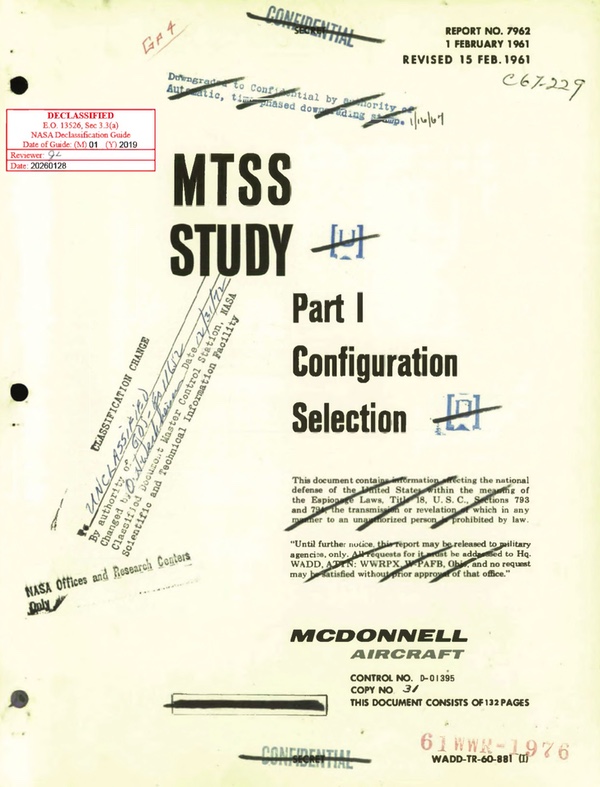
While most contractor reports of the SR studies remain classified, one MTSS technical report by McDonnell Aircraft was recently declassified and sheds new light on the McDonnell designs and MTSS concepts.[2] The newly released report shown in Figure 1 has 132 pages and is dated February 1, 1961, with a revision in February 15,1961. Henceforth, this is simply referred to as “the report.” Although the title is slightly different, one of the earlier references and the new report are most likely identical.[1,2,5.i]
The new report explains that the full phase I McDonnell MTSS report consisted of three reports and this newly released report is part one. Part two and three are not released yet but were titled “Preliminary design of early space stations” and “Technical design considerations,” which matches well with the known references.[5]
As the first NASA human spaceflight program, project Mercury started in October 1958 despite US Air Force objections. McDonnell Aircraft produced the Mercury capsules. On May 5, 1961, Alan Shepard flew into space on a suborbital flight with the “Freedom 7” Mercury capsule. The first Mercury orbital flight was by John Glenn on February 20, 1962 with “Friendship 7”. In total, six astronauts flew on Mercury and the project continued until 1963.[22-25]
After the establishment of NASA in 1958, the USAF continued its own military space studies but was effectively banned from competing with NASA. However, the USAF pursued military space projects such as the MTSS and the Boeing X-20 Dyna-Soar. The Dyna-Soar was a military spaceplane sufficiently different from Mercury and studied between 1957 and 1963.[14-17]
The report contains five sections plus an appendix, which lists the MTSS experiments. These experiments were discussed at length in the earlier MTSS article.[1,19] As the title of the new report indicates in Figure 1, this report is about space station configurations for the MTSS. Three categories of early capability space station configurations are discussed, specifically the one-man, two-man, and five-man stations. All deployable by 1965. The report discusses boosters, launch, and supply schedules, and concludes with a summary and a recommended program plan for development.[2]
The periods of before and after 1965 are also relevant with respect to available boosters to launch manned stations into space. The Atlas-Agena B and the Centaur were the only boost vehicles projected to be available before 1965 while the more capable Saturn C-1 was scheduled for 1965 and later. While the Atlas-Agena B could barely lift the one-man MTSS, it was seen as important to get the USAF space development started and test rendezvous and docking in space before more advanced stations were developed.
The McDonnell one-man MTSS was proposed as a combination of re-entry and cylindrical laboratory module with enough supplies to support one astronaut in a “shirt sleeve” environment for 14 days in zero gravity. Figure 2 illustrates the station, which was 6 feet (1.8 meters) wide and carried all experiments and equipment. It was to be launched in a manned configuration only.
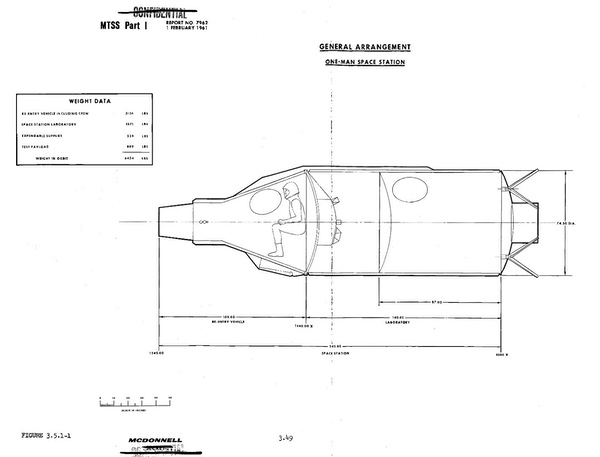 Figure 2: Cross-section McDonnell one-man MTSS. [2] |
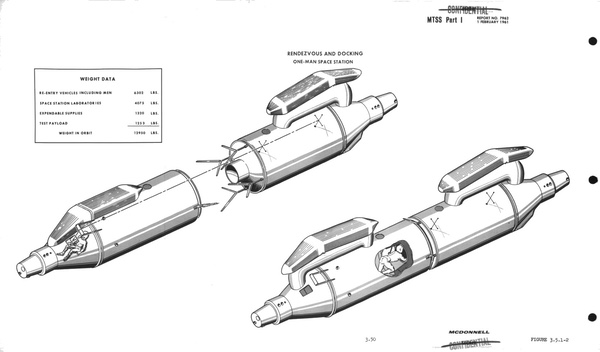 Figure 3: Astronaut transfer, rendezvous and docking with the one-man MTSS. [2] |
Electrical power was provided via fuel cells. Transfer between Mercury capsule and laboratory was via an external, inflatable, pressurized tunnel as shown in Figure 3.
| The illustrations with Mercury, laboratory, and an inflatable tunnel to connect the modules are identical in the military MTSS and civilian “One Man Space Station” concept. |
Figure 2 and 3 visualize the one-man MTSS. Note that this configuration was also shown in Figure 5 in the earlier MTSS article when only a blurred image of unknown origin was available.[1] The new report confirms that this was a McDonnell, pre-1965, one-man space station plus science laboratory.[2]
The MTSS science laboratory could be docked back-to-back to make a two-man station connected via a pressurized gateway. The back-to-back MTSS docking was designed to test and optimize rendezvous and docking maneuvers, which were untested in 1960.
In Figure 3, the device connecting the capsule with science laboratory is a fairing plus inflatable tunnel. The tunnel was planned to be pressurized such that astronauts could move between capsule and science lab, and the shirtsleeve environment was maintained in both sections. The concept of inflatable components and space station was discussed extensively at the time as the compacted components would have been easier to launch.[8-11]
On August 24, 1960, McDonnell Aircraft proposed to the Space Task Group (STG) at NASA’s Langley Research Center a concept for a one-man, civilian space station. Note that the new MTSS report was published in February 1961 but submitted initially in August 1960.[2]
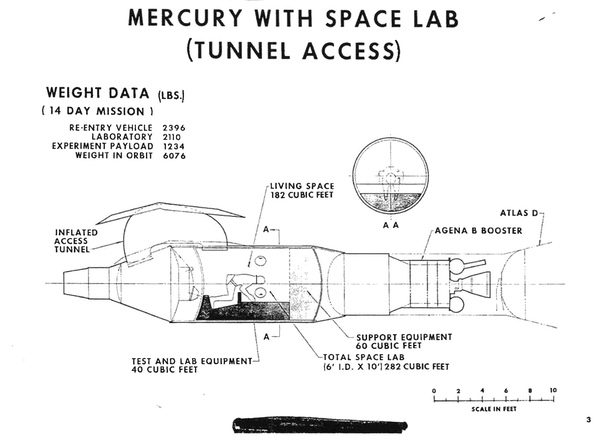 Figure 4: McDonnell civilian one-man space station based on Mercury. [11] |
The illustrations with Mercury, laboratory, and an inflatable tunnel to connect the modules are identical in the military MTSS and civilian “One Man Space Station” concept. For example, Figure 4 is an illustration from the civilian, one-man space station proposal with an inflatable tunnel to connect the Mercury capsule with the laboratory module in the back. The tunnel is identical to the MTSS proposal in Figure 3.[2,10,11]
Therefore, the new report answers a question previously asked by historical researchers and confirms that the civilian proposal by McDonnell had a very large overlap with a hidden-at-the-time USAF military concept, the MTSS.
Secondly, McDonnell discussed a larger MTSS configuration in the report for a two-man space station.
NASA’s Space Task Group started work on the Mercury spacecraft in 1958. In 1959, proposals were made to expand the capsule to include an additional astronaut. The available boosters were incapable of lifting the expanded capsule and it was not pursued at the time. However, two years later, NASA asked Mercury contractor McDonnell to consider designing a two-man Mercury spacecraft, which by the middle of 1961 had acquired the name “Mercury Mark II” instead of “Advanced Mercury”.
Going into the new year 1962 this became Gemini. It is not known in detail everything that McDonnell studied between the MTSS in 1960 and the “Advanced Mercury,” but it is likely that some of the two-man MTSS work overlapped with various Mercury design iterations.[14-16] For example, the access tunnel from the Gemini capsule to the laboratory was a hatch through the heat shield into the laboratory instead of an external construct. [21] This is very similar to the back-to-back laboratory-to-laboratory access for the two-module MTSS in Figure 3.
Instead of a modified Mercury capsule on an Atlas-Agena B booster, McDonnell envisioned the two-man MTSS as a half-cone re-entry system shaped not unlike an arrowhead. Figures 5 and 6 show this in context. Just like the one-man station, two could be combined to make a four-man station. Unlike the one-man station with its six-foot width, the two-man MTSS was a bit wider at ten feet (three meters). There is no further information on the half-cone re-entry vehicle, but it should be noted though that this two-man configuration was also the left part of Figure 3 in the earlier MTSS article.[1]
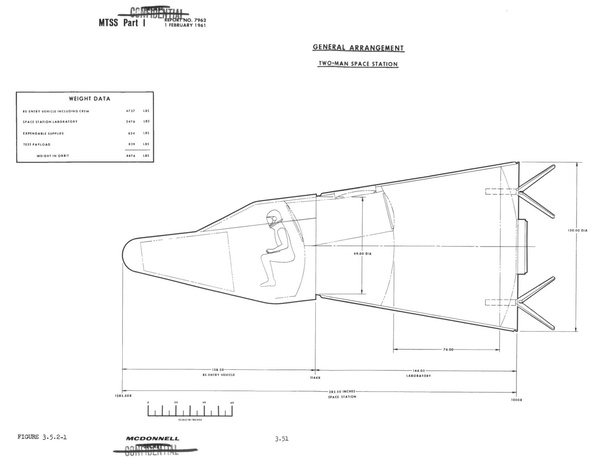 Figure 5: Cross section two-man McDonnell MTSS concept. [2] |
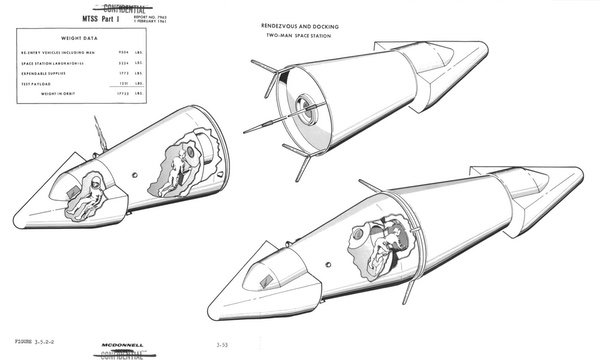 Figure 6: Astronaut transfer, rendezvous and docking with the two-man MTSS. [2] |
It could be argued that the design in Figure 5—the cross section of a two-man station composed of re-entry capsule plus laboratory module—is visually very similar to the Mercury Mark II plus laboratory module.[15] The only difference was whether the re-entry module was a ballistic capsule or a maneuvering half-cone.
In practical terms, to have enough payload for experiments and supplies, this two-man configuration required the more powerful Atlas-Centaur booster.
An intriguing variation on this two-man MTSS was where the two-man station was launched into space unmanned, followed immediately by crew and supply on a second flight. The second flight was projected to be a cargo vehicle which consisted of a half-cone re-entry vehicle and a cargo module. That would allow a station as shown in Figure 7, a ten-foot-wide cylindrical station where power would be generated via the solar dynamic power “Sunflower” system instead of fuel cells.[1,12]
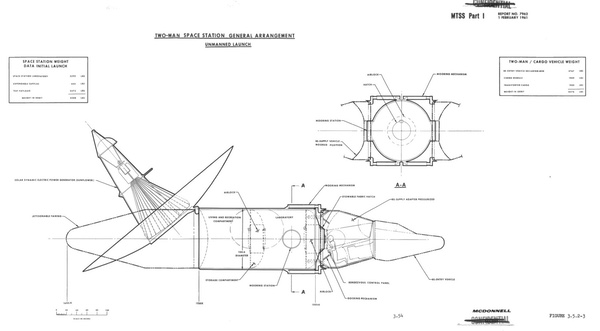 Figure 7: Two-man MTSS concept with unfolded “Sunflower” power system. [1,2] |
The maneuverable, half-cone re-entry vehicle seemed to reflect very much the thinking of the USAF at the time. In the contemporary study SR-79814 “Evaluation of Space Logistics and Rescue (SLOMAR)”, conducted between July 1960 and June 1961, McDonnell was not a contractor. However, all the five SLOMAR contractors came up with re-entry vehicles like the McDonnell half-cone and winged vehicles with some cross range.[13]
Finally, the winged re-entry thinking seemed to have influenced McDonnell’s five-man MTSS concept as well.[2] Dyna-Soar re-entry configurations were discussed with many companies in early 1960.[17,18] McDonnell attended but only with a Mercury design for re-entry. Figures 8 and 9 show the five-man re-entry configuration in this new MTSS report, which is remarkably similar to the Bell and Boeing Dyna-Soar X-20 proposals from January 1960.[17]
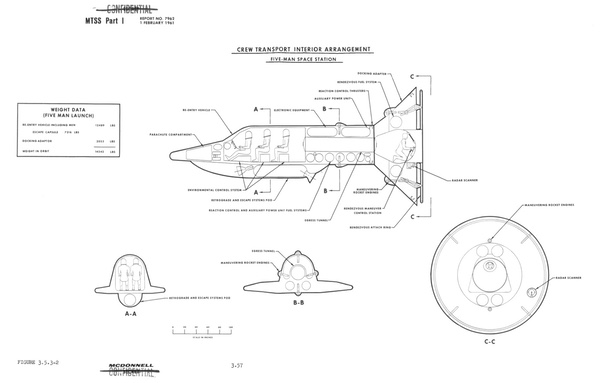 Figure 8: Cross section five-man McDonnell MTSS concept. [2] |
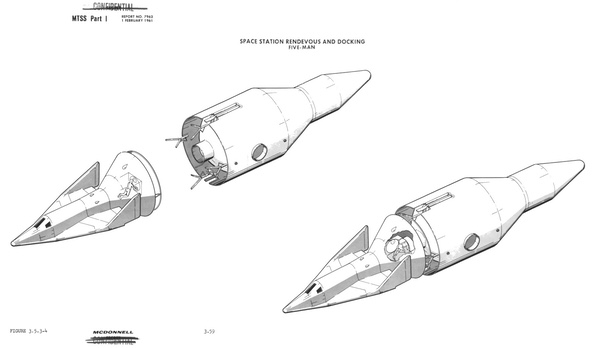 Figure 9: Five-man crew transport in docking with MTSS. [2] |
More research is needed to find out why a winged re-entry vehicle was chosen in this McDonnell MTSS concept instead of an enlarged ballistic Mercury capsule. It could be as simple as “all other USAF studies preferred them” or “re-entry cross range trumps simplicity.”
| The report notes that only the five-man MTSS could achieve close to 100% of the planned MTSS experiments. |
Figure 8 shows the McDonnell proposed five-man crew transport and re-entry system. The crew layout was 1-2-2 for one pilot plus four passengers.[2] The tapering docking adaptor was to connect to the MTSS. As Figure 9 demonstrates, the docking of this crew transporter would be to the back of an earlier launched cargo vehicle plus laboratory module. The cargo vehicle was envisioned as a modified Mercury capsule to minimize development costs.
Figure 10 goes into detail what would happen after the initial connection between a crew and cargo module. In the top row, it shows the crew vehicle to be moved to a side berthing port, then a Sunflower erected to supply energy, followed by the arrival of a new cargo vehicle, which is then moved to a secondary side berthing. Quite a busy station for one year of experiments.[2]
 Figure 10: Five-man crew and cargo orbital movements during supply cycle. [2] |
Two types of vehicles, cargo and crew, might be perceived as a liability with its extra costs, but the McDonnell designers actually preferred it for redundancy reasons.
The report notes that only the five-man MTSS could achieve close to 100% of the planned MTSS experiments. The smaller, one-man station could probably only do about 25% of the experiments during a 14-day mission. After all, you do need a crew to operate experiments and a larger space station to store more voluminous experiments. The relation between crew size, supply schedules, and amount of experiments is discussed at length in the report.[2]
Figure 11 summarizes the MTSS configurations in the report. It also clarifies the boosters to launch them. The recommended development schedule was to start with the one-man station for 14 days, launching on an Atlas Agena B in September 1963, using it as testbed for experiments plus rendezvous and docking. The five-man station would follow later based on at least two Saturn C-1 launches in September 1965 and would allow all MTSS experiments.
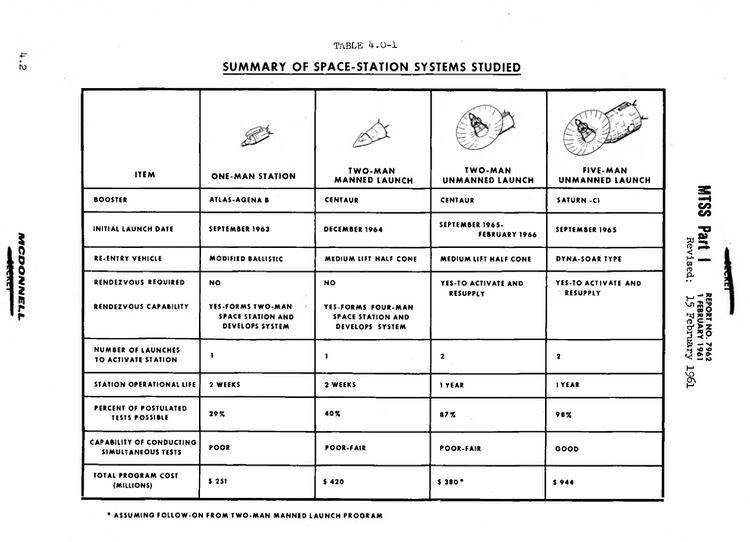 Figure 11: Summary of McDonnell MTSS configurations 1961. [2] |
The report provides insight into some of the USAF research being performed in support of the fledgling military man-in-space program. Contemporary with the Mercury program, the US Air Force continued to be interested in flying astronauts in space
The report confirms that the SR-17527 MTSS study by McDonnell was a combination of short- and long-term planning with a pretty ambitious scope. The large overlap between civilian and military space station concepts in the early 1960s was clarified and contributed new insights in configurations and phasing. The military interest continued even after the cancellation of the Dyna-Soar program in late 1963, but more investigations in military space stations eventually led to the Manned Orbiting Laboratory (MOL) program.[14]
References
- Dolfing, H., “The Military Test Space Station (MTSS)”, August 2024.
- “MTSS Study Part I Configuration Selection”, McDonnell Aircraft, Report No. 7962, WADD-TR-60-881 (I), NASA NTRS 20150016131, 1 February 1961, revised 15 February 1961, 132 pages.
- General Dynamics/Astronautics (GD/A), San Diego, Calif., Contr. AF 33(600)-42457, Rept. no. AE 61-0570, ASD TR 61-208, Dated: 15 Jul 1961
- SR-17527, “MILITARY TEST SPACE STATION. VOLUME I. SUMMARY (U)”, AD 328 351L, AE61-0570-Vol-1, vol. 1, 75 pages.
- SR-17527, “MILITARY TEST SPACE STATION. VOLUME II, PART I, PRE-1965 SPACE STATION (u)”, AD 328 352L, AE61-0570-Vol-2-Pt-1, vol. 2, part 1, 166 pages.
- SR-17527, “MILITARY TEST SPACE STATION. VOLUME II, PART I, PRE-1965 SPACE STATION (U)”, AD 328 353L, AE61-0570-Vol-2-Pt-2, vol. 2, part 2.
- SR-17527, “MILITARY TEST SPACE STATION. VOLUME III. ADVANCED SPACE STATIONS (U)”, AD 328 354L, AE61-0570-Vol-3, vol. 3, illus. tbl. refs.
- Lockheed Aircraft Corp., Sunnyvale, Calif. by S. B. Kramer, Contr. AF 33(600)-41944, ASD TR 61-21, Dated: 1 Jul 1961
- SR-17527, “PRE-1965
“, Rept. no. LMSD-895028, Dated: 1 Feb 1961 - SR-17527, “POST-1965 VEHICLE MILITARY TEST SPACE STATION (U)”, 1 July 1961, AD 328 338L, Rept. no. LMSD-895091, vol. 1, illus., tbl., 37 refs.
- SR-17527, “PRE-1965
- McDonnell Aircraft Corp. (MAC), St. Louis, AF 33(600)-41945, ASD TR 61-212,
- SR-17527, “Military Test Space Station Study”, MAC Report No. 7962, 15 February 1961.
- SR-17527, “MTSS Final Report”, Volume I, MAC Report No. 8277, 15 July 1961.
- SR-17527, “MTSS FINAL REPORT. VOL. II. Preliminary design of early space stations, report 8277-V2, AD0328342, 381 pages, July 1961,
- SR-17527, “MTSS FINAL REPORT. VOL. III. TECHNICAL DESIGN CONSIDERATIONS.”, ADC 960474, MDC-7962-PT-3, 692 pages, February 1961.
- Martin Co., Denver, Colo., by R. Hale, Contr. AF 33(600)-42456, Rept. no. M-0361-61-87, ASD TR 61-211, ASD CR 61-14, Dated: Jul 1961.
- SR-17527, “MTSS PHASE II (GAMMA) VEHICLE DESIGN. VOLUME I, (u)”, AD 328 358L, vol. 1, illus., tbl.
- SR-17527, “MTSS TEST MISSIONS. VOLUME II, (u)”, AD 328 359L, vol. 2, 178 pp., illus., tbl.
- SR-17527, “GENERAL HUMAN FACTORS CONSIDERATIONS. VOLUME III”, AD 273 005L, AD0273005, WAL-TR320 4 4 1, vol. 3, January 1st, 1962.
- General Electric Co, Philadelphia, PA, Missile and Space Div., AF 33(600)-41943, 65-16 FLD.22A
- “MILITARY TEST SPACE STATION FINAL REPORT. VOLUME II TECHNICAL DESIGN AND IMPLEMENTATION PLAN (BOOK 2)”, Vol 2. BK2., AD-362 668L, AD0362668, DIN-2351-16-5-Vol. 2-Bk 2
- “MILITARY TEST SPACE STATION FINAL REPORT. VOLUME III APPENDICES”, Vol 3., AD-362 669L, AD0362669, DIN-2351-16-5-Vol. 3.
- Carter, J.W., Bogema, B.L., “Inflatable Manned Orbital Vehicles”, in “Proceedings of the Manned Space Stations Symposium”, pp. 188-196, April 20-22, 1960.
- Berglund, R., “Self erecting manned space laboratory” in “Proceedings of the National Meeting on Manned Space Flight”, NASA NTRS 19620004479, 19620004468, pp 144-149, St. Louis, Apr. 20 - May 2, 1962.
- Portree, D., “One-Man Space Station (1960)”, Wired, 28 Sep 2014.
- “One-Man Space Station”, NASA NTRS 19650081309, McDonnell Aircraft, 24 August 1960.
- “Sunflower power conversion system” quarterly report, mar. - may 1963 (Sunflower 3 kW mercury Rankine power conversion system), NASA NTRS 19650010819. https://ntrs.nasa.gov/ search?q=sunflower
- RG 255.4.1, NACA Ames Aeronautical Laboratory and NASA Ames Research Center, Series 24, Box 3, Central Files - research correspondence, 1943-1965, “Presentation on MTSS SR 17527 by Col. Lowell B. Smith”, “Presentation on SLOMAR SR-79814 by Maj. Jack W. Hunter”, 10 Dec 1963, 19 pages, National Archives and Records Administration (NARA), Pacific Region (San Francisco), San Bruno, California.
- “The DORIAN files revealed : A compendium of the NRO’s Manned Orbiting Laboratory documents”, edited by James D. Outzen, Ph.D., incl. Carl Berger’s - “A History of the Manned Orbiting Laboratory Program Office” Aug. 2015
- “From Mercury Mark II to Project Gemini”
- Day, D., “A darker shade of blue: The unknown Air Force manned space program”, September 12, 2022.
- Milton, J. F., “Review of Dyna-Soar reentry-vehicle-configuration studies”, Boeing Co. Seattle, WA, NASA NTRS 19720063133, January 1, 1960.
- “Joint Conference on Lifting Manned Hypervelocity and Reentry Vehicles.”, “Part 2: A compilation of the Papers Presented”, NASA Langley Research Center, N72-71002, April 1960.
- “MTSS experiments”, RG 255, NACA Langley Memorial Aeronautical Laboratory and NASA Langley Research Center Records, A200-4 Manned Space Stations, Series II: Subject Correspondence Files, 1918-1978, Box 421, 422, Sep. 1963 - Nov. 1964, National Archives and Records Administration (NARA), Philadelphia.
- Col. Lowell B. Smith, USAF, Space System Office, WADD, ARDC, “The Military Test Space Station”, page 18-19, Aero/Space Engineering (Manned Space Station Issue), May 1960.
- “Modular space station evolving from Gemini, Volume I Technical Proposal”, McDonnell Aircraft (MAC) Report No. 9272, NASA NTRS 19660090229, 238 pages, 15 December 1962.
- Grimwood, J.M., “Project Mercury - A Chronology”, NASA SP-4001, N63-21848, NASA NTRS 19630011968, 255 pages, 1963.
- Grimwood, J.M., Hacker, B., Vorzimmer, P., “Project Gemini Technology and Operations, A Chronology”, NASA SP-4002, N69-36501, 326 pages.
- Swenson, L.S., et al, “This New Ocean. A History of Project Mercury”, NASA NTRS 19670005605, NASA SP-4201, N67-14934, 698 pages, 1966.
- “Project Mercury”
Note: we are now moderating comments. There will be a delay in posting comments and no guarantee that all submitted comments will be posted.