Jupiter on the Space Shuttle and the Titan II: the FARRAH signals intelligence satellitesby Dwayne A. Day
|
| The shuttle had enough payload capability that future FARRAH satellites could be substantially enlarged. At least four of the new satellites would be procured, and they would be larger and heavier than their predecessors, equipped with more antennas and receivers. |
The NRO performed an “ELINT Mix Study” and related studies to examine issues related to the transition of low altitude signals intelligence programs to the shuttle. One possibility was combining existing low altitude programs, or to replace selected low altitude capabilities with an upgraded high-altitude satellite like the JUMPSEAT that had begun operating in the early 1970s. The NRO determined that existing systems should be upgraded but not combined. The upgraded satellites would also be launched along with Improved PARCAE ocean surveillance satellites on the shuttle.[2]
The shuttle had enough payload capability that future FARRAH satellites could be substantially enlarged. At least four of the new satellites would be procured: FARRAH III, IV, V, and VI, and they would be larger and heavier than their predecessors, equipped with more antennas and receivers. They were designed to operate for up to six hours a day compared to 3.5 hours a day for the first two satellites. The new satellites would weigh over 1,360 kilograms (3,000 pounds), compared to 340 kilograms for FARRAHs I and II.[3] The new FARRAH satellites spun at 50 rpm and had three high-gain parabolic antennas that covered 0.8 to 6 gigahertz, 6 to 12 gigahertz, and 12 to 18 gigahertz. The latter used “cooled front-end electronics” to receive the higher frequencies. They were also equipped with single- and double-boom omni antennas to suppress sidelobe interceptions.
Several dozen Program 989 satellites had been launched since 1963. As the satellites lasted longer and became more capable, the launch rate dropped. When the NRO began operating signals intelligence satellites in geosynchronous and highly elliptical orbits starting in the late 1960s, they took on some missions performed by the low Earth orbiting Program 989 satellites. But there were still missions that the low altitude satellites could perform that could not be accomplished by higher orbiting satellites. At some point, Program 989 was renamed the Jupiter Program, and given a unique seal.[5]
 The symbol for the Jupiter signals intelligence satellite program. This name was not revealed until earlier this month. It is unclear when it was first applied to the satellites also known as Program 989. (credit: NRO) |
FARRAHS III-VI
The NRO has now released illustrations of all three of the later FARRAH satellites, indicating that the design was a large, squat cylinder, generally referred to as a “tuna can,” and equipped with three dish antennas and several other pole antennas like the much smaller FARRAHS I and II.
FARRAH III had a tactical on-board processor and could directly downlink its data to users. One artist illustration showed this data being transmitted to fixed ground stations, ground-based mobile vans, and an aircraft carrier. FARRAH could therefore send data directly to some ships. In contrast, at the time, data was apparently not directly downlinked from the PARCAE ocean-surveillance satellites to ships but was first relayed through fixed ground stations for processing, and then through geosynchronous communications satellites to ships at sea, as well as through a dedicated communications satellite network in highly elliptical orbits.
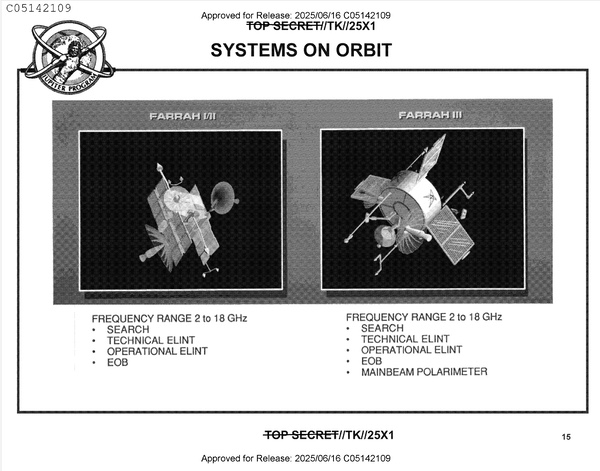 Five FARRAH satellites were launched between 1982 and 1992. They had two major designs. The satellites were named after actress and model Farrah Fawcett. (credit: NRO) |
The FARRAH III design had been optimized to enable growth for future missions. H-brackets and louvers were added that allowed for door-mounted equipment and to dissipate the additional heat. FARRAH III was apparently designed with a three-year nominal lifetime.[6]
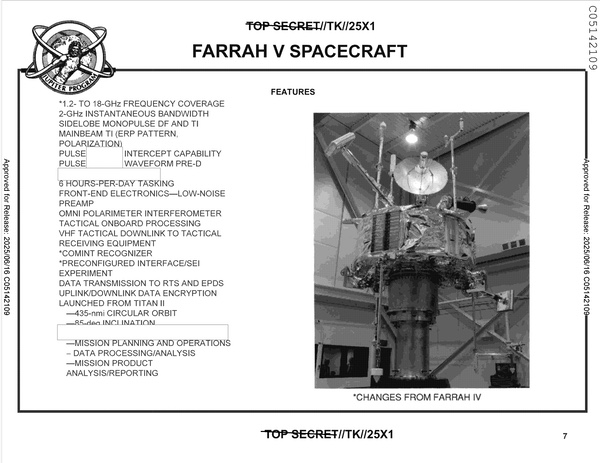
FARRAH V added a communications intelligence recognizer receiver that provided on-orbit, real-time communications signal characterization that could be routed through the tactical onboard processing system, merged with geolocation data, and downlinked to tactical users.[7] It also had a low frequency extension to its collection range. It was equipped with a preconfigured interface so that quick reaction payloads could be added relatively easily. The add-on for the mission was a specific emitter identification (SEI) experiment.
The available documentation on the program still leaves some questions. FARRAH VI was partially built and placed in storage when the program was canceled. However, one declassified NRO document refers to plans for an “Advanced FARRAH” “with a focus on improved sensitivity, greater frequency and accuracy, and specialty receivers to collect the emerging signal mix.” This would require some changes in the onboard data handling and control.
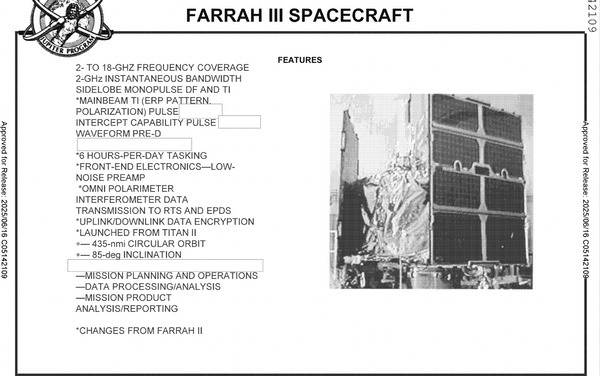 When the HEXAGON reconnaissance satellite was scheduled for retirement in the 1980s, the FARRAH program needed to find another launch vehicle. The small boxy satellites were redesigned to be much bigger and heavier and to launch on the space shuttle. But by the mid-1980s, they were removed from the shuttle and transferred to converted Titan II ICBMs. FARRAH III launched on a Titan II in September 1988. (credit: NRO) |
Abandoning the shuttle
Although the plan had been to launch at least the first three of these larger FARRAH satellites on the Space Shuttle, the NRO official in charge of the FARRAH program realized that this would require major upgrades to the shuttle that might not be funded in time, if at all. During the mid-1980s, he chose to remove the satellites from the shuttle and launch them on converted Titan II ICBMs instead. The Titan IIs were then planned to launch meteorological satellites, and adding FARRAH to the payload manifest helped to further justify the new rocket. Eventually, the PARCAE program also switched from the shuttle to the expensive Titan IV rocket. According to an official history updated in 1991, the switch from expendable rockets to the shuttle and then back again for both the FARRAH and PARCAE programs “proved extremely costly” for both programs.[8]
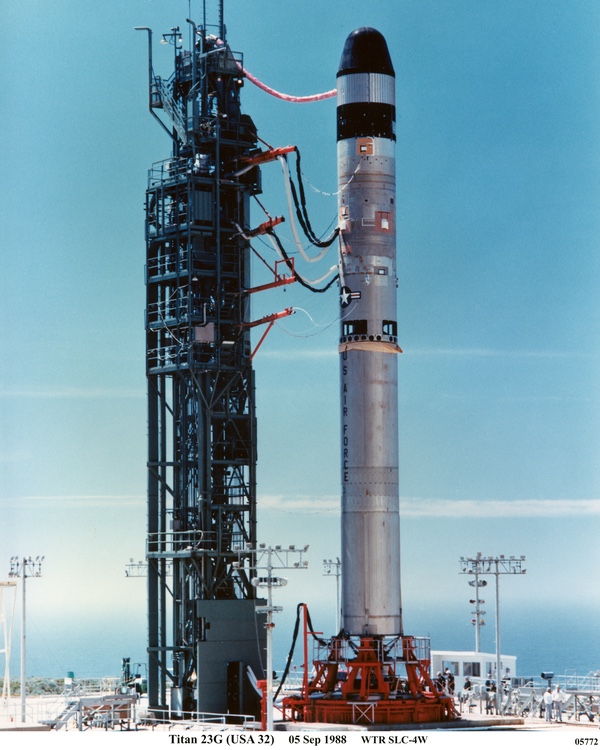 The FARRAH III satellite launched into orbit atop this Titan II rocket from Vandenberg Air Force Base in September 1988. (credit: Peter Hunter) |
Debut on the Titan II
FARRAH III was launched in September 1988. FARRAH IV was launched in September 1989 but failed soon after reaching orbit.[9] FARRAH V was launched in April 1992. FARRAH VI was partially complete when it was placed in storage in the early 1990s when the program was canceled in favor of a new program named LISA. No details have been released about when FARRAH III and V ceased operating, but in 2021 they were observed still spinning in orbit. In 1993, three additional Titan II rockets that had been assigned to “classified payloads” were made available for other programs. It is likely that these three were originally allocated to FARRAHs VI-VIII, but a program reorientation resulted in their cancellation. [10]
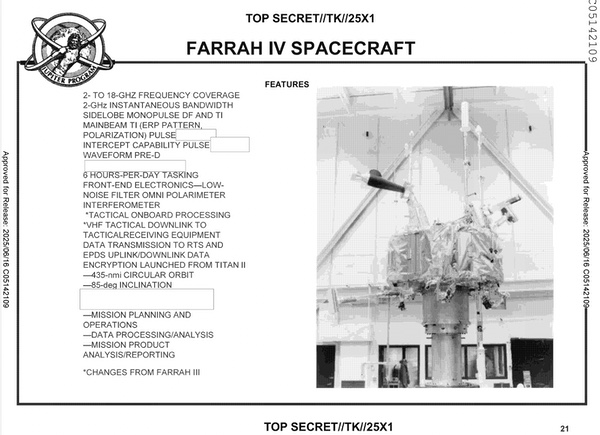 FARRAH IV was launched into orbit on a Titan II in 1989 but failed to turn on and eventually reentered. According to one source, the failure was ultimately traced to the change in launch vehicles--the satellites had been designed to launch completely dormant inside the shuttle bay, but when switched to the Titan II, this feature was not changed. Due to a software or timing error, when FARRAH IV separated from its Titan II, it never turned on. (credit: NRO) |
Talking to the ground
The data from the FARRAH satellites could be sent down in several different ways. Data from the Tactical Onboard Processor could be transmitted by direct downlink to receivers, either fixed or mobile, including ships at sea. The signals intercepted by the satellites could be either recorded for later playback, or “transponded,” meaning that the data was sent as soon as it was collected. Data sent to a fixed ground station could then be relayed through a military comsat to another ground station or other users.[11]
| Although designed with a three-year nominal lifetime, FARRAH III and V were both still alive in late 2004. |
An NRO document explained that the remote operating locations “are NRO assets strategically located near high interest areas, providing greater, near real-time coverage without putting tape recorder cycles on the satellites. This contiguous field of view between target area and receive site reduces the number of tape recorder cycles on the vehicles while preserving the intelligence value. The mechanical tape recorders are the life-limiting factor on our store-and-forward mission capabilities.” There were three remote operating ground sites for the satellites, although their locations are still classified.[12] The satellite data was also “fused” with other data, most likely from the PARCAE ocean surveillance satellites.
Although designed with a three-year nominal lifetime, FARRAH III and V were both still alive in late 2004.[13] Recently the Space Force celebrated more than three decades of operations of the first Milstar communications satellite, and Defense Support Program missile warning satellites remain operational after two decades in orbit, indicating that long lifetimes are not unusual for military satellites. It is unknown when the last two FARRAH satellites ceased operations, but they could have lasted many years in orbit, listening for elusive signals from below.
References
- “A Brief History of the U.S. Low Earth Orbit Reconnaissance Programs,” n.d. C05027386.
- Ibid.
- Ibid.
- “Mission 7300 Payload,” n.d., C05098533, pp. 8-9.
- “Jupiter Program SIGINT Collection Systems,” February 14, 1992.
- Ibid., p. 13. The document is somewhat confusing because although the cover page indicates it was produced in 1998, page 13 includes a reference to the FARRAH program being “Still alive in 2005!”
- “[Deleted] Orientation Course,” M7200 & M7300 System Overview, April 28, 1998, C05098519, p.11.
- “A Brief History of the LEO Program,” (file dated 8/13/91), C05098892, pp. 7-8.
- FARRAH IV is referenced in C05098529, p. 3.
- See Jeffrey Richelson, The U.S. Intelligence Community, 4th Ed. 1999, pp. 195-186.
- “Mission Planning Mission 7300,” contained in “Chapter 5, Command and Control,” [n.d. but probably 1990], p. 41. C05098521.
- Ibid.
- This is mentioned in an addendum to a 1992 document which provides 2004 mission end dates for FARRAH I and II, but shows FARRAH III and FARRAH V as still operational. “Jupiter Program SIGINT Collection Systems,” February 14, 1992.
Note: we are now moderating comments. There will be a delay in posting comments and no guarantee that all submitted comments will be posted.