Opening the path to the lunar surfaceby Jeff Foust
|
| “It’s a difficult time because the flight control team wants to see data,” said Henfling.“When we don't have data, we’re trying to figure out what to do with ourselves.” |
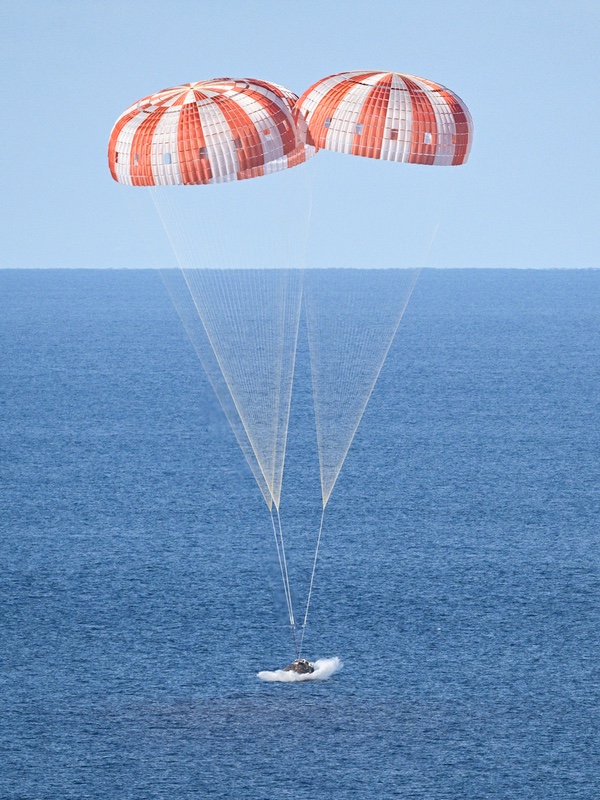
The Orion spacecraft splashed down right on schedule at 8:07 pm EDT, within about a kilometer and a half of its targeted spot in the Pacific Ocean near San Diego. Two hours later, the four Artemis 2 astronauts were out of the Orion, transported by helicopter to the recovery ship USS John P Murtha. Several hours later, the spacecraft itself was secured inside the ship.
There were minor glitches along the way: Artemis 2 commander Reid Wiseman reported problems talking to the recovery teams in boats just outside the capsule by both radio and satellite phone. Those recovery teams also had problems installing a floatation collar around the capsule.
That was a microcosm of the mission itself. From liftoff April 1 to splashdown a little more than nine days later, the Artemis 2 mission largely went according to plan. None of the issues encountered during the mission threatened the safety of the crew of the ability to complete the mission’s major objectives—even if problems with a wastewater vent line for the capsule’s toilet were fodder for jokes.
Perhaps the most serious issue, at least for future missions, was a helium leak in an oxidizer line for thrusters in the spacecraft’s service module. That leak did not affect performance of the minor burns needed to correct Orion’s trajectory on Artemis 2.
NASA officials indicated they saw some leaks before launch but they got worse as the mission progressed. “The leak rate we saw in flight is now an order of magnitude higher than what we saw on the ground,” Amit Kshatriya, NASA associate administrator, said at an April 9 briefing. “It’s still acceptable, but that will lead us to probably an extensive redesign of that valve system.”
The redesign won’t be needed for Artemis 3, scheduled to launch next year, since Orion will remain in low Earth orbit with limited demands on the performance of the thrusters, but will be needed when Orion returns to, and orbits, the Moon on Artemis 4 in 2028.
“I don’t need those valves to hold pressure in the same way for a LEO orbiting mission, but for a lunar orbit mission, I do. I need all the performance in the system so I can pressurize,” he said, hence the need to redesign the system.
“I’m convinced this will not be the pacing item for a lunar mission, so we’ll be able to fix it in the time we need to,” he concluded. “It might take a little while.”
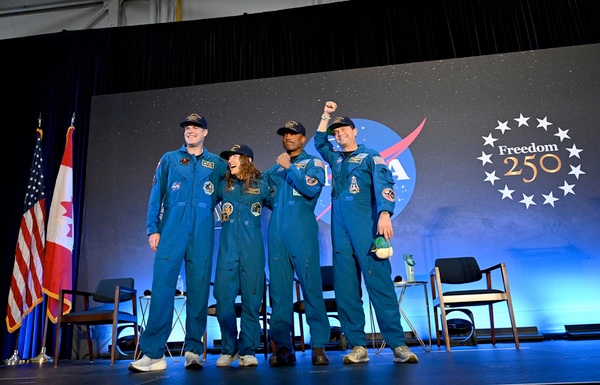 The Artemis 2 astronauts—Jeremy Hansen, Christina Koch, Victor Glover, and Reid Wiseman—at Ellington Field in Houston for a welcome-home ceremony April 11. (credit: Helen Arase Vargas / NASA-JSC) |
Looking ahead to Artemis 3
The agency took a victory lap with the successful end of the Artemis 2 mission. “After a brief 53-year intermission, the show goes on, and NASA is back in the business of sending astronauts to the Moon and bringing them home safely,” NASA administrator Jared Isaacman said Saturday at an event at Ellington Field in Houston to welcome home the crew. “As we return to the lunar surface, we build the base and we never give up the Moon again.”
Kshatriya offered similar sentiments at the post-splashdown briefing. “The path to the lunar surface is open, but the work ahead is greater than the work behind us.”
| “The path to the lunar surface is open, but the work ahead is greater than the work behind us,” said Kshatriya. |
That work ahead starts with Artemis 3. The revised plan for the mission, announced in late February, would send Orion to low Earth orbit around the middle of 2027 to rendezvous and dock with either or both Human Landing System landers being built by Blue Origin and SpaceX. Those companies are working to accelerate development of those landers, but neither the companies nor NASA have disclosed details about how they will speed up landers to ensure at least a prototype would be ready by Artemis 3.
“We’re not resting” after Artemis 2, said Lori Glaze, acting associate administrator for exploration systems development at NASA, during a discussion Monday at the Space Symposium in Colorado Springs. She said that, five minutes after the Artemis 2 splashdown, her deputy sent a note to Isaacman outlining the status of Artemis 3 preparations.
“We’re moving on scales of minutes, hours, and days, not months, years, and decades,” she said.
Much of the hardware for Artemis 3 is taking shape for a launch next year. The SLS core stage will ship next week from the Michoud Assembly Facility in New Orleans to KSC, where it will join the engine section. The mobile launch platform that supported the Artemis 2 launch is soon heading back to the Vehicle Assembly Building, having suffered less damage than during Artemis 1. The Orion crew and service modules are also on track.
The biggest questions involve the new elements for Artemis 3, as well as the mission plan itself. Besides HLS, NASA has discussed testing Axiom Space’s lunar spacesuit, known as AxEMU, on Artemis 3.
“We’ve provided the agency with a number of options” for testing the suit on Artemis 3, Russell Ralston, senior vice president and general manager of extravehicular activity at Axiom said during a briefing at Space Symposium. “It would certainly be a valuable exercise, but we just don’t have the specifics at this time.”
Jonathan Cirtain, president and CEO of Axiom, said the company intends to test AxEMU—currently completing its critical design review with a qualification unit being built—next year, but said those tests could be done on the International Space Station instead of Artemis 2.
He said he had a “confidence briefing” with Isaacman after last month’s Ignition event that outlined changes to the Artemis architecture.
“I reassured him on our ability to deliver the Artemis suit should it be utilized on Artemis 3,” Cirtain said. “However, whether it’s Artemis 3 with the HLS service providers or in a free-flying demonstration to the International Space Station, the administrator made it crystal clear to me that he expects to fly our suit next year.”
He added that a test on Artemis 3 might not include a spacewalk, something that could be done on ISS. For Artemis 3, the intent would be to test how the suit holds up to launch loads, along with potential tests in both pressurized and unpressurized environments inside the lander.
There is also the issue of coordinating Orion with potentially both Blue Origin’s Blue Moon and SpaceX’s Starship on the same mission in low Earth orbit.
“We have to find a common orbit. We have to find a common launch opportunity, and orchestrating a launch of an SLS and two HLS’s will be some kind of feat,” said Kent Chojnacki, HLS deputy program manager, in an interview before the Artemis 2 launch. “So, we’re working on what the art of the possible is there.”
That would need to be done on a tight timeframe. Chojnacki said he had been instructed to prepare for an Artemis 3 launch no earlier than March 2027 and no later than June.
| “This is a relay race,” Koch said. “In fact, we have batons that we bought to symbolize physically that, and we plan to hand them to the next crew.” |
The landers, he said, would not have to be the full versions needed for a lunar landing: the landers would not need landing gear or the guidance, navigation and control systems needed for landing.
“We asked for ideas ranging anywhere from doing proximity operations,” he said, similar to what took place on Artemis 2 where Orion flew around the SLS upper stage, “all the way to a docking with a crew cabin, where you can cross the hatch and do operations within the common atmosphere.”
“We’re working with our partners in the Human Landing System, SpaceX and Blue, to help better define exactly what that Artemis 3 mission will look like, but we’re moving fast,” Glaze said. She did not disclose how long that process will take.
NASA also has not announced a crew for Artemis 3. The Artemis 2 crew was named in April 2023, at a time when the mission was projected to launch in late 2024.
Asked after splashdown when NASA would announce the astronauts flying on Artemis 3, Kshatriya simply said, “Soon.” He then added, “I will not put units on that.”
That crew will have a hard act to follow. The Artemis 2 astronauts have been universally praised for their performance on the mission, including how they have communicated the experience of flying around the Moon in a small capsule, seeing the Earth recede and grow again.
In a call with reporters on the way back to Earth, Christina Koch said she and her crewmates were ready to hand the baton—literally—to their colleagues that will fly Artemis 3.
“This is a relay race,” Koch said. “In fact, we have batons that we bought to symbolize physically that, and we plan to hand them to the next crew. Every single thing we do is with them in mind.”
Note: we are now moderating comments. There will be a delay in posting comments and no guarantee that all submitted comments will be posted.