Mirroring mango salad: How ISS culture shaped Artemis 2by Deana L. Weibel
|
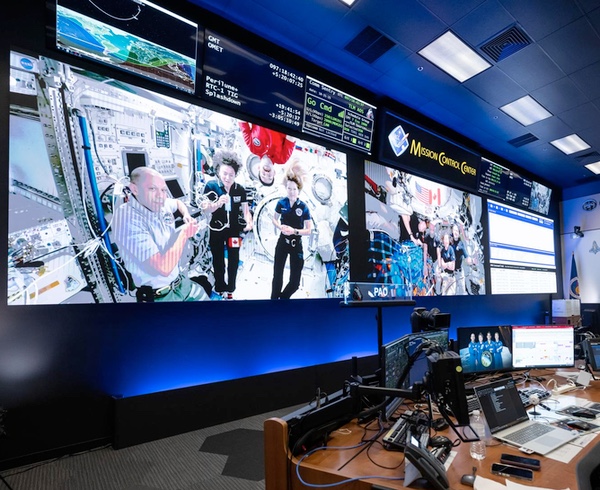
| This was not a conversation between strangers, nor did it resemble the more structured, and even awkward, exchanges the Artemis crew had with politicians or journalists. |
Artemis 2 follows naturally from decades of astronauts living and working in space aboard the International Space Station. The difference we see is not where the crew went. The difference is who the members of the Artemis 2 crew were when they got there. This is a group shaped not just by training, but by lived experience in space. Their time in low Earth orbit gave them a deep and familiar understanding of how to exist and operate in microgravity. That experience influenced everything that followed.
A phone call for history
On April 9, shortly before the Integrity capsule splashed down to Earth, the crew of the International Space Station and the crew of the Orion spacecraft Integrity were connected through NASA for what was described as a space-to-space phone call. Present on Integrity were Commander Reid Wiseman, Christina Koch, Victor Glover, and first-time astronaut Jeremy Hansen. Aboard the ISS during the call were Commander Jessica Meir, ESA astronaut Sophie Adenot, Jack Hathaway, and Christopher Williams. The three cosmonauts on the ISS did not take part. The conversation began following protocol, with a commander-to-commander exchange. Formality soon disappeared, and the tone became very relaxed.
Although the audio could only pick up whoever had the microphone at a given moment, it was clear from the visuals that voices were overlapping and that the conversation was filled with lighthearted banter and laughter. The rhythm of the interaction felt comfortable rather than tentative. This was not a conversation between strangers, nor did it resemble the more structured, and even awkward, exchanges the Artemis crew had with politicians or journalists. Instead, it felt like a friendly communication between two groups of people who had worked with each other for different periods of time. The ease of the interaction was immediately apparent.
Early in the call, Jessica Meir said, “We feel like we have you with us, and this is just making our entire week right now.” Reid Wiseman replied, “We have been waiting on this like you can’t imagine.”[2] Throughout the conversation, there was laughter, as well as gestures of encouragement and agreement. As a group used to communicating with only one available microphone, both crews were practiced in expressing agreement through body language as well as speech. Astronauts were frequently communicating physically rather than verbally, using clapping, miming, thumbs-up gestures, and even a Hawaiian shaka to convey meaning.
It might seem that a mission traveling far beyond Earth’s orbit for the first time in more than 50 years would involve communication that was more formal or more cautious. Conversation during the Apollo missions ranged from formal to informal but radio exchanges between two spacecraft—for instance, between the Lunar Module and the Command Module—were more focused on the business at hand. In contrast, the Artemis-ISS call felt very much like people who cared about each other catching up after time spent apart. The interaction did not reflect uncertainty or distance, but familiarity and shared experience. That familiarity is one of the most important clues to understanding what Artemis 2 represents. It is not simply a return to the Moon, but a mission shaped by decades of living and working in space.
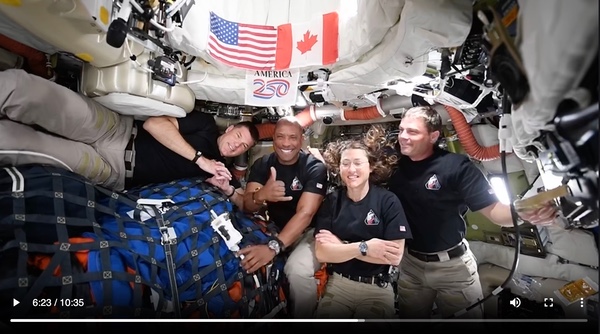 The Artemis 2 crew during the ship-to-ship call. (credit: NASA) |
An experienced crew
One of the most striking aspects of the Artemis 2 mission is just how experienced the crew was before they ever set out into deep space. These were by far the most seasoned space travelers ever to travel so far from Earth. Christina Koch spent more than 300 days in space before undertaking the mission, while both Victor Glover and Reid Wiseman had spent more than 160 days in low Earth orbit. Only Jeremy Hansen was a true first-time astronaut. The experience that three-quarters of the crew brought with them was not abstract or obtained primarily through simulations or high-performance aircraft but instead came from living and working in space over extended periods of time.
| The experience that three-quarters of the crew brought with them was not abstract or obtained primarily through simulations or high-performance aircraft but instead came from living and working in space over extended periods of time. |
This was a group of people who already had a deep and familiar understanding of how to live in space. They knew how to sleep, how to brush their teeth, how to clean their hair, and how the small, everyday customs of life in microgravity work. They were even experienced with repairing faulty spacecraft plumbing. The Apollo astronauts were all extraordinary, but none had anything like this kind of long-duration space experience before traveling to the Moon. Several had undertaken multiple missions, but none had the embodied knowledge that comes from weeks or months spent aboard a space station. Artemis 2 should therefore be acknowledged as the first NASA mission where astronauts with extensive lived experience in microgravity were sent beyond Earth’s orbit.
What these astronauts learned on the ISS made a visible difference in how they behaved on Integrity. The call’s conversation was relaxed, playful, and confident. Everyone involved, with the possible exception of Hansen, was operating in an environment they already understood. They were not figuring out how to exist in space as they went along. Instead, they were extending habits and expectations developed on the space station. This difference shaped the interaction in subtle but important ways.
Moments of shared identity
One of the clearest examples of this familiarity came in a brief exchange about food that gives this article its title. Reid Wiseman brought up the topic of meals, noting that both crews were eating the same pre-made meals, including sweet-and-sour chicken and spicy green beans. He then said, “We want to know what you’re eating and we’re going to mirror you today.” Both crews laughed as Christopher Williams said he’d had the spicy green beans for lunch. ESA astronaut Sophie Adenot then added, “I had a mango salad this morning. I think you have this on board too.” Jessica Meir took the microphone and addressed Christina Koch by her nickname, saying, “Oh Nana, I know you love that mango salad just like I do.” Glover confirmed that Koch’s mango salad was “on the deck right now!”[3]
This exchange was not small talk. It was a shared memory, or at least shared knowledge, drawn from time spent together in orbit or from weeks of life aboard the ISS. It reflected a level of recognition that develops through extended experience in the same environment. It also demonstrated how even small details can signal belonging within a shared cultural environment, even in outer space.
Another moment that demonstrated this shared culture had to do with cohort identity. The astronauts participating in the call, apart from Adenot, all belonged to specific NASA astronaut classes. “The Chumps” from 2009 included Hansen and Wiseman. The following group, known as the “8-Balls” from 2013, included Koch, Glover, and Meir. The most recent group, “The Flies” from 2022, included Williams and Hathaway. These cohort names signal shared training history and create recognizable subgroups within larger interactions. They also reflect long-standing relationships that extend beyond any single mission.
The 8-Balls dynamic was particularly strong during the call. Koch, Glover, and Meir interacted with emotional warmth, shared humor, and rapid conversational rhythm. At one point, Koch referred affectionately to Meir as her “astro-sister.” Their interaction felt less like something formal and more like the kind of communication seen among close peers or family members. This kind of relationship is built over time and reinforced through shared experience.
Admitting inexperience
Jeremy Hansen’s role in the conversation highlighted another aspect of astronaut culture. Although his selection in 2009 placed him among the more senior astronauts in terms of cohort, the fact that he had not flown until April 2026 made him the most junior in terms of actual flight experience. This created an interesting dynamic in which formal seniority and practical experience did not align. Hansen responded to this situation not by asserting his cohort status, but by emphasizing his inexperience in a humorous and self-aware way.
| Rather than being a continuation or replication of Apollo, then, Artemis actually fulfills the promise of the International Space Station. |
When asked about whether anything funny had happened, Hansen described a mistake he had made during training: “I just had a process escape on my water training up here. I left the PWD valve open a bit too long.” His voice rising in volume, he continued, “Now I will say I’m not the only one to have done this, but I do have the record so far for the largest process escape.” The response from both crews was immediate. Laughter broke out, and Koch used her hands to mime the size of the floating water leak, apparently more than a foot across. Hansen’s willingness to tell the story, and to frame it humorously, made him more relatable and reinforced his place within the group.
The idea of being a “rookie” in this context is not a fixed category. It is situational and performed in real time. Hansen’s humor and the crew’s response placed him inside the group as a full participant, with his mistake creating a shared moment rather than setting him apart. This kind of interaction demonstrates how status is negotiated through communication rather than determined solely by formal hierarchy.
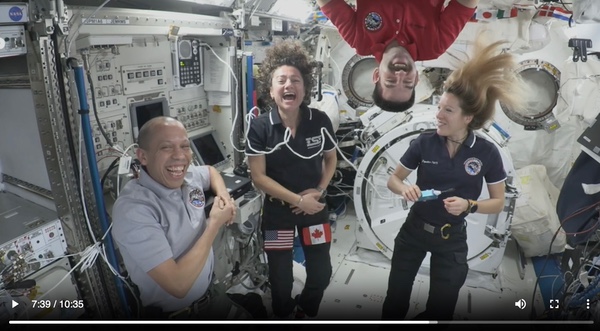 The ISS crew during the ship-to-ship call. (credit: NASA) |
A culture of collegiality
Another example of shared understanding came through several references by Koch to the ISS crew’s activities, demonstrating her deep awareness of the other team. She said to Christopher Williams about his March 18th spacewalk with Meir, “Chris, it was awesome to watch you and Jessica go out on a spacewalk. I was lucky enough to sit console for your suit-up.” Later, referring to another activity that had likely been rescheduled due to the successful launch and return of Artemis 2, Koch told Meir, “Sorry to steal your… spacewalk day.”[4] Scheduling shifts are common in space operations, where priorities must be balanced across multiple missions. Koch’s comments showed awareness of ISS operations and acknowledged the impact of the Artemis mission on the station crew’s plans. Her remarks were specific, informed, and aligned her with their experience rather than placing her mission above theirs. This reflects a type of humility often seen in the astronauts I’ve interviewed that recognizes and validates the work of others in the larger community.[5]
Astronauts do not simply train for spaceflight. They learn how to live physically in space and how to coexist with other people in space. An astronaut I call by the pseudonym Alan (anthropologists typically use pseudonyms to protect research participants’ confidentiality) described arriving on the ISS as being like a house guest who needs to learn the basics of an unfamiliar home, like learning where the towels are. This kind of knowledge is not procedural. It is cultural, passed from one crew to another through experience. Another astronaut, “Beverly,” told me that when she “interviewed people to be astronauts, my whole thing was would I want to spend six months in a small place with this person?” The space station is not just a workplace. It is a system for living and working together over long periods of time, and the way activities and interactions happen there shapes how astronauts interact, make decisions, and understand their environment.
During the space-to-space phone call Victor Glover made this point by explicitly comparing culture on the ISS with what was possible on Integrity. After being asked what surprised him on the journey he mentioned the feeling of the translunar injection and the amazing view of the Moon but also brought up a bit of mission-based culture shock. He explained, “How we move around and eat, those things have also been surprising. Because the difference between ISS and here is we don't have another module to deconflict, and so everything we do essentially starts with a spatial conflict and we have to take the time to work it out in every activity.”[6] (Deconfliction refers to mapping out the location of different spacecraft, setting aside different workspaces, etc. so that operations run smoothly. Glover is essentially noting that the Integrity is a much smaller place to live than the ISS.) This example brings home just how much the experience of living and working on ISS informs living and working on Integrity. Astronauts’ shared experiences on the ISS shape how they move, how they communicate, how they make decisions, and how they interact.
Conclusion
There has been some discussion about whether a flyby mission should count as going to the Moon. NASA has never defined lunar travel solely in terms of landing. Apollo 13 astronauts Fred Haise and Jack Swigert neither landed on the Moon nor conducted a standard lunar orbit , yet they are still counted among the 24 people who have gone to the Moon.[7] (Apollo 13 was meant to orbit the Moon and include a lunar landing, but its infamous accident meant that the crew only experienced a lunar flyby, very similar to the flyby done by Artemis 2. I don’t mention Jim Lovell here because he did do a standard orbit of the Moon as an Apollo 8 astronaut.) By that same standard, the Artemis 2 crew has also gone to the Moon. The question of whether the mission “counts” is therefore not especially meaningful within NASA’s own historical framework.
| The call showed that what astronauts have learned in low Earth orbit will define space culture moving forward. |
Some observers have dismissed Artemis 2 as a repetition of earlier achievements. This perspective misses many important achievements of the mission but also its cultural significance beyond important demographic firsts. The experience and background of the crew are meaningfully different from those of the Apollo astronauts, influencing what they did, what they paid attention to, how they made decisions, and how they interacted with one another.
Rather than being a continuation or replication of Apollo, then, Artemis actually fulfills the promise of the International Space Station. The ISS, built and operated by international teams, was designed for and expects cultural diversity among its crew members, serving as a model for harmonious cooperation. The stage for this was set when NASA changed its recruitment approaches in 1978, seeking excellence among applicants from groups that had been excluded previously when piloting skills were given priority.[8] This diversity was reflected in Artemis 2. The crew brought a range of backgrounds, experiences, and perspectives that shaped how the mission was experienced and understood, a change that had an impact beyond the crew itself, influencing how different groups of people on Earth related to the mission.
It became clear, for example, how important it was to Canadians that Jeremy Hansen had gone to the Moon.[9] Many people in the African American community were deeply engaged with Victor Glover’s experience.[10] Christina Koch’s presence made a profound difference for women and girls, who could now say that one of their own had traveled to the Moon.[11] These responses show that who goes to space matters as much as where they go.
Given all of this, the ease between the crews of the International Space Station and Integrity during their space-to-space call was not surprising. It was the result of shared experience and shared culture. In the context of how culture changes, is shared, and unites people, Artemis 2 was less a sister to Apollo and more the child of the International Space Station. It showed that what astronauts have learned in low Earth orbit will define space culture moving forward. The ISS has spent nearly 30 years as a workspace and home, the birthplace of a new culture with its own customs, understandings, and even foodstuffs like mango salad. Glover, Koch, and Wiseman did not arrive at the Moon as novices encountering something entirely new. Instead, they arrived as people who already knew how to live in outer space because of long months spent on the ISS. And their crewmate, Jeremy Hansen, is an even newer type of astronaut: one who has learned to live in space while Moon-bound, perhaps the first member of a truly lunar community.
Bibliography
Creech, Steve, John Guidi, and Darcy Elburn. "Artemis: An overview of NASA's activities to return humans to the moon." In 2022 ieee aerospace conference (aero), pp. 1-7. IEEE, 2022.
McNeal, Stephanie. “The NASA Artemis II Mission Is a Rare Hopecore Moment for the Girls.” Glamour, April 9, 2026.
Mobley, Cedric. “Honorary Howard Alumnus Victor Glover Pilots Spacecraft around the Moon and Farther than Any Human Has Ever Traveled.” The Dig at Howard University, April 3, 2026.
NASA. “Spaceship-To-Spaceship Call - NASA,” April 10, 2026.
Pope, Alexandra. “Iconic Moments from the Artemis II Mission to the Moon and Back.” Canadiangeographic.ca. Canadian Geographic, April 10, 2026.
science.nasa.gov. “Who Has Walked on the Moon? - NASA Science,” February 26, 2026.
Swanson, Glen E. “Chief Communicator: How Star Trek’s Lieutenant Uhura Helped NASA.” The Space Review, August 15, 2022.
Weibel, Deana L. The Ultraview Effect. University of California Press, 2026.
Endnotes
- Marshall Smith et al., “The Artemis Program: An Overview of NASA’s Activities to Return Humans to the Moon.”
- “Spaceship-To-Spaceship Call - NASA,” NASA.
- “Spaceship-To-Spaceship Call - NASA,” NASA.
- “Spaceship-To-Spaceship Call - NASA,” NASA.
- Deana L Weibel, The Ultraview Effect.
- “Spaceship-To-Spaceship Call - NASA,” NASA.
- “Who Has Walked on the Moon? - NASA Science.”
- Glen E. Swanson, “Chief Communicator: How Star Trek’s Lieutenant Uhura Helped NASA.”
- Alexandra Pope, “Iconic Moments from the Artemis II Mission to the Moon and Back.”
- Cedric Mobley, “Honorary Howard Alumnus Victor Glover Pilots Spacecraft around the Moon and Farther than Any Human Has Ever Traveled.”
- Stephanie McNeal, “The NASA Artemis II Mission Is a Rare Hopecore Moment for the Girls.”
Note: we are now moderating comments. There will be a delay in posting comments and no guarantee that all submitted comments will be posted.