The TWINSTAR mission concept: A pragmatic path to finding Earth 2.0by Sherine Ahmed El Baradei
|
| A $3–5 billion budget—a parameter refined through mission studies at Embry-Riddle Aeronautical University—is significant enough to support a four-meter-class observatory and a complex starshade, yet remains lean enough to be developed and launched within a single decade. |
To bridge this gap, the TWINSTAR (Terrestrial Worlds Identification Near Sun-like Targets through Advanced Reconnaissance) mission concept offers a solution designed to balance high-level science with fiscal reality. By combining a four-meter telescope with an external starshade at the Sun-Earth L2 Lagrange point, this architecture bypasses the most punishing stability requirements of current designs while fitting into a strategic $3–5 billion budget window.
The “strategic middle”: why $3–5 billion?
In the current NASA funding landscape, missions often fall into two extremes: “Probes” capped at $1 billion, and “Flagships” like the Habitable Worlds Observatory (HWO), which may exceed $11 billion. TWINSTAR targets the “strategic middle.” A $3–5 billion budget—a parameter refined through mission studies at Embry-Riddle Aeronautical University—is significant enough to support a four-meter-class observatory and a complex starshade, yet remains lean enough to be developed and launched within a single decade. This cost-cap is achieved by aggressive “heritage-harvesting”: using existing, flight-proven technologies rather than inventing new ones (Larson & Wertz, 2018).
The technology choice: the external starshade
A primary debate in exoplanet imaging involves the method of starlight suppression: an internal coronagraph or an external starshade. While internal coronagraphs have significant heritage, they demand picometer-level (one trillionth of a meter) wavefront stability. TWINSTAR instead utilizes an external starshade, a separate spacecraft flying tens of thousands of kilometers ahead of the observatory (Seager, 2010).
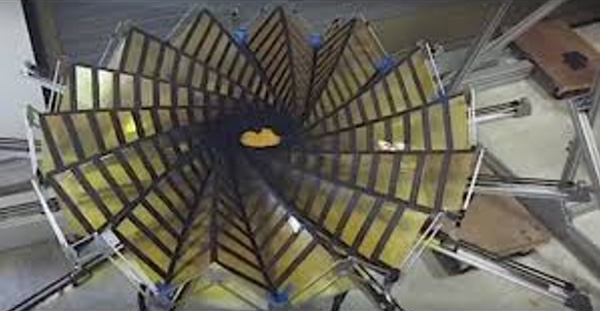
One of the most innovative aspects of this technology is its deployment. Because of its massive scale (more than 30 meters in diameter), the starshade cannot fit into any existing rocket fairing while fully expanded. Instead, it is launched in a highly compact, origami-like stowed configuration. Once in space, it unfurls like a mechanical flower, expanding from a tightly packed cylinder into a precise geometric “sunflower” shape. This shape is specifically engineered to diffract light away from the telescope’s aperture, creating a “dark hole” in the starlight where the planet’s faint reflection can finally be captured (NASA Exoplanet Exploration Program, n.d.).
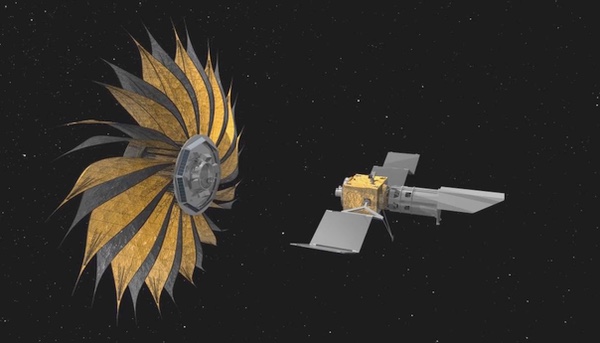 An intermediate stage of the “origami” deployment, illustrating how the starshade petals unfurl in space to reach their full diameter. (credit: NASA/JPL-Caltech) |
To maintain the $3–5 billion budget, the choice of the spacecraft “bus” and its orbital destination are critical. The TWINSTAR concept utilizes the Sun-Earth L2 Lagrange point. This specific orbit is chosen because it offers an exceptionally stable thermal environment, far from the heat radiation of Earth. At L2, the observatory can maintain a constant orientation, keeping the sunshield positioned to block the Sun, Earth, and Moon simultaneously. This allows for the ultra-stable, long-duration exposures required to resolve faint planetary signals.
Table 1: Comparative trade spacecraft bus suitability
| Criteria | Hubble (HST) | Nancy Grace Roman | TWINSTAR (JWST-Derived) |
|---|---|---|---|
| Orbit | Low Earth Orbit (LEO) | Sun-Earth L2 | Sun-Earth L2 |
| Thermal Stability | Low (Day/Night cycles) | Moderate (Stable L2) | High (Cryogenic Sunshield) |
| Pointing Specs | 7 mas stability | Milli-arcsecond class | Milli-arcsecond class |
| Cost Risk | High (Legacy tech) | Moderate | Low (Active production) |
| Suitability | Low | Moderate-High | High (Optimal for Direct Imaging) |
By leveraging a JWST-derived bus (NASA GSFC, 2023), TWINSTAR gains the benefit of billions of dollars already spent on research and development. This platform is already flight-proven to provide the passive cooling and extreme stability required to keep the starshade and telescope aligned across 30,000 kilometers of empty space.
Science traceability and target detectability
The mission design is governed by a Science Traceability Matrix (STM) that links the goal of finding life to the physics of the telescope (Des Marais et al., 2002):
- Science Goal: Detect habitable exoplanets and search for biosignatures (oxygen, water).
- Physical Requirement: Achieve 10-10 contrast at an Inner Working Angle (IWA) less than or equal to 0.1 arcsec.
- Instrument Solution: A four-meter telescope, 34-meter starshade, and a visible/near-infrared spectrometer (0.4–1.6 µm).
The feasibility of this approach is validated by calculating the IWA. A 4.0-meter aperture provides an IWA of 39.29 milliarcseconds (mas). As shown in the detection results below, this allows for the clear resolution of habitable zones (HZ) around our nearest stellar neighbors:
Table 2: Target detectability calculations
| Target Star | Distance (pc) | Habitable Zone (mas) | Detection Result |
|---|---|---|---|
| Alpha Cen A | 1.3 | 746 | Confirmed (Clear resolution) |
| 18 Scorpii | 14.1 | 74 | Confirmed (Clear resolution) |
| HD 98649 | 38.0 | 25 | Rejected (Planet hidden by IWA) |
Managing risk and heritage
Despite the reliance on heritage, TWINSTAR must manage significant technical risks (Mankins, 1995). The dominant risk is the starshade starlight-suppression system, which currently sits at a Technology Readiness Level (TRL) of 5–6. Because no full-scale operational starshade has yet been flown, the precision required for formation flying—maintaining sub-meter alignment between two spacecraft separated by thousands of kilometers—remains a tall pole for the mission (NASA, 2020).
To mitigate this, the mission plan recommends a precursor technology demonstration. Furthermore, by using Roman and JWST-class detectors in the spectrometer suite (Beletic et al., 2008), the mission keeps its instrument TRL at a high 7–8, ensuring that the primary development focus remains on the starshade’s mechanical deployment and station-keeping.
Conclusion
The TWINSTAR mission concept represents a scientifically robust and programmatically feasible pathway to fulfilling the Astro2020 goals. By decoupling the telescope’s size from its contrast capability via a starshade and utilizing a JWST-class bus architecture, the mission offers a high-reward search for life that respects the fiscal constraints of the modern era. The mission stands ready to provide the first definitive spectral fingerprint of a living world beyond our own.
Selected references
Beletic, J. W., et al. (2008). Teledyne Imaging Sensors: Infrared imaging technologies for astronomy. Proceedings of SPIE.
Des Marais, D. J., et al. (2002). Remote sensing of planetary properties and biosignatures. Astrobiology.
Larson, W. J., & Wertz, J. R. (2018). Space Mission Engineering: The New SMAD.
Mankins, J. C. (1995). Technology Readiness Levels: A White Paper. NASA.
National Academies of Sciences. (2021). Pathways to Discovery in Astronomy and Astrophysics for the 2020s.
NASA GSFC. (2023). James Webb Space Telescope Project Documents.
Seager, S. (2010). Exoplanet Atmospheres: Physical Processes.
Note: we are now moderating comments. There will be a delay in posting comments and no guarantee that all submitted comments will be posted.