Redefining success in space diplomacy: emerging space nations in the Artemis Era and the case of Türkiyeby Elif Yüksel
|
| Success is no longer measured primarily by launch and technological capability, but by the ability of states to translate space activities into governance influence. |
In an exclusive interview on space diplomacy, the author spoke to Türkiye’s official national news agency, Anadolu Ajansı, on a request to describe this transformation as a shift “from orbits to outcomes.”[1][2] The central question today is no longer simply whether nations can access orbit: it is about what their access to space generates in terms of societal impact, economic growth, security capabilities, and governance influence. In this sense, space diplomacy is no longer merely about technical coordination or compliance. It is increasingly about structuring the governance environment of the space domain itself.
Measuring successful space diplomacy
This transformation also raises an important question: how should success in space diplomacy be measured today? While several factors shape space diplomacy, the author argues that two dimensions are particularly decisive: cooperation architecture and international impact.
The first concerns how partnerships are structured. Are collaborations temporary and project-based, or are they institutionalized frameworks capable of generating long-term technological and diplomatic influence?
The global space sector is entering a period where collaboration itself has become competitive. Space exploration programs, including lunar exploration, megaconstellations, commercial launch markets, and competing governance frameworks, are generating parallel cooperation architectures. In this environment, countries are not only competing technologically, but they are also competing for partnerships (e.g., the US-led Artemis program and the China-led International Lunar Research Station framework, neither of which Türkiye has formally signed). Strategic influence grows when partnerships involve shared infrastructure, joint research and development, co-production, and long-term institutional engagement. This creates a structural dynamic: increasing competition for collaboration.
The second pillar of a successful space diplomacy is international impact, the ability of space activities to shape global governance debates. Because space activities are inherently transnational, their strategic value depends not only on domestic applications but also on how they shape global governance debates. Discussions surrounding space traffic management, debris mitigation, lunar resource governance—including “safety zones” within the Artemis framework—space situational awareness, and responsible behavior norms remain open and evolving. In such an environment, emerging space nations have meaningful opportunities to contribute to norm-shaping processes.
Traditional diplomacy vs. space diplomacy
This transformation also challenges traditional foreign policy reflexes. Conventional diplomacy often operates through tools that generate rapid feedback in areas such as negotiations, positioning, and crisis management. Space diplomacy, by contrast, may unfold over much longer time horizons, relying on infrastructure, institutional capacity, and technological validation. Its impact accumulates gradually rather than appearing immediately. In this sense, space diplomacy does not replace traditional foreign policy; it complements it by adding a long-term, technical, and institutional dimension that increasingly requires interdisciplinary expertise.
| Space diplomacy does not replace traditional foreign policy; it complements it by adding a long-term, technical, and institutional dimension that increasingly requires interdisciplinary expertise. |
In the evolving global space environment, emerging space nations are no longer peripheral actors. Yet visibility alone does not guarantee influence. Many governments pursue rapid “catch-up” strategies, attempting to participate in multiple international initiatives simultaneously. Even though increasing visibility demonstrates a valuable effort, participation alone does not ensure influence over how the space domain is governed. Strategic positioning increasingly depends on institutional depth, governance capacity, and coherent long-term policy frameworks. Moreover, even though they are considered “latecomers”, they can even turn this delay into opportunities, including having strategic flexibility when strategically tailored.
Where Does Türkiye Stand
Türkiye offers an instructive case for understanding how emerging space nations are repositioning themselves within the evolving governance architecture of space.
Building on decades of experience in the aerospace and defense sectors, Türkiye has expanded its space ecosystem through institutional reform, technological development, and growing international engagement in civil space activities. The establishment of the Turkish Space Agency in 2018, followed by the National Space Program (2021) and the National Space Strategy Document (2022), positioned space as a strategic domain. Long-term efforts for sovereign launch capability—including the ongoing construction of a spaceport in Somalia—reflect Türkiye’s intent to expand independent access to space, while the discourse of “Uzay Vatan” (Space Homeland) signals the increasing strategic framing of space within national and foreign policy debates.
| Türkiye offers an instructive case for understanding how emerging space nations are repositioning themselves within the evolving governance architecture of space. |
Recent developments reinforce this trajectory. Earlier this year, Turkish Space Agency President Yusuf Kıraç was elected Chair of the Asia-Pacific Space Cooperation Organization (APSCO) Council—Türkiye is a founding member of the organization since 2006—becoming the first Turkish representative to assume this role.[3] The 2026 central government budget allocates approximately 8.7 billion Turkish lira (around US$270 million) for space and aerospace programs, while hosting the International Astronautical Congress (IAC) 2026 in Antalya further positions Türkiye as a platform for global space dialogue.[4] Türkiye also participates actively in global space governance as a party to all five UN space treaties and a member of key institutions including COPUOS, ITU, APSCO, COSPAR, EUMETSAT, IAF, EURISY, APRSAF, and ICG. Regionally, it plays a convening role within the Organization of Turkic States through initiatives such as the CubeSat project and the Space Explorers Academy, while maintaining bilateral cooperation with partners across Europe, Eurasia, the Middle East, and Africa.[5]
Technological milestones further reflect this progress. With the development of Türksat-6A, Türkiye has become the 11th country to design, produce, and operate sophisticated GEO communications satellites within a sovereign national program. As of March 2025, Türkiye operates nine active government-controlled satellites: six communications satellites—Türksat-3A, 4A, 4B, 5A, 5B, 6A—and three Earth observation satellites: Göktürk-1, Göktürk-2, and İMECE or Göktürk 2B, the country’s first sub-meter resolution satellite with domestically developed optical systems.[6][7]
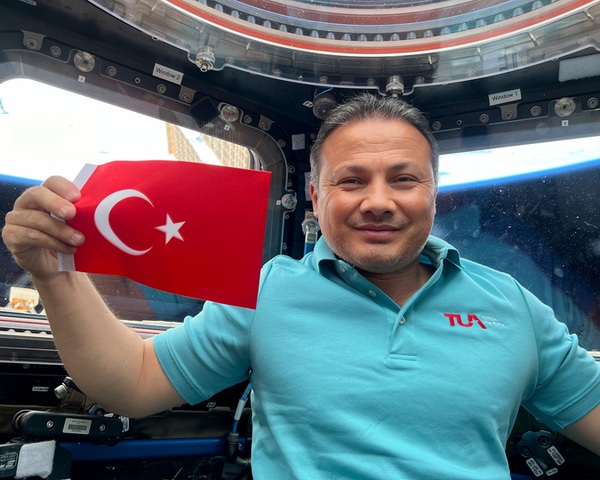
Investments in science missions and critical technologies, including the first Turkish astronaut and science mission with 20 scientific experiments on ISS and suborbital flights in 2024. DeltaV’s indigenous hybrid propulsion development as well as TUBITAK UZAY’s indigenously developed hardware (e.g.,Tstar platforms and HALE) will be critical for the Lunar Mission of Türkiye, with its first phase being a high-impact landing on the lunar surface scheduled for 2027.[8][9]
Taken together, these developments provide much of the strategic “raw material” necessary for effective space diplomacy and showcase the country’s growing role in regional and global space diplomacy.
Institutionalizing space diplomacy as a pillar of Türkiye’s grand strategy
In earlier analyses by the author, institutionalizing space diplomacy was proposed as a pillar of Türkiye’s grand strategy.[8] Within this framework, mechanisms such as a Turkish National Space Council and a Space Diplomacy Task Force could help align technological achievements with long-term strategic objectives and translate technological capability into sustained diplomatic influence. Translating this capacity into sustained diplomatic impact will require institutionalizing space diplomacy through clearer policy frameworks, stronger interagency coordination, and specialized expertise. In this context, preparatory work on the proposal for a Space Diplomacy Task Force, developed by the author, is currently underway and will be submitted to the relevant institutions.
Also, the country’s space efforts would be strengthened with the establishment of a separate national space policy document prepared by interdisciplinary space experts, followed by a national space law in the longer term.
Another critical dimension for practicing successful space diplomacy is investing in interdisciplinary specialized human capital. The future of space diplomacy will increasingly depend on Turkish space diplomats (e.g., space attaches, counselors, and interdisciplinary-trained career diplomats) serving as bridges through their interdisciplinary expertise and practice that connects space sciences, engineering, security, economy, law, policy, and international relations. Türkiye should invest in such specialized human capital that will make the country better positioned to navigate the governance challenges of the expanding and increasingly intertwined nature of space affairs.
References
- Andolu Agency. “From Orbit to Results: Turkey's Space Diplomacy Course”
- Elif Yüksel. “Redefining space diplomacy for the 21st century: from orbits to outcomes.” SpaceNews, September 26, 2025.
- TUA. “Historical Success in Space Diplomacy: TUA President Yusuf Kıraç elected as APSCO Council President” December 8, 2025.
- MERKEZİ YÖNETİM BÜTÇE ÖDENEKLERİNİN PROGRAMLARA GÖRE DAĞILIMI (2026-2028)
- Organization of Turkish States. “Cooperation in the space area”
- Turksat. “Satellite Fleet.”
- TÜBİTAK. “İMECE Satellite Taken into the Air Forces Command Inventory as GÖKTÜRK-2B” May 27, 2025.
- Delta V. “TÜRKİYE'S PROPULSION POWER”
- TÜBİTAK. Catalog.
- Elif Yüksel. “Why institutionalizing space diplomacy should be a pillar of Turkey’s grand strategy.” The Atlantic Council, October 23, 2025.
Note: we are now moderating comments. There will be a delay in posting comments and no guarantee that all submitted comments will be posted.