A Fortress Moon for cislunar securityby Alan T. Dugger
|
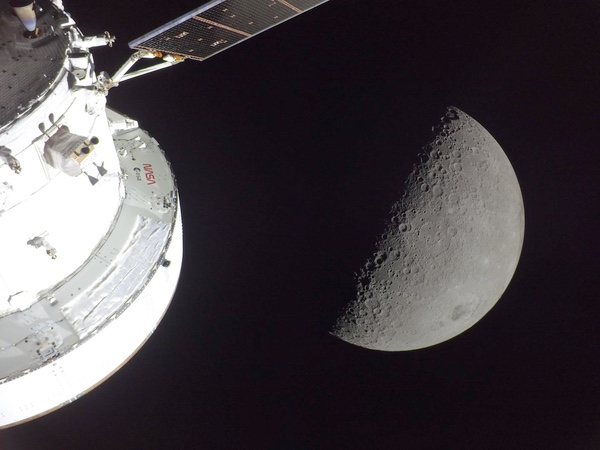
| The prospect of a cislunar space conflict is no longer purely theoretical, but increasingly plausible. |
Cislunar space is that region of space between the Earth and the Moon. Historically, it has been treated as little more than a transit corridor for missions to and from Earth or as a background for scientific missions meant to study the Earth, the Sun, and the Moon from a distance.
But sustained lunar programs and emerging plans for cislunar communications are making this region of space increasingly valuable. Analysts have already warned that existing space situational awareness systems are poorly suited to monitor activity in this system.
Recent US policy documents acknowledge that an increasing number of nations and commercial providers now possess reliable and sustainable access to cislunar space. What was once an infrequently transited region is becoming an environment of sustained operations by multiple state, commercial, and hybrid actors with a diverse set of ideas, goals, and methods to achieve them. These activities range from scientific research, economic development, and human exploration to signal intelligence collection, secure data relay, and ambiguous proximity operations that blur the line between peaceful use and strategic competition.
As a result, the prospect of a cislunar space conflict is no longer purely theoretical, but increasingly plausible.
The focus on cislunar space is not missing, but the efforts are fragmented, often built around singular missions, and are frequently limited in concept. This reflects the traditional understanding of cislunar space as a transit and mission-support region rather than an operational domain.
This is insufficient.
As this domain increasingly becomes an area of strategic competition, a staging arena for effects felt on Earth, and missions aimed in deeper space, an architecture is required to increase awareness of domain activity and translate seemingly unconnected action into coherent narratives.
What is required is a framework for presence without occupation, persistent awareness without total observation, and comprehensive coverage without continuous collection. If history can serve as a reference for the future, one historical concept meets all of these requirements: the fortress—not as a structure, but as a system of administration and control. The system required is Fortress Moon.
Systems over satellites
Historically, medieval fortresses were more than impressive walls bristling with archers or cannons. They were systems that housed small cities, markets, and populations within their areas of influence. They shaped the behavior of individuals and groups by providing structure, facilitating commerce, and enforcing security. They did not control everything, but they did control what mattered. Fortress Moon applies this logic to a new domain.
| The most effective way to monitor and defend cislunar space is not a single point of failure, but multiple points for success. |
Fortress Moon is not a proposal to build a physical structure on the lunar surface. Instead, it is a distributed system designed to connect sensing, communication, and response across the Earth-Moon system into a cohesive picture of activity. The network this framework enables makes actions taken by space players visible, attributable, and governable. This is a need that is not only relevant today but will become increasingly valuable as the cislunar area of operations becomes more congested and contested over the coming decades.
Fortress Moon is a web of interconnected nodes distributed across cislunar space. From Earth orbits to the lunar surface and in between. These nodes consist of visual and electromagnetic sensors, communication satellites, and kinetic and non-kinetic delivery platforms. Some nodes are commercial, some are state-owned, and others are passively or actively dual use. No single node is decisive. Redundancy and resiliency are built in. If one vantage point fails to observe an event, another may capture its associated signals or patterns. If one pathway for a kinetic response is unavailable, other non-kinetic responses remain capable of shaping behavior. The result is a web of assets with overlapping fields of awareness and influence that can indicate, identify, and isolate possible threats.
This web makes more practical sense for cislunar space. A lunar base or structure may concentrate power and capability, but can also be easily identified, obscured, or targeted. Lunar bases will also have an inherently limited reach when trying to create effects in Earth orbit or on the opposite side of the lunar surface.
A web provides more comprehensive coverage while distributing capabilities across innumerable and sometimes elusive points. Expensive and exquisite single or limited-series platforms may provide an overwhelming advantage in the near future but will quickly become obsolete in the face of an adaptive and pacing threat. Nodes in the web may be narrower in scope, but can be rotated, upgraded, or replaced on shorter timelines and at lower costs. This allows the system to evolve as the environment changes. The most effective way to monitor and defend cislunar space is not a single point of failure, but multiple points for success.
Fortress Moon enables deterrence by forcing actors to consider that trajectory changes, area observations, or communications become increasingly difficult to hide. Over time and with multiple points collected, patterns begin to emerge, intent becomes visible, and surprise becomes costly or impossible.
Observation, deterrence, and capability
Strategists have long understood that persistent observation can deter conflict as effectively as weapons. Thomas Schelling observed that the central challenge of surprise attack was not simply limiting weapons but creating systems capable of providing timely and reliable warnings of hostile actions.
An actor that knows his movements are being observed, and that those observations are being communicated quickly to decision-makers, understands that the conditions required for a surprise attack begin to erode and his overall incentive to act quicky diminishes. Fortress Moon extends this logic into the cislunar domain. The web does not just need to announce its ability to destroy opposing systems in order to shape their behavior. Its presence alone can alter decision-making and deter any aggressive behavior. It demonstrates that hostile actions will be observed and responded to before they can achieve any effects.
Critical to this deterrence is that Fortress Moon isn’t limited to just sensing. Awareness without consequences invites exploitation. The web must be able to deliver effects when needed. These can include electromagnetic interference, temporary anti-access or area denial, orbital pressure, public attribution, or economic and regulatory enforcement. Kinetic options, while deliberately constrained, must remain available. The power of the web is not in its ability to destroy, but to become aware of and mitigate actions proportionally before a fait acompli of events transpire.
| At its core, Fortress Moon is a systems problem, not a technological one. The United States, its allies, and its commercial partners possess all the tools required, but lack a cohesive architecture to link them together. |
Importantly, the technology that makes Fortress Moon feasible already exists today or is near-term in its realization. Space domain awareness sensors exist on Earth and are in orbit now. Government communications satellites have existed for decades, and commercial variants continue to grow and expand. Payload delivery systems for the Moon and on-orbit maneuvering and rendezvous proximity systems are maturing in parallel. What is missing is not hardware, but cohesion. Fortress Moon can begin today. As activity increases, capabilities grow, and new requirements are defined, nodes can be added incrementally. This enhances the effectiveness of the web, expands coverage, and builds redundancy without a monolithic “built-from-scratch” program.
At its core, Fortress Moon is a systems problem, not a technological one. The United States, its allies, and its commercial partners possess all the tools required, but lack a cohesive architecture to link them together. Too often, efforts in space remain stove-piped with a narrow set of objectives given to a singular and expensive piece of equipment. Fortress Moon aims to shift that emphasis from one of invention to one of integration, from individual abilities to collective capabilities. By shifting the focus to architecture, data sharing, and coordination across government, commercial, and allied systems, the United States can begin to impose structure in an increasingly complex, dynamic, and evolving landscape.
This reflects Christian Brose’s observation that modern military advantage lies in integrating sensing, decision, and response into cohesive systems rather than relying on individual platforms. The advantage lies not in one sensor, communicator, or weapon, but in how current and near-future systems and capabilities are combined to create a unified common operating picture of cislunar space.
No single service, agency, or organization has the ability to patrol cislunar space alone. This is inherently a joint and interagency problem. The US Space Force would provide the backbone of space domain awareness, while US Space Command would command and integrate the architecture operationally. The National Reconnaissance Office could contribute resilient and advanced satellite constellations to strengthen orbital intelligence gathering. NASA’s civil exploration systems and communications infrastructure are optimized for deep-space observation, especially on the lunar surface and in lunar orbit. Commercial partners supply additional communication and sensing nodes and forthcoming logistics solutions. Here on Earth, US Cyber Command would help shape the information environment and provide cyber-enabled effects across the domain.
Whose sky does the world want to live under?
The alternative is a future plagued by episodic crises. Without persistent governance, cislunar space will be shaped by whoever is most willing to exploit the ambiguity. Norms have already begun to emerge unevenly and will continue to do so. Decision-makers will be constrained by tighter timelines, shorter decision cycles, incomplete information and the ability to assign attribution may be lost to uncertainty. This amplifies the risk of miscalculation and escalation that could manifest in space, in orbit, or on Earth.
The choice is not between militarizing space or preserving a peaceful common. That framing no longer reflects reality. The only choice is between administering cislunar space deliberately or allowing others to define its order by default.
| Fortress Moon offers a solution where uncertainty remains beyond its boundary, but within its walls, the unknown is replaced by awareness and security. |
Fortress Moon offers a way forward. By prioritizing awareness, redundancy, and proportional response to threats, it treats the Earth-Moon system as a domain to be governed. Cislunar space is not empty volume nor is it solely the corridor from here to there. Rarely are the transitional spaces from one place to another treated as such. The sea lanes of the Atlantic controlled movements between the continents during World War II. Air corridors are frequently patrolled, covered in radar zones, and lined with air defenses. In ancient history, mountain passes were the strategic focus as much as the cities on either side. These regions were valuable not as destinations, but as corridors.
Cislunar space is emerging as the next generation of this type of terrain; a domain whose importance lies in the movement it enables and the visibility it affords. Fortress Moon recognizes the historical advantage of understanding such a space and offers a historical response to that challenge. Fortress Moon offers a solution where uncertainty remains beyond its boundary, but within its walls, the unknown is replaced by awareness and security.
Note: we are now moderating comments. There will be a delay in posting comments and no guarantee that all submitted comments will be posted.