The Moonbase momentby Jeff Foust
|
| Leadership, budgets, and technology, said Garcia-Galan, “have aligned with us being here today to frickin’ build a Moonbase.” |
At this spring’s LSIC meeting, split between downtown Washington and the Applied Physics Laboratory in Laurel, Maryland, the mood was very different. A month earlier, NASA held its “Ignition” event where the agency not only declared its intent to develop a lunar base in lieu of the orbiting Gateway, but also committed spending tens of billions over the next decade to so do, with plans for dozens of lander missions, habitats, power systems, and more.
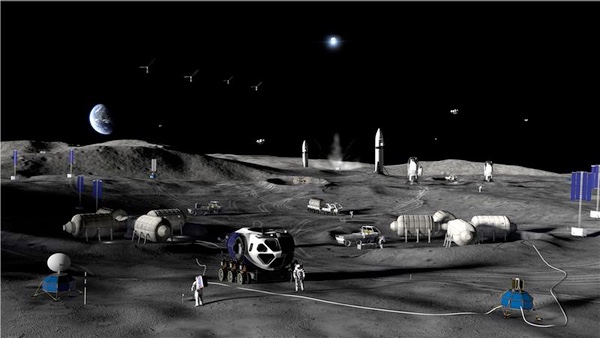
Those advocates of lunar base found themselves in the position of being, if anything, not ambitious enough about their visions of lunar bases. In opening remarks, Bobby Braun, head of APL’s space exploration sector, compared one illustration of a lunar base from those earlier efforts with the expansive vision NASA presented at Ignition.
“Our concept ended up being, I hate to admit this, small,” he said. “In hindsight, what were we thinking?”
The biggest advocate for a lunar base at the meeting was the NASA person responsible for it, Carlos Garcia-Galan. His formal title is program executive for Moon Base, but at the Ignition event NASA administrator Jared Isaacman dubbed him the “lunar viceroy.” Garcia-Galan, though, prefers a different moniker, one he has even put on briefing charts: Moon Base Guy.
“I was really not a lunar guy before,” he said in a speech at the meeting, having previously worked on programs like Gateway and the ISS. “I was a spacecraft guy.”
He is, though, all-in on a lunar base. “Leadership has aligned with the technical capabilities, which have aligned with the state of readiness of industry, which have aligned with the budgets, which have aligned with us being here today to frickin’ build a Moonbase.”
| “From our perspective at Blue Origin, the number one absolute must-have is frequent, low-cost, high-mass access to the lunar surface,” said Cortese. |
The audience at LSIC didn’t need to be convinced that their moment had finally arrived. Over two and a half days, they discussed technologies and approaches that could be used to develop a lunar base. That included the key enabling technologies a Moonbase would need, which, not surprisingly, often aligned with the technologies companies at the event were developing.
“From our perspective at Blue Origin, the number one absolute must-have is frequent, low-cost, high-mass access to the lunar surface,” said Jacki Cortese, vice president of civil space at Blue Origin, on one panel. Blue Origin, of course, wants to offer just that with its Blue Moon line of landers.
The adjectives she used, she said, were deliberate. Frequent access is needed to build up experience and, with it, expertise in landing on the Moon. Reduced costs are important , she noted, “because the budgets aren’t getting any bigger.” Larger landers are also needed for the heavier infrastructure needed for a lunar base.
That would enable other infrastructure, such as power, mobility, and in-situ resource utilization. “Once we get frequency,” she said, “we can embed power towers on every single [Blue Moon] Mark 1 and send these to every peak of eternal light,” regions around the south pole of the Moon that are in near-constant illumination. “You’re setting everyone up for success.”
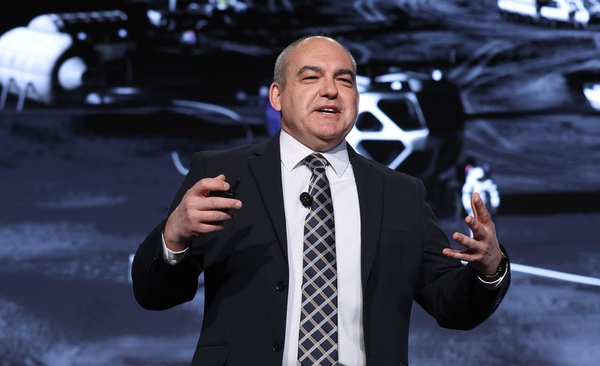 Carlos Garcia-Galan, NASA’s “Moon Base Guy,” discusses the agency’s plans at the 41st Space Symposium in April. (credit: Space Foundation) |
Another key technology is communications. “We should not be starting from scratch. We should not be reinventing the wheel,” said Thierry Klein, president of Bell Labs Solutions Research at Nokia, which tested using terrestrial mobile communications standards like 4G/LTE on the IM-2 mission last year. “We should take those investments, we should take those technologies, and adapt them for the environment.”
Lunar Outpost, which was one of the companies competing for NASA’s Lunar Terrain Vehicle (LTV) program, emphasized mobility. “We see our Eagle LTV as the backbone to lunar surface infrastructure,” said Tim Mounsey, director of business development for commercial sales at the company.
At Ignition, NASA announced it would not select proposals for an LTV submitted last fall by Lunar Outpost, along with Astrolab and Intuitive Machines, but instead have them offer different designs that would be less capable but also faster to build.
He seemed unfazed by the change in direction. “We’ve got a fleet of rover solutions,” he said. “Rovers and mobility solutions are a key enabling, and critical, technology for the build out of the Moonbase.”
At the LSIC meeting and other events, it was hard to find any company that was skeptical or dismissive of NASA’s lunar base plans, either because of an interest in supporting the effort or because of the funding NASA is proposing to invest in it.
“We are putting the full force of SpaceX to attacking this problem because we are inspired by the vision of the administration and of NASA for the Moon,” said Nick Cummings, a senior director at SpaceX, during a panel at the 41st Space Symposium in Colorado Springs earlier in April.
SpaceX’s interest, unsurprising, was transportation. “We need at least be able to transport things and people to the Moon as regularly, reliably and affordably as we do for the space station today,” he said.
| “We are putting the full force of SpaceX to attacking this problem because we are inspired by the vision of the administration and of NASA for the Moon,” said Cummings. |
In an interview during Space Symposium, Robert Lightfoot, president of Lockheed Martin Space, said his company was looking at leveraging the work it has been doing on inflatable habitat technology and applying it for a lunar base. Separately, Voyager Space announced earlier this year it was working with Max Space, another company developing inflatable modules for commercial space stations, on repurposing that technology for lunar habitats.
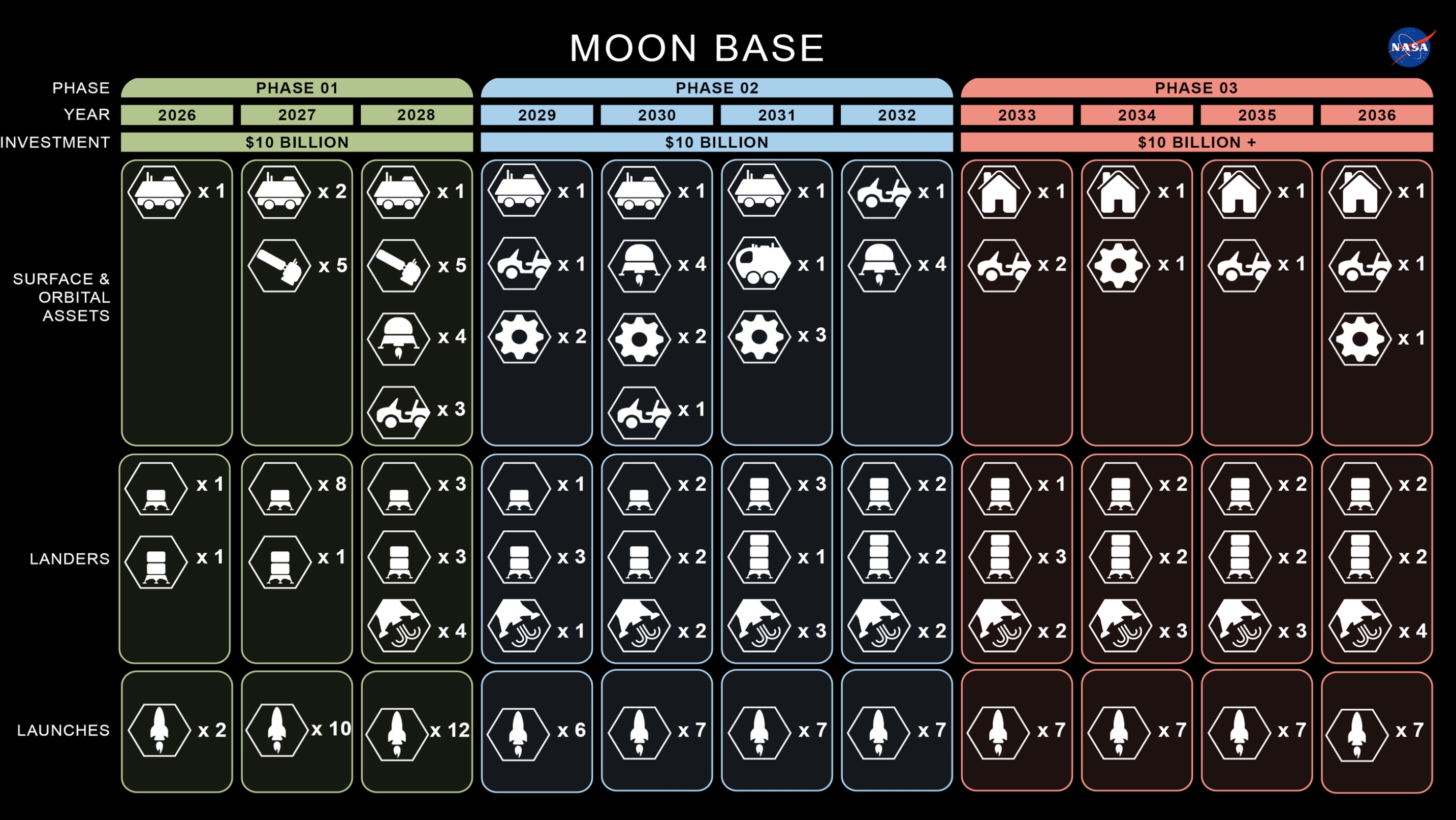
However, while there is all this interest in supporting—and winning contracts for—development of a lunar base, there are still few details about how it will all come together. At Ignition, Garcia-Galan outlines a three-phase plan for its development from 2026 through 2036. That included a chart with showed all the landers, rovers, habitats, satellites and other components envisioned for the base.
It also included cost estimates: $10 billion for Phase 1, from 2026 to 2028, another $10 billion for Phase 2, from 2029 through 2032, and at least $10 billion for Phase 3, from 2032 through 2036.
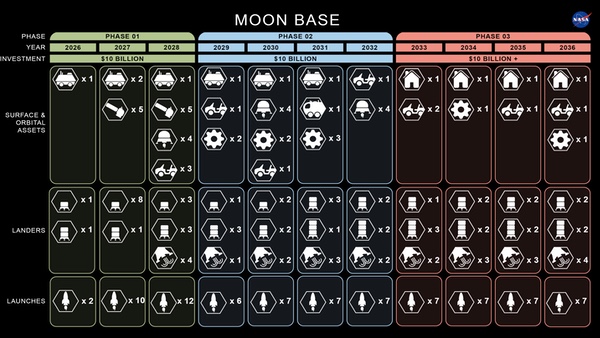 A chart from a NASA presentation at Ignition listing all of the missions and infrastructure planned for its lunar base. (larger version) (credit: NASA) |
However, beyond that, NASA has offered few details about exactly how it will spend that money. That vagueness is deliberate in some respects: the agency issued requests for information on topics such as LTV, Moonbase capabilities, and a new version of its Commercial Lunar Payload Services (CLPS) contract, CLPS 2.0.
NASA should lead development of the lunar base, said Nujoud Merancy, deputy associate administrator of the exploration mission directorate’s strategy and architecture office at NASA, during a panel at the LSIC meeting. But, she noted, the agency will look to industry for its concepts of how to provide the hardware and services it envisions for the base.
“That’s what we’re doing and we’re looking to buy,” she said. “That doesn’t mean we tell you exactly how to build something.”
How much NASA will be buying it also uncertain despite the dollar figures announced at Ignition. The agency is already more than seven months into the 2026 fiscal year, limiting how much it could spend on projects related to a Moonbase. (The agency has yet to publish an operating plan detailing how it would spend the money appropriated by Congress in January, well before the Ignition announcement.) NASA’s fiscal year 2027 budget proposal, released a week and a half after Ignition, did not include funding lines for the effort for 2027 or future years.
One likely contracting vehicle for the lunar base will be CLPS. At Ignition and subsequent events, agency officials have talked about going to nearly a monthly cadence of lunar landings, including nine in 2027 and ten in 2028. That’s far more than the two performed last year and the two to four expected this year.
Last week, NASA issued a procurement notice announcing its intent to increase the ceiling on the CLPS contract, which runs through 2028, from $2.6 billion to $4.2 billion. NASA has, so far, awarded less than $2 billion in CLPS task orders, suggesting it is planning a major increase in awards through the current contract’s final years.
Companies participating in CLPS, who have been building on average of one lander a year, said at the LSIC meeting they’re ready to rapidly ramp up production, but offered few details about how many landers a year they can make or how quickly they can accelerate production. They emphasized expanded facilities and developing “build-to-print” landers rather than customized ones.
“We’ve got the basic DNA and roadmap” to meet higher demand, said Dan Hendrickson, vice president of business development at Astrobotic. “We’re starting from a place in which we have facilities that were intended to have multiple landers in development.”
In an earnings call Monday, Jason Kim, CEO of Firefly Aerospace, also said his company was ready to capitalize on NASA’s projected increased demand. “The lunar opportunity is here,” he said. “Our prior growth strategy was to extend from one moon landing a year to multiple a year, and now we have an amplified demand signal from NASA.”
That included, he added, development of landers larger than Blue Ghost, which can carry up to 240 kilograms, with versions that can meet NASA’s needs to deliver several metric tons to the surface. “Those are all in our roadmap,” he said. “Our larger lunar lander designs are scalable to meet that demand.”
| “There’s a lot of reasons to build the Moonbase. The first is because we can,” said Charlie Powell. |
There is also a more fundamental uncertainty: what the Moonbase will be used for. NASA has said little about specific requirements for the facility, such as how many people it can support and for how long, how much power it will need, what amount of bandwidth it will use, or even general descriptions of activities that will take place there. All those, of course, drive the technologies that need to be developed and the infrastructure emplaced there.
“There’s a lot of reasons to build the Moonbase. The first is because we can,” said Charlie Powell, assistant director for space and spectrum in the White House’s Office of Science and Technology Policy, during a session at Space Symposium. What has halted development of a base, he argued, was the “myopia of policy vision” and high transportation costs, both of which he believed were being corrected.
“The second reason to build a Moonbase is that we must,” he said, citing its strategic importance and value in inspiring future generations. A base, he said, had value for science, “programmatic flexibility” in working with various partners, and commercial potential.
One company examining the commercial potential of the Moon is Interlune, a Seattle-based company with ambitions to extract helium-3 emplaced by the solar wind in the lunar regolith. That isotope, relatively rare on Earth, could have applications in fields like medical imaging and quantum computing—and, of course, fusion power, eventually.
Rob Meyerson, CEO of Interlune, said in an interview that his company doesn’t necessarily expect to operate at the lunar base, in part because of its location at the south polar region of the Moon: the lunar equatorial regions are thought to have higher concentrations of helium-3 that makes mining feasible.
However, he said he expected Interlune to leverage the infrastructure that will be developed to support the base no matter where the company chooses to operate. “The Moonbase is going to be essential to us, whether we’re operating adjacent to the Moonbase or not,” he said. “We can serve, and we do serve, as a commercial partner and commercial use case for anyone that’s building infrastructure on the Moon.”
In the coming months, NASA’s lunar base plans will likely come into sharper focus as the agency processes responses to its RFI and refines its budgets. That will help determine if the excitement NASA kindled at Ignition can be turned into a sustainable program that results in a real lunar base of any size.
Note: we are now moderating comments. There will be a delay in posting comments and no guarantee that all submitted comments will be posted.