Battle for the heavens: intelligence satellite vulnerability in the 1970sby Dwayne A. Day
|
| There was another and more obvious response to the increasing vulnerability of US satellites to attack: make them less vulnerable. |
American satellite vulnerability became a major concern by the mid-1970s and, in July 1976, President Ford signed National Security Decision Memorandum 333 (NSDM 333), titled “Enhanced Survivability of Critical U.S. Military and Intelligence Space Systems.” It shifted the United States from a policy of assuming space was a “sanctuary” and satellites would not be attacked, eventually to development of an American capability to attack Soviet satellites. By the late 1970s, space warfare had become a real possibility (see “To attack or deter? The role of anti-satellite weapons,” The Space Review, April 20, 2020.)
But there was another and more obvious response to the increasing vulnerability of US satellites to attack: make them less vulnerable. In response to NSDM 333 in October 1976, the National Reconnaissance Office, which managed the nation’s fleet of intelligence satellites, produced a report on the vulnerability of its satellites to attack and plans to reduce their vulnerability. The executive summary of the report was recently declassified and provides a fascinating insight into the emerging threats to American satellites in the mid-1970s.
Titled “Survivability Enhancement Action Plan,” with a clever 1970 cover illustration produced by Soviet military officers depicting “The Space Networks of Espionage,” the summary stated that, up to this point the NRO had assumed “that reconnaissance satellites are stabilizing in times of crisis, and that reconnaissance spacecraft are therefore sanctioned,” in other words safe from attack. But this situation was changing and they could no longer assume this.
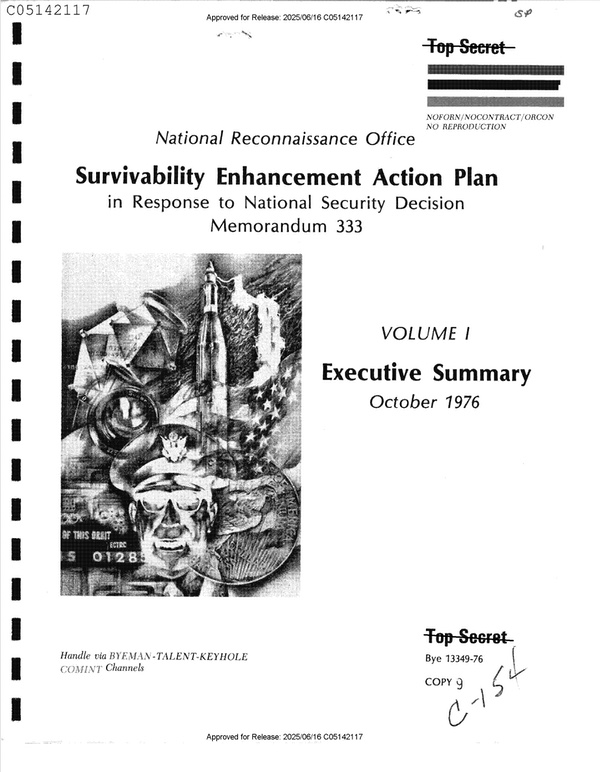 The cover of a 1976 study on how to make American intelligence satellites more survivable. The cover art was produced by two Soviet officers for a Soviet military journal and probably not used with their permission. (credit: NRO) |
The document added: “In the belief that the programmatic goal at this point is to define a general survivability objective and level of effort, the NRO has developed several alternative programs of graduated cost and effectiveness against the foreign threat. To assure confidence in the resulting cost estimates, these alternatives have been constructed from specific projects identified for each system.” Because of the speed of the study, the cost estimates were rough and a detailed follow-on study would be required.
The study focused on the next five to ten years, developing remedies for systems already in acquisition. It noted, “Such remedies are typically only partially effective, since they basically require retrofitting systems not initially designed for survivability. The far-term offers greater opportunity. New reconnaissance system concepts can be developed from the beginning with survivability as a major system performance criteria. Systems specifically emphasizing survivability can be conceived, taking advantage of such recent introductions as the Space Shuttle.” The NRO indicated that it might also investigate fundamentally different systems, such as quick-reaction imagery and signals intelligence systems.
| Countermeasures came with costs, however. These were not only monetary—hardening a satellite could be expensive—but could affect satellite operations. |
The study divided existing NRO satellite systems into three categories: most critical, critical, and least critical. In the most critical category was the KH-11 KENNEN near-real-time imaging satellite, which would have its first launch in December 1976. Two other systems with their names deleted were also included in the most critical category and these were most likely high-altitude signals intelligence satellites, such as the recently declassified JUMPSEAT satellite. Several systems with their names deleted were included in the “critical” category, probably including the newly-fielded PARCAE ocean-surveillance system and at least one other high-altitude signals intelligence system.
In the least critical category were the HEXAGON and GAMBIT imagery satellites, and the Program 989 low-orbiting signals intelligence satellites. A primary characteristic of these three systems was that they did not deliver their data to the ground very quickly and therefore were not as vital during a crisis situation.
The DoD/Intelligence Community NSDM 333 Response Working Group developed a list of operational options:
- Maintain space operations in peacetime (but during interference)
- Manage and control escalation or deescalation of US/Soviet crisis/confrontation
- Manage and control escalation of a conventional conflict involving the US but not involving the Soviet Union or vital Soviet interests (e.g., Vietnam)
- Maximize military support of a conventional conflict involving the US but not involving the Soviet Union or vital Soviet interests (e.g., Vietnam)
- Manage and control escalation of a US/Soviet conventional conflict
- Maximize military support during a US/Soviet conventional conflict
- Manage and control escalation of a NATO/Pact conflict
- Maximize military support during a NATO/Pact conflict
- Support the conduct of limited strategic nuclear options
- Support the conduct of strategic nuclear conflict
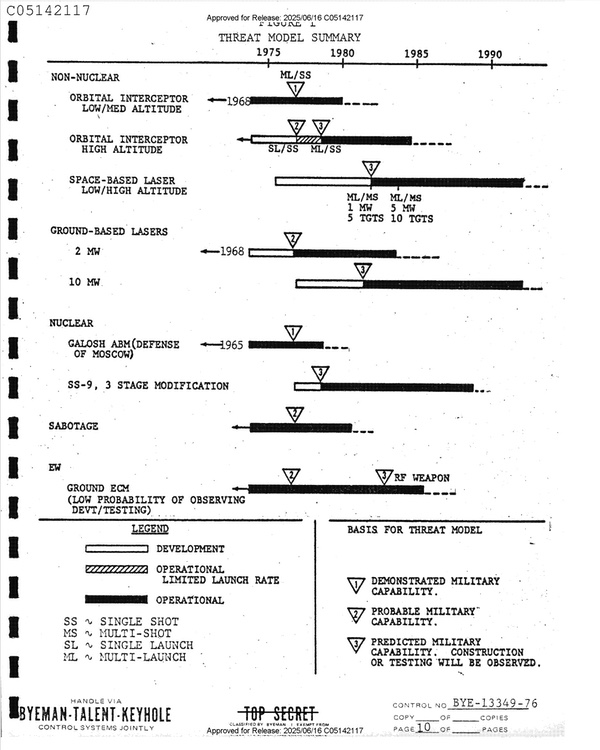 In the mid-1970s, the US military determined that there were multiple potential threats to American satellites from Soviet weapons, not only operational anti-satellite weapons, but also newly emerging threats like high-powered lasers. (credit: NRO) |
The Soviet threat
The vulnerability study summarized the Soviet threat, noting that:
The Soviet ASAT threat to U.S. satellites consists of a variety of systems and capabilities. The Soviets have a coorbital intercept system that uses a fragmentation warhead. It uses a modified SS-9 ICBM booster and can intercept targets at up to 2,500 NM altitude. Using a larger space booster, it could intercept targets in semi-synchronous and synchronous (19,300 NM) orbits. A probable high power ground-based laser, possibly already in operation, may be an ASAT system under development. It is likely the Soviets will undertake development of a very high power ground-based laser ASAT system. The Soviets intend to conduct electronic warfare against satellites during wartime and are believed to have such a capability. The Soviets are reportedly developing a space-based laser weapon for use against satellites which could be demonstrated in the early 1980s. In addition, the nuclear-armed Galosh ABM interceptors would undoubtedly be used in an ASAT role against satellites thought to threaten Moscow. The Soviets could develop nuclear intercept systems for attack of very high altitude satellites. There is no evidence of such development. The Soviets also have the capability for covert attacks on space systems ground facilities in the U.S. and overseas. It is highly likely that the Soviets will develop radio-frequency damage weapons, in spite of the uncertainty in achieving kill inherent in such weapons.
The NRO also noted that its “systems are also vulnerable to inadvertent destruction from non-targeted nuclear weapons and sabotage of ground facilities.”
The report stated that “the development of very high value National Reconnaissance Program collection systems has placed a premium on survival techniques to allow mission completion by existing or replacement systems. The application of sophisticated U.S. space technology in the survival enhancement area is expected to provide a high payoff in mission completion and in increasing the difficulties encountered by the Soviet ASAT forces.”
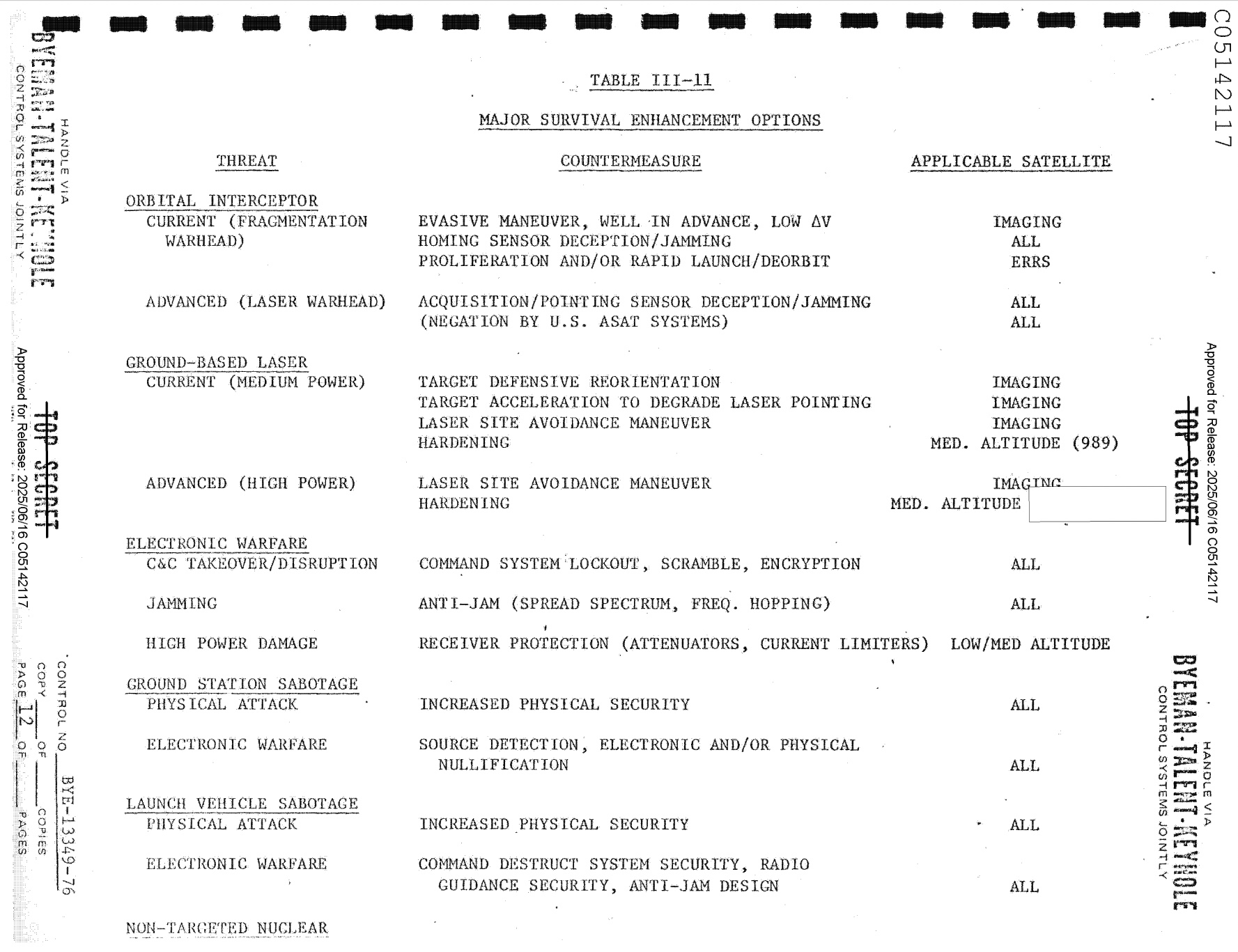
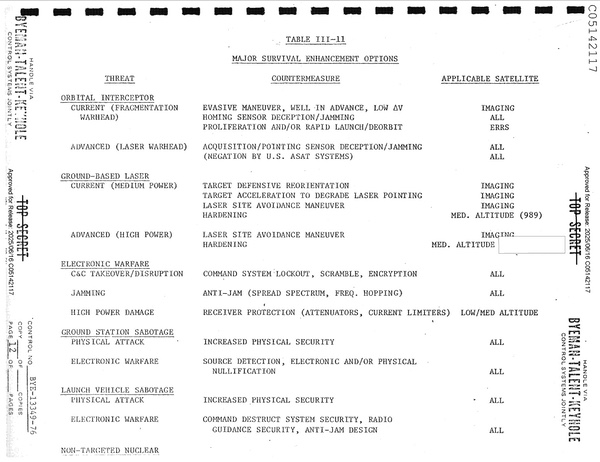 A table showing potential threats to American intelligence satellites and potential countermeasures to defeat them. (larger version) (credit: NRO) |
Surviving the Soviet threat
The summary included a table of “Major Survival Enhancement Options” that identified both the threat and the countermeasure. For instance, countermeasures to orbital interceptors included evasive maneuvers, homing sensor deception and jamming, as well as the proliferation of systems (i.e. not putting all the NRO’s eggs in one basket.) For a high-power laser threat, the countermeasures included avoiding the laser site and hardening the satellite. Physical attacks on ground stations and launch vehicles could be countered with increased physical security.
Countermeasures came with costs, however. These were not only monetary—hardening a satellite could be expensive—but could affect satellite operations. As the report noted, maneuvering would make an attack more difficult, but would also limit the effectiveness, and maybe the orbital lifetime, of the satellite. In the future, if decreasing vulnerability was a design goal, satellites could be designed with more fuel, increasing their lifetime and making it possible to change orbits to dodge threats.
The report stated that encryption was by then fully implemented on several systems and would be included in all new systems and retrofitted onto older ones. “Minimal on-board verification sensors for laser attack” were included on HEXAGON and KENNEN satellites, and a “more complete verification package, including an expanded sensor complement to respond to other threats and reduce ambiguities” would be developed in the near-future.
| Certainly, the issue of satellite vulnerability has become more urgent today, as many more governments now have access to anti-satellite capabilities. But as the report makes clear, this has been true for a very long time. |
Eighteen months earlier the NRO had started an effort to harden its ground facilities against attack. However, some of these facilities, like the ground tracking and communications station at Buckley Air Force Base north of Denver, and the Space Tracking Center in Sunnyvale, California (famously referred to as “The Blue Cube”), were located very close to busy civilian areas. It would not be difficult for an enemy special operations team to get close to them to attack, even if that only meant firing rocket-propelled grenades from the back of a pickup truck on the 101 Freeway in California. Vandenberg Air Force Base, where many NRO satellites were launched, was a sprawling facility with vast, open, lightly-patrolled spaces. Throughout its history, there is evidence that both amateur rocket enthusiasts and possibly even Soviet special operatives penetrated the base.
One of the major recommendations was that survivability should be included as a system performance evaluation criteria. It had to be considered from the start, not added in after all the other performance decisions were made.
Although the summary is not highly detailed, the fact that the NRO even declassified it is remarkable. Certainly, the issue of satellite vulnerability has become more urgent today, as many more governments now have access to anti-satellite capabilities, and space has become, in the euphemism of the warfighter, “a contested realm.” But as the report makes clear, this has been true for a very long time.
Note: we are now moderating comments. There will be a delay in posting comments and no guarantee that all submitted comments will be posted.