Flagships on a budgetby Jeff Foust
|
| “We're on track, as the administrator said, to launch early in September, and that is, I can't stop saying it, ahead of schedule and under budget,” Fox said of Roman. |
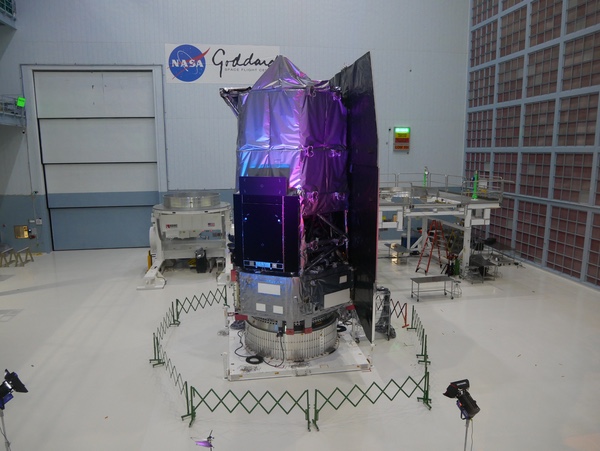
Roman has been spared much of the development drama that enveloped the James Webb Space Telescope. At the media day, NASA administrator Jared Isaacman announced the agency is planning a launch of Roman on a Falcon Heavy in early September. That is eight months ahead of the launch readiness date of May 2027 NASA set for the mission when it passed its confirmation review several years ago, while also remaining within a total lifecycle cost of $4.3 billion.
“We're on track, as the administrator said, to launch early in September, and that is, I can't stop saying it, ahead of schedule and under budget,” said Nicky Fox, NASA associate administrator for science (who indeed has consistently mentioned Roman’s cost and schedule performance.)
Given the delays and overruns experienced by JWST, no one can blame NASA for trumpeting the performance of Roman. But what is the secret to its success?
One factor, project officials said, is that the mission took into account programmatic factors like cost and schedule into account alongside technical issues. “Something that we’ve done on Roman is we added the programmatics to that balancing equation, so everybody from the project manager all the way down to the techs on the floor understand how the cost and the schedule and the technical all have to come together on Roman,” said Jackie Townsend, Roman deputy project manager, in an interview during the media day.
Another factor, she said, was the cost cap placed on Roman early in its development, along with “forward-phased” funding that avoided cash flow issues. “That combination of a cost cap and forward-phased funding allows for smart decisions all the way through the life cycle.”
NASA officials long stressed that keeping Roman on budget and on schedule was critical to the future of large flagship missions in the agency’s science directorate. If NASA could convince stakeholders, particularly in Congress, that it can avoid the problems from Webb, it believes it will be easier to secure funding for future flagship missions, like the Habitable Worlds Observatory.
That logic appears to be working. Congress, in a fiscal year 2026 spending bill passed in January, provided $150 million for the Habitable Worlds Observatory, far more than the $3.3 million NASA requested for the mission in its proposal that slashed funding across the agency’s science programs.
The funding is helping the program accelerate early design and technology work on the mission, which will fly a mirror between six and eight meters across with a coronagraph that will enable it to directly image Earth-sized exoplanets. “We’re finally going to get to accelerate our mission progress with real funding,” Giada Arney, project scientist for the mission, said at an American Astronomical Society (AAS) conference in January.
Habitable Worlds is projected to launch no sooner than the early 2040s, but at the conference NASA officials suggested they would like to move up the mission.
| “Nancy Grace Roman is not the last flagship mission for us” despite budget uncertainty, Isaacman said. |
“The things you do to move faster on the larger-scale missions at the outset are things we’re asking this community, and the people you work with outside this room, to do over the next few years,” said Shawn Domagal-Goldman, director of NASA’s astrophysics division, during a session about the mission at the AAS meeting.
Isaacman, in a town hall the day after he was sworn in as administrator in December, also endorsed faster and more frequent flagship missions. “It would be great if we were launching flagship missions with even a greater cadence,” he said.
That, though, clashes with both the costs of flagship missions as well as budget challenges. NASA’s fiscal year 2027 budget proposal would again cut NASA’s science programs by nearly 50%. Habitable Worlds would get just $5 million, jeopardizing the progress made to date on the mission and any efforts to accelerate its development.
Isaacman argued that there is still room for flagship-class missions with those budgets. “Nancy Grace Roman is not the last flagship mission for us,” he said, citing work on Dragonfly, a mission under development to send a nuclear-powered rotorcraft to Saturn’s moon Titan. (Dragonfly is not technically a flagship mission, instead selected as part of the New Frontiers line of planetary science missions, but its costs have swelled to levels closer to a flagship.)
“Going out and trying to unlock the secrets of the universe is fundamental to NASA's mission. I expect there'll be plenty of flagship missions in the future,” he argued.
The flaglet approach
It is difficult, though, to square the desire to continue to do flagship space science missions, let alone do more of them, in the current budgetary environment. That’s led to discussion about other ways to do science associated with such missions.
When the latest astrophysics decadal survey, Astro2020, recommended what became known as the Habitable Worlds Observatory as its top flagship mission, it did so as part of a program of such missions that would later include X-ray and infrared space telescopes. It was modeled on NASA’s original “Great Observatories” program that included the Hubble Space Telescope, Chandra X-ray Observatory, Compton Gamma-Ray Observatory, and Spitzer Space Telescope, which observed the universe from infrared to gamma rays.
Habitable Worlds and those future observatories would address many key scientific questions, but do so on a timescale of decades. That is in part because of the schedule for their development: NASA doesn’t anticipate starting work on the mission to follow Habitable Worlds—either the X-ray or infrared telescope—until at least the early 2030s.
| “This was really exciting because four seems like a tractable number” of missons, said Caputo. “It’s not 100.” |
There may be ways to accelerate that scientific quest. In a white paper completed last September and published last week on the arXiv preprint server, a team at NASA Goddard proposed a faster approach to addressing most of the scientific questions from Astro2020.
“The study really came from a feeling that I had,” said Regina Caputo, first author of the study, during a seminar last Thursday, “that the current mission approach that we had, that we were implementing in order to realize Astro2020, was missing some key capabilities.”
That sentiment, she said, was shared by colleagues at Goddard. “We thought we’ll do the nerdiest thing that we could possibly think of and actually analyze the questions in the decadal survey to see if our feelings were correct.”
The approach the study took was not to try to build more flagship missions but instead see if they could be supplemented by smaller missions, dubbed “flaglets.” These would be missions costing $1 billion to $2 billion each, similar to the Astrophysics Probe line of missions also recommended by the decadal that NASA is starting to pursue.
The study took the priority questions from Astro2020 and the capabilities needed to answer them, along with similar questions from planetary science and heliophysics decadal surveys that could also be addressed by potential missions. Those 85 questions were cross-referenced with both flagship missions and 23 concepts for probe missions that were submitted as part of the development of Astro2020.
The goal was to see how many probe-class missions could answer the majority of the science questions from the decadal, filling gaps from the flagships. “What was really cool was that, with four probes, you could at least somewhat address over 80% of decadal survey science questions,” she said. “This was really exciting because four seems like a tractable number. It’s not 100.”
Caputo and others involved in the study emphasized they were not recommending four specific probe concepts but rather that some combination of four of them could address 80% of the science questions to come degree, with different sets of missions answering a different group of questions.
The study presented what it called the “Flaglet Great Observatories” program to develop those missions. In one scenario, one flaglet would start development in fiscal year 2030 with the other three following every two years, each costing $1.5 billion. A spending profile showed the peak annual spending on the program reaching just under $525 million in 2041, but with the overall funding profile significantly smaller than that of JWST.
An alternative approach would cap annual spending on the program at $400 million, or about a quarter of the current NASA astrophysics budget. That had the effect of stretching out the program, with missions starting every three to four years instead of every two.
In a panel discussion that followed, members of the study team emphasized that the flaglets they proposed were not meant to replace flagship missions like Habitable Worlds Observatory.
“There are gaps in the recommendations from the decadal survey going forward that the even the current suite of flagships don’t address and won’t address in the coming decades,” said Jennifer Wiseman, senior project scientist for Hubble. “This is a wonderful, we think, way of addressing a lot of those questions—something like 80% of the decadal survey priorities—in the next decade or a little bit beyond.”
| When NASA selects a flagship mission for development, “the whole field is often warped into that one direction,” said Mandell. |
Flaglets would fit into NASA’s astrophysics budget, particularly using the cost-cap approach, along with a flagship-class mission and other, smaller missions and research. “There are some puts and takes, but it all still fits,” said Joshua Schlieder of Goddard’s Exoplanets and Stellar Astrophysics Laboratory.
Flaglets have other advantages as well. When NASA selects a flagship mission for development, “the whole field is often warped into that one direction,” said Avi Mandell of Goddard’s Planetary Systems Laboratory. “People specializing in other wavelength ranges feel like maybe they don’t even have a career for the next 15 years.”
A series of missions spread across the spectrum and the range of scientific questions highlights in the decadal eases those concerns. “In this perspective, where you have a built-in cross-wavelength, cross-science portfolio that is somewhat locked in, it gives a lot of impetus and motivation for people to feel free to pick the wavelengths and science that is really of need and interest,” he said.
The flaglet concept is, for now, just a concept, without formal agency backing. However, it fits into a new effort within NASA called the Astrophysics Strategic Technology and Research Accelerator (ASTRA). It is designed to identify and study probe and flagship mission concepts in their earliest phases. That will include far-infrared and X-ray flagship concepts as recommended by Astro2020 but also other future concepts.
ASTRA includes workshops late this month on innovation in astrophysics mission concepts and another in September on science priorities. The agency plans to select mission concepts for study at the January 2027 AAS conference.
That work will continue amid budget uncertainty: NASA’s Astrophysics Probe program, the model for the flaglet concept, is among the dozens of science missions that the agency’s fiscal year 2027 budget request would cancel. That was also true in 2026, but Congress rejected those cuts and may do so again.
The flaglet approach does offer a way to answer astronomers’ pressing questions without relying primarily on flagships. “The fleet is bigger than the sum of its parts,” said Caputo. “You answer bigger questions when you have more tools at your disposal to address them.”
Note: we are now moderating comments. There will be a delay in posting comments and no guarantee that all submitted comments will be posted.