Exquisitely unnecessary: very high resolution satellite reconnaissanceby Dwayne A. Day
|
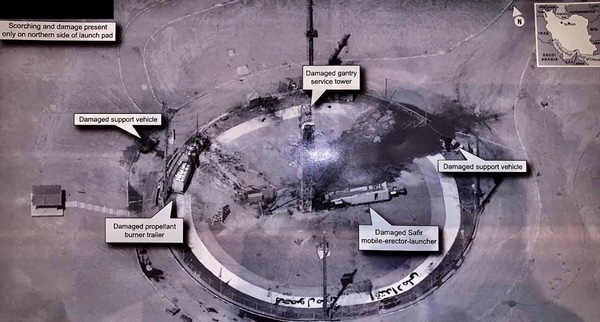
| Other than carrying astronauts, MOL’s primary attribute was very high resolution, so intelligence officials asked what could VHR do, what did that mean for national security, and was it worth the immense cost? |
Despite the discussion now being almost 60 years old, it provides an excellent insight into Cold War deliberations about the value of very high resolution satellite reconnaissance. Prior to the cancellation of MOL, very high resolution was discussed solely in terms of MOL, which had the primary justification—although not openly admitted—of putting military astronauts in space first, and finding something useful to do second. Thus, VHR was not the primary requirement for MOL. After MOL’s cancellation, very high resolution reconnaissance had to be evaluated against other factors, such as its cost and its value for intelligence collection.
What the discussion makes clear is that very high resolution could not be judged merely in relation to other photo-reconnaissance systems like the then high-resolution GAMBIT-3, but had to be considered in relation to other types of intelligence collection including signals intelligence. The opportunity costs of developing it also had to be evaluated. Finally, a major question was whether very high resolution reconnaissance would substantively affect US military policies and forces. How would VHR imagery, as opposed to high-resolution imagery, improve understanding of Soviet weapons development, and would this matter? A VHR satellite required large optics, a large spacecraft, and a larger rocket—all of which added up to higher costs. If building a new VHR satellite meant that the United States did not build another type of satellite, how would this affect intelligence collection? If a new VHR satellite was expensive to build, but did not save money by improving or reducing the need for strategic forces, was it worth it?
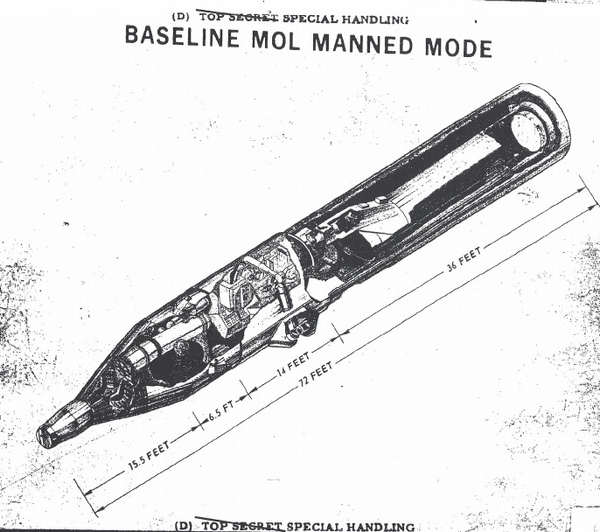 Declassified cutaway of the Manned Orbiting Laboratory and its DORIAN optical system. MOL was a very high resolution system that was canceled in 1969. (credit: NRO) |
MOL development change paper and ODDR&E study on VHR
In late 1968, the MOL program produced a development change paper, or DCP, intended to justify the continued need for MOL despite its increasing costs. The DCP was supported by a study produced by the Secretary of Defense’s Office of Design, Development, Research and Engineering (ODDR&E) titled “The Need for Very High Resolution Imagery and Its Contribution to DoD Operations and Decisions.” Although neither the DCP nor the VHR study have been released, there is a detailed response to it written in early 1969 by a DoD official. He sought to address what he believed to be the core issues: “the value of very high resolution imagery, the urgency with which we need it, and alternative ways of obtaining such imagery.”
Ivan Selin, who at that time was the Deputy Assistant Secretary for Strategic Programs for the Department of Defense wrote: “The MOL DCP concludes that the need for VHR imagery is great enough and urgent enough to spend more than $1.5 billion on MOL in FY69 through FY71.”
Selin wrote that the DCP and the ODDR&E study “argue that VHR imagery will be valuable in two general ways. First, such imagery might improve our estimates of the capabilities of Soviet and Chinese forces, permitting us to plan less conservative, and therefore less expensive, forces. Second, VHR imagery might provide enough detail about the military characteristics of Soviet and Chinese weapons to permit better design of our weapons, either to reduce their vulnerabilities or to enhance other aspects of their effectiveness.”
The value of VHR
The CORONA search satellite had, at best, six-foot (1.8-meter) resolution and was scheduled to be replaced by 1970 or 1971 by the HEXAGON, with resolution of one to three feet (61-91 centimeters). The GAMBIT-3 (also referred to as the KH-8) entered service in 1966 and its resolution was apparently initially around two feet (61 centimeters), improving to twelve-inches (30 centimeters) relatively quickly. The goal for the Manned Orbiting Laboratory and its big DORIAN optical system was around six inches (15 centimeters) resolution on the ground, possibly up to four inches (10 centimeters) if viewing conditions were ideal. The Very High Resolution satellite then being discussed in 1968 was intended to have resolution better or equal to DORIAN.
Selin stated that the DCP and ODDR&E study justified very high resolution according to several factors: its value for evaluating anti-ballistic missile (ABM) capabilities, assessing Soviet air defense systems, and determining Soviet capabilities to attack American armored vehicles. He also sought to place it in context with other possible new reconnaissance systems.
| Selin thought that the analysis of very high resolution satellite photography in support of future strategic force decisions was weak. In short, very high resolution satellite photographs would not have any notable impact on the US warfighting strategy. |
“VHR imagery is not required to determine such things of immediate importance as numbers of Soviet strategic offensive and defensive weapons and numbers of Soviet, Bloc, and Chinese general purpose forces units, where these are deployed, and the equipment they possess,” Selin wrote. He believed that “VHR imagery can contribute to more refined estimates of some of the performance parameters of weapons, both before and after their deployment. The resulting estimates even with VHR imagery will be of modest confidence because of a large number of factors. We have not found examples of such estimates to which VHR can contribute, which have a strong influence on major resource allocation decisions.”
Selin stated that there were some “relatively urgent intelligence needs” that could be provided by real-time systems able to return imagery within hours of taking photographs, but very high resolution would not be able to contribute much. “On balance, I believe that VHR imagery may provide some useful information we cannot now obtain and that it will be a worthwhile if marginal addition to our collection program. However, I do not believe large savings will result from VHR imagery,” nor that it would make major changes in the confidence with which the United States estimates Soviet and Chinese threats.
Selin believed there were two realistic courses of action: exploit an existing system such as GAMBIT-3 or HEXAGON to obtain photography of resolution between that of GAMBIT-3 and MOL (meaning between 4 to 13 inches ground resolution), or do advanced development of the optical and other systems for an unmanned VHR satellite to be operational at some time in the future.
The cost of MOL
By late 1968, both the HEXAGON and MOL programs were behind schedule and over-budget. MOL had cost more and slipped more than HEXAGON. But they were not equivalent systems. MOL was a very high resolution system, whereas HEXAGON was designed to gather medium-resolution imagery for large areas. MOL’s startup costs were estimated to be around $3 billion, with $100 million for each mission. Both were scheduled to become operational by 1970.
Much of Selin’s memo was devoted to discussing the current US strategic warfighting strategy, which he referred to as the Assured Destruction strategy. This strategy required the US to be able to accept a nuclear first strike from the Soviet Union and still “kill 20% to 25%” of the Soviet population.
Selin thought that the analysis of very high resolution satellite photography in support of future strategic force decisions was weak. In short, very high resolution satellite photographs would not have any notable impact on the US warfighting strategy. The US strategic policy towards the Soviet anti-ballistic missile system was “exhaustion” of the defending ABM system—send more warheads than the ABM system could shoot down. It was a question of numbers, not of capability. Higher resolution photographs of Soviet ABM interceptors were not going to change that policy.
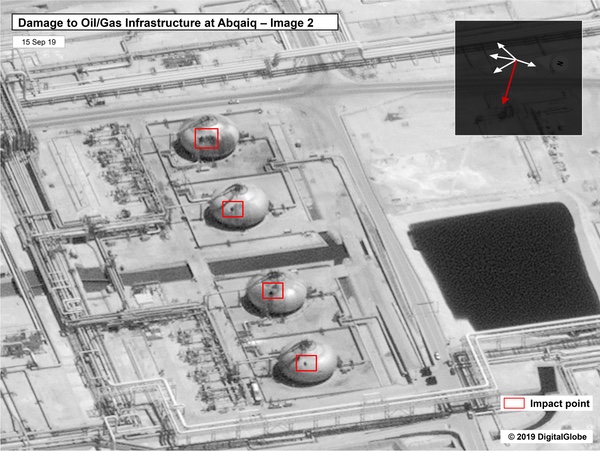 A commercial satellite image from 2019 showing damage to an oil refinery. Commercial imagery with resolution of 0.3 to 1 meters is readily available and sufficient for most non-military and many military uses. (credit: DigitalGlobe) |
Strategic forces decisions and VHR
The arguments in favor of VHR were divided into several other categories. Selin believed these arguments were also weak.
Soviet ballistic missiles
“We need to know the number of independent ballistic missile reentry vehicles that can be delivered, their reliability, delivery accuracy, and yield. Of these, by far the most important are numbers and accuracy,” Selin stated. Very high resolution photos would not change that.
The American Sentinel ABM system then being proposed would have very little defense against Soviet attack. “If the Soviets take even simple steps to exhaust it, Soviet penetration capabilities beyond use of chaff are now of little importance.”
“VHR imagery can be expected to make little or no additional contribution to determining either numbers or accuracy of Soviet ballistic missiles. It is conceivable that such imagery could help determine the payload (through better measurements) and hence the yield of a missile such as the SS-13, but because our ICBM vulnerability is not very sensitive to yield, the value of every refined yield information is low.”
“The primary damage limiting contributions suggested by the report for DORIAN are improving our estimates of Soviet ICBM silo hardness and determining more about Soviet capabilities to penetrate our anti-Soviet ABM (which we have not yet decided to buy).”
VHR could improve estimates of Soviet silo lid thickness, but other factors dominate. “Even with complete drawings, exhaustive soil tests, and finally, full scale high explosive tests, we were and are unsure of the true hardness, especially the upper limit, of the [U.S. Air Force’s] Minuteman facilities.” The hardness of Soviet silos “is of interest, but does not drive either our force requirements or the way we might use these forces.”
“The study also argued that DORIAN might get VHR pictures of Soviet reentry systems. This seems highly unlikely. Advanced reentry systems of the type we are developing and testing just aren’t exposed to overhead photography; MIRVs, decoys, chaff, etc., are nearly always, as a minimum, under wind shields when the boosters are on the test pads. Even if such photographs were obtained, they would tell us very little about penetration capabilities. If we were to deploy a heavy ABM against the Soviets, we would still need collectors like Sentinel Foam to acquire necessary reentry data. DORIAN would add very little to our knowledge in this case.”
Very high resolution would not change the best confidence in best estimates of ABM parameters, and even if it did, that would not change the strategic situation. Selin added that “relatively few lives can be saved by modifying our war plan if it is discovered that a Soviet ABM is in fact totally ineffective.”
Soviet area defense
“The effectiveness of Soviet air defenses, given known Soviet aircraft, are almost completely determined by the capabilities of Soviet airborne warning and control (AWACs) aircraft, interceptors, and air-to air missiles to find and shoot at low altitude targets.”
| It was difficult to define very high resolution requirements. This was a result of there being little experience with VHR over denied areas. |
One of the key questions at the time was whether the Soviet Union’s high-speed MiG-25 Foxbat interceptor would have shoot-down missiles that could attack low-flying American aircraft. The MiG-25 first flew in 1964, and was shown off to the Soviet public in a 1967 airshow. Although VHR satellites might detect missiles under the wings of MiG-25s, they would not provide information on whether the missiles could be fired downward and detect an aircraft from ground clutter, so-called “look-down/shoot-down” capability. Indeed, in 1976, when a Soviet pilot flew his MiG-25 to Japan, American technicians were able to examine the plane’s radar in detail—and question the pilot—and were surprised that it still lacked that capability.
As Selin stated, the primary factors for successful Soviet air defense were “an electronic capability, SAM [surface-to-air missile] firepower and SAM reaction time, both electronic and data handling capabilities. None of these are very susceptible to analysis by VHR imagery.”
Soviet anti-submarine warfare (ASW)
“The kinds of things we might see with VHR imagery such as deck-mounted ASW weapons, sonar domes, and antennas are not the critical elements in a system with capabilities against our SSBNs [ballistic missile submarines]. The fundamental problems of detecting and tracking these submarines are not likely to be solved with equipment subject to VHR imagery.”
Similar to his argument about area defense, Selin claimed that very high resolution photos of Soviet anti-submarine warfare systems would not provide the most important information about them. The effectiveness of a sonar, for instance, had to be evaluated in the water by listening to it, not by looking at it from space.
In summary, Selin explained that “the report has identified the wrong features of Soviet systems as the important ones.”
Tactical forces decisions and VHR
Tanks and armored personnel carriers are designed to last five to ten years. They are designed conservatively to include possible threats even at the end of their lifetimes. “If VHR imagery were to reveal lesser threats [to American tanks], we would not reduce the design requirements on the” tank. “It is very unlikely that we would see advances exceeding our conservative postulation since: (1) many of the weapons simply would not be available to overhead photography of any resolution, and (2) because our postulations are very conservative, it is by definition, unlikely that we would discover more serious threats.”
“The capabilities of Soviet general purpose forces change slowly because it simply takes a long time to modernize these forces, since such modernization may require literally thousands of new weapons. A large change in the balance of our general purpose forces and the Soviets’ is very unlikely to come about because of Soviet technical innovations. We will gain much information on such changes from COMINT [communications intelligence], direct observation, and other sources in time to respond if a response is needed.”
Selin argued that the study “does not follow the arguments through that high priority efforts to get high resolution photography should result in similar efforts to respond to such photography—possibly because we have not in the recent past engaged in any major high priority programs to change the general purpose force weapons in response to surprises discovered by means other than VHR imagery.”
Unconvincing arguments
In May 1969, highly respected intelligence advisor Edwin “Din” Land wrote President Nixon recommending that he cancel MOL and continue development of a very high resolution camera that exploited DORIAN technology advances. Land also urged that most reconnaissance research and development be concentrated on near-real-time reconnaissance. He urged Nixon to start “highest priority” development of a “simple, long-life imaging satellite, using an array of photosensitive elements to convert the image to electrical signals for immediate transmission,” a system that the CIA was then developing known as ZAMAN (see “Intersections in Real Time: the decision to build the KH-11 KENNEN reconnaissance satellite (part 1)” The Space Review, September 9, 2019, and Part 2.)
The MOL program was canceled in June 1969. In September 1969, Major Richard L. Geer wrote a memo to the head of the NRO’s West Coast program office about the VHR issue. He noted that “Several high-powered studies have attempted to establish a case for VHR photography, mostly in support of MOL. A number of these (e.g. the Foster Study/Ad Hoc Evaluation Group) have made innumerable arguments, many of which were fairly impressive. Taken together, they ought to have made an unshakeable rationale for VHR. That they have not made a sufficient case to justify MOL is a matter of record. Whether they have made a sufficient case to justify funding any other VHR development is a matter of doubt.”
Geer’s memo mentioned Selin with a hint of disdain, implying that the people working in the NRO were aware of his arguments and didn’t agree with him. Nevertheless, they were not making a sufficient case for very high resolution to overcome those arguments.
Major Geer noted that it was hard to get complete community support for VHR funding when that might come at the expense of more pressing requirements such as search and surveillance. Now that the HEXAGON program seemed to be secure, VHR might have a better chance. But any VHR system was going to ultimately compete against other systems for funding.
Geer wrote that the second problem was that it was difficult to define very high resolution requirements. This was a result of there being little experience with VHR over denied areas. “Each intelligence target in the overhead reconnaissance inventory has a range of resolution requirements corresponding to what is desired to be known at any given time about that target. These requirements vary for a given target and a given time, but they range down to the equivalent of parade photography,” meaning the big military parades where the Soviets showed off some of their missiles while foreigners, including American intelligence officers, took photos.
“Partly as a consequence of this problem, there has never existed a consolidated list of actual targets requiring VHR,” Geer wrote. “There is some limit for any intelligence target beyond which increasing resolution of overhead photography is less rewarding than investment in other collection means.”
Geer noted that one problem that occurred with MOL was that the air and space weapons requirements for MOL imagery were much firmer than Army and Navy requirements, because the Air Force was given much more time to develop its requirements than the other two services. Thus, it appeared that the Air Force needed the imagery more than the Army or Navy, but this may have been inaccurate. The other forces needed more time to study the issue.
Geer also wrote that some of the statement of requirements for VHR were inflexible, citing the example of requiring VHR for an airfield for experimental aircraft, whereas the VHR was really only required when a new aircraft or missile was present. By being more flexible, this might create more opportunities. An example was using a modified GAMBIT satellite to spot VHR targets and only using the last few orbits to take the photos before jettisoning the first film return vehicle.
The high-level perspective
From around 1969 to 1971 there was apparently discussion of a VHR system that some referred to as HEXADOR, a combination of the HEXAGON spacecraft and DORIAN optics. However, it is unclear whether this was actively studied, or simply a basic proposal. There was also apparently some study of the technological advances required to achieve very high resolution in general.
| By 1971 the NRO should have realized that 2.5-centimeter (i.e. 1-inch) ground resolution wasn't possible, because it defied the laws of physics. |
What is better documented is that, from 1970 thru 1971, the majority of the discussion of new reconnaissance systems within the intelligence community focused not on VHR but on near-real-time. Acquiring imagery faster was a higher priority than acquiring better imagery. The resolution goal for the KH-11 KENNEN, which was approved for development in 1971, was probably around 12–18 inches (30–45 centimeters) ground resolution.
In April 1971, Director of the NRO John L. McLucas wrote a memo titled “Future of Drones and Aircraft in Overhead Reconnaissance” where he discussed the limited utility of drones and aircraft such as the U-2, particularly when it came to overflying hostile territory. McLucas explained that the approach the NRO was taking to improve the ability to return imagery faster was to have a satellite in orbit constantly, with the ultimate goal being the deployment of a near-real-time satellite using an electro-optical imaging system that beamed its images to the ground.
The new electro-optical imaging system, soon named KENNEN, was also going to cost a lot of money. “In order to acquire such a capability, which is some three or more years away, constraints have caused us to terminate all activities leading to a Very High Resolution system capable of some 1-inch to 5-inch resolution” (2.5–12.7 centimeters), McLucas explained.
But by the latter 1960s it was known within the reconnaissance community that there was a physical limit to resolution from a satellite due to atmospheric turbulence, and the lower-end number that McLucas cited as VHR’s goal was impossible to achieve.
In 1966, David Fried published a paper in the open literature that determined the atmospheric resolution limits of a satellite in low Earth orbit. Fried calculated that a satellite was limited to a resolution of no better than five to ten centimeters no matter how powerful its optics, and his conclusion was independently confirmed two years later by John C. Evvard. By 1971 the NRO should have realized that 2.5-centimeter (i.e. 1-inch) ground resolution wasn't possible, because it defied the laws of physics. Available technology, or even technology that might become available in the foreseeable future, could not bend the laws of physics. McLucas’ memo indicates that VHR was killed by budget constraints, not physical limits.
By 1971, Lew Allen was a brigadier general, and the head of the NRO’s headquarters staff in Washington, and would soon be named head of the Secretary of the Air Force Special Projects office (also known as SAFSP, the NRO’s Program A) in Los Angeles. He would later go on to become a full general, run the National Security Agency, become Air Force Chief of Staff, and after leaving the Air Force in 1982, he became director of the Jet Propulsion Laboratory. He had developed an almost scholarly perspective of satellite reconnaissance and the bureaucracy that managed it.
In 1974, Allen wrote an extended commentary about a top-secret draft NRO history and discussed what he referred to as the conflict between requirements for new reconnaissance systems vs. the “technological imperative”—meaning simply pushing the technology as far as it could go regardless of any specific requirement.
Allen observed that there were essentially three aspects to satellite reconnaissance. The first was quality, which mainly meant the resolution capability of a system. The second was quantity, which primarily referred to how much area coverage a satellite could provide. The third was timeliness. “There can be developed a logical description of requirements, as it relates to each factor,” Allen wrote, “but in truth (as [reconnaissance pioneer Amrom] Katz would say) the developments have been driven by the ‘technological imperative’ and the requirements here caught up later.”
Quality—the desire for higher and higher resolution photographs from space—drove the NRO to develop the GAMBIT system, the Manned Orbiting Laboratory (MOL) and its DORIAN optics system, and then to pursue improvements to GAMBIT. Quantity—the need for area coverage—led to the first reconnaissance satellite, CORONA, in 1959, followed by its replacement the HEXAGON system, which first flew in 1971. Allen viewed HEXAGON as an “ultimate” system. Its success had left the need for quantity “unfruitful for further dreams.”
Allen could often state—at least in top secret documents—the uncomfortable truths that others in his field might not acknowledge. In Allen’s view, the unstated primary requirement for MOL was to put military astronauts in space. Taking very high resolution photos was really only a justification for orbiting the astronauts, not a requirement that led to MOL.
“As the enormous value of overhead recce became more appreciated, it was always the strategic concept which dominated – technological advancement of Soviet weaponry – SALT – order of battle, etc.,” Allen wrote. General Allen’s views in 1974 did not contradict Selin’s arguments five years earlier.
Although General Allen indicated that he believed the technological imperative drove most space reconnaissance systems, that was not completely true. There were stated requirements that drove the development of CORONA, GAMBIT, and HEXAGON. Once each of those systems was in operation, the technological imperative took over as their designers strove to improve them to the maximum extent possible, eventually exceeding their requirements, sometimes substantially.
He was, however, correct about the technological imperative regarding very high resolution. There does not appear to have been any clear requirement during the 1960s for VHR. MOL’s requirement was to fly military astronauts and find something useful for them to do, and VHR was subservient to that requirement. If the astronauts were not needed, neither was VHR.
KENNEN, HEXADOR, and Advanced GAMBIT-3
This snapshot of arguments for and against very high resolution satellite photography represents only a brief moment of time. It is possible that the arguments changed, or that new types of strategic threats resulted in a change in the arguments for or against very high resolution. An example of the latter was the development by the Soviet Union of mobile ICBMs in the 1970s. Very good photos of mobile ICBMs were not important, but imagery that showed where they were right now was important. Tracking the locations of mobile ICBMs was much more dependent upon timely imagery, including possibly radar imagery to penetrate clouds and nighttime. Thus, a non-photographic system capable of providing that kind of imagery would have become more important during the 1970s when the Soviet Union began fielding road-mobile ICBMs.
| MOL’s requirement was to fly military astronauts and find something useful for them to do, and VHR was subservient to that requirement. If the astronauts were not needed, neither was VHR. |
In the early 1970s, the US Intelligence Community created the National Imagery Interpretability Rating Scale, or NIIRS, a subjective scale used for rating the quality of imagery acquired from various imagery systems. NIIRS consisted of ten levels, from 0 (worst quality) to 9 (best quality). The scales included the kinds of targets that could be identified for each level. (See Table 1) These changed over time as some targets, like obsolete weapons systems, were removed from use and no longer seen in imagery. NIIRS provides a good introduction to the kinds of things that could be seen in imagery, and NIIRS 9 represented the very high resolution category that Selin and Geer had discussed in 1968. But looking at NIIRS only provides some of the story—it tells us the kinds of targets that could be seen. It does not answer the “so what?” question of their importance to the intelligence community.
In 1973, the NRO evaluated a proposal for an updated GAMBIT satellite with a larger mirror, capable of achieving the VHR goal. This would have required new development money, including an improved Titan III rocket. (See “Advanced Gambit and VHR,” The Space Review, July 25, 2022.) But GAMBIT-3’s resolution was improving steadily throughout this time. Although the resolution capabilities of the GAMBIT-3 film-return system then in service are mostly classified, some information has been released. In 1969, GAMBIT-3’s best resolution was around 13 inches (33 centimeters). It improved steadily throughout the 1970s with several upgrades. By March 1975, a GAMBIT-3 satellite had returned imagery with 4.5-inch (11.4-centimeter) ground resolution, and by the end of the program it had returned imagery reportedly of “better than four inches.” Thus, the National Reconnaissance Office achieved the upper end of very high resolution by the mid-1970s without developing an entirely new system. This helps explain why GAMBIT stayed in service until 1984 even though the KH-11 KENNEN entered service in late 1976—GAMBIT-3 provided higher resolution photos than KENNEN for many years.
If KENNEN’s overall evolution followed the same general path as CORONA, GAMBIT, and HEXAGON, then its designers undoubtedly sought to improve its capabilities over time until they eventually exceeded the original requirements. KENNEN started as a high resolution system, but almost certainly achieved very high resolution capability at some time in the 1980s. How much that capability was of value to the intelligence community remains unknown.
Further reading:
James Edward David, “How much detail do we need to see? High and very high resolution photography, GAMBIT, and the Manned Orbiting Laboratory,” INTELLIGENCE AND NATIONAL SECURITY, 2017, VOL. 32, NO. 6, 768!781
Table 1: Visible National Imagery Interpretability Rating Scale (NIIRS) - March 1994
RATING LEVEL O
- Interpretability of the imagery is precluded by obscuration, degradation, or very poor resolution.
RATING LEVEL1
- Detect a medium-sized port facility and/or distinguish between taxiways and runways at a large airfield.
RATING LEVEL2
- Detect large hangars at airfields.
- Detect large static radars (e.g., AN/FPS-85, COBRA DANE, PECHORA, HENHOUSE).
- Detect military training areas.
- Identify an SA-5 site based on road pattern and overall site configuration.
- Detect large buildings at a naval facility (e.g., warehouses, construction hall).
- Detect large buildings (e.g., hospitals, factories).
RATING LEVEL 3
- Identify the wing configuration (e.g., straight, swept delta) of all large aircraft (e.g., 707, CONCORD, BEAR, BLACKJACK).
- Identify radar and guidance areas at a SAM site by the configuration, mounds, and presence of concrete aprons.
- Detect a helipad by the configuration and markings.
- Detect the presence/absence of support vehicles at a mobile missile base.
- Identify a large surface ship in port by type (e.g., cruiser, auxiliary ship, noncombatant/merchant).
- Detect trains or strings of standard rolling stock on railroad tracks (not individual cars).
RATING LEVEL 4
- Identify all large fighters by type (e.g., FENCER, FOXBAT, F-15, F-14).
- Detect the presence of large individual radar antennas (e.g., TALL KING).
- Identify, by general type, tracked vehicles, field artillery, large river crossing equipment, wheeled vehicles when in groups.
- Detect an open missile silo door.
- Determine the shape of the bow (pointed or blunt/rounded) on a medium-sized submarine (e.g., ROMEO, HAN, Type 209, CHARLIE II, ECHO II, VICTOR II/III).
- Identify individual tracks, rail pairs, control towers, switching points in rail yards.
RATING LEVEL 5
- Distinguish between a MIDAS and a CANDID by the presence of refueling equipment (e.g., pedestal and wing pod).
- Identify radar as vehicle-mounted or trailer-mounted.
- Identify, by type, deployed tactical SSM systems (e.g., FROG, SS-21, SCLID).
- Distinguish between SS-25 mobile missile TEL and Missile Support Vans (MSVs) in a known support base, when not covered by camouflage.
- Identify TOP STEER or TOP SAIL air surveillance radar on KIROV-, SOVREMENNY-, KIEV-, SLAVA-, MOSKVA-, KARA-, or KRESTA-II-class vessels.
- Identify individual rail cars by type (e.g., gondola, flat, box) and/or locomotives by type (e.g., steam, diesel).
RATING LEVEL 6
- Distinguish between models of small/medium helicopters (e.g., HELIX A from HELIX B from HELIX C, HIND D from HIND E, HAZE A from HAZE B from HAZE C).
- Identify the shape of antennas on EW/GCI/ACQ radars as parabolic, parabolic with clipped corners or rectangular.
- Identify the spare tire on a medium-sized truck.
- Distinguish between SA-6, SA-ll, and SA-17 missile airframes.
- Identify individual launcher covers (8) of vertically launched SA-N-6 on SLAVA-class vessels.
- Identify automobiles as sedans or station wagons.
RATING LEVEL 7
- Identify fitments and fairings on a fighter-sized aircraft (e.g., FULCRUM, FOXHOUND).
- Identify ports, ladders, vents on electronics vans.
- Detect the mount for antitank guided missiles (e.g., SAGGER on BMP-1).
- Detect details of the silo door hinging mechanism on Type III-F, III-G, and II-H launch silos and Type III-X launch control silos.
- Identify the individual tubes of the RBU on KIROV-, KARA-, KRIVAK-class vessels.
- Identify individual rail ties.
RATING LEVEL 8
- Identify the rivet lines on bomber aircraft.
- Detect horn-shaped and W-shaped antennas mounted atop BACKTRAP and BACKNET radars.
- Identify a hand-held SAM (e.g., SA-7/14, REDEYE, STINGER).
- Identify joints and welds on a TEL or TELAR.
- Detect winch cables on deck-mounted cranes.
- Identify windshield wipers on a vehicle.
RATING LEVEL 9
- Differentiate cross-slot from single slot heads on aircraft skin panel fasteners.
- Identify small light-toned ceramic insulators that connect wires of an antenna canopy.
- Identify vehicle registration numbers (VRN) on trucks.
- Identify screws and bolts on missile components.
- Identify braid of ropes (1 to 3 inches in diameter).
- Detect individual spikes in railroad ties.
Note: we are now moderating comments. There will be a delay in posting comments and no guarantee that all submitted comments will be posted.