After Gateway: the case for a middle power lunar consortiumby Phil McCrory
|
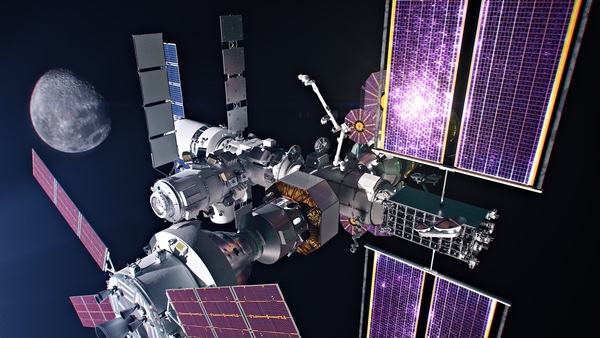
| What is needed is something that the evidence of recent agency behavior strongly suggests several of them have privately concluded is necessary: a collectively governed lunar installation built and operated by the capable mid-tier space agencies, on terms that no single external power can unilaterally redirect. |
The June 2026 ESA Council meeting is not primarily a governance discussion. It is a hardware discussion. What do we do with what we built? The most likely answer, absent any alternative proposal, is absorption: ESA’s Gateway hardware gets repurposed into NASA’s unilateral surface base program, on terms set by NASA, under governance ESA does not control. This is the path of least institutional resistance. It is also the path that recreates, one program later, the exact dependency that just produced the Gateway cancellation.
There is another path. But it requires someone to say it out loud before June.
What the bilateral network already tells us
The argument for a middle power lunar consortium does not begin with this article. It is already being assembled, bilaterally, by the agencies themselves—apparently without anyone having yet named what they are doing.
JAXA and ISRO are jointly developing the LUPEX lunar south pole rover, with ESA instruments aboard, approved in March 2025. ESA launched a formal internal study of a European-led post-ISS station in February 2026, naming JAXA and CSA as proposed partners. South Korea’s new KASA agency signed a cooperation memorandum of understanding with CSA in April 2026. Australia is in active negotiations on a Cooperative Agreement with ESA. The Moon Village Association’s governance working group has been developing multilateral lunar frameworks for five years.
Every bilateral relationship required for a founding coalition already exists. JAXA–ISRO. ESA–JAXA. ESA–CSA. ESA–ISRO. KASA–CSA. ESA–Australia. What does not exist is the multilateral frame: the single table at which these agencies sit together, with a shared installation as the object of discussion rather than a series of bilateral arrangements that individually leave each agency dependent on the US-led program for their crewed lunar future.
The agencies are behaving like people who have each privately concluded that a lifeboat is needed. No one has yet said it out loud or started building one together.
The hardware credit argument
The financial objection to an independent installation—that it requires new money that ESA member states and partner agencies simply do not have—misreads the situation. ESA is not being asked to spend more money. It is being offered a mechanism to redeem the money it has already spent.
| The proposed founding coalition—ESA, JAXA, ISRO, CSA, KASA, and the Australian Space Agency—collectively covers every dimension of capability a permanent south pole installation requires. |
The $3–4 billion in stranded Gateway hardware represents a founding contribution credit. Under any serious consortium founding agreement, existing hardware investments would be valued and credited against contribution obligations before Phase 1 funding commitments are made. ESA’s I-Hab is directly applicable as a surface installation habitat core with minimal redesign: the difference between adapting I-Hab and designing a new habitat from scratch is measured in years and hundreds of millions of dollars. The ESA Council’s most important financial decision in June is not whether to spend new money on an alternative program. It is whether to allow existing investments to be absorbed into a program ESA does not govern, or to convert them into founding equity in a program it does.
The distinction matters because it changes the domestic political argument in every ESA member state. This is not a request for additional budget. It is a proposal to recover value from an investment that has just been rendered uncertain by a unilateral decision made in Washington.
What the consortium would actually look like
The proposed founding coalition—ESA, JAXA, ISRO, CSA, KASA, and the Australian Space Agency—collectively covers every dimension of capability a permanent south pole installation requires. ESA brings Ariane 6 launch, the Argonaut lander program, I-Hab hardware, and the Moonlight communications constellation. JAXA brings H3 launch, the most mature non-US life support system in production, and the LUPEX south pole reconnaissance mission. ISRO brings the only successful south pole landing to date, LVM3 launch, and world-leading mission cost efficiency: Chandrayaan-3 delivered south pole surface operations for approximately $75 million. CSA brings Canadarm3 robotic assembly capability. KASA brings a funded south pole lander and a $72 billion ten-year program budget. Australia brings New Norcia-3 deep space ground coverage, remote operations expertise from the mining sector, and the Roo-ver oxygen extraction rover.
The governance model should draw on proven precedents: CERN’s equal-vote structure that has survived 70 years of geopolitical turbulence, ITER’s legal personality and in-kind contribution framework that accommodates strategic adversaries in the same program, and the explicit lessons of the ISS hub-and-spoke model that produced the very vulnerability the Gateway cancellation just demonstrated. A binding intergovernmental agreement, not a series of MOUs. Full legal personality. A council where each member has one vote regardless of financial contribution size. An open science mandate that is structural rather than aspirational, built into the data architecture, not vulnerable to ministerial override.
The program proceeds in three phases, each complete and scientifically productive in its own right. Phase 1 (2027–2032) establishes orbital infrastructure and affiliates with ESA’s Moonlight navigation constellation. Phase 2 (2032–2038) establishes a permanent robotic surface presence with ISRU demonstration. Phase 3 (2038 onwards) delivers the first crewed occupation. Total cost to first crewed operations: approximately $20–30 billion: one-fifth to one-third of comparable superpower program costs, achieved through existing launch vehicles, adapted Gateway hardware, and ISRO’s demonstrated cost efficiency.
The Artemis Accords are not an obstacle
The most likely objection from officials in alliance-constrained agencies is that Artemis Accords membership creates an incompatibility with an independently governed program. It does not. The Accords are non-binding bilateral political commitments between the US government and individual signatory states. They commit signatories to norms—peaceful use, transparency, interoperability, data sharing, emergency assistance—not to any specific program or governance structure.
The consortium endorses every Accords norm. Its open science mandate is more demanding than the Accords’ data-sharing provision. Its humanitarian access clause extends the Accords’ emergency assistance principle further than any current signatory program. Its interface standard is designed for reference compatibility with the LunaNet framework the Accords endorse. A Japan, Canada, or Australia that is an Artemis Accords signatory and a consortium founding member is in full compliance with its Accords commitments.
The tension is political, not legal, and the political tension is managed by a doctrine this paper calls equidistance: cooperative at the operational and technical level with both US-led and China-led programs, independent at the governance level. That is not a new posture for middle powers. It describes how most of the proposed founding members already navigate great-power competition in every other domain.
What needs to happen before June
The realistic goal for the next several weeks is not the founding of a consortium. It is ensuring that the consortium proposal is a named, credible option in ESA’s internal deliberations before the June Council meeting, not an idea that arrives as commentary on decisions already made.
| The agencies that have individually concluded that the current trajectory is not sustainable have weeks, not months, to say so collectively and propose an alternative. |
The ideal June 2026 outcome is specific and modest: ESA’s Council endorses an independent feasibility study into post-Gateway program options, including a multi-agency independently governed installation. That is a different and more achievable threshold than “ESA joins the consortium.” A feasibility study mandate provides political cover for the Track 1.5 engagement—agency-to-agency, below ministerial level—that would need to happen in parallel. It buys the time required to commission the hardware valuation process, draft the governance framework, and bring ISRO and KASA formally into the conversation.
The window is real. I-Hab is in production now. The bilateral relationships exist now. The hardware credit opportunity exists now, in the specific form of stranded assets whose disposition is genuinely undecided. The agencies that have individually concluded that the current trajectory is not sustainable have weeks, not months, to say so collectively and propose an alternative. After June, the trajectory will have been set for another program cycle.
The middle-power space agencies do not need permission to build this. They need each other. And they need to say so before June.
About this analysis
This article draws on a longer working paper, “Toward a Middle Power Lunar Consortium”(April 2026), which develops the governance architecture, technical phasing, financial framework, and risk assessment of the proposal in full. The paper is available on request from the author. All factual claims reflect publicly available information as of April 2026.
Note: we are now moderating comments. There will be a delay in posting comments and no guarantee that all submitted comments will be posted.