Why the vagueness of the Outer Space Treaty was a strategically calculated moveby Aditya Raj
|
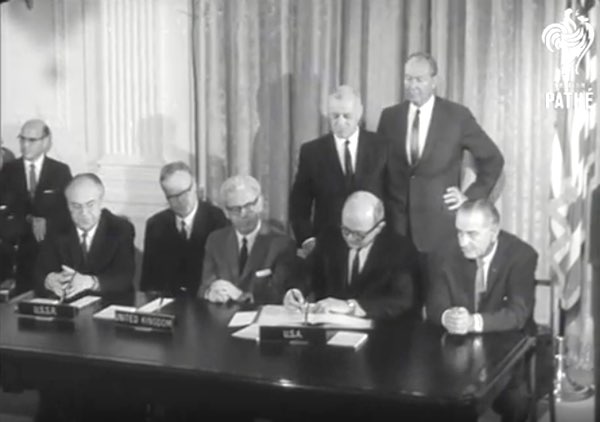
| It is not just about where the OST needs reform, but also about why the treaty was framed this way, leaving the door open for interpretations of its vague terms. |
These accords reaffirm the principles of the 1967 Outer Space Treaty (OST) that are frequently criticized as outdated and geopolitically ambiguous. Yet it’s worth noting that the same criticisms of the treaty’s vague terms helped sustain the primary objective of intergovernmental cooperation and peace. This has occurred even without any major political animosity from the Cold War era to the present. Peaceful relations among spacefaring nation-states are achieved through the stable legal framework for space activities provided by the OST.
From an analytical perspective, and to properly understand the core foundation of any treaty, an essential question arises. It is not just about where the OST needs reform, but also about why the treaty was framed this way, leaving the door open for interpretations of its vague terms.
If the Antarctic Treaty of 1959 can evolve through additional agreements, conventions, and protocols to become a comprehensive, legally binding framework known as the Antarctic Treaty System (ATS) to govern Antarctica, why not the OST? Both were established during the Cold War through negotiations, and both govern areas beyond national sovereignty. Yet the OST has undergone minimal institutional change, whereas the ATS has witnessed institutional expansion.
International relations and realist power politics, which underpin the very heart of today’s statecraft, can provide insight, making the OST’s vagueness not a flaw but a design feature.
In the early 16th century, Niccolò Machiavelli popularized a pragmatic approach to statecraft in his book The Prince, which later influenced the emergence of political realism (classical), shifting the moral and ethical grounds to prioritize the state’s interest in survival and progress.
National decision-makers make strategic calculations before signing a treaty, allowing the possibility of accommodation or changing future interests. The early stages of both the OST and ATS were the same; however, the divergence between them is associated with the provision of timely updates.
Historical background
The launch of Sputnik 1 by the Soviet Union in 1957 sparked global debate over the legal, scientific, and political implications of outer space exploration.
The startled response led to the establishment of the ad hoc Committee on the Peaceful Uses of Outer Space (COPUOS). In 1967, the OST—officially known as the Treaty on Principles Governing the Activities of States in the Exploration and Use of Outer Space, including the Moon and Other Celestial Bodies—entered into force. This multilateral international treaty sets out the major agreed-upon rules for the use of space technology when spacefaring capabilities were limited to the Soviet Union and the United States of America.
The response was to limit the research and development of technologies that could be used to produce weapons of mass destruction. As that tense period was in the valley between two peaks, the Cuban Missile Crisis had already happened, and the nuclear buildup of the 1970s and 1980s was unfolding.
When COPUOS was formed, it lacked a periodic rectification mechanism. Although Article XV provides a provision for amendments, it is nonbinding and appears to be merely a recommendation. It is a major loophole that can be flexed as required.
The concerns about the credibility of the OST
Advanced technologies are emerging so rapidly that it is difficult to frame a coherent legal structure. and especially cannot be fully stated in just a seven-page document of 17 articles. For once, the limited technological advancement of that time might be the factor associated with the vague construct. The point to keep in mind was that it was not a static doctrine, formulated for a limited time, but instead a lasting, multinational, aspirational, dynamic one.
| The formation of extraterritoriality and international ownership treaties depends on a state’s overall interests. which often conflict with others. |
The scientists, diplomats, and other foundational fathers might have envisioned and encountered the issue that the OST would need to address over time as the treaty entered into force. On the American side, the Apollo program was shaping its trajectory toward landing humans on the Moon. Their target, as declared by President John F. Kennedy, was before the end of the decade (the 1960s). The Soviet Union and the United States competed intensely in the Space Race to be the first to achieve many milestones, including sending the first human, the first woman, and even animals into space, launching spy satellites, and conducting the first spacewalk.
Even more, France, the United Kingdom, Canada, Japan, China, and India were also beginning to establish dedicated institutions for outer space research, unequivocally to become spacefaring nations.
So, it’s evident that the provision for updates was critical to this treaty, but less emphasis was given to it. The most probable reason for not being updated and ratified can be attributed to reasons including but not limited to:
Progress is essential. A sovereign nation-state doesn’t want to restrict its growth in the security domain. Simultaneously, it wanted to constrain strategic competition. The self-centric worldview gives rise to the Thucydides Trap. It is a situation where a rising power threatens to replace a dominant power, and this tension often leads to war.
During the Cold War, the conflict was between the US and Soviet Union. Now it’s among the USA and its allies, with Russia and China. This underscores the purpose of constructing the OST as a broad, deliberately open-ended treaty, that does not constrain any far-fetched dual-use military implications, reducing the possibility it backfires on the national space interests of a nation-state that signed it.
Clashing interests. Each nation-state and private player has its own lens for seeing space and taking opportunities from it. Some are driven by short-term profit motives, some by national pride, and some by a sole curiosity of the universe. The formation of extraterritoriality and international ownership treaties depends on a state’s overall interests. which often conflict with others. Hence, achieving a clear consensus to amend the OST under Article XV, which requires a majority, is extremely difficult.
Competition to capture the potential market. Nation-states don’t want to restrict the future prospect of a trillion-dollar market for space resources, like helium-3. The world’s largest fusion-based experimental power projects—the International Thermonuclear Experimental Reactor (ITER), Alcator C-Mod (MIT), and the Joint European Torus (JET)—are struggling to advance this breakthrough technology and even to achieve breakeven energy output for commercial use because of extremely scarce fuel.
In addition, private companies are setting the path for mining and utilizing future technology by signing pre-market contracts to use extracted helium-3. Finnish tech firm Bluefors, known for making ultra-low-temperature refrigerator systems critical to quantum computing, signed an contract with commercial space company Interlune potentially worth $300 million. The deal is to purchase helium-3 from Interlune to achieve ultra-cold temperatures that can sustain qubits for quantum computers.
Nevertheless, with limited yet advancing technologies, helium-3 remains technically challenging to extract but presents a burgeoning market opportunity.
Evaluating cost vs. benefit. Unlike the Antarctic Treaty System, the OST was framed to be more restrictive, with more ambiguous and wide-ranging provisions. A contracting state weighs potential gains against possible losses, particularly regarding sovereignty and strategic freedom of action. For a less active nation-state, the OST will work to nurture its involvement in the space domain. But for a powerful nation-state already active, it acts as a restriction on research and development. For example, Article VI states that states are internationally responsible for the activities of their private companies.
The key issue is that human progress is possible when there is some sort of competition and encouragement of high-risk innovation, but the liability for private companies’ work is put on the state. This decreases the state’s risk-taking agility for high-risk, high-reward opportunities. So open-ended terms can be flexed by a nation as needed. Hence, the formation of the OST reflects realist power calculations.
Possibility of interpretation. The ambiguity allows states to interpret the treaty in ways that protect their strategic interests. Amending these provisions could impose stricter constraints on emerging technologies and military capabilities. As a result, major spacefaring powers have little incentive to push for treaty revision.
The treaty, for example, restricts the placement of any nuclear weapons but fails to specify detailed parameters. Current nuclear systems can come under scrutiny for dual-use technologies. A spacefaring nation or even a private company will use legal loopholes to push its agenda. Take the example of Article 4, which states that there should be no development or testing of “weapons of mass destruction”; the term itself is ambiguous, as mass destruction can be achieved with nuclear weapons causing physical damage, as well as through biological and chemical means. So, do they abide by restricting all the development and placement of weapons, or just for nuclear weapons? The OST functions; however, its strength diminishes when viewed through the lens of strategic leverage.
Securing resilience to foreign dictation. To maintain a stable international order, there should be a powerful check-and-balances entity to punish, enforce the law, issue advisory opinions, and settle contentious cases between parties. The closest institutions are the International Court of Justice (ICJ) and UN COPUOS. Moreover, they have their own institutional limitations under international law. Their impact can be nullified easily by a superpower spacefaring nation that they don’t want to lose. Because enforcement institutions are weak, powerful states retain freedom of action, which reinforces the realist dynamics shaping space governance.
| Despite these issues, the OST serves its purpose, It helped in making subsequent space laws and accords. |
From a nation’s perspective, it always hampers its power-projection image when another power entity condemns its work. Take the examples of the 2007 Chinese anti-satellite test, private entities’ plans to mine the Moon’s surface, the development of dual-use technologies, the United States’ Commercial Space Launch Competitiveness Act of 2015 for commercial resource extraction, and many more. Breaking the terms will not cause any predetermined punishments, as there are none. Punishments, such as penalties, blacklisting, and so on, are always changing depending on the situation.
Despite these issues, the OST serves its purpose, It helped in making subsequent space laws and accords.
For example, there are the Agreement on the Rescue of Astronauts, the Return of Astronauts and the Return of Objects Launched into Outer Space (Rescue Agreement) of 1968, Convention on Registration of Objects Launched into Outer Space (Registration Convention) of 1974, Agreement Governing the Activities of States on the Moon and Other Celestial Bodies (Moon Agreement) of 1979 and Artemis Accords of 2020. The quintessential International Space Station (ISS) exists largely because of the legal framework established by the OST, which led to the 1998 Intergovernmental Agreement. Also, the development of the NASA-ISRO Synthetic Aperture Radar (NISAR) was a byproduct of cooperation under the OST.
The only constraint that needs mitigation is the long-term safeguarding of future interests. Recent developments in the space sector have made rocket launches cheaper. Companies are generally more short-sighted than the national long-term interest, which could possibly accelerate a new space race.
It is extremely improbable that there would be any reform in a realist-based anarchic international system before a major mishap or crisis, such as the Kessler Syndrome or a lunar territorial skirmish.
A preemptive approach is always beneficial, but it will impose constraints on nation-states’ growth potential and monetary returns. Only a powerful governing body, even as a cooperative effort of nations, will work to mitigate the pressing issues. Fundamentals of realism hold that only a possible hegemonic power (historically, the USA and the USSR) can act if there is no world government to regulate the whole planet.
It’s essential to have some sort of rules and regulations that provide a platform for cooperation among nations in outer space, rather than none at all.
Note: we are now moderating comments. There will be a delay in posting comments and no guarantee that all submitted comments will be posted.