Sovereign capability and assured access: a tension in Europe’s space strategyby Nicholas Borroz
|
| No major political entity can build, host, and operate all critical infrastructure entirely within its own borders. |
What the EU seeks in practice is not self sufficiency, but a combination: strong sovereign capability at home, paired with assured access to strategically important infrastructure beyond its borders. This is especially true where geography, safety, or scale make purely internal solutions impractical.
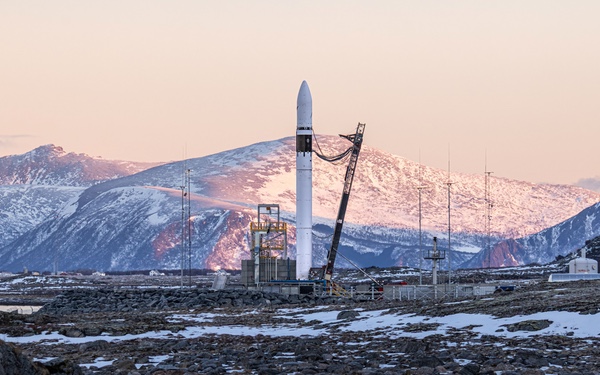
The challenge is that current EU policy tools do not always reflect this dual ambition, and in some cases pull against it. The Norwegian spaceport Andøya Space offers a clear illustration of this tension.
Assured access, not self-sufficiency
Even as geopolitical risk has increased, Europe continues to depend on cross-border industrial activity. Space launch is a particularly clear example. Suitable launch locations depend on geography, population density, safety corridors, and orbital access. Not all optimal sites lie inside EU territory.
As a result, the EU has a clear interest in assured access to launch infrastructure located outside the Union, provided it is located in trusted and closely aligned countries. Access to such external infrastructure provides redundancy, resilience, and operational flexibility that cannot always be replicated domestically.
From a European perspective, not all non-EU countries are equal. Infrastructure located in politically aligned, institutionally stable countries that apply EU-equivalent rules is fundamentally different from reliance on distant or potentially misaligned partners. This is where countries like Norway occupy a distinct position.
Why Norway has built a spaceport oriented toward Europe
Through the European Economic Area (EEA) Agreement, Norway mirrors large parts of EU law relevant to industrial and commercial activity. While EU space-specific regulation is still evolving, much of the surrounding legal and regulatory framework that enables cross-border industrial cooperation is already closely aligned.
This matters because Norway is too small to justify large-scale space infrastructure based on domestic demand alone. A spaceport in Norway can only be economically viable if it serves international markets. Due to regulatory alignment and market access, the EU naturally becomes the most accessible and attractive customer base. European firms face lower compliance barriers, clearer legal pathways, and fewer transactional frictions than they would elsewhere.
The Norwegian spaceport is therefore best understood as internationally oriented infrastructure that is structurally predisposed to serve European demand. It is open to global customers, but EEA alignment makes Europe the easiest market to serve.
Where policy pulls in a different direction
The tension emerges when EU industrial policy tools and program-level rules work against this alignment.
| Regulatory alignment and market access under the EEA encourage closely aligned countries to invest in infrastructure the EU can rely on, while funding mechanisms and operational rules simultaneously make that infrastructure harder to finance and operate competitively. |
On the funding side, EU programs that support space infrastructure and activities tend to prioritize projects located within EU territory. Spaceports inside the Union benefit from public financing and risk-sharing mechanisms that comparable projects outside the Union do not. This is not inherently unfair. Access to the internal market does not imply a right to EU taxpayer funding, and it is reasonable for the EU to favor investment on its own territory.
At the same time, regulatory design choices in several EU space programs further tilt the playing field. In some cases, launches conducted from third-country territory are subject to additional conditions, such as case-by-case waivers or special authorizations. These requirements are understandable. In practice, however, they introduce extra administrative steps and reduce predictability for operators, even when launches take place in closely aligned countries that otherwise apply EU equivalent rules.
Taken individually, these measures are defensible. Taken together, they create mixed signals. Regulatory alignment and market access under the EEA encourage closely aligned countries to invest in infrastructure the EU can rely on, while funding mechanisms and operational rules simultaneously make that infrastructure harder to finance and operate competitively.
A weakened business case
For high-capital, long-horizon projects like spaceports, this matters greatly. Such infrastructure depends on predictable demand and stable competitive conditions. If the primary market is European, but only infrastructure on EU territory can fully benefit from EU support instruments, and if using infrastructure outside the Union involves additional procedural hurdles, the incentive to invest in such infrastructure outside the EU weakens substantially.
The result is not merely a gradual competitive disadvantage. It directly undermines the business case for developing strategically useful infrastructure just beyond the EU’s borders that would enhance European resilience and access.
Sovereignty versus assured access
To be clear, this tension does not threaten the EEA relationship itself. The spaceport is a minor issue compared with the extensive benefits both sides derive from deep market integration. In addition, most of the friction today stems from specific industrial policy and program rules, rather than from the core internal market principles that underpin the EEA.
The deeper issue is strategic. The EU wants to build sovereign capability while also maintaining assured access to infrastructure beyond its jurisdiction. When that external infrastructure requires large upfront investment and depends on EU demand to be viable, these objectives can come into conflict.
For certain categories of critical infrastructure, this tension remains unresolved.
Possible ways forward
One possible response would be to refine EU policy instruments to recognize a category of closely aligned non-EU countries. The current distinction is largely binary: EU member or third country. In reality, the EU’s external relationships vary widely. European Free Trade Association EEA states are obvious candidates for differentiated treatment, though depending on the sector, other strategically aligned partners could also be considered.
| If closely aligned partners are systematically disadvantaged, the incentive to host infrastructure that serves European needs will diminish. |
From a strategic standpoint, there is a case for carefully designed mechanisms that support infrastructure where the EU itself is a major beneficiary, even if that infrastructure lies just beyond its borders. Politically, though, this is difficult. It raises legitimate questions about the use of taxpayer funds, geographic balance, and precedent. Any approach would need clear limits and explicit justification.
But ignoring the issue also carries costs. If closely aligned partners are systematically disadvantaged, the incentive to host infrastructure that serves European needs will diminish.
A narrow but real problem
This is neither an argument against sovereign capability nor a call to relocate critical infrastructure outside the EU. It is an acknowledgment that assured access beyond EU territory remains an important strategic objective, and one that current policy tools do not always support.
Resolving, or at least reducing, this tension would strengthen the EU’s ability to balance sovereignty with resilience. For certain critical infrastructure projects outside the Union, that balance has not yet been fully worked out.
Note: we are now moderating comments. There will be a delay in posting comments and no guarantee that all submitted comments will be posted.