Review: The Echoing Universeby Jeff Foust
|
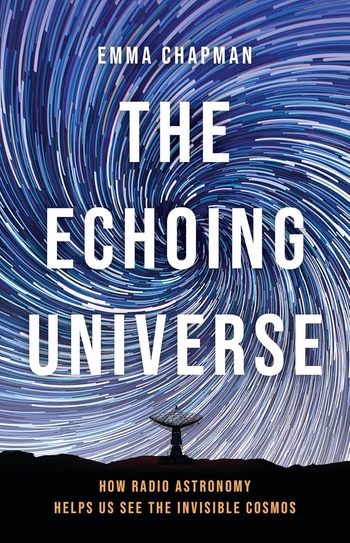
| “In the fruit bowl of astronomy, optical light is the apple,” writes Chapman. “It is the light our eyes have evolved to see and, like an apple, there is no preparation needed to enjoy it.” |
DSA, scheduled to be completed by 2029, is expected to be the most sensitive radio telescope in the world. It will also be the first to have a “radio camera,” a supercomputer that will instantly convert radio signals into images. “DSA, for the first time, provides realtime images of the dynamic radio sky,” said Arpita Roy, director of astrophysics and space at Schmidt Sciences, at a National Academies meeting early this month. The large number of antennas provides enough baselines to correct for the “broken mirror” problem, enabling that imagery, she said.
Radio astronomy is not known for its imagery, and what images can be produced from radio telescopes often require months of processing. That has been a lament for radio astronomers, who feel their work is not as appreciated as those who work in visible wavelengths. “In the fruit bowl of astronomy, optical light is the apple,” writes Emma Chapman in the introduction of her book The Echoing Universe. “It is the light our eyes have evolved to see and, like an apple, there is no preparation needed to enjoy it.”
Radio light, in her analogy, is the lemon in that fruit bowl: something that cannot be appreciated as easily but, with the right tools and time, can be a versatile tool for understanding the universe. In other words, the juice is worth the squeeze.
Chapman, a radio astronomer, uses the book to provide a tour of the universe through the lens (or, perhaps, aperture) of radio astronomy. Starting with the Moon and going out to cosmological distances, she discusses how radio astronomy has shaped our understanding of the universe.
Some of that work is widely known, like the discovery of the cosmic microwave background, compelling evidence for the Big Bang that resulted in Nobel Prizes for the researchers who detected it. The same is true for the discovery of pulsars through radio bursts so regular astronomers first wondered if they were alien signals (this, too, resulted in Nobel Prizes, although infamously not for Jocelyn Bell Burnell, the graduate student who discovered the signal.)
The book, though, also includes less well-known discoveries linked to radio astronomy. One early in the book involved radio observations of the Moon, finding that the temperature of the lunar surface, derived from radio emissions, lagged the phase of the moon by several days. That led scientists to conclude the lunar surface was covered in a relatively thin layer of regolith, providing confidence long before the first lunar missions that spacecraft could land there without sinking into deep banks of dust as some feared. The book features similar accounts across a wide range of topics in astronomy, as well as profiles of some of the key radio telescopes and astronomers who advanced the field.
| “Instead of striving for high-resolution images comparable to what optical telescopes can give, radio astronomers strip away the glitter and graphics to get to the raw data that describes the whole story.” |
While radio astronomy is not known for its imagery, there are surprisingly no images included in the text of the book (at least in the review copy provided by the publisher) of radio telescopes, astronomers, or research. There is also this odd statement, in the discussion of a radio message sent by astronomer Frank Drake using the Arecibo radio telescope in 1974: “Drake selected the number 1,679 deliberately because it is a prime number and also the product of two other primes: 23 and 73.” Needless to say, if a number is the product of two prime numbers, it cannot be a prime number itself.
Despite that, The Echoing Universe is a good overview of the role radio astronomy has played in helping us understand the universe. Later in the book, Chapman exchanges the fruit bowl analogy to one from video games, calling her field “eight-bit astronomy,” a nod to classic video games of decades ago with their limited graphic capabilities. “This philosophy is at the heart of radio astronomy,” she argued. “Instead of striving for high-resolution images comparable to what optical telescopes can give, radio astronomers strip away the glitter and graphics to get to the raw data that describes the whole story.”
In a few years, the Deep Synoptic Array might provide radio astronomers with something like the high-resolution imagery we’re accustomed to from optical telescopes. But many radio astronomers will continue to use other observatories without such imaging capabilities, laboring to turn radio wave lemons into astrophysical lemonade.
Note: we are now moderating comments. There will be a delay in posting comments and no guarantee that all submitted comments will be posted.