Yellow Fleets: stranded ships in Suez and the Persian Gulfby Dwayne A. Day and Harry Stranger
|
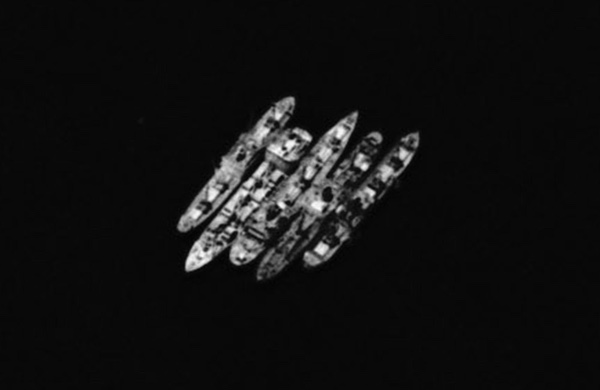
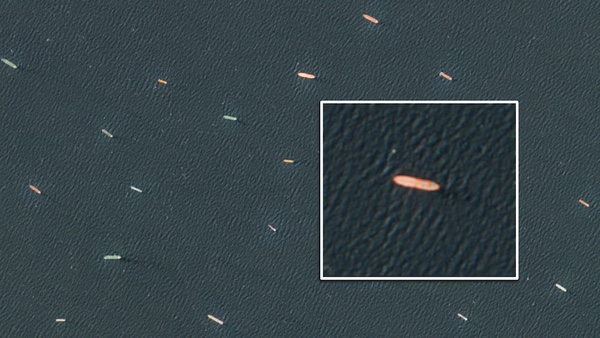 Merchant ships stranded in the Persian Gulf in March 2026. Sailors were running out of food, supplies, and even fresh water during this period. Some are still stuck in the Persian Gulf today. (credit: Sentinel Hub) |
For eight years following the Six-Day War between Israel and Egypt in 1967, 15 merchant ships were trapped in the Suez Canal after Egypt sealed it off. As the desert sand coated the ships over the years, they became known as the Yellow Fleet. When the canal was reopened in 1975, only two of the ships could move under their own power. During this time, American reconnaissance satellites overflew the Middle East. Although their primary targets were the military forces in the region, they often photographed the Yellow Fleet as it was trapped in the Great Bitter Lake, halfway along the Suez Canal.
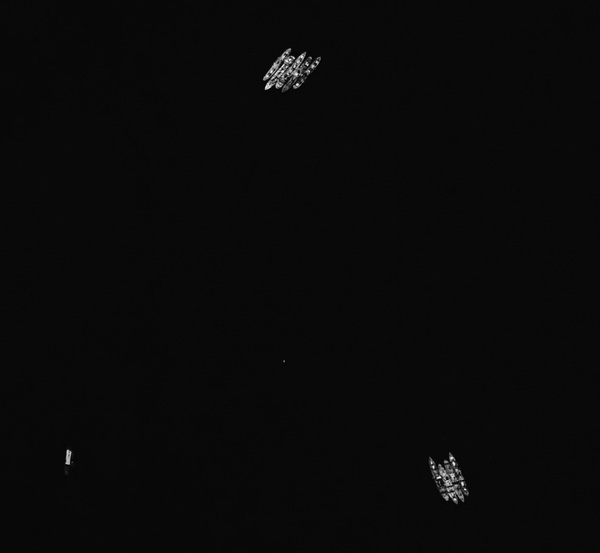 After being stuck in the Great Bitter Lake along the Suez Canal, the ships began mooring together. Two groups are visible in this 1973 HEXAGON reconnaissance satellite photo. (credit: Harry Stranger) |
The ships of the Yellow Fleet were from eight nations and stuck in a political limbo. Their crews visited each other socially, watching movies, holding church services, forming a boating club, and hosting lifeboat races. Eventually, Egypt allowed some of the crews to rotate out for replacements and the ships were grouped together for easier upkeep so the crew numbers could be reduced. The crews of two German ships had it the hardest, with the last of their crewmembers not leaving their ships until 1972.
The ships were the Nordwind and Munsterland from West Germany; Killara and Nippon from Sweden; Essayons from France; Agapenor, Melampus, Scottish Star, and Port Invercargill from the United Kingdom; African Glen and Observer from the United States; Vasil Levsky from Bulgaria; Lednice from Czechoslovakia; and Djakarta and Boleslaw Bierut from Poland.
Like the merchant sailors recently stranded in the Persian Gulf, the Yellow Fleet crews knew that they were in a war zone that could turn violent at any moment. They learned this brutally in 1973 when the African Glen was sunk during the Yom Kippur War.
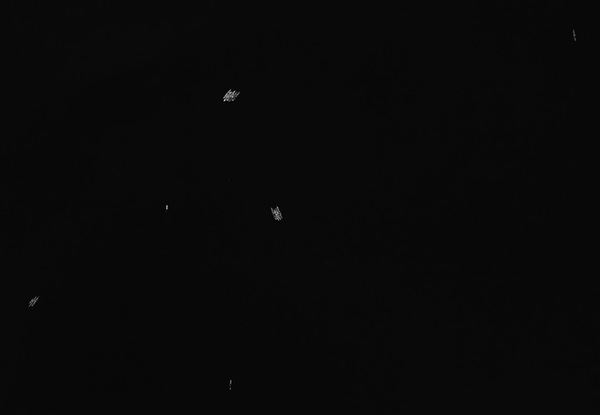 At least 13 of the stranded merchant vessels are visible in this photo. One of the stranded ships was sunk during the 1973 war. (credit: Harry Stranger) |
Satellite photos from a 1973 HEXAGON reconnaissance mission show the Suez Canal and the Yellow Fleet stranded there. Nine ships are gathered in two clusters, moored side-by-side. Although the declassified satellite photos are relatively low resolution, they may be sufficient to identify most of the ships, illustrating a footnote to one of the Middle East’s many conflicts.
Note: we are now moderating comments. There will be a delay in posting comments and no guarantee that all submitted comments will be posted.