Transforming domains: Space, military justice, and the Air Force Judge Advocate General’s Corps in 2050by Todd Pennington
|
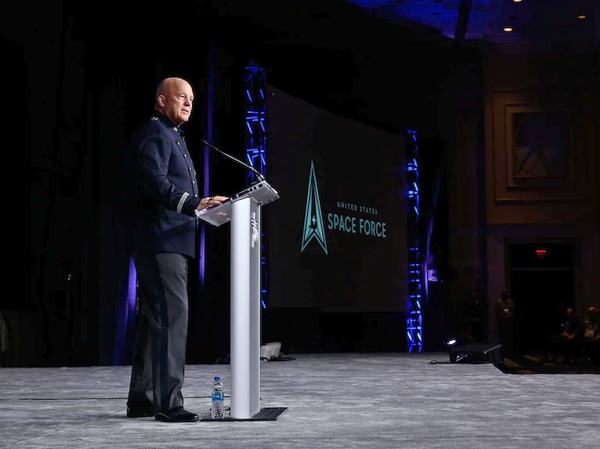
| The Judge Advocate General’s Corps will evolve to address a growing Space Force at the same time it adapts to the decline of the military justice system. |
The establishment of the Space Force was driven by the maturation and proliferation of activity in the space domain. As dynamic as the Space Force is, it is not, as an institution, what drives the growth and relevance of space. Rather, the establishment and growth of the Space Force is a trailing indicator of the strategic importance of the space domain. Early in the space age, only governments had the means to reach space. Following entry into force of the Outer Space Treaty, most activities were uncontested, with plenty of space (physical and political) for everyone who could get there. The Gulf War was a wake-up call to our strategic competitors about the military advantages the United States enjoyed based on our space capabilities, which we employed from a domain we could, at the time, treat as a sanctuary.[1]
Why would our competitors not seek to first deny us those advantages, then strive to outmatch us? This is exactly what they have done over the past 30 years.[3] And this competition emerged at a time when plummeting costs of space launch made the domain more accessible: first to other states, then to large corporations, eventually to small startups and even not-for-profit organizations. Today, space access is sufficiently democratized that high school student groups have been able to fund the construction, launch, and operation of satellites. Trends in miniaturization of technology accelerate this trend. Compare the costs of launching a room-sized 1970’s era supercomputer into orbit, at a cost of $100,000 per kilogram, to the cost today of launching an iPhone-sized microsat into orbit, about $2,000 per kilogram.[3] Where human activity goes, there goes competition. Between now and 2050, the most consequential frontier of human activity (and competition) will be outer space.
The Space Force was established in December 2019 in a manner reflecting the political compromises necessary to make it happen at that time. The law establishing the Space Force did so by re-designating the legacy Air Force Space Command as “U.S. Space Force.”[4] In six short years—a strobe flash in Pentagon time—the nation’s military space enterprise has been comprehensively transformed into something closer to space enterprise leaders’ vision.[5] However, the rapid implementation of these new organizational structures should not invite complacency. The growth of existing capabilities, the fielding of future capabilities, and their growing relevance in competition and conflict mean that the Space Force is sure to grow and evolve—a lot—in the decades to come.
The Judge Advocate General’s Corps will evolve to address a growing Space Force at the same time it adapts to the other phenomenon mentioned above: the decline of the military justice system. When I speak of the “decline” of military justice, I am not asserting any moral flaw in our current and legacy justice systems, nor do I mean to imply any diffidence or dereliction among military justice practitioners. Indeed, the experience of prior rounds of military justice reforms show that military justice practitioners uniquely appreciate the military value of a commander-based discipline system and are exceptionally proficient at advocating its merits.[6] I predict a “decline” in the military justice system driven by external political considerations, not any intrinsic design flaw or deficiencies in execution.
While the broad structure of the Uniform Code of Military Justice has long history in the legal traditions of British and American armed forces, the heyday of modern military justice practice for Judge Advocates occurred in the two decades between enactment of the Code in 1951 and the 1971 decision to maintain an all-volunteer force. These were the decades when the conflicts in Korea and Vietnam required a mechanism to enforce military discipline on large numbers of conscripted forces deployed overseas, in an era when due process protections for accused service members had advanced substantially from prior conflicts.[7] In the decades since Vietnam, the number of persons in the US armed has diminished in total numbers and as a percentage of the population.[8]
Most military justice specialists first experienced cracks in the armor of the modern military justice system in the 2010s, during the intense public and Congressional focus on sexual assault in the ranks. Many will recall a series of Congressional hearings starting in that decade and continuing into the present, at which successive senior Judge Advocates from all services were confronted with asserted shortcomings of the military justice system.[9] Most recently, the Code was amended to remove the most consequential decisions about when and how to exercise military justice authority from command, and vest this authority in Judge Advocates.[10] These reforms are in the earliest stages of implementation, and they will probably not be the last military justice reforms before 2050.
Once the most serious military justice matters are no longer vested in command, can it be long before our society (and its representatives in Congress) question why the military requires jurisdiction in many of these cases at all? In the decades to come, the jurisdiction of the Uniform Code of Military Justice is likely to be dramatically curtailed, through a series of incremental reforms. We may see military jurisdiction curtailed when a US state or territory has effective jurisdiction over an offense. This curtailment could arise from a law- or policy-driven decision to limit or defer the exercise of military jurisdiction, or from state and local jurisdictions asserting the jurisdiction they already hold in parallel with the military over most offenses committed by service members in the United States. To the extent military jurisdiction endures over offenses in domestic areas, it may come to be less preferred than state or territorial jurisdiction when the victim of a crime is a civilian with no military affiliation.
There will always be a role for some form of military justice system. However, by 2050 the standards for UCMJ jurisdiction may look very different than today. In 1978, the Supreme Court eliminated a requirement for “service connection” to a charged UCMJ offense.[11] In the years to come, the requirement for service connection as a threshold for UCMJ jurisdiction may be re-established by legislation or policy. UCMJ jurisdiction in 2050 could be limited to offenses that occur outside of US civilian jurisdiction, or which have some particularly acute military nexus, such as law of war violations or an offense involving the abuse of military authority. Such a change is a predicable trend in a system transitioning from one grounded on command authority, to one in which the most consequential criminal law decisions are vested in “professional prosecutors,” the phrase often used describe the leaders and staff of the Office of Special Trial Counsel.[12] The number of cases satisfying such narrow jurisdictional thresholds by 2050 could be a small fraction of today’s court-martial docket.
| There will always be a role for some form of military justice system. However, by 2050 the standards for UCMJ jurisdiction may look very different than today. |
How will the concurrent trends of an ascendant Space Force and a waning military justice system work together to drive major changes to the Judge Advocate General’s Corps? The increase in overall activities in the space domain and the Space Force’s expected growth as an organization as space capabilities proliferate in number, in orbital diversity, and in mission type, will probably expand the scale and complexity of legal support for space operations. This trend of growth in operational space law support will likely be in inverse proportion to the diminishing role of military justice as the military justice function trends away from command authority toward a small, lawyer-led, niche discipline. In other words, the Space Force will need more legal support for operations, and less legal support for military justice. This trend will tend to drive the professional development of Judge Advocates more through the operations and civil law practice areas, and less through military justice. The military justice system of 2050 may look much more like the claims function of 2025: a small cadre of specialists, mostly civilian, operating from a single consolidated location.
The efficiencies of this type of military system are not hard to imagine. Based on my observations as a Staff Judge Advocate, already most court-martial participants must travel for trial proceedings. A diminishing number of cases will compound that trend, particularly if the overall case processing time for General Courts-Martial continues to expand. At some point efficiency or necessity will warrant consolidating court-martial functions at fewer locations—eventually, a single location—for court-martial proceedings. Continued attenuation of command authority in the military justice system will tend to shift the rationale for military jurisdiction away from “good order and discipline” and toward “jurisdictional necessity” in cases where state and local jurisdiction does not apply, or when the military nexus to an offense is particularly acute. The nation will always need good order and discipline in its armed forces: however, it may be that tools other than plenary criminal jurisdiction will suffice for this purpose.
As the relationship between military jurisdiction and command authority wanes to principally involve petty offenses and administrative infractions, the rationale for requiring convening authorities, judges, and trial counsel to be military officers may fade as well. By 2050, the need for lawyers experienced in a niche practice, occurring at a small number of locations, may drive reforms that authorize court-martial trial counsel who are civilian government attorneys. Once military jurisdiction is distinct from command authority, service leaders may question the wisdom of placing responsibility for the accused’s personal well-being through the disposition of charges on the commander of the accused’s unit. Persons awaiting trial in 2050 might be administratively transferred from their former unit to one located at the consolidated court-martial location. Consolidation of court-martial activities could incentivize creation of a unit chartered and resourced to employ and care for the well-being and resilience of Airmen and Guardians awaiting trial.
Indeed, many may come to question why service members facing court-martial charges are kept on active duty for the entire time they await trial at all, especially if the time it takes to pursue a case to sentence or acquittal continues to grow longer (as was the trend during my final decade on active duty.) Legal reforms could establish the option to place service members facing trial in an appellate leave-like status, pending the adjudication of charges. Similar trends could prompt new authority for provisional discharge of service members facing criminal charges of sufficient gravity, with a mechanism to return a member to active service could exist should they ultimately secure an acquittal. As the nexus between military criminal jurisdiction and command authority grows more attenuated, such options may gain support.
By 2050, the military justice practice may be sufficiently small and specialized that it will no longer be a defining mission of the Judge Advocate General’s Corps. Military Justice may not remain the primary legal discipline for the professional development of military legal officers. If the trend of de-linking command authority from military justice authority continues, by 2050 military justice could be a niche, mostly civilian, specialty practice.
The Space Force was established without a legal career field of its own, relying on Air Force judge advocates assigned to Space Force organizations. Today the Space Force relies on the Air Force to provide a judiciary system, a defense bar, and a cadre of victim’s counsel. Because military justice will be in decline as the Space Force grows in size and relevance, it will not be military discipline that creates demand for a legal career field for the Space Force. Rather, the growing scale, significance, and legal complexity of activities in outer space will be the principal drivers for the Air Force Judge Advocate General’s Corps to adapt to a legal career field in the Space Force.
Three trends in space operations explain why this will be. First, the overall volume of space operations activities is rising,[13] and will continue to rise rapidly for the foreseeable future. We are fielding systems in greater numbers, intentionally designed for shorter service life. Advances in launch capability, miniaturization, and computing power challenge legacy thinking about quality versus quantity: today, it is often possible to have both.[14]
Second, the foundational principles of space law will be increasingly challenged as our competitors grow more capable and bolder in space. Will the Outer Space Treaty principle of non-appropriation survive Chinese settlement of the lunar south pole? Will principles of state responsibility for space activities be undermined by a trend toward launch and registration state “flags of convenience” as in the maritime domain?[15] Could a Russian assertion of an excessive “safety zone” around a space vehicle orbiting in Lagrange Point space impinge on a US assertion of free access to that same orbital regime? Many of the foundational premises of law governing space activities will be tested in unexpected ways in the decades to come.
| By 2050, the Space Force will probably be advised by Judge Advocates who are Guardians, that is, attorneys commissioned as United States Space Force officers. |
Third, addressing all these issues will increasingly require commanders, space operators, and legal advisors recruited and developed in a military culture focused on the space domain. In the 1930s and 1940s, Airmen argued forcefully that the air forces were not fundamentally an extension of land or sea forces. More recently, prior to establishment of the Space Force, airpower advocates were as opposed to the independence of a Space Force as Army leaders of an earlier era were opposed the independence of the Air Force.[16] They argued that air was a wholly different domain, requiring a different way of thinking about all sorts of problems, not just the tactics of flying an airplane. By way of example, tradition holds that Air Force convening authority came to be aligned with installation command, not mission command, because aircraft launch and recover from airfields. This operating convention led to many responsibilities in the Air Force—including court-martial convening authority—being vested in the commander responsible for the airfield itself rather than the airpower mission.
Military space systems do not have this same link to a terrestrial installation. Most military satellites remain on orbit their entire service life, and the globe-orbiting nature of Space Force missions means that Space Force units are often geographically dispersed around the planet. Factors like these motivated the Space Force to adopt a mission-aligned model of court-martial convening authority in which a Delta commander serves as special court-martial convening authority for forces under his command, regardless the installation at which those forces are based. The space domain is as different from the air domain as air operations are from land operations or naval operations. The fundamental differences in the domains are why we have separate military services, each structured to build warfighting experts for their own domain. Those differences can be seen in the differing traditions, strategy, doctrine, and culture of the military services.
Today, Airmen assigned to various Space Force units serve effectively and are appreciated by the Guardians they serve with. However, the Space Force is only six years old. The traditions, strategy, doctrine, and culture of the Space Force will evolve over time to reflect the operational distinctives of the space domain. In doing so, the Space Force will begin to diverge from Air Force traditions. There will always be places in the joint force for Airmen and Guardians to work side by side: however, over time the Space Force will need to become a force of Guardians, to include their assigned legal counsel.
The Space Force was originally established with only a handful of career fields focused on the space-distinctive functions of the Space Force. Most of its combat service support continues to be provided by the Air Force for now, but there is no reason to believe the Space Force will not, over time, take on independent responsibility for these functions.
This is exactly what happened when the Air Force was established as a military service independent of the Army. In 1947, commenting on the original organizational decisions regarding the Air Force, Secretary of Defense Louis Arthur Johnson (also an attorney) noted, “Provision had also been made for the Army to go on performing common services for the Air Force in finance, hospital facilities, quartermaster administration, and transportation.”[17] As the Air Force eventually developed organic capability for those functions, so will the Space Force.
By 2050, the Space Force will probably be advised by Judge Advocates who are Guardians, that is, attorneys commissioned as United States Space Force officers. What that career field looks like will largely depend on how stakeholders address the inevitable Space Force demand signal for its own legal career field. One possibility would be for the Space Force to break away from the Air Force entirely, forming a new Department of the Space Force within the Department of Defense[18] and taking its pro rata share of the Air Force Judge Advocate General’s Corps with it. In this model, a Space Force Judge Advocate General’s Corps would be a truly separate, independent entity, as organizationally independent from the Air Force as the Judge Advocate General’s Corps of the Air Force is from that of the Army or Navy.
Alternatively, a Judge Advocate career field could emerge in the Space Force even as the service remains in the Department of the Air Force. This future would resemble today’s Department of the Navy, with separate Navy and Marine Corps Judge Advocate career fields in the services of that Department, with many functions organized as dual-service entities (such as the Naval Justice School, the Navy-Marine Trial Corps Judiciary, and the Navy-Marine Corps Court of Criminal Appeals).[19] Under this model certain functions, such as the uniformed judiciary (should any remain by 2050) and legal education, would continue to serve both the Air Force and the Space Force in the same military department. Perhaps a future Space Force legal function will be entirely civilian, rather than uniformed?
The growth of the Space Force and the decline of military justice will drive radical transformation in the Air Force Judge Advocate General’s Corps in the decades to come. As these two inversely proportional trends drive change, some will embrace the change and some will resist it. For those Judge Advocates who will be around to experience it, I do not advocate either approach. Rather, I encourage you to stay grounded on what is in the best interest of the United States at the time. Change is not inherently an indictment of past practice. The Judge Advocate Generals’ Corps of the future will adapt, as they have in the past, to meet the needs of their time.
References
- Rajeswari Pillai Rajogopalan, China Aerospace Studies Institute, 2020 Conference Paper, China’s Growing Military Space Prowess: Institutions And Capabilities 6 (2020).
- U.S. Dep’t Of Def. Report To Congress, Space Policy Review And Strategy On Protection Of Satellites, September 2023.
- Thomas G. Roberts, Space Launch to Low Earth Orbit: How Much Does It Cost?, CSIS Civil And Commercial Space Data Repository, last updated Sep. 1, 2022, (last visited Feb. 10, 2025).
- United States Space Force Act, Subtitle D of Pub. L. No. 116-92 (National Defense Authorization Act for Fiscal Year 2020), § 952 (2019).
- Jennifer Dimascio, Cong. Rsch. Serv. If12610, Defense Primer: The United States Air Force (2024)
- See, e.g., Examining the Role of the Commander in Sexual Assault Prosecutions, Hearing Before the H. Armed Services Comm. Subcomm. on Mil. Personnel, 116th Cong. (2019) (statement of Lt Gen Jeffrey Rockwell, Judge Advocate General of the United States Air Force).
- Elizabeth Lutes Hillman, Cold War Crime and American Military Culture: Courts-Martial in the United States Armed Forces, 1951-1973, 69-88 (Ph.D. dissertation, Yale University) (ProQuest).
- Armed Forces Personnel As A Share Of Total Population, 1985 to 2020, ourworldindata.org, (last accessed Feb. 10, 2025)
- See, e.g., Sexual Assaults In The Military, Hearing Before the S. Armed Services Comm. Subcomm. on Personnel, 113th Cong. 303 (2013) (statement of Lt Gen Richard Harding, Judge Advocate General of the United States Air Force).
- See generally David Schleuter and Lisa Schenck, Transforming Military Justice: The 2022 and 2023 National Defense Authorization Acts, 231 MIL. L. REV. 1, 1 (2023).
- US v. Solorio, 483 U.S. 435 (1987).
- John Donnelly, Gillibrand calls new NDAA ‘huge milestone’ in military justice, Roll Call, Dec. 7, 2022 (last accessed Feb. 10, 2025).
- See generally Challenges To Security In Space, Def. Intel. Agency, (2022) (last accessed Feb. 10, 2025).
- Charles Galbreath with Aidan Poling, Small Satellites: Answering The Call For Space Superiority, Mitchell Institute Policy Paper, Vol. 52, July 2024.
- See generally Franz von der Dunk, Towards 'Flags of Convenience' in Space?, Space, Cyber, And Telecommunications Law Program Faculty Publications, 76 (2012).
- See, e.g., David Deptula, Yes To A U.S. Space Command But No To A Separate Space Force, Forbes, Apr. 10, 2019 (last accessed Feb. 11, 2025).
- Herman S. Wolk, The Struggle For Air Force Independence, 1943-1947 226 (Air Force History and Museum Programs 1997).
- Space Policy Directive 4, Establishment of the United States Space Force, 84 Fed. Reg. 6049 (Feb. 19, 2019). Para 2.b. states “The term ‘Department of the Space Force’ refers to a future military department within the Department of Defense that will be responsible for organizing, training, and equipping the United States Space Force.”
- Also, per 10 U.S.C. § 8088, 8089, the Judge Advocate General of the Navy and the Deputy Judge Advocate General of the Navy may be a Judge Advocate from either the Navy or the Marine Corps.
Note: we are now moderating comments. There will be a delay in posting comments and no guarantee that all submitted comments will be posted.