The mystery of Mission Zeroby James Behling
|
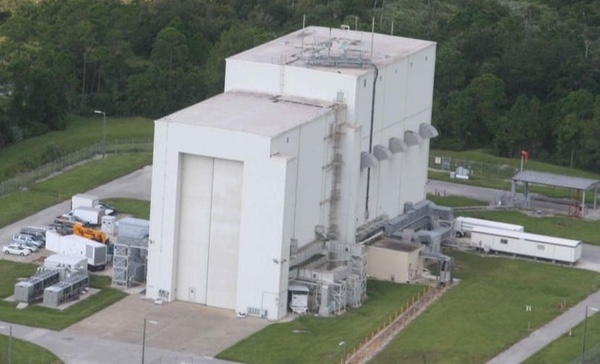
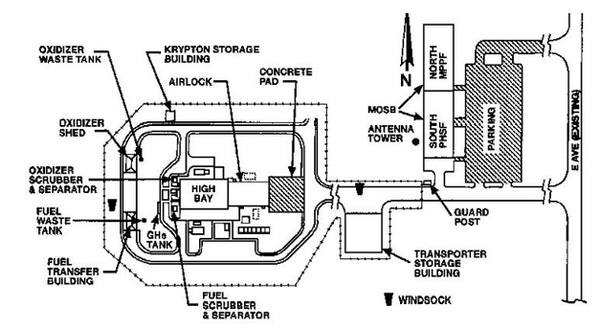 Layout of the PHSF. (credit: NASA) |
The origins of the Payload Hazardous Servicing Facility
The PHSF is a payload processing facility in the KSC industrial area. It started out as the Cargo Hazardous Servicing Facility (CHSF) and was conceived in the early 1980s to address the need for a hazardous processing facility for large shuttle class payloads.[1] A hazardous processing facility supports operations such as loading high-pressure gases and hypergolic propellants, as well as work involving solid rocket motors.
| Despite being designed to support shuttle-class payloads, the facility ultimately supported only five Space Shuttle missions. |
The existing Delta Spin Test Facility, Explosive Safe Area-60, and Spacecraft Assembly and Encapsulation Facility-2 (SAEDF-2) were limited to Delta-, Atlas-, and Titan-class payloads. The need for the facility was identified as early as 1982 and initial funding was provided in 1983. The design was complete in 1984 and construction finished in 1987.[2] The name was changed to PHSF during the Challenger stand down.
The PHSF is a complex of five buildings: the PHSF itself; the MOSB, a building with office space and control rooms for the project using the PHSF; and three buildings for storing transporters, propellants, and krypton gas. The PHSF proper is a large building measuring 210 x 98 x 112 feet (64 x 30 x 34.1 meters).[3] It is dominated by a high bay and main airlock.
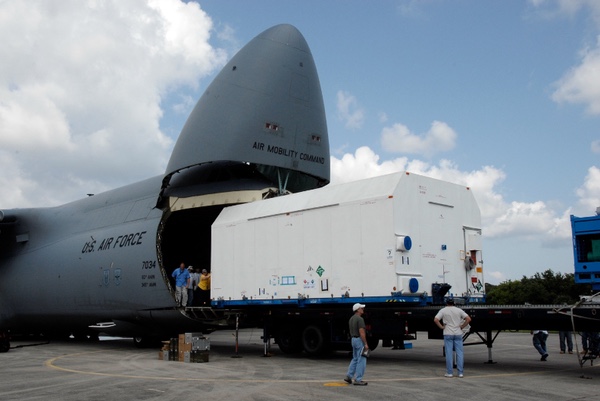 DSP Shipping Container. (credit: NASA) |
Missions supported
The first documented mission supported by the PHSF was the Combined Release and Radiation Effects Satellite (CRRES) in 1990. Despite being designed to support shuttle-class payloads, the facility ultimately supported only five Space Shuttle missions: Gamma Ray Observatory (GRO), Upper Atmospheric Research Satellite (UARS), Advanced Communications Technology Satellite (ACTS), and Hubble Space Telescope Servicing Missions 1 and 2 (HST SM-1 and HST SM-2).
The opening of the Space Station Processing Facility in the mid-1990s, along with a decline in shuttle hazardous payloads, contributed significantly to this outcome. Instead, the PHSF became a key facility for planetary missions launched on expendable launch vehicles, beginning with Mars Observer. Notable programs included Cassini, the Mars Exploration Rover (MER), Mars Science Laboratory (MSL), and Mars 2020 missions, as well as Pluto New Horizons and Europa Clipper. A complete list of supported missions is provided at the end of the article.
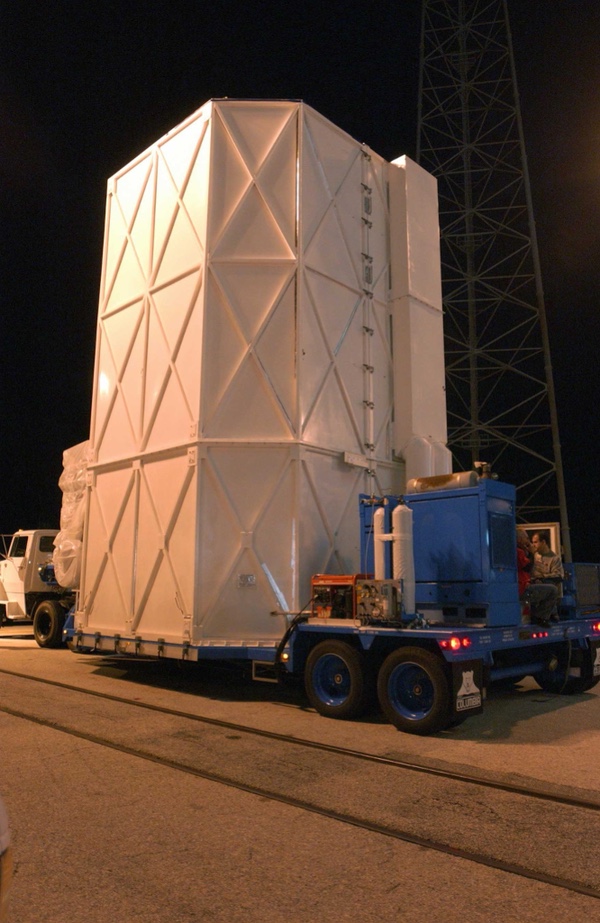 DSP Vertical Transport Container. (credit: USAF) |
Mission Zero
When construction of the PHSF was completed, NASA and the USAF were finalizing their shuttle return-to-flight plans and launch manifests. Three DOD shuttle missions—STS-27, STS-28, and STS-33—were planned for 1988 and 1989. During the same period, the first Titan IV launch was to launch, with the Defense Support Program (DSP)-14 as its payload. DSP-14 was the first of a new version of missile warning spacecraft and had originally been designed to fly on the Space Shuttle. After the Challenger accident, all DSP spacecraft were transferred to expendable launch vehicles (Titan IV & Delta IV) except DSP-16, which flew on STS-44.
By the standards of the time, DSP was a large spacecraft, measuring 28 by 13.7 feet (8.5 by 4.2 meters), and it was shipped horizontally in a large shipping container aboard a C-5 aircraft.[4] The shipping container did not allow the spacecraft to be lifted directly onto the Titan IV. As a result, DSP-14 had to be rotated into a vertical position and transferred to another transport container better suited for pad lifting operations. This work needed to take place in a clean room to prevent spacecraft contamination.
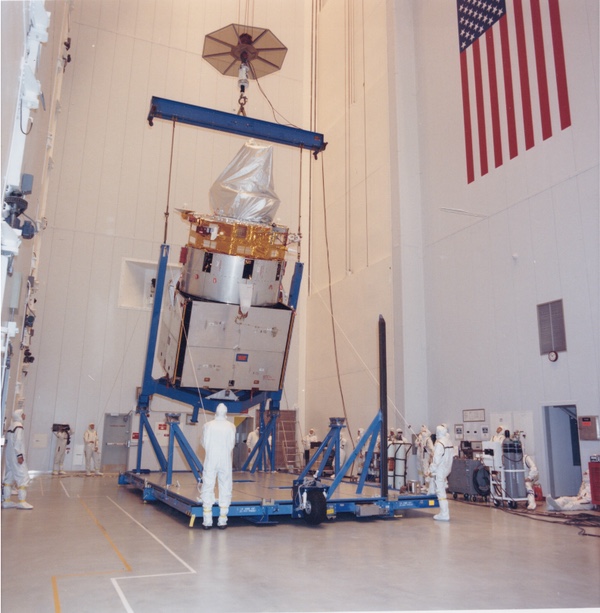 DSP spacecraft rotating to vertical on shipping container base. (credit: USAF) |
The only USAF facility large enough to accommodate DSP-14 and its containers was the Spacecraft Processing and Integration Facility (SPIF), but it was already committed to supporting the three DOD shuttle payloads. NASA facilities that could support the work were SAEF-2, the Vertical Processing Facility (VPF), and the PHSF. SAEF-2 was to be occupied with the Magellan and Galileo planetary spacecraft, which were scheduled to launch during the same period. The VPF was supporting two Tracking and Data Relay Satellite missions and the upper stages for the two planetary missions.[5]
With all this payload preparation work going on at the Cape in the late 1980s, the PHSF was the only facility available, and it was just coming online. The USAF provided funding to help ensure the facility completion and to add security measures, such as internal shades to cover external and internal windows of the high bay and airlock. The actual spacecraft container transfer operation occurred in the spring of 1989.[6]
Since payload identities on Titan IV launches were initially classified, DSP operations at the PHSF were classified and not documented in any open literature. Now, DSP launches on Titan IV have been long declassified.
PHSF Missions
| Date | Mission | Launch Vehicle |
|---|---|---|
| 6/14/89 | DSP-14 | Titan IV |
| 7/25/90 | CRRES | Atlas I |
| 4/5/91 | GRO | STS-37 |
| 9/12/91 | UARS | STS-48 |
| 9/25/92 | MO | Titan III |
| 9/12/93 | ACTS | STS-51 |
| 12/2/93 | HST SM-1 | STS-61 |
| 11/1/94 | Wind | Delta II |
| 11/7/96 | MGS | Delta II |
| 2/11/97 | HST SM-2 | STS-82 |
| 10/15/97 | Cassini | Titan-IVB |
| 10/24/98 | Deep Space 1 | Delta II |
| 2/7/99 | Stardust | Delta II |
| 8/8/01 | Genesis | Delta II |
| 6/10/03 | MER-A | Delta II |
| 7/7/03 | MER-B | Delta II |
| 8/12/05 | MRO | Atlas V |
| 1/19/06 | PNH | Atlas V |
| 8/4/07 | Phoenix | Delta II |
| 11/26/11 | MSL | Atlas V |
| 11/18/13 | MAVEN | Atlas V |
| 12/3/14 | EFT-1 | Delta IV Heavy |
| 12/6/15 | OA-4 | Atlas V |
| 3/23/16 | OA-6 | Atlas V |
| 9/8/16 | OSIRIS-REX | Atlas V |
| 3/19/17 | OA-7 | Atlas V |
| 4/18/18 | TESS | Falcon 9 |
| 7/20/20 | Mars 2020 | Atlas V |
| 10/13/23 | PSYCHE | Falcon Heavy |
| 10/14/24 | EUROPA CLIPPER | Falcon Heavy |
| 8/30/26* | RST | Falcon Heavy |
References
- Schuiling, Roelof L. "Launch Site Payload Ground Support Factors in Space Shuttle Launch Operations." AIAA Paper 88-4730, presented at the AIAA Space Programs and Technologies Conference, Huntsville, Alabama, September 27–29, 1988. American Institute of Aeronautics and Astronautics, 1988, 87
- National Aeronautics and Space Administration, John F. Kennedy Space Center, Space Transportation System Cargo Projects: Milestones, Schedules and Status Summary, K-CM-03.2 (Kennedy Space Center, FL: NASA John F. Kennedy Space Center, March 15, 1982), 5-2
- National Aeronautics and Space Administration, John F. Kennedy Space Center, Cargo Hazardous Servicing Facility, Phase I, Specification No. 79K27025, Rev. D (Kennedy Space Center, FL: NASA John F. Kennedy Space Center)
- United States Space Force, "Defense Support Program Satellites," Fact Sheets, updated October 2020, accessed July 6, 2026.
- Roelof L. Schuiling, "Space Shuttle Planetary Payload Launch Site Operations," Paper AIAA-90-0517, presented at the 28th Aerospace Sciences Meeting, Reno, Nevada, January 8–11, 1990 (Reston, VA: American Institute of Aeronautics and Astronautics, 1990), 1
- James Behling, personal observations while assigned to the 6555th Aerospace Test Group, Cape Canaveral AFS, FL, Spring 1989.
Note: we are now moderating comments. There will be a delay in posting comments and no guarantee that all submitted comments will be posted.