Vikram-1: A success for India’s entire space ecosystemby Ajey Lele
|
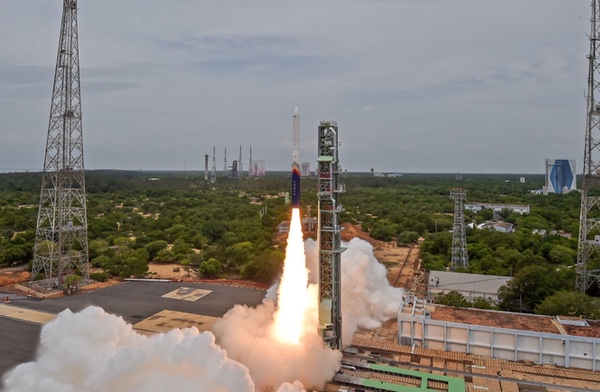
| Skyroot’s rapid rise reflects the remarkable growth of India’s private space sector since its liberalization in 2020. |
Vikram-1 is a small orbital launch vehicle developed by Skyroot Aerospace, based in Indian city Hyderabad. The vehicle is designed to provide orbital launch services for payloads of up to 480 kilograms. This vehicle is developed for launching small satellites into 500-kilometer low and Sun-synchronous orbits. This four-stage vehicle is a combination of solid propulsion technology and liquid-fueled orbital maneuvering engines. The first three stages are solid-propellant stages called Kalam-1200, Kalam-250, and Kalam-100. Each of these stages have a burn time of approximately 80 to 100 seconds. The fourth and final stage is equipped with a cluster of four Raman-1 engines powered by monomethylhydrazine and nitrogen tetroxide. These engines are designed to enable precise orbital insertion and final orbit adjustments.
Although Vikram-1 marks India’s first privately developed orbital launch vehicle, ISRO has a long history of collaborating with private industry globally to launch satellites. A notable early milestone was the Ariane Passenger Payload Experiment (APPLE), ISRO’s first indigenously developed experimental communication satellite, which was launched into a geosynchronous transfer orbit (GTO) aboard the third developmental flight of the Ariane launch vehicle from Kourou on June 19, 1981. The Ariane program had experienced a launch failure during its second developmental flight in 1980. As a result, the consortium was struggling to attract customers. But by securing a payload slot on the third developmental flight of Ariane, ISRO demonstrated remarkable confidence in their vehicle. The mission was successful, qualifying Ariane for operational service and marking the beginning of Arianespace’s emergence as a dominant player in the global commercial launch market. Even today, ISRO uses the services of Arianespace for launching heavy satellites into geostationary orbit.
Founded in 2018 by former ISRO scientists, Skyroot Aerospace undertook the successful launch of Vikram-1 from ISRO’s launchpad at SHAR in Sriharikota and also got assistance from ISRO’s ground networks and its Telemetry, Tracking and Command Network during this launch. Centers located in Indonesia and Australia also assisted the tracking.
Skyroot Aerospace is one of India’s leading private space companies. It made history in 2022 by launching Vikram-S, a suborbital launch vehicle. Building on this achievement, this startup raised $60 million in a funding round that valued the company at $1.1 billion, making it India’s first space tech unicorn. This company has been backed by prominent investors, including Sherpalo Ventures, Singapore’s GIC, and BlackRock. Skyroot’s rapid rise reflects the remarkable growth of India’s private space sector since its liberalization in 2020.
Vikram-1 is India’s first orbital launch vehicle built entirely with an all-carbon composite structure. Carbon-fiber composites are substantially lighter than conventional rocket-grade steel but have comparable structural strength. This enables a relatively small launcher to place payloads of up to 350 kilograms into LEO. The Orbital Adjustment Module (OAM) on Vikram-1 is powered by a fully 3D-printed liquid engine, aiding precise orbital insertion and in-orbit maneuvers after the solid propulsion stages complete their burn. This 3D-printed system helps in reducing the number of components, lowers production time and cost, and improves engine reliability and performance.
This mission had six payloads:
- SCOPE: Skyroot’s in-house atmospheric and Earth-observation satellite.
- SOLARAS: A 1U CubeSat by an Indian company called Grahaa Space for observing solar activity
- Embrace: An in-orbit robotic arm demonstration by Indian company Cosmoserve Space for space debris capture technology
- uD3PP and mD3RN: In-orbit technology demonstration payloads developed by the Germany-based company DCubed
- Cosmic Bloom: A diamond jewelry creation shaped like a blooming flower, mounted on an aluminum base
- Micro-Art: An 18K gold micro-sculpture; the sculpture features an 18K gold rocket holding micro portraits of celebrated Indian space scientists Dr. Vikram Sarabhai, Dr. A.P.J. Abdul Kalam, and Sir C.V. Raman, each smaller than a grain of rice
The payload Embrace remains attached to the rocket’s payload deck throughout this mission to demonstrate soft-robotic capture technology. It is an in-space demonstration of a robotic arm, a key step towards developing technologies for capturing and servicing objects in orbit. Such capabilities are expected to play a critical role for space debris removal, in-orbit servicing, and orbital sustainability. The validation of this technology in space is expected to meaningfully accelerate the development of India’s indigenous soft-robotic capture systems for next generation on-orbit operations.
| The successful orbital launch of Vikram-1 marks a defining moment in India’s space journey, demonstrating that the country could emerge as a hub for private launch services in near future. |
Over the past few years, the Indian space ecosystem has increasingly focused on capitalizing on the growing global demand for small satellite launch services. ISRO has also taken a major step towards commercializing India’s launch capabilities by transferring the Small Satellite Launch Vehicle (SSLV) technology to an Indian public sector agency called Hindustan Aeronautics Limited (HAL) through an arrangement worth $60 million. This is the first time ISRO has transferred the complete design, manufacturing, integration, testing, and operational knowhow of an entire launch vehicle to an external entity. So far, the SSLV, which is capable of putting 500 kilograms into LEO, has completed three developmental flights. Its first mission in August 2022 failed, but the next two missions in 2023 and 2024 were successful and the vehicle has been validated for commercial operations.
Along with Skyroot Aerospace, another prominent Indian space startup, AgniKul Cosmos Pvt. Ltd., is developing the Agnibaan, a small-lift launch vehicle, designed to place payloads of up to 100 kilograms into a 700-kilometer orbit. On May 30, 2024, the company successfully conducted the first launch of its suborbital test vehicle. This vehicle was fitted with the world’s first flight of a single-piece 3D-printed semi-cryogenic engine. The mission was launched from a privately built launch pad, the first in India. AgniKul has also established a Large Format Additive Metal Manufacturing (LFAMM) facility, housing India’s largest 3D metal printer dedicated to rocket components. With such facilities in their service, the company is confident of producing an entire rocket engine in just seven days. Expanding beyond launch services, AgniKul announced a partnership with NeevCloud (India’s first AI “supercloud” startup) in February 2026 and is working towards developing a space-based AI data center, which is planned to be launched aboard Agnibaan as soon as 2027.
Another Indian startup called Bellatrix Aerospace conceptualized in 2017–2018 a two-stage, liquid methane-powered micro launch vehicle called Chetak, to place payloads of up to 150 kilograms into Sun-synchronous orbit. However, today the company is focusing more on satellite propulsion technologies and have discontinued the development of Chetak.
Unlike India’s recent successes in private launch vehicle development, private launch companies in other Asian states like Japan and China are facing setbacks. Japan’s Space One has yet to achieve a successful orbital launch with its Kairos rocket. Its maiden launch in March 2024 ended in an explosion seconds after liftoff and its second and third attempts also suffered failures. Similarly, China’s leading private launch company, Space Pioneer, suffered a major setback when the maiden flight of its Tianlong-3 heavy-lift rocket failed on April 3, 2026. This failure followed an earlier accident in June 2024, when a Tianlong-3 first stage accidentally lifted off during a ground test and crashed nearby after detaching from its test stand.
The successful orbital launch of Vikram-1 marks a defining moment in India’s space journey, demonstrating that the country could emerge as a hub for private launch services in near future. As global demand for small satellite launches continues to grow, India is expanding its overall space ecosystem to capture a share of this rapidly expanding market. Beyond proving the technical capabilities of Skyroot Aerospace, this mission has generated valuable engineering data that will help them to refine future launch vehicles. Today, with more than 400 space tech startups, around 90 of which have collectively attracted nearly $870 million in investment, India’s commercial space sector is on a growth trajectory. The success of Vikram-1 should be viewed as a demonstration of the growing strength of India’s private space ecosystem.
Note: we are now moderating comments. There will be a delay in posting comments and no guarantee that all submitted comments will be posted.