Price it like a Tomahawk, not a Falcon 9: the case for sovereign microlaunch as deterrenceby Evangelos Dimitriou
|
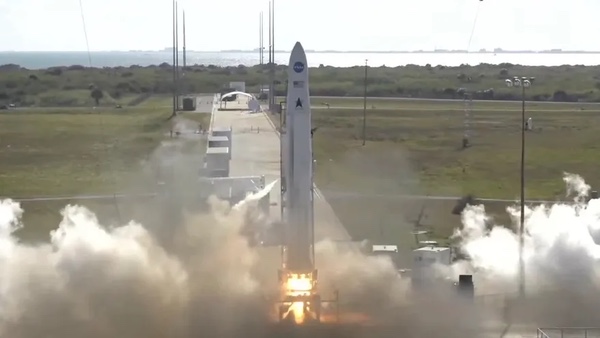
| Nations that care about not being cut off from space in a crisis should consider owning a small, dedicated, frequently uncompetitive rocket of their own. |
The standard objection arrives immediately, and it is correct as far as it goes. A dedicated launcher sized for a 3U or 6U cubesat—a payload class measured in kilograms, not tons—is a poor way to get mass to orbit. Measured in dollars per kilogram, a small dedicated vehicle loses to almost any rideshare slot on a Falcon 9, and does so badly: commercial launch has spent two decades getting relentlessly cheaper and more reliable, while a clean-sheet microlauncher inherits none of that scale. Judged as a transportation product, the case is closed before it starts.
But that is the wrong question, because rideshare and allied launch capacity share a hidden assumption: a functioning, willing, available market. That assumption is exactly what breaks in the scenarios this capability exists for. An alliance realigns. A government changes its export-control posture overnight. A commercial provider’s own launch site becomes a target, or its government restricts manifests during a crisis it isn’t party to. None of this requires an exotic prediction, only that “buy services from someone else” is a poor backup plan for the specific moment when someone else is also the variable that just changed.
So set transportation economics aside and ask a different question: what does it cost a nation to hold an option it hopes never to need?
Defense budgets already answer this question routinely, just not for rockets. A Patriot PAC-3 interceptor costs on the order of $4 million per unit; a Tomahawk cruise missile runs $2–3.5 million. Nations buy these by the hundreds and stockpile them for years, fully expecting that most will never be fired, and accepting depreciation, obsolescence, and periodic replacement as the unavoidable cost of deterrence. The US Army’s own Stockpile Reliability Program exists for exactly this reason: it has extended the average usable shelf life of stockpiled missiles from roughly 7.9 to 22.6 years, an entire bureaucratic apparatus dedicated to keeping unused weapons ready. Saudi Arabia’s DF3A missiles deterred adversaries through the Gulf War without a single launch. Earlier this year, reporting on US missile expenditures during its conflict with Iran noted that roughly half of the country’s most expensive interceptor stockpiles had been depleted, with an estimated four years required to rebuild them, providing a vivid, current illustration of how seriously nations take the lead time on replenishing assets that, ideally, sit unused.
A small dedicated launch system, fully developed, costs in a comparable rangeL call it $5 million to $25 million depending on configuration and propulsion choice. Inside a transportation-economics frame, that is an absurd price for the kilograms it lifts. Inside a stockpile-economics frame, it is unremarkable: a single line item next to interceptors and cruise missiles a country already holds in reserve for contingencies it hopes never to face. The product on offer is not cheap access to orbit. It is instead the same kind of assurance a nation already buys in every other domain of its defense posture, applied to space.
| The payload is almost beside the point. The actual product is a launch system that does not depend on a fixed pad, a foreign government’s goodwill, or months of lead time to field. |
None of this works, though, unless the resulting capability is honest about its own limits—and it’s worth being precise about what a 3U or 6U system actually delivers in very low Earth orbit (VLEO), where small dedicated launchers are most plausible. At that altitude, a satellite completes an orbit roughly every 87–88 minutes—about 16 passes a day—but any single ground location is only in view for a few minutes per pass, at best. And because atmospheric drag is so strong that low, the satellite itself typically re-enters within days to a few weeks unless it carries its own propulsion.
That sounds like a weak case until you remember what it’s being compared against: zero capability, at the exact moment when zero capability matters most. A handful of short, bursty contact windows a day is not a substitute for a functioning constellation, but it is a real, demonstrated military function. The US Army’s SMDC-ONE, a 4.5-kilogram, 3U cubesat launched in 2010, proved exactly this kind of beyond-line-of-sight relay between dispersed ground units and a base station. A nation cut off from its normal communications architecture does not need continuous bandwidth; it needs a way to get a short, encrypted message out a few times a day.
The same logic applies to observation: a few daily passes showing how a front line is moving is not a replacement for a dedicated reconnaissance constellation, but it is precisely the kind of intermittent, periodic-revisit intelligence that earlier generations of reconnaissance satellites provided for years before continuous coverage was even possible and that was still considered strategically indispensable.
There is also a credible upside on the horizon that would strengthen this case further: VLEO drag-compensation propulsion. ESA’s GOCE satellite held an orbit as low as 250 kilometers continuously for 55 months using an ion thruster, and Japan’s SLATS/Tsubame demonstrated similar station-keeping below 200 kilometers. Neither is a cubesat—both are larger, dedicated platforms—but the underlying physics is sound, and air-breathing electric propulsion and pulsed plasma thrusters are both in active development for smaller platforms. If that technology matures down to 3U/6U scale, the product changes from an expendable surge satellite that must be relaunched every few weeks into one or two standing assets that last years—a substantially stronger pitch than today’s baseline, and one worth tracking rather than assuming.
The payload, in other words, is almost beside the point. The actual product is a launch system that does not depend on a fixed pad, a foreign government’s goodwill, or months of lead time to field. This is not a hypothetical design goal: mobile, low-infrastructure launch has real precedent. Astra’s Rocket 4.0 (its Launch System 2) is designed to be transported and stood up at a new site in days, not months. Russia’s Start-1 has launched from an unmodified Topol ICBM transporter-erector-launcher, proof that launching from wherever the vehicle happens to be is achievable engineering, not science fiction.
| Most of what a defense budget buys is insurance nobody wants to need. A sovereign microlauncher belongs in that same category. |
That agility is the actual point of sovereignty: the ability to put something, anything, into orbit on your own schedule, using your own equipment, without asking anyone’s permission. A nation that owns this capability is not betting that a 6U cubesat will win a war. It is betting that having an option nobody can take away is worth paying for, the same way a stockpiled missile is worth paying for even though, with any luck, it will sit in a bunker for its entire service life.
This is not a pitch for every spacefaring nation, and it shouldn’t be sold as one. The realistic buyer is narrower. It is wealthy enough to absorb a capital cost in the seven-figure to low-eight-figure range for an asset it hopes never to use. It is exposed enough to a credible adversary to take the threat seriously. It is also positioned—diplomatically and under export-control regimes like the Missile Technology Control Regime—to actually receive the technology in the first place. That is a short list, not a global market, and any serious version of this idea must be honest about that from the outset.
But for that short list, the logic holds in a way it doesn’t for the broader commercial launch industry. Most of what a defense budget buys is insurance nobody wants to need. A sovereign microlauncher, priced and evaluated the way a nation already prices and evaluates its munitions stockpile rather than the way it prices a freight contract, belongs in that same category. It is not a cheap rocket, but a small, expensive-per-kilogram piece of strategic reserve, built to be used exactly once, in exactly the moment when nothing else is available.
Note: we are now moderating comments. There will be a delay in posting comments and no guarantee that all submitted comments will be posted.