The roads to the Moonby Ernesto Gabriel Arias
|
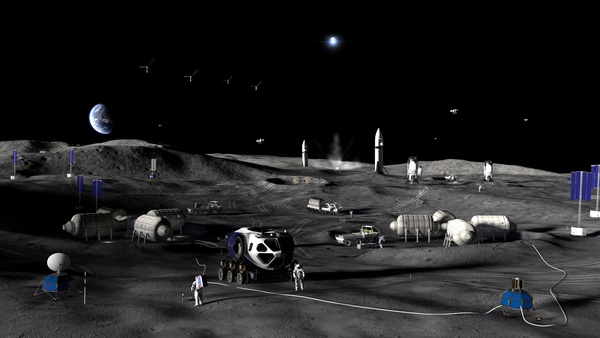
| But the true lunar race is not about repeating the feats of Apollo. It is about who establishes the first permanent logistical infrastructure capable of defining the operational standards of cislunar space. |
The Vikings reached America centuries before Columbus, but their arrival did not transform the world. They did not build ports, stable trade routes, or a network capable of sustaining a continuous flow. Rome followed a different path: its power rested not just on its legions, but on an extraordinary network of roads, ports, and common laws that integrated territories and facilitated exchange for centuries. The legions left. The roads remained. Roman law remained.
Today, as governments and companies compete to return to the Moon, attention remains focused on the visible elements: giant rockets, crewed landings, and flags. But the real strategic issue lies elsewhere.
Most current debates remain centered on the same question that dominated the Apollo era: who will reach the Moon and when. But the true lunar race is not about repeating the feats of Apollo. We have already been there first. It is about who establishes the first permanent logistical infrastructure capable of defining the operational standards of cislunar space.
Whoever builds the first logistical network will not just move cargo and people. They will define the routes, interfaces, protocols, and regulations under which everyone else will have to operate for decades.
The window of opportunity
Throughout history, great technological transformations usually occur during brief periods when exceptional circumstances converge. During these windows, infrastructures are established, strategic positions are occupied, and standards are defined that can endure for generations. Then, the window closes. Examples include the electrical grid and the Internet.
For the first time in the space age, three decisive factors coincide: geopolitical rivalry between the United States and China, high-capacity reusable launch systems, and sufficient technological maturity to build basic lunar infrastructure. None of them is completely new. What is extraordinary is that they appear simultaneously.
This convergence has opened a historic window. But windows of opportunity do not close on their own over time: they close when someone exploits them. The first power to establish an operational and sustainable infrastructure will gain a structural advantage difficult to match: the ability to define standards that others will find easier to adopt than to replace.
Two different problems
There is a widespread confusion that assuming an architecture capable of performing lunar missions is also suitable for sustaining a permanent presence. But they are not the same problem.
A mission architecture is designed to maximize the probability of success of a specific operation. Its goal is to transport a crew or cargo from an origin to a destination and complete a given sequence of activities. Efficiency is measured in terms of mission success.
A permanence architecture is optimized to sustain a continuous flow of people, equipment, consumables, and resources for decades. Efficiency is no longer measured by the success of an isolated operation, but by the system's capacity to maintain stable, predictable, and scalable activity.
Artemis, in its current configuration, is a mission architecture.
The bottleneck: Orion and the Gateway orbit
Orion cannot enter low Lunar orbit (LLO). Its main engine lacks the necessary thrust and delta-V to perform an LLO insertion and a subsequent departure toward Earth.[1] Orion is too heavy, its propulsion system too limited, and its cargo capacity too small to operate autonomously in the lunar environment.[2]
| The first power to establish an operational and sustainable infrastructure will gain a structural advantage difficult to match: the ability to define standards that others will find easier to adopt than to replace. |
NASA's solution has been to create a tailored orbit: the Near Rectilinear Halo Orbit (NRHO), or “Gateway orbit”.[2] It is an unstable orbit that circles the Moon at a distance of several thousand kilometers. Its real advantage is that it requires very little delta-V to enter and exit. In other words, NRHO is not the optimal orbit for lunar exploration; it is the optimal orbit for Orion.
By placing the rendezvous point in NRHO, NASA forces the lander (HLS) to cover the remaining segment: from NRHO to the surface and back. And that is far from a short trip. It requires 2,700 meters per second to descend and another 2,700 meters per second to ascend. Additionally, the HLS must travel from Earth to NRHO, adding another 3,600 meters per second. In total, the HLS must accumulate roughly 9,000 meters per second of delta-V in a single mission.
That figure is the true enemy of Artemis. Because the Tsiolkovsky rocket equation—the fundamental law of space propulsion—is logarithmically penalizing rather than linear. Even with an specific impulse of 380 seconds and an exceptionally good structural fraction, a single vehicle covering 9,000 meters per second ends up with a severely limited payload capacity. This is why the Starship HLS requires between 12 and 16 refueling launches per mission: not because SpaceX is executionally flawed, but because the architecture forces it to fight the rocket equation in its most punishing regime.[3] Yet, it was Tsiolkovsky himself who suggested the solution over a century ago: breaking large delta-V requirements into smaller segments.
The alternative: a logistical network
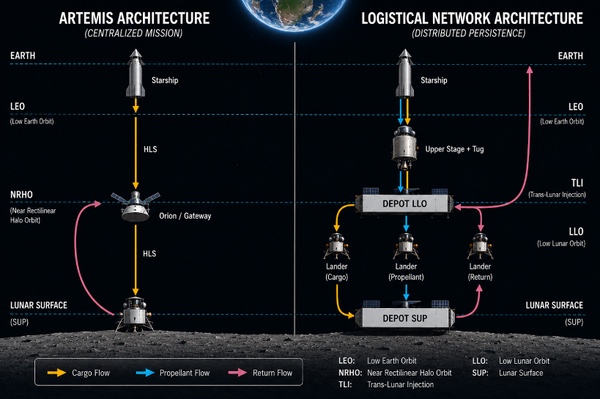
The solution does not lie in a larger vehicle or more refuelings. It lies in changing the architecture: dividing the journey into natural nodes and segments, each serviced by specialized vehicles. When this is done, the architecture begins to self-organize.
The topological baseline of the network consists of four nodes:
- The Earth's surface (KSC)
- Low Earth Orbit (LEO)
- Low Lunar Orbit (LLO), where a propellant and cargo depot will be placed
- The Lunar Surface (SUP), where another propellant depot will be built
 |
First segment: from KSC to LEO
The existence of reusable launchers with massive payload capacity to LEO is an essential component of the window of opportunity we are currently experiencing. For this baseline analysis, Starship is adopted, though any other heavy launch system with similar capabilities would be equally valid.
According to SpaceX, this carrier will have a capacity in the range of 100 to 200 tonnes.[4] We assume a baseline of 150 tonnes of payload delivered to LEO. However, the network topology does not depend on a specific payload mass; the same logic applies identically whether utilizing 100, 60, or 200 tonnes.
Second segment: from LEO to TLI
The leap between low Earth orbit and the trans-lunar trajectory requires approximately 3.1 kilometers per sedond. This is the most demanding segment of the entire network and also where cryogenic propellants offer their maximum energetic advantage.
Starting from a baseline capacity of 150 tonnes in LEO, an expendable cryogenic upper stage based on current technology can place approximately 68 tonnes onto a Trans-Lunar Injection (TLI) trajectory.
This is not a matter of technological preference. It is a direct consequence of utilizing the most efficient propulsion system where the energy requirement is at its peak. The stage serves a single function, operates for a few hours, and is discarded. It requires no orbital refilling, long-term storage, or cryogenic propellant transfer.
Third segment: from TLI to LLO
Once the trans-lunar trajectory is achieved, a completely different problem arises. Only about 900 meters per second is required to capture the cargo into LLO. We are no longer dealing with an expendable stage, but rather a permanent route between two fixed nodes of the network.
| Depots are not an optional feature added to the architecture. They are a logical consequence of a network’s existence. |
Applying the rocket equation with a modern hypergolic engine (specific impulse of 340 seconds) and a conservative structural fraction of 20%, the 68 tonnes arriving at TLI yield a striking result: a vehicle with a dry mass of just 4 tonnes and 17 tonnes of propellant can deliver approximately 47 tonnes of net payload into LLO.
This is where the Tug emerges. It appears not because someone arbitrarily decided to design a space tug, but because a repetitive route between two permanent nodes makes a specialized vehicle the most efficient mathematical solution. Its function is simple: transport cargo and propellant between the trans-lunar trajectory and lunar orbit. After refilling at LLO, it can also propel Earth-bound return cargo onto a re-entry trajectory.
Fourth segment: from LLO to the surface
Landing, loading and unloading, surface operations, ascent, and descent. For the first time, a highly specific operational environment appears. Applying the rocket equation again with hypergolic propellants and a conservative structural fraction of 26%, a specialized lander emerges with approximately 14 tonnes of dry mass and 39 tonnes of propellant.
Here lies the fundamental difference between a mission architecture and a network architecture. A mission forces a single vehicle to simultaneously carry its descent and ascent fuel, while a network allows it to refill at the nodes. If the lander must descend directly from a trans-lunar trajectory, it can deliver on the order of 16 tonnes of payload to the surface.
However, if a propellant depot exists in lunar orbit and another on the surface, descent and ascent become decoupled operations. The exact same vehicle can then transport approximately 37 tonnes of payload between LLO and the lunar surface, more than doubling its capacity. This performance spike happens not because the vehicle changes, but because the network exists.
Furthermore, upon each return to the LLO depot, it can bring up dozens of tonnes of materials harvested from the Moon, which the hypergolic Tug can then transport back to Earth.
The role of propellant depots
Depots are not an optional feature added to the architecture. They are a logical consequence of a network’s existence.
In a mission architecture, a single spacecraft must carry cargo to the Moon, return cargo to Earth, and transport the massive propellant weight needed for those maneuvers simultaneously. Conversely, a logistical network materially decouples three independent streams: the outbound cargo flow (Earth to Moon), the inbound cargo flow (Moon to Earth), and the propellant supply chain.
This exact logic governs every mature transportation system on Earth. Ports, railway stations, logistical hubs, and warehouses exist because transportation flows must be decoupled from the schedules of production and consumption. The Moon should be no exception.
The surface network
Our first direct launch to the lunar surface serves as the seed for the Surface Network. Its payload consists of a nuclear reactor, such as a fission surface power system or a space micro-reactor—along with the hardware required to interconnect landers on the lunar surface.[5]
This surface network links the propellant tanks of separate landers together, creating a distributed surface depot. Instead of transporting massive standalone tanks, pumps, valves, avionics, solar panels, and radiators to construct a centralized surface depot from scratch—a monumental and high-risk task—we exploit the fact that the landed vehicles already incorporate all of these subsystems.
By interconnecting the landers with a utility line carrying a heated glycol solution line at its core (utilizing waste heat from the nuclear reactor that would otherwise be radiated away), bundled with conduits for nitrogen tetroxide, hydrazine, helium, power, and data, we create a multi-functional surface network. Protected simply by burial within the local regolith, this network acts as a propellant depot, shares solar and reactor power, distributes radiator heat dissipation, and cross-utilizes pumping capacities. This eliminates the risk of vehicle freezing during the lunar night.
Additionally, installing navigation beacons on each lander generates an autonomous local positioning system (LPS), enabling rapid, modular, and technically simple base expansion. In doing so, we lay down the foundational energy and data infrastructure for a future lunar base.
The ISRU multiplier
The specialized network engines operate using hydrazine and nitrogen tetroxide, one of the most flight-proven propellant combinations in aerospace history. Their primary advantage is that they are hypergolic, igniting spontaneously upon contact without requiring external ignition hardware. These propellants remain stable liquids at ambient temperatures, completely bypassing cryogenics and boil-off challenges.
Roughly 50% of the mass of these molecular propellants consists of hydrogen and oxygen, which can eventually be extracted directly from lunar ice. The remaining 50% consists of carbon and nitrogen, which are absent on the Moon. Because carbon and nitrogen are missing locally, we import them from Earth as compact, stable, and easily transportable compounds.
| The first network to be deployed will not merely be a transit system; it will be a foundational infrastructure. |
An in-situ resource utilization (ISRU) plant supplied with these Earth-born chemical building blocks effectively doubles the mass of the imported material, delivering twice its weight in usable hypergolic propellant directly to the surface depot. This yields a massive logistics leverage compared to hauling completed propellants entirely from Earth's gravity well.
Does it work?
An architecture of this nature must be evaluated as an integrated system. Can such a network truly sustain a continuous logistical flow across decades? To verify this, a dedicated operational model of the network was built and simulated, with the complete quantitative datasets available via open access.[6]
Under a nominal operational regime of 12 annual launches delivering 150 tonnes to LEO, the network achieves a stable, steady-state throughput of approximately 240 tonnes of net payload delivered to the lunar surface per year.
When scaling up the launch frequency, the network's performance exhibits a highly linear behavior:
- Sustaining ~350 tonnes annually with 18 launches
- Surpassing 400 tonnes annually with 20 launches
Crucially, handling these higher throughputs requires zero architectural redesign. The exact same topology continues to operate efficiently under significantly higher load factors.
The simulation also quantifies the mass efficiency of the system. For every 150 tonnes placed into LEO, the mass breakdown across the nodes tracks as follows:
| Network Node | Payload Mass |
|---|---|
| Low Earth Orbit (LEO) | 150 t |
| Trans-Lunar Injection (TLI) | 68 t |
| Low Lunar Orbit (LLO) | 47 t |
| Lunar Surface (SUP) | 20 t |
In practical terms, approximately 13% of the initial mass placed in LEO successfully arrives at the lunar surface as pure net payload. Furthermore, even when prioritizing this outbound flow, the system retains the capacity to return tens of tonnes of cargo back to Earth annually, establishing a genuinely bidirectional cislunar logistics pipeline.
Conclusions
The bidirectional logistical network presented here does not claim to be the only solution to the lunar challenge. It is a conceptual framework. It serves as a working model of how permanent infrastructure can be engineered once the objective shifts away from flying isolated missions and focuses on sustaining a continuous, multi-decade flow of people, hardware, energy, and information between worlds.
Alternative architectures will undoubtedly emerge. Different orbits will be advocated, and distinct propellant combinations or vehicle layouts will be explored. Many of those variations may prove entirely viable. But that is beside the point.
The core takeaway is that the construction of permanent cislunar networks has definitively migrated out of science fiction. Nothing outlined in this architecture requires warp drives, antigravity, or theoretical breakthroughs:
- The engines exist
- The automated guidance systems exist
- Orbital docking mechanisms exist
- Surface fission reactors are actively in development
- Orbital depots, space tugs, and reusable landers are straightforward extensions of engineering baselines that have been mature for decades
The engineering challenges remain formidable, and they should not be underestimated. Designing, deploying, and operating a permanent lunar infrastructure will be one of the most complex technical endeavors our species has ever attempted. But complexity must not be conflated with impossibility. This is precisely why the current window of opportunity is so critical.
The first network to be deployed will not merely be a transit system; it will be a foundational infrastructure.
The nation or coalition that establishes the first permanent logistical network will secure an asset far more valuable than a fleet of vehicles or a record of successful flights. They will gain the operational footprint to effectively occupy the strategic nodes of cislunar space and the lunar surface. They will define the routes, set the physical interfaces, dictate the operational protocols, and establish the standards.
And history consistently demonstrates that operational standards routinely outlive the specific technologies that birthed them. The Vikings reached America first. Rome built roads. The enduring difference between them was infrastructure.
The true lunar race is not about flying more missions. It is about building the first network. Just as the standardized ISO container codified global maritime trade and the TCP/IP protocol defined the architecture of the Internet, the first permanent lunar network will possess the ultimate structural power: the capacity to define who writes the rules.
References
- NASA Flight Mission Design: Evolution of Orion Mission Design for Artemis (NASA Technical Reports Server)
- Orion Main Engine Specifications: Aerojet AJ10 Engine Family Legacy and Orion Integration (SpaceNews / Wikipedia)
- Artemis HLS Architecture & Refueling: NASA Artemis Program Framework and Starship HLS Status (The Space Review)
- SpaceX Starship Payload Capability: Starship User's Guide & Technical Specifications (SpaceX)
- Space Micro-Reactor Programs: Rolls-Royce Space Micro-Reactor Exploration Model (Rolls-Royce Official / UK Space Agency)
- The Quantitative Dataset: Lunar Logistics Network: A Persistent Infrastructure for the Lunar Base (Zenodo https://doi.org/10.5281/zenodo.20584985)
Note: we are now moderating comments. There will be a delay in posting comments and no guarantee that all submitted comments will be posted.