Lemons to bitter lemonade: from the Samos E-5 to the LANYARD reconnaissance satellite (part 2)by Dwayne A. Day
|
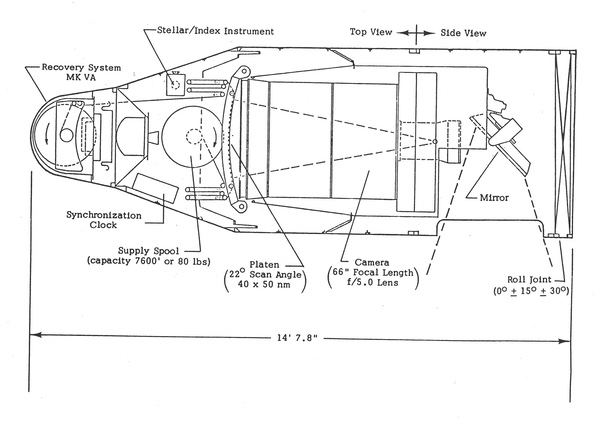 The interior of the LANYARD spacecraft. This aft part of the spacecraft in this illustration shows a side view to highlight the image reflecting mirror. (credit: NRO) |
Because the E-5 camera was inside the reentry vehicle, the heavy parts of the camera had to be located near the heat shield so that the capsule would not tumble during reentry. This meant that the big film supply and takeup spools had to sit flush next to the heat shield, like coins in a tube, rather than in a better location for camera operation. The spools had the same rotation axis as the roll axis of the spacecraft. Whenever the camera started up, the very heavy “doughnut” film spools would start turning and would begin rolling the spacecraft in the opposite direction of the heaviest spool. The camera was designed to counteract the spool momentum with a balancing mechanism, but this would not eliminate all of the motion and the remaining momentum had to be damped out or the images would blur. Herther felt this had never been fully addressed on the Samos E-5 and would have severely affected the performance of the camera had it ever become fully operational.[2]
| When Jack Herther set about redesigning the E-5, he knew exactly what to change first. |
When designing the LANYARD, Herther eliminated the E-5’s very large film spools and installed smaller spools, mounted parallel with the line of flight and the long axis of the spacecraft. When they started turning, they would exert their inertia against the yaw axis of the spacecraft, with minimal effect on the vehicle because it was harder to yaw the heavy spacecraft than it was to roll it. In addition, instead of the Samos E-5’s massive 250 pounds (113 kilograms) of film, the LANYARD would only carry 75 pounds (34 kilograms) of film, an increase from the initial estimate of 40 pounds.[3]
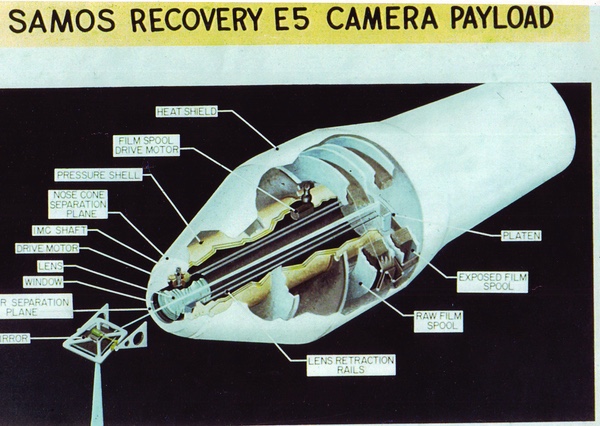 The Samos E-5 had an image reflecting mirror at the nose with the panoramic camera mounted behind it and the film supply and takeup reels at the bottom of the spacecraft, near the heat shield. For recovery, the mirror was jettisoned and the heavy lens assembly pulled down towards the bottom to lower the center of gravity. Compare this to the design for LANYARD, which was much simpler. (credit: NRO) |
Another Samos E-5 requirement was for a special system to pull the heavy lens assembly down toward the heat shield after the photographic phase so that the capsule could reenter without tumbling. Itek engineers called this system the “Mendelson Mod,” after the commercial hardware store where they bought the parts. Now that they were throwing the camera away at the end of the mission, they no longer needed this system.
With the big reentry vehicle gone and the new reentry vehicle utilizing proven components from CORONA, they could also eliminate other unnecessary systems. The Samos E-5 had started as a spacecraft that could carry a military astronaut and thus was designed to be pressurized. The E-5 reconnaissance spacecraft was pressurized with nitrogen at half an atmosphere. CORONA had already operated in vacuum and LANYARD would use the same polyester-based film, so it too could operate in vacuum. Because the E-5 capsule was pressurized, it required an optically pure quartz window for the camera to look through. With the pressurization requirement gone the camera no longer required the quartz window. The camera now looked out of a port in the Earth side of the spacecraft protected by a cover that was jettisoned after launch.
The E-5 camera was mounted the long way in its capsule, parallel to the surface of the Earth. At the nose of the vehicle, outside of the pressure vessel, was a large mirror that reflected the ground into the lens assembly. This mirror was jettisoned at the end of the mission because it was too heavy to return. But LANYARD would use the CORONA reentry vehicle, which had to ride at the nose of the rocket. To simplify the film path, Herther turned the entire camera around to face backward and mounted the mirror inside the spacecraft, where it no longer had to be jettisoned at the end of the mission. Instead, the entire camera, mirror included, would be discarded and burn up in the atmosphere.
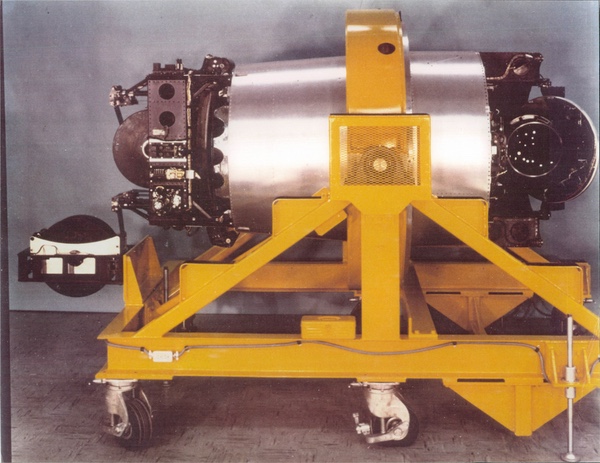 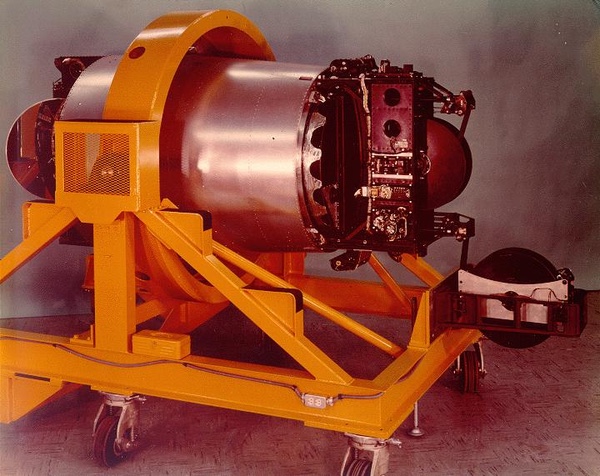 The KH-6 LANYARD camera system showing the film reels and the image reflecting mirror. The film supply reel was next to the camera. The film takeup reel would be mounted inside a reentry vehicle at the front of the spacecraft. These photos show the Earth-facing side of the spacecraft. (credit: NRO) |
With the smaller film spools and the new spool position, Herther and his engineering team could also dramatically simplify the film path through the camera. The E-5’s film had to be twisted before it could go to the curved surface, known as the platen, upon which the film rested when it was exposed. It then had to be twisted again to go to the takeup spool. Camera designers sought to minimize any stress on the film, which increased the possibility that the film could break, jump off its track, or get stress or static discharge marks.
With the LANYARD design, film could come off the supply spool, run over several rollers, and then travel to the platen without twisting. It could then come off the platen and head forward to the takeup spool in the reentry vehicle, also without twisting. It was a simple and direct film path through the camera, which reduced stresses on the film and increased reliability.
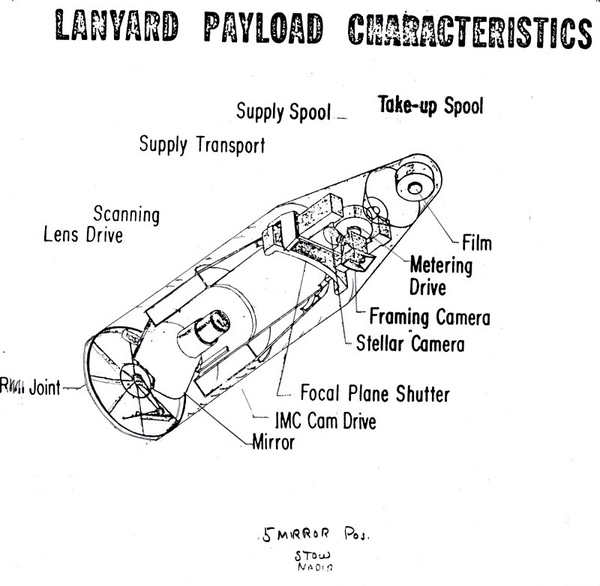 The LANYARD design turned the camera around compared to the earlier Samos E-5 so that the reentry vehicle was at the front of the spacecraft and the image reflecting mirror was at the rear. The film path through the camera was relatively simple, increasing reliability. (credit: NRO) |
There was one final change to the LANYARD camera: the replacement of the movable image reflecting mirror with a lightweight design. The image reflecting mirror was used to enable the spacecraft to take stereo pictures with only a single camera. It reflected the Earth below into the lens assembly, fixed at 15 degrees forward for a “burst” of 16 frames, then moved to 15 degrees aft for a second burst of 16 frames. The Itek team had encountered many difficulties developing this mirror and its mount for the Samos E-5. They had carved the kidney-shaped mirror out of solid quartz and it weighed a hefty 150 pounds (68 kilograms). LANYARD could not afford that kind of weight and so the Itek team had to completely redesign the E-5’s mirror.
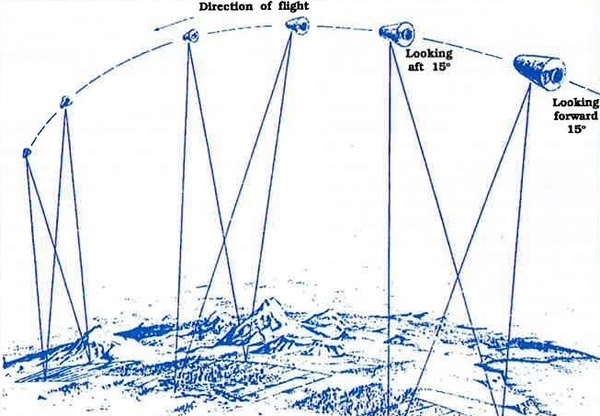 In order for LANYARD to take stereo photos of a target using its single camera, the image reflecting mirror was placed at one angle for the first set of photos and then rotated to a new angle for the second set of photos. This limited how much ground could be continuously photographed as the satellite flew overhead. (credit: NRO) |
The earlier Samos E-5 mirror had introduced Itek to the task of designing and manufacturing large, optical-quality mirrors. Now the LANYARD pushed the company even further, Herther said. “We had a technology development on how to make and mount mirrors that size that were lightweight. We tried hollowed-out glass quartz, we tried cirbit, we tried beryllium, Kanigen-coated. We tried aluminum, we tried egg crate quartz and the mounts in the back and everything—and mounting them so you don’t spherically or thermally distort the mirror. We had a whole technology development there… we just sorta dove into mirrors this size,” he remembered.[4]
| “The government guy was going to crack a mirror. And one of the guys said ‘Can I have that? I want to make a coffee table.’ He said ‘sure,’” Herther recalled. |
They finally manufactured a circular mirror out of beryllium and coated it with a nickel alloy known as Kanigen that could be polished to optical tolerances. Beryllium is toxic, requiring careful manufacture. “We had to machine it in a place that could handle beryllium like that,” Herther said. “And then we had it dipped in what we called a Kanigen coating. And then our optical fabricators polished the Kanigen. And we had maybe like a sixteenth of an inch of Kanigen to get a real smooth surface on it.”[15] The Kanigen-coated beryllium mirror cut the weight to only 40 pounds (18 kilograms), less than a third of the weight of the original E-5 quartz mirror.[6]
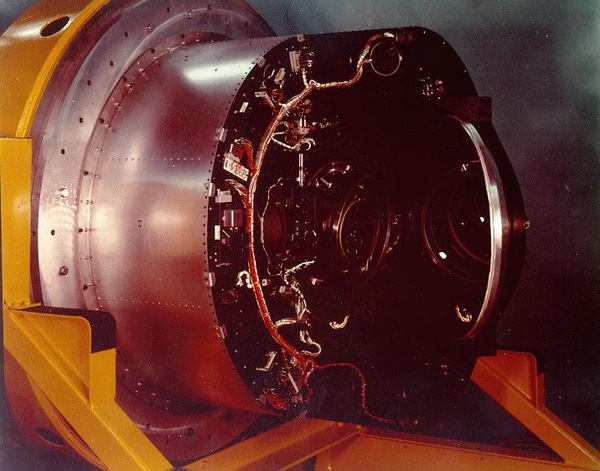 The image reflecting mirror directed light from below into the camera assembly. Itek experimented with many different materials and designs before finalizing on the one used for the LANYARD spacecraft. It was significantly lighter than the Samos E-5 mirror. The lens assembly is reflected in the mirror. (credit: NRO) |
“Ironically,” Herther remembered, “after the program was canceled they were breaking up the lenses and everything and one of those lenses ended up in our Museum of Science. I saw one there, an E-5 lens.” Another leftover E-5 mirror had an even more unusual destination: it became a coffee table. “The government guy was going to crack a mirror. And one of the guys said ‘Can I have that? I want to make a coffee table.’ He said ‘sure.’ We paid thirty-thousand [dollars] for the blank, plus by the time you polished it it was worth some big money…” Herther remembered with a chuckle, “and he’s got a coffee table.”[7]
There was another way that the LANYARD camera, and its predecessor, the E-5, saved weight. The CORONA camera had a scan arm that connected the lens assembly to the shutter that swept above the film and drastically reduced the inertia from each scan across the film. A feature they had used with the E-5 and continued with the LANYARD eliminated the need for a scan arm. “We had a little curtain that went by it with a little slit and a little servo followed the lens,” Herther remembered. We didn’t have a scan arm, just a thin piece of metal with a slit on it. It had a toilet seat capper,” Herther said.[8]
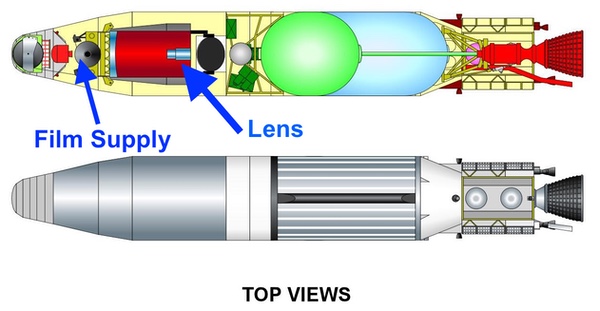 The LANYARD used many systems developed and proven for the CORONA spacecraft. (credit: Giuseppe Di Chiara) |
The overall camera weighed 610 pounds (277 kilograms), the film supply cassette weighed 15 pounds (7 kilograms) plus a 75-pound (34-kilogram) load of film. The LANYARD also included a stellar index camera of the same type that Itek had developed for CORONA.[9] The stellar index camera took lower resolution pictures of a large area so that photo-interpreters could determine what they were looking at on the high-resolution images by comparing them to terrain features on the stellar index photographs. One index image would be taken for every ten panoramic images. It also simultaneously took pictures of the star positions to determine the spacecraft’s position.
The resulting spacecraft was substantially stripped down and simpler than the Samos E-5. Ten major E-5 subsystems were incorporated into LANYARD, seven had been eliminated, and five had been substantially simplified.
Panoramic with a twist
With all of these changes the camera system’s performance could be increased by up to 40% or better. Itek’s engineers figured that the satellite could produce images as good as 3–5 feet (0.9–1.5 meter) resolution, and laboratory tests of the actual cameras before flight indicated an average ground resolution of about 3.5 feet (1 meter) from a normal orbit.[12] But there were other improvements as well. The satellite had a four-day orbital lifetime and five different target programs could be incorporated into the system so that it could photograph different targets while in orbit, allowing them to avoid photographing cloud-covered areas.[13]
The LANYARD still had a limited viewing area of the ground: 22 degrees, producing a swath of 42.3 nautical miles width by 7.5 nautical miles (78 by 14 kilometers).[14] The E-5 had been able to roll 30 degrees to either side while in flight to allow the camera to look to either side of the ground track. On the LANYARD, Lockheed engineers accomplished this by installing the payload on a roll joint forward of the Agena. The entire payload could then be rolled in 15 degree increments up to 30 degrees to either side of straight down, somewhat like the periscope on a submarine.
This off-track photo capability would distort the photographs slightly because the camera was now looking at an oblique angle at the Earth instead of straight down. The far sides of each film strip image would be wider than the near sides, and one square centimeter at one point on the image would not cover the same amount of territory on the ground as one square centimeter at another point on the image. But the rolling capability expanded the total viewing angle by 60 degrees, enabling LANYARD to potentially photograph more territory below its flight path, although the camera was still limited to its 22-degree maximum on the film.
There was one other new situation that the designers confronted. When a camera moves, the image inside of that camera also moves, which is why a photo taken looking out the side of a fast-moving car is blurry. To take sharp photos, the camera has to compensate for this image movement. But the LANYARD also faced a new problem: its images were of higher resolution and this, combined with other camera characteristics such as film speed, meant that the rotation of the Earth underneath the spacecraft would also cause some image smearing.
Lockheed officials proposed yawing the spacecraft during photography to reduce this effect. But the problem was that ground controllers who were commanding the spacecraft did not have the security clearances to know what the spacecraft actually did. Program officials felt that the controllers could figure out that this motion was necessary for photography and determine that the vehicle was a reconnaissance satellite, and so they would have to obtain more security clearances for people at the satellite tracking stations “in order to plug any possible conjecture.”[15]
It is not known what solution the program officials finally adopted. But the incident highlights the occasionally bizarre rules of the highly secretive reconnaissance world, where even the people operating the reconnaissance satellites sometimes were not supposed to know what they did.
Preparing for flight
According to the Statement of Work, Lockheed was supposed to deliver the first complete LANYARD by February 1963, the second and third in April, and the remaining two each month.[16] Although later than the initial estimates, it was a fast schedule, but by this time the reconnaissance satellite program was in full swing and the Air Force was regularly launching about one CORONA or ARGON mapping satellite a month from its launch facility at Vandenberg Air Force Base on the central Californian coast.[17]
The various government officials and contractor representatives held a “LANYARD Systems Engineering Meeting” on October 19, 1962. The people at the meeting evaluated the status of the overall camera system, including such things as testing procedures. They identified several problems, such as radiofrequency interference of the LANYARD’s electronics with a sub-satellite planned to be ejected from the Agena.[18] Lockheed engineers were concerned about the large door required for the camera scan and requested a test to determine how much the imagery would degrade if they put a door support across the opening. The smallest possible support strut would degrade the imagery by 10%, but was rejected as unnecessary.
| Although it seemed like the first LANYARD had dodged bad luck with its launch vehicle, that proved not to be. |
Jack Carter at Itek suggested that six additional cameras be purchased for 1964. Available records are inconsistent, but NRO Director Joseph Charyk apparently added two more for 1963, but limited the total order to five. In October 1962, Charyk approved three more LANYARD payloads, for launch in January, February, and March 1964. This would be an additional hedge in case GAMBIT did not work as planned. At that time, Itek was also authorized to buy optical glass for nine additional systems.[19]
In late 1962 there was concern about the stellar index camera’s schedule due to a decision to add substantially more film for the camera, requiring a change in its design. The stellar index camera was vital for LANYARD’s main camera operation because unlike the CORONA system, there was no separate camera to take stellar pictures to determine where the main camera was pointing when it operated.[20]
The first LANYARD camera was delivered by Itek on November 21, 1962, one day ahead of schedule and well below budget.[21] The launch was scheduled for February, but slipped into March.[22]
On January 31, Itek indicated that the beryllium mirror intended for the first flight was not ready and recommended that the aluminum mirror that had been included in the spacecraft during the testing phase be retained for flight. Lockheed engineers rejected that idea, and Itek ended up shipping a second beryllium mirror slated for use in a later spacecraft for use in the first vehicle.[23]
The first vehicle was delayed going into thermal vacuum testing until February, and then experienced a series of problems during test. The problems delayed vehicle acceptance and thus NRO leadership decided to fly a CORONA satellite payload at the end of February on the first Thrust-Augmented Thor Agena launch instead of the LANYARD. Because a technician failed to push an umbilical connector in hard enough, one of the TAT’s three solid rocket motors failed to ignite and the CORONA satellite was lost. Although it seemed like the first LANYARD had dodged bad luck with its launch vehicle, that proved not to be.[24]
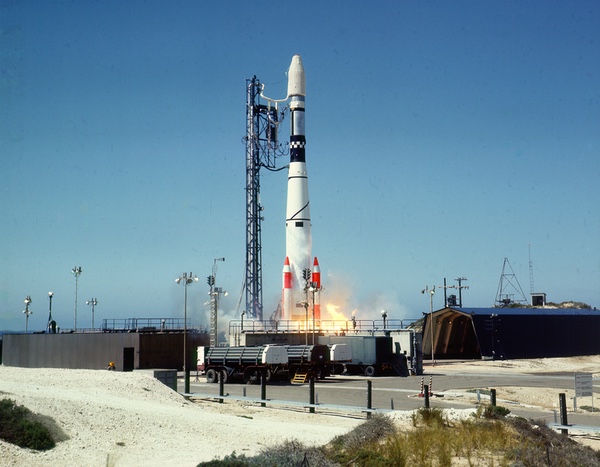 The first LANYARD launch was in March 1963 from Vandenberg Air Force Base, but the vehicle failed and fell into the Pacific Ocean. A May 1963 launch was more successful, but the spacecraft failed in orbit. The LANYARD reentry vehicle was recovered, but contained no film. (credit: Peter Hunter Collection |
First missions
Every classified reconnaissance project had multiple designations. The overall code name for the program was LANYARD. This was its “BYEMAN” security system code name. BYEMAN was a specific classification level, above Top Secret, that covered some intelligence satellites. Not all intelligence satellites received BYEMAN code names. Some only had Air Force “Program” numbers. Some had both. LANYARD did not have an Air Force Program number but it was also designated the KH-6. This was its position in the “KEYHOLE” sequence. “KEYHOLE” was the security designation applied to photographic reconnaissance satellites for the people who were cleared to see the photographs.
Within Itek the LANYARD project had been designated Program 9040, and the CIA apparently referred to the specific camera model as the Mark 1 Panoramic Camera System.[25] Each LANYARD camera had its own serial number, and of course the Thor rocket and the Agena also had identification numbers as well. The launch from Vandenberg also had a designation so that the launch personnel who did not know what the payload was could still refer to the launch. The first LANYARD launch was designated “CAMP OUT.”
The reconnaissance mission was designated 8001. KH-4A CORONA missions at that time had numbers in the 9000 series, with an “A” tagged onto these numbers to designate an ARGON mapping mission.
LANYARD Mission 8001 also included a small P-11 sub-satellite nicknamed “Hitchhiker” and designed to take radiation and other measurements in orbit. The P-11 would soon be adapted for signals intelligence work, and several dozen later flew as part of a broad-ranging signals intelligence program.[26] (see “Little Wizards: Signals intelligence satellites during the Cold War,” The Space Review, August 2, 2021.)
Because the first LANYARD mission was primarily an engineering test flight and because the sun angle during the winter allowed photography to be taken only on descending (north-south) passes over the Soviet Union, only 106 of 225 potential targets were scheduled for the first mission.[27]
On March 18, 1963, only 11 months from formal program start, the first LANYARD roared off its launch pad at Vandenberg Air Force Base. This was the second launch to use the more powerful TAT-Agena D rocket. Unfortunately, an electrical system failure resulted in the gas valves that controlled Agena stabilization during orbital injection operating for only a second. Without attitude control, the Agena began to roll. The engine then stopped firing 13 seconds early, probably because the rolling prevented fuel from reaching the ignition chamber. The vehicle failed to reach orbit.[28]
Exactly two months later, on May 18, 1963, LANYARD Mission 8002 began with a roar as its TAT-Agena D rose off the pad at Vandenberg. There was no sub-satellite along for the ride on this mission. This time the Agena did reach orbit but failed soon after and the camera payload was never activated.[29] For the second LANYARD mission, the Agena’s “Lifeboat” system was used to eject the satellite recovery vehicle. This was independent of the main command circuitry and had its own systems. The capsule was recovered from the water but contained no film.[30]
The P-Camera experiment
In April 1963, Director of Central Intelligence John McCone wrote to NRO Director McMillan that “since the success of the GAMBIT system is quite uncertain,” it was a good idea to purchase additional LANYARDs to cover the period August 1963 to August 1964. On May 24, 1963, the LANYARD program was expanded to include five additional payloads. At that time there were three remaining of the original five, along with three more authorized spares.[31]
McCone was apparently concerned about getting higher resolution imagery of the Soviet Union. After the first LANYARD launch had failed, in April 1963 McCone flew to Boston to persuade Dr. Edward M. Purcell of Harvard to chair a panel to survey the future of reconnaissance satellites and ways to improve their imagery. McCone also mentioned the need to obtain imagery of a suspected anti-ballistic missile site at Leningrad. Purcell suggested a method of obtaining imagery quickly: put a telescope and strip camera in a CORONA satellite specifically to photograph the Leningrad site. McCone passed Purcell’s suggestion to the CORONA program office, which took it to Itek, developer of both the CORONA and LANYARD cameras.
Itek’s engineers came up with a proposal for a 240-inch (610-centimeter) focal length Cassegrain telescope using “folded optics” and attached to a 127-millimeter strip camera. This was soon known as the P (for Purcell) camera experiment, or the P-Camera.
In California, Lockheed engineers came up with a plan to use the empty space in the film transport area of a KH-4 CORONA-MURAL satellite. This was where the film traveled to the single reentry vehicle. They built a dummy unit to fly in a CORONA spacecraft and cut an opening in the side of the spacecraft with a door that would be blown off by a pyrotechnic device after orbital insertion, like the doors for the two CORONA-MURAL cameras.
On June 12, 1963, a CORONA mission was launched from Vandenberg Air Force Base carrying the dummy P-Camera. The flight was intended to determine if the P-Camera would disrupt the main camera operations, if the rocket could carry the heavier load into orbit, and if the Agena spacecraft could still stabilize the spacecraft. The CORONA mission went normally.
| The “P-Camera experiment,” as it became known, was a backup to the backup program. Now that it had failed, it was up to LANYARD to deliver. |
On June 26, a second CORONA mission, number 9056, was launched carrying the only P-Camera onboard along with a standard CORONA-MURAL camera. Unfortunately, telemetry indicated that the P-Camera’s door had not blown off as planned. In the hopes that this was faulty telemetry, Lieutenant Colonel Vernard Webb, the CIA chief of satellite operations on the west coast, ordered that the camera be turned on during the next pass over Leningrad. When the Satellite Recovery Vehicle was deorbited on June 30 and the film recovered and developed, it was blank, indicating that the optical-port door had not blown off.[32]
The “P-Camera experiment,” as it became known, may have been inspired by the March launch failure of the first LANYARD mission, as well as McCone’s lack of faith in the GAMBIT. It was a backup to the backup program. Now that it had failed, it was up to LANYARD to deliver.
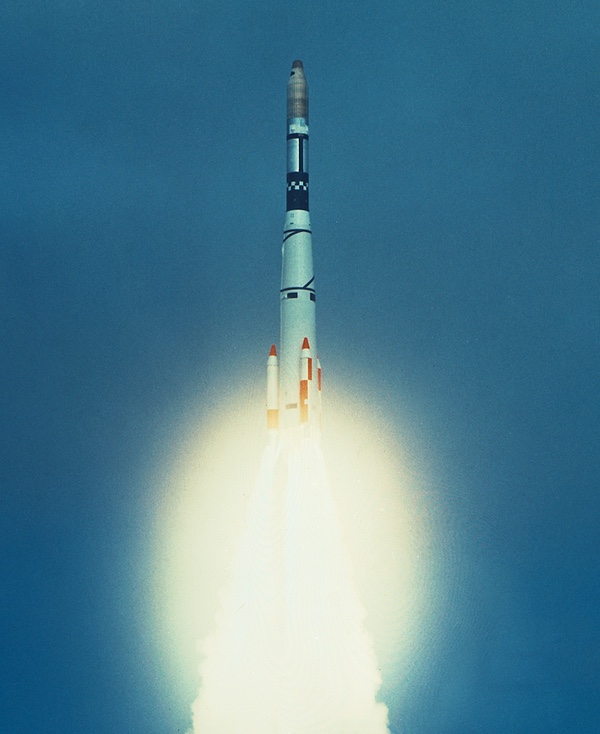 The third LANYARD launch took place in late July 1963 and successfully placed the spacecraft in orbit. LANYARD Mission 8003 returned film, but the spacecraft overheated, affecting camera performance. (credit: Peter Hunter Collection |
Mission 8003
Mission 8003 was launched on July 31, 1963, and achieved the proper orbit of 168 by 467 kilometers at 74.94 degrees inclination. It was programmed to fly a five-day mission. Upon reaching orbit, the camera operated for one burst to verify that the lens lock had released and to demonstrate that the camera was working.[33] By the ninth revolution the telemetry indicated that the main camera was operating normally, but the stellar index camera was apparently taking too many pictures. In addition, sensors indicated that the payload was too hot.
On the 16th revolution the roll joint was unlocked. Roll maneuvers to obtain photography were conducted 13 times, with the instrument being rolled back to zero—straight down—at the end of each pass.[34]
But the payload was still too hot and this worried ground controllers. By the 22nd orbit the camera stopped working due to a short circuit.[35] On the 23rd pass neither the main camera nor the stellar index camera system would start. The primary suspect for the failure was an effort to correct the rate of image motion compensation in the camera during a pass over the Vandenberg ground station. Some system had failed as a direct result of that corrective action and the cameras never worked again.[36]
By the 25th orbit the spacecraft was no longer responding to commands and telemetry indicated an increased drain of the Agena’s batteries, probably due to the heat. For the remaining passes there was no indication that the camera was operating despite commands from the ground. The increased power drain continued. Ground controllers decided to recover the payload, and on orbit 33 the spacecraft went into recovery mode. It ejected its Satellite Recovery Vehicle (SRV) which reentered the atmosphere, deployed its parachute, and was recovered by a C-130 Hercules aircraft high over the Pacific Ocean northwest of Hawaii.[37]
The first images taken by LANYARD were of targets within the United States which could be measured on the ground and compared to the satellite photos. The later targets were in the Soviet Union. A total of 908 frames (approximately 1,900 feet, or 579 meters) was recovered from the main camera, 500 feet from the index camera, and 250 feet from the stellar camera (152 and 76 meters respectively). About 60% of the main camera coverage was in stereo.[38]
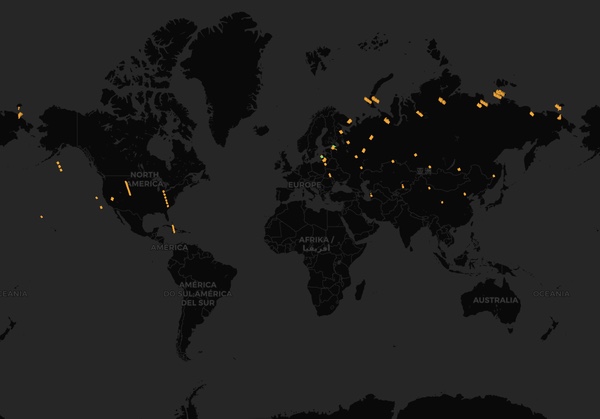 Map showing areas of the Earth imaged during the July/August 1963 LANYARD Mission 8003. (credit: Harry Stranger) |
In the early years of satellite reconnaissance, ground resolution for reconnaissance satellites was usually approximated, and there was a difference between the best possible resolution and the average resolution for the entire mission. Although Itek engineers had hoped for resolution of 4–5 feet (1.2–1.5 meters), the actual resolution was more like 8–10 feet (2.4–3 meters), although sources disagree on this point. A post-mission report blamed this low performance on high temperatures that deformed the camera structure and shifted the focus of the camera, blurring the images. It also noted that there was a sudden performance drop on the ninth orbit, which could have been a structural element giving way.[39] Another source indicates that overall, the resolution was four to five feet, allowing identification of vehicles, small aircraft, and runway markings.[40]
Camera designer Jack Herther remembered back to that mission almost 40 years earlier. Photo-interpreters, or PI’s, were responsible for looking at the film and determining what it showed. But the camera engineers also evaluated the film to determine how the camera had performed. “When we got the film back I went up to Westover and looked at it myself with some PI's,” Herther said. Westover Air Force Base in Maine was the site of an Air Force film processing facility.
Herther remembered looking at the strips of film from Mission 8003. “Somebody at the [1995] CORONA symposium said that the best LANYARD imagery was two feet (0.6 meter), but most of it was four to six (1.2-1.8 meter). I would agree with that,” Herther said. “When I first saw it, when it first turned on, there was a gas tank with a one-foot (0.3-meter) ring around it. One of those huge storage tanks. That was sharp. It looked pretty good. After that, I never saw anything sharp,” he said, probably due to the thermal problems affecting the camera’s focus. “We calculated and the two feet was reasonable for that” early image[41] Herther was likely referring to a refinery photographed in Billings, Montana, which was photographed early in the mission.
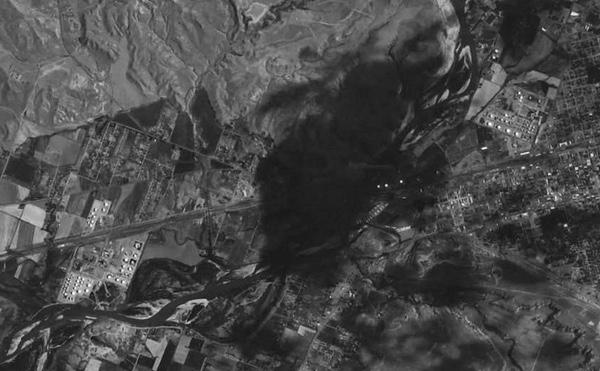 A LANYARD photo of Billings, Montana taken early during Mission 8003. It is likely that this is the image that Jack Herther looked at and saw a large oil tank in good resolution. This version is much lower resolution on the internet, but Herther remembered that the original was very sharp. Later images were much less sharp. (credit: Harry Stranger) |
The spacecraft made fourteen imagery passes over the Soviet Union, photographing targets in Dudinka, Tomsk, and Tiksi in Siberia, as well as Novaya Zemyla, Gorkiy, and a spot in central China.[42]
The operators were disappointed with the thermal problems on the mission. Obviously something was wrong with the design of the spacecraft and passive efforts to keep the payload cool, using reflective paint and other techniques, were insufficient. The remaining LANYARD flights were grounded until this problem could be studied and solved.
| The goal for the first GAMBIT mission was to return one good picture. The first GAMBIT mission did considerably more than that, and proved that the system could work as needed. |
Itek suggested two modifications to the payload to prevent thermal distortions. The first proposal was to install heated magnesium rods with thermostatic controls to compensate for shifts in the distance between the film platen and the lens. The second proposal was to stow the mirror horizontally, minimizing temperature gradients across it and preventing radiative cooling of the mirror from affecting the lens focus. These modifications would take two months to implement and test.[43]
The LANYARD program’s goal was to return imagery before the GAMBIT satellite became operational. On July 12, 1963, the first GAMBIT spacecraft roared off the launch pad at Vandenberg Air Force Base. The goal for the first GAMBIT mission was to return one good picture. The first GAMBIT mission did considerably more than that, and proved that the system could work as needed.[44] Now that LANYARD was no longer an interim program, was it still useful even if it could be made to work properly?
    The only successful LANYARD mission took hundreds of photos of the Soviet Union as well as some photos of the United States. Thermal problems degraded the images taken later in the mission. (credit: Harry Stranger) |
Program termination
By September the second set of GAMBIT images had been processed and it was clear that GAMBIT was going to work. Although the fourth and fifth LANYARD vehicles were being readied for flight, they were no longer needed.[45]
In September 1963, with further LANYARD missions still on hold, the CIA conducted an evaluation of the LANYARD compared to the other two primary reconnaissance satellites then in use: the KH-4 CORONA, which had been developed under the codename MURAL (and soon changed back to CORONA) and had entered service in early 1962, and the KH-7 GAMBIT, which had entered service in July.[46]
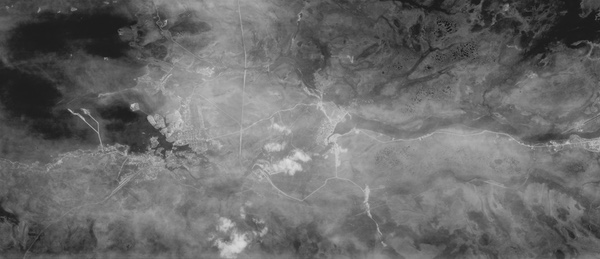 Industrial and urban areas in the northwestern USSR imaged during the 1963 LANYARD mission. Intelligence analysts wanted to be able to detect new construction as well as the location of strategic weapons systems in such imagery, hopefully in enough detail to firmly identify them. (credit: Harry Stranger) |
The assessment was conducted under the direction of Dr. Albert D. “Bud” Wheelon, who had taken over the CIA’s Directorate of Research from Dr. Herbert Scoville and was building it into the powerful Directorate of Science and Technology that in later years would oversee the development of several highly ambitious and revolutionary satellite systems. One of Wheelon’s early actions was to create a study team to evaluate overall reconnaissance requirements and the ability of existing systems to meet them.
Now Wheelon wanted to determine if LANYARD could fulfill the agency’s intelligence requirements, which were designated search/surveillance, indications, and technical intelligence. CORONA was currently partially satisfying the search/surveillance and indications intelligence requirements, but the CORONA missions were of inconsistent quality. The cameras were returning pictures with resolution between 10 and 20 feet (3 to 6 meters). If the quality could be improved so that the cameras consistently returned 10-foot (3-meter) resolution, then the CORONA would largely satisfy the requirements. The CIA was focusing a research and development program on this problem.[47] GAMBIT was intended to provide technical intelligence, with resolution of four feet (1.2 meters) or better.
The assessment noted that the LANYARD lacked the ability to cover as many targets as CORONA and did not have the resolution of the GAMBIT. It stated:
The primary deficiency of LANYARD is in the operational areas. Because of the gaps of stereo coverage and the requirement for rolling the camera to cover off-track targets, the programming of LANYARD is much more difficult; in addition, limitations are imposed on the geographical spacing of targets for acquisition. With a more involved programming of LANYARD, there is a concurrent requirement for a more elaborate command and control; this is inherently less reliable. The narrow swath requires adjustment of the program to compensate for differences between actual track of the vehicle and the pre-flight planned tracks.[48]
Clearly LANYARD was not ideal for the search mission nor the technical intelligence mission. But Wheelon noted that GAMBIT photographed a very small swath of ground and it was possible that it would miss its targets due to inaccuracies in its orbit—something that the photo-interpreters would not discover until after the mission was over. “It is possible, therefore, that neither G nor L will meet our technical intelligence requirement, and that we may have to develop a system with greater swath width and less resolution than G, but smaller swath width and greater resolution than L and M,” Wheelon wrote. “We may also find that we cannot achieve a useable system yielding GAMBIT’s ground resolution from satellite vehicles.”[49]
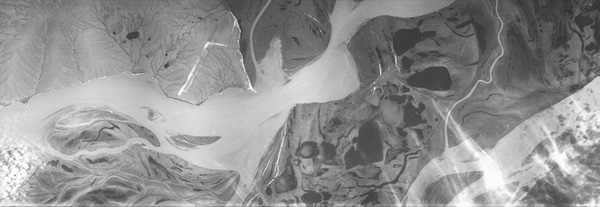 LANYARD was designed to cover large amounts of territory at ground resolution better than CORONA. But its capabilities were increasingly overlapped by both CORONA and GAMBIT. (credit: Harry Stranger) |
Wheelon concluded by stating: “It is our opinion that ground resolution achieved by the LANYARD system is not sufficiently better than that of MURAL to offset the problems associated with programming and target acquisition. The needs in the community for high resolution photographs for technical intelligence must be met by [an] other system.”[50]
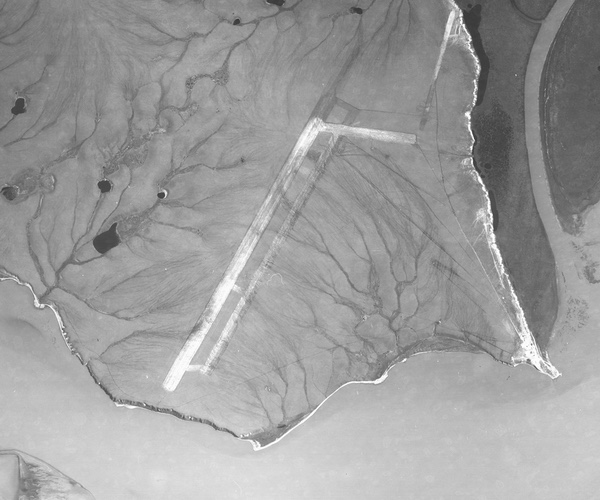 Aspidnoye Air Base in the Soviet Union started construction in 1960 and was detected by American CORONA reconnaissance satellites. However, construction was never finished. In this LANYARD image, the roughness of the airfield surface is evident, and there are no significant support structures around the runway, like fuel tanks or maintenance buildings. (See: https://en.wikipedia.org/wiki/Aspidnoye_(air_base) ) (credit: Harry Stranger) |
There was one inconsistency in the CIA’s assessment, however. In an accompanying table comparing the performance of the LANYARD, GAMBIT, and CORONA, the table listed the resolution achieved on the LANYARD flight as 8–10 feet (2.4–3 meters), and the expected resolution as 5–8 feet (1.5–2.4 meters). This latter figure was considerably less than earlier predictions of 4–6 feet (1.2–1.8 meters) and even three-foot (0.9-meter) resolution. And none of these figures were consistent with the two-foot (0.6-meter) resolution figure officially released 33 years later and also recollected by camera designer Jack Herther. Whether this meant that the CIA had lowered its expectations for LANYARD, was deliberately underestimating the resolution figures to make LANYARD appear less attractive, or was simply mistaken, remains unknown.[51]
Apparently as a follow-up to Wheelon’s letter, Director of Central Intelligence John McCone wrote:
I am told (but this has not been confirmed) that the present NRO program upon which the ’64 expenditures and the ’65 budget is based anticipate the procurement of 19 LANYARDs. On the other hand, I have the impression (and this had not been investigated) that there is no appreciable difference in resolution between CORONA and LANYARD; furthermore this is evidenced by the production of the one and only successful LANYARD mission. Also I understand but have not confirmed that a 4-day LANYARD mission will photograph about 700,000 square miles, whereas a 4-day CORONA mission will cover 10,500,000 square miles and a CORONA J twice as much if both capsules are productive. However, this would involve 8 days of photography. I am advised that the LANYARD and the CORONA cost about the same amount, namely [deleted] to launch.[52]
McCone further noted that the second GAMBIT mission, launched two weeks before on September 6, had reportedly been successful, although he did not know how good the pictures were or what targets had been photographed. McCone continued: “The question therefore is: if the above is correct, if the LANYARD resolution is not an improvement and if the GAMBIT is successful, should we at this time drop the LANYARD? Alternatively, should we not keep the LANYARD in an R&D status procuring two or three cameras, arrange for launching at an appropriate time, and then make a final decision after examining our results?”[53]
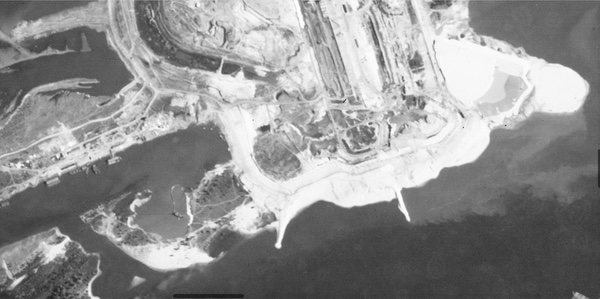 The Balakovo Dam started construction in the early 1960s on the Volga River and was finished by 1967. (credit: Harry Stranger) |
The remaining five payloads were still under construction and being readied for launch after Mission 8003.[54] At the time of cancellation, five of the follow-on payloads were between 80% and 100% complete, and a remaining five were in lower states of construction.[55] Itek was permitted to keep two cameras. Two complete lenses and five sets of LANYARD optical glass were transferred to the photo reconnaissance laboratory at Wright-Patterson Air Force Base. All remaining LANYARD hardware was put into bonded storage.[56] It is unclear if the 19 LANYARDs that McCone referred to as future purchases included the five unflown payloads or represented all new vehicles.
On October 23, NRO Director Brockway McMillan finally terminated the LANYARD program and sent a message to Lockheed stating: “Effective immediately LMSC is hereby directed to stop all work on LANYARD…” Lockheed was also directed to not incur any further costs under its contracts.[57] This required the canceling of five contracts, two with Itek and three with Lockheed. Soon after, McMillan ordered that three camera units be completed by Itek, numbered 02, 07, and 08. They were to be completed through the acceptance testing phase of the contract, meaning that they would be ready for final launch preparation once they were accepted by the government.[58] When the program was finally shut down there were five complete LANYARD payloads in storage, two at Lockheed and three at a classified CIA storage facility in California.[59]
Meanwhile, as a result of the CIA’s ongoing evaluations of intelligence requirements, Albert Wheelon initiated a more advanced research and development program at Itek. This project, known as FULCRUM, was intended to develop a much more powerful replacement for the CORONA, performing the search mission while at the same time providing higher resolution to enable the collection of technical intelligence.[60] Itek’s experience building lightweight mirrors for LANYARD proved valuable in this new effort.
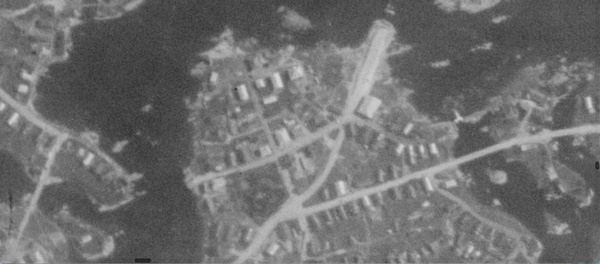 Closeup of an industrial area in the Soviet Union. The LANYARD mission's thermal problems prevented the camera from achieving its highest resolution. (credit: Harry Stranger) |
The undead
Although LANYARD was canceled, several nearly complete camera systems were still sitting in a classified storage facility operated by Lockheed and they were simply too enticing to ignore. Over the next year unnamed intelligence officials made several proposals to revive the program using the completed hardware.
In August 1964, over a year after the last flight, someone in either CIA or NRO headquarters raised the question of reviving the LANYARD program. This time they proposed using LANYARD to image targets in South China, probably the nuclear fuel processing facility at Lhangzou. A quick study determined that the first LANYARD could fly 16 weeks from the go-ahead, with the remaining four systems following at one flight per month.[61]
| What is unclear is why a LANYARD mission against Cuba was even considered by the NRO. |
The only available document on this proposal does not indicate what targets were considered and why LANYARD and not GAMBIT was proposed for this mission. At the time the Chinese nuclear facilities were the highest intelligence priority. The CIA was sponsoring a series of dangerous U-2 aircraft missions over China flown by Taiwanese pilots.[62] LANYARD might have been proposed due to continuing uncertainty about the ability of GAMBIT to achieve the high accuracy necessary to photograph its targets. LANYARD also photographed a wider swath of territory from east to west than the GAMBIT as it traveled from pole to pole. If the target was spread over many kilometers, such as a large industrial or rocket launch facility, GAMBIT would not be able to capture all of it in a single image. Another consideration might have been simple orbital dynamics: it was easier to photograph targets in the Soviet Union because its northern location meant that polar orbiting satellites covered northern latitudes more often than southern latitudes. Satellites passed over China far less often, so a dedicated LANYARD mission over China might have been warranted.
The LANYARD thermal control problem still remained from the last flight and had to be fixed. There were three possible solutions to this problem, the two previously proposed by Itek plus a new one: the addition of a thermal door or curtain to protect the camera during off periods.[63] None of them would have been difficult to implement, but for unknown reasons the Director of NRO decided not to fly the China mission.
In December 1964 the LANYARD again came up for review. This time someone proposed putting a LANYARD atop a more powerful Atlas Agena launched from Vandenberg Air Force Base into a low inclination orbit and using it to photograph Cuba. Launching from Vandenberg into a low inclination orbit would have been unprecedented. Although designed for the TAT Agena-D, the LANYARD was fully compatible with the Atlas Agena launch vehicle. In fact, the Atlas offered a less severe launch environment for the spacecraft compared to the TAT, which had solid rocket motors that produced a great deal of vibration.[64]
One problem with this proposal—other than the inherent limitations of the LANYARD camera—was that the stellar index camera used to fix the position of the photographs taken on the ground would be struck by sunlight during portions of the orbit over Cuba and would be useless. There were two solutions: reversing the direction that the stellar index camera looked, and using data from the vehicle guidance system instead of the stellar index camera during those portions of the flight.
The spacecraft would have flown in a 23-degree angle inclination providing four passes per day over Cuba. Two would run full length over Cuba and the other two would cross at about a 40-degree angle. This lower inclination also presented a problem for the ground command and control system. The NRO had one ground station capable of communicating with the satellite in this lower inclination orbit, presumably in Hawaii. Although the satellite would pass overhead four times a day, this was insufficient for proper command and control and a mobile ground command and control station—which was apparently already under development—would be necessary for this mission.
What is unclear is why a LANYARD mission against Cuba was even considered by the NRO. One of the agreements reached by the United States and the Soviet Union in the wake of the October 1962 Cuban Missile Crisis was that the United States would resume the U-2 spyplane missions over Cuba that it had halted after Major Rudolph Anderson was shot down during the height of that crisis. The CIA now had substantial regular reconnaissance intelligence from these Cuban overflights. It is probably for this reason that this Atlas Agena LANYARD mission, like the proposed earlier mission against China, was also not approved.
Although a considerable amount of LANYARD hardware was left over after program termination, its fate remains unknown. The National Reconnaissance Office has been unable to account for what happened to this top-secret hardware, although it was most likely destroyed in the 1960s or early 1970s.[65]
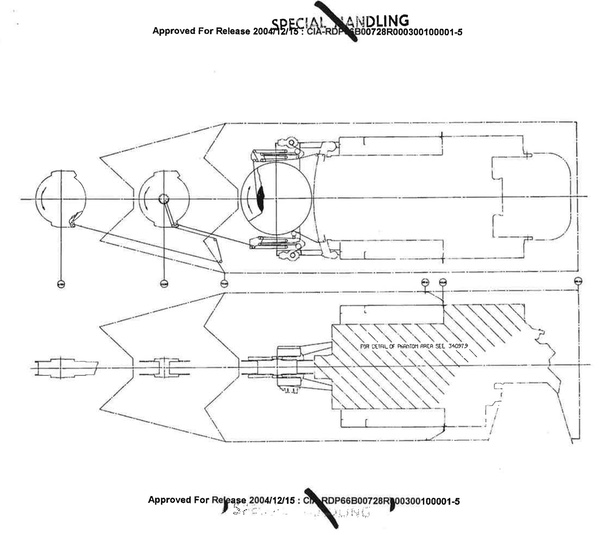 A later proposal for a "LANYARD Prime" design would have added a second reentry vehicle to extend the mission lifetime. There is no indication this was ever seriously considered. (credit: NRO) |
Upgraded LANYARDs
Two other prospective LANYARD designs in addition to the Mark 1 panoramic camera were also proposed by Itek. The first proposal, called LANYARD Prime and evaluated in summer 1963, was for a basic camera equipped with a second reentry vehicle. Multiple reentry vehicle spacecraft had been proposed as early as 1958 but had not become feasible until the early 1960s when rockets became powerful enough to carry them. The KH-4A CORONA, first launched in August 1963, had two reentry vehicles, dramatically extending the lifetime and operational flexibility of the satellite, and essentially doubling the satellite’s capability. The CORONA’s two cameras could operate for a day and its first reentry vehicle jettisoned. The cameras would then be switched off while the satellite entered “zombie mode” for up to two weeks before the cameras were turned on again to fill up the second reentry vehicle. This extended the lifetime of the mission and assured that the photographs returned from orbit would be relatively recent. LANYARD Prime would have operated in a similar manner.[66]
A single undated sketch of LANYARD Prime exists. Such a configuration required no major modifications to the basic camera, although the film supply reel would have had to be enlarged and other spacecraft subsystems modified to increase on-orbit lifetime. The existing LANYARD spacecraft probably could have been adapted to this configuration without much trouble. Whether it would have required an Atlas Agena to place it in orbit is unknown, but had the LANYARD program continued, this would have been an obvious upgrade.
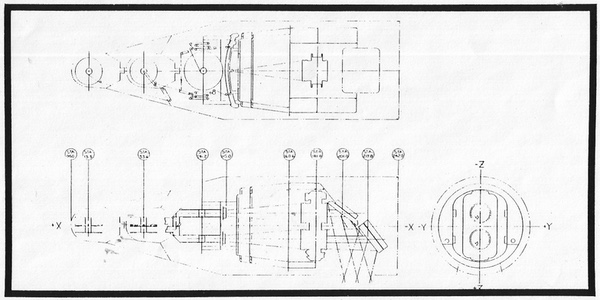 A late proposal for a “Quad LANYARD” design would have had two cameras, enabling simultaneous stereo photos. There is no indication this was ever seriously considered. (credit: NRO) |
Itek’s second proposed upgrade to LANYARD was known as “Quad-L” and was far more elaborate. One of the fundamental limitations of the LANYARD design was that it had only a single camera. The designers had developed a clever means of getting this camera to provide stereo images, but this method of operation limited the number of pictures that could be taken because the camera had to stop taking photographs so that it could move its mirror and take them from a different angle. Itek’s upgrade would have solved this limitation by adding a second camera parallel to the first one, “above” it as the spacecraft flew along in its orbit. This second camera would have had its own reflecting mirror tilted at a slightly different angle. Because there were two cameras and two mirrors, the mirrors no longer needed to move. The overall spacecraft diameter was larger to accommodate the two cameras. But this proposal also never advanced beyond paper.
| Although a considerable amount of LANYARD hardware was left over after program termination, its fate remains unknown. |
At the time, Itek was also proposing a much bigger CORONA known as the MURAL-2 or M-2. It would have used the same general configuration as the existing version, but with cameras with twice the focal length (48 inches, or 122 centimeters, compared to CORONA’s 24 inches or 61 centimeters). Although it would not have produced resolution as good as LANYARD, it would have covered more area and been less complex. M-2 was not approved.
LANYARD camera designer Jack Herther was not involved in either LANYARD upgrade proposal. “I was already on risk reduction for a new system and didn’t believe LANYARD would be resurrected,” he said.[67]
Next: From the Samos E-6 to SPARTAN.
Endnotes
- Robert Perry, “A History of Satellite Reconnaissance, Volume IIB – SAMOS E-5 and E-6,” October 1973, p. 357.
- Dwayne A. Day, “A Square Peg in a Round Hole, The Samos E-5 Reconnaissance Satellite, Part Two, Spaceflight, February 2003, pp. 71-79.
- John (Jack) Herther, interview by Dwayne A. Day, Waltham, Massachusetts, September 26, 2002.
- Ibid.
- Ibid.
- “L Program – Key Features, Mark I Pan Camera System.” CAL 2/C/0053.
- John Herther interview.
- Ibid.
- The records on the payload weight are inconsistent. According to NRO historian Robert Perry, as the system evolved the film load increased from the initial 40 pounds to 78 pounds, plus two pounds for the stellar index camera system. The LANYARD panoramic camera system was expected to weigh 635 pounds, the film cassette 20 pounds, and the stellar index camera another 20 pounds. Perry, p. 358.
- The LANYARD film spools inside the reentry vehicle were mounted 90 degrees from the way that the film spools for the CORONA camera were mounted in their similar vehicle; sideways instead of vertical, relative to the direction to the Earth’s surface. Because of this, Lockheed engineers also had to make another minor change to the film path for the stellar index camera so that it could now fit into the reconfigured reentry vehicle. [DELETED], Memorandum for Chief, Development Branch, DPD, “Trip Report,” May 4, 1962. CREST.
- Perry, p. 365.
- “LANYARD Status and Capability,” [ca. 1963], p. 2. CAL 2/C/0035.
- “L Program – Key Features, Mark I Pan Camera System.” CAL 2/C/0053.
- Sources are not consistent. Perry indicates that the main camera would image a swath 50-nautical miles wide and eight miles along the flight path, with a ten-percent overlap. Perry, pp. 364-365.
- [DELETED], Memorandum for Chief, Development Branch, DPD, “Trip Report,” May 4, 1962. CREST.
- LMSC Statement of Work: Development of a Satellite Reconnaissance & Recovery System CORONA “L” Program, April 3, 1962. CAL 7/B/0069, pp. 9-10.
- Lieutenant Colonel [DELETED], Assistant for Systems Engineering [DELETED], Memorandum for Record, “LANYARD Systems Engineering Meeting,” October 19, 1962, pp. 5-6. CAL 2/C/0035.
- Ibid.
- Perry, pp. 358-359.
- Ibid., pp. 360-361; 364.
- F.A. Lindsey, Chief Executive Officer, Itek Corporation, to Members of Department 342 and Applied Optics Division, December 7, 1962.
- James A. Cunningham, Jr., Deputy Assistant Director (Special Activities), Memorandum for Director of Central Intelligence, “Status Report on CIA Air Activities for the Period 14 through 20 February 1963,” February 20, 1963. CREST.
- Perry, p. 371.
- Ibid., pp. 372-373.
- Ibid.
- Dwayne A. Day, “Little Wizards: Signals intelligence satellites during the Cold War,” The Space Review, August 2, 2021; Dwayne A. Day, “Wizards redux: revisiting the P-11 signals intelligence satellites,” The Space Review, September 7, 2021.
- James Q. Reber, Chairman, Committee on Overhead Reconnaissance, Memorandum for Committee on Overhead Reconnaissance, “LANYARD Target List,” February 20, 1963, with attached: “LANYARD Target List.” CREST. Because this was primarily an engineering flight, operators chose not to use the spacecraft’s roll joint during the first day, meaning that only targets directly below the satellite could be photographed during that time. The same procedure was also used on the first operational mission.
- Perry, pp. 373-374.
- As of February 1963, it was planned to use this spacecraft to photograph the same set of targets as the first. James Q. Reber, Committee on Overhead Reconnaissance, Memorandum for Director, National Reconnaissance Office, “Requirements for the First LANYARD Mission,” February 5, 1963. CREST.
- Perry, p. 379.
- Ibid., pp. 378; 381-382.
- Frederick C.E. Oder, James C. Fitzpatrick, and Paul E. Worthman, “The GAMBIT Story,“ National Reconnaissance Office, 1988, p. 181; CORONA Mission 9056 Performance Report, July 8, 1963, pp. 6-7.
- Performance Evaluation Team, Report No. [DELETED], Section I, Mission 8003 History. CAL 4/A/0033, p. 1.
- Ibid., p. 2.
- “LANYARD Status and Capability,” [ca. 1963], p. 1. CAL 2/C/0035.
- Perry, pp. 384-385.
- Performance Evaluation Team, Report No. [DELETED], Section I, Mission 8003 History. CAL 4/A/0033, p. 3.
- Ibid., p. 3. Another source indicates approximately 2000 feet (610 meters) of film was recovered.
- “LANYARD Status and Capability,” [ca. 1963], p. 1. CAL 2/C/0035.
- Perry, p. 385.
- John Herther interview.
- Based upon the actual results of this mission, it is impossible to determine what the high priority targets were that had justified the start of the program in early 1962. The targets that intelligence analysts were most interested in changed regularly. Comparisons of available “highest priority target” lists from 1960 and 1965 indicate considerable differences, although Soviet ICBM complexes such as Baikonur (referred to as Tyura-Tam by the CIA) were always near the top of the list.
- “LANYARD Status and Capability,” [ca. 1963], p. 3. CAL 2/C/0035.
- Perry, p. 382.
- Ibid., p. 386.
- An improved version of the CORONA, designated the KH-4A and equipped with two reentry vehicles, had just entered service in August, but the performance of its camera system, designated the “J-1” camera, was comparable to the KH-4.
- Albert D. Wheelon, Deputy Director, Science and Technology, to Director of Central Intelligence, “Comparison of the MURAL, [GAMBIT] and LANYARD Systems,” [ca. September 20, 1963]. CAL 1/C/0057.
- Ibid., p. 2.
- Ibid., p. 2.
- Ibid., p. 3.
- “Performance Comparison of MURAL, LANYARD and [GAMBIT],” Attachment B to: Albert D. Wheelon, Deputy Director, Science and Technology, to Director of Central Intelligence, “Comparison of the MURAL, [GAMBIT] and LANYARD Systems,” [ca. September 20, 1963]. CAL 1/C/0057.
- John A. McCone, Director of Central Intelligence, to General Carter, Dr. Wheelon, September 20, 1963.
- Ibid. The name “GAMBIT” is deleted in the declassified version of this memo, but it is clear that McCone was referring to that satellite program.
- To [DELETED] “LANYARD, For DNRO, From Gen. Greer,” June 6, 1963. CAL 7/B/0071.
- Perry, p. 386-387.
- Ibid., p. 388.
- “For immediate delivery eyes only to Messrs. Plumber [sic], [DELETED],” October 23, 1963. CAL 8/A/0044. Director of Central Intelligence John McCone was angered when McMillan soon made some unknown change in the termination rules. “McCone said he had been doing this and would continue. However, he had reluctantly come to the conclusion that he had to question McMillan’s ability to handle the job as Director/NRO. For example, he pointed out that complete agreement had been reached on the issue of how to handle the termination of LANYARD, and then within 48 hours, McMillan had issued orders which were apparently in direct contradiction of that agreement.” Walter Elder, “John A. McCone as the Director of Central Intelligence, 29 November 1961 – 28 April 1965,” March 1973, p. 1341.
- [DELETED] Contracting Office, to [DELETED], “Termination of Lanyard Program,” November 27, 1963, CAL 8/A/0043; To [DELETED] “LANYARD,” November 20, 1963, CAL 8/A/0047; [DELETED] “LANYARD,” November 8, 1963, CAL 8/A/0046; Priority [DELETED] “For immediate delivery to Messrs Plummer, [DELETED],” November 1, 1963. CAL 8/A/0045.
- “LANYARD Status and Capability,” [ca. 1963]. CAL 2/C/0035.
- For further information on the origins of FULCRUM, see: Jeffrey Richelson, The Wizards of Langley (Boulder, CO: Westover Books, 2001) and Jonathan Lewis, Spy Capitalism: Itek and the CIA.
- Colonel Frank Buzard, Memorandum for Dr. McMillan, “LANYARD Status,” August 14, 1964. CAL 3/D/0032.
- See, for instance: Jeffrey Richelson, The Wizards of Langley, pp. 94-95; Chris Pocock, The Black Bats: CIA Spy Flights over China from Taiwan 1951-1969, Schiffer Publishing, 2010.
- Colonel Frank Buzard, Memorandum for Dr. McMillan, “LANYARD Status,” August 14, 1964. CAL 3/D/0032.
- TWX: “Consideration of Launching of Atlas/Agena “L” System From Vandenberg AFB for Use Against Cuba,” December 2, 1964. CAL 2/C/0006
- This is not the only classified hardware that the NRO can no longer account for. Several Samos reconnaissance cameras of different types were also placed in storage in the early 1960s and can no longer be found. Records of their destruction were either destroyed or are still classified.
- There is some supposition involved in the conclusion that the dual-bucket version was designated LANYARD Prime. The LANYARD Prime designation (actually “L’,” which is similar to the “C’” designation for the CORONA Prime camera also developed by Itek) appears in only one declassified document among a list of camera development projects underway at Itek Corporation in June 1963. See: “Agenda, Purcell Panel Meeting, 4-5 June 1963,” May 31, 1963. CREST.
- Comments by Jack Herther on early draft of an earlier LANYARD article, September 13, 2002.
Note: we are now moderating comments. There will be a delay in posting comments and no guarantee that all submitted comments will be posted.