Colonizing Antarctica and other anti-space fablesby Milan M. Ćirković
|
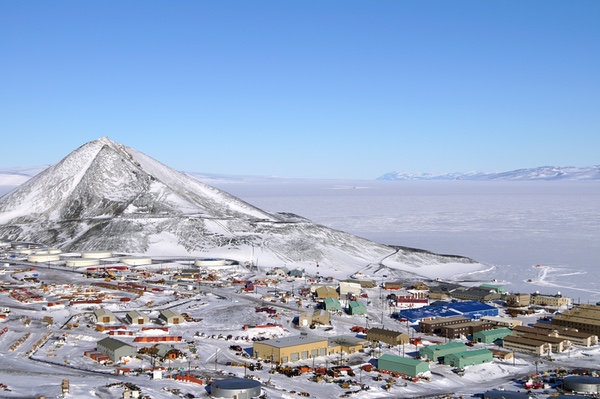
| Colonization of Antarctica would do nothing, or at least almost nothing, for mitigating global catastrophic and existential risks we face on Earth. |
An obvious point: unless our primary motivation for undertaking space colonization is the concern about overpopulation (as it was, for instance, in the Ancient Greek colonization), then the “let us try Antarctica first” argument makes no sense. There are still many mostly empty places on Earth outside of Antarctica, such as northern Siberia, the interior of Saharan desert, or the Australian outback. If living space were the only concern, it would even make more sense to reclaim the sea, Netherlands-style, or to create artificial islands and floating ocean-cities at moderate latitudes and in proximity to trade routes, than to colonize Antarctica.
In reality, however, we do not need more living space on Earth, since the overpopulation is a phantom of weak minds containing an abject lesson how ridiculous is to mechanically extend the perceived trends into the future. Otherwise, we could seriously expect that human population will approach/have approached infinity on Friday, November 13, 2026! (As Heinz von Foerster argued tongue-in-cheek, since that would have been his 115th birthday.) Not once since the 1960s heyday of Ehrlich’s Population Bomb have space advocates seriously argued that we need space settlements to prevent overpopulation. In fact, the population of the planet—barring some collapse or extinction catastrophe—will likely stop growing and begin to rapidly shrink by the end of the century, bringing forth its own bunch of problems.
2. Shared terrors of the Earth. Colonization of Antarctica would do nothing, or at least almost nothing, for mitigating global catastrophic and existential risks we face on Earth. It is exactly the touted advantages of Antarctica, namely its proximity to the rest of humanity and its sharing the same atmosphere (and the same climate trends), which make it superfluous in this regard. It is obvious: a colony in Antarctica would not do much for prospects of humanity in the case of a Chicxulub-scale asteroid strike, a Wah Wah Springs-scale supervolcanic eruption, a nuclear winter, a runaway climate change, or a global totalitarian revolution (led or “served” by a hostile AI.) While Antarctica could and should host some catastrophe refugia similar to the Svalbard Vault, it is not obvious that the benefit of full-fledged colonization in this regard would be anything but marginal. The problem lies in the shared atmosphere. Both natural and engineered pathogens of significance for the global catastrophic risk studies are likely to be airborne, and thus the issue of shared atmosphere is crucial.
3. The unbearable lightness of laziness. To put it simply: While colonizing Antarctica would be easier than colonizing Mars, easy is not what we look for. In fact, easy here is an obstacle of and in itself! Not just because President Kennedy said so (although his speech at Rice University on September 12, 1962, remains certainly one of the most important orations ever delivered), but because, just as in point 1 above, it is the foundation of our understanding of goals. If the goal is human flourishing, it makes no sense to follow the path of least resistance. Quite to the contrary, resistance below a certain threshold is wildly counterproductive on multiple levels.
It is easy (pun intended) to see it on examples from everyday life. If members of your household increase in number, say through marriage of your children and their having offspring, would you rather put them in a cellar—with some make-shift adaptation of that cold and damp cellar—or help them build a house of their own? This is not just some moralistic grumbling: it is very much a practical issue, although it may be difficult to visualize from our myopic, day-in, day-out mundane lives.
| What the Antarctic Treaty has very successfully done is to make everything related to the southernmost continent outrageously expensive. |
Toynbee’s theory of challenge-and-response may be useful here: a primitive community encounters a chance to build true civilization when faced with a challenge: some unpredictable factor or event posing a threat to the well-accustomed, “normal” way of life. A challenge would arise as the result of many things: population growth, exhaustion of a vital resource, climate change, a belligerent neighboring tribe, an earthquake. It is the response to this challenge which really matters: the action taken by the group to cope with the new and difficult situation.
Successful responses result in magnificence: as once fertile Saharan plains desiccated due to climate change, the most ingenious tribes living there moved to the swampy Nile valley, drained the marshes, and established the ancient Egyptian civilization that would last more than 3,000 years. Unsuccessful responses are usually forgotten by history; only modern archaeological methods enable us to reconstruct those lost civilizations that could have been.
Going forward requires things not to be easy, a lesson only recently forgotten by postmodern snowflakes searching for “safe spaces“ and whining about everything, from traumas of reading Shakespeare to not diverse enough vegan meals in the cafeteria to too much homework. Looking for easy modes has a simple enough and time-tested name: laziness.
4. It’s illegal! Busybody lawyers and do-gooder politicians have already ruined Antarctica for humanity. The Antarctic Treaty, which entered into force in 1961, effectively prohibited any commercial usage of material resources of the continent and even prohibited prospecting for such resources. An even worse fact is that the treaty system cannot be changed before 2048, and will even then be excessively difficult to amend or change. So, the question about colonizing Antarctica is moot: those still asking it are either uninformed or, more probably, just hostile toward space colonization and using empty rhetoric to undermine the idea.
It is hardly credible to hear that many legal scholars find the Antarctic Treaty quite a success; and way more disturbing still is the fact that some people would like to see a similar legal mechanism for Moon, Mars, and other extraterrestrial bodies. They will say that the treaty has maintained peace, without any shred of evidence that either its absence or a different content would have led to war.
Now, you may think that this legalistic argument is nonsense just as, for example, the prohibitions on wearing fake moustaches in churches in Alabama or chewing gum in Singapore, and it indeed might be. Notice that, by definition, it cannot be worse nonsense than the corresponding argument that space colonization is illegal under the international law, which many space skeptics try to assert. If anything, the space version contained in the Outer Space Treaty is more ambiguous and open to interpretation.
What the Antarctic Treaty has very successfully done is to make everything related to the southernmost continent outrageously expensive. Habitation, transport, food, communications—everything is awfully and unnecessarily expensive, for both tourists and workers in one of the Antarctic research stations or lighthouses. A century ago, for example, prices of everything in Alaska were very high, vaguely comparable to those in Antarctica. Since then, Alaska got much cheaper, while expenses of living, even for a short term, in Antarctica have been frozen (no pun intended) at the very high level, without chances for going down significantly in the near future. The major difference? There has been no Alaska Treaty! Consequently, hard-working and ingenious American settlers and entrepreneurs (together with many Native Americans) developed the Alaskan hostile environment and made it a prosperous state which is consistently among the first 10 US states by GDP per capita, corresponding to $95,147 in 2024 (the data of the US Bureau of Economic Analysis). It is not only higher than the US average, but also higher than in countries often listed as rich, such as Norway, Qatar, Denmark, Japan, or Germany. And it is not just the wealth: Alaska has the Human Development Index of 0.933 (data for 2022), which is also above the USA average and is exactly equal to the one of California, an outstanding and frankly unbelievable fact when the difference between physical conditions in these two places is taken into account.
| Invoking that canard is at least reflection of shallow thinking on the subject. It corresponds to a “minor” difference between a future human civilization lasting, say, 1,000 years and the one lasting 1,000,000,000 years. |
5. Morally suspect disturbance to penguins. Even if colonizing Antarctica were not a dead end and even if it were legally permitted, it would exactly be the place to exercise our ecological caution. In contrast to Moon, Mars (most likely), the asteroids, Titan, or your favorite Kuiper Belt object, the southernmost continent is home to an actual, living, even relatively rich ecosystem which does need conservation and protection measures. There’s nothing problematic or hypocritical here: if alien biospheres are detected elsewhere in the universe, the project of human settlement within the same habitat should be at the very least re-evaluated and severely restricted, until we know more.
Therefore, an actual conservationist argument can be made for Antarctica without invoking nebulous antihuman nonsense such as postmodernist “rights” or “desires” of Moon rocks.[2] Penguins do not need “rights” assigned by bored human bureaucrats, but they need to be left reasonably alone in the wilderness, or at least in sufficiently extensive natural reserves. This does not mean, of course, that if one day humans find themselves in dire need of the Antarctic land for survival—perhaps due to some awful industrial accident in the northern hemisphere which happened because humans had not been wise enough to move risky industries to outer space!—the comfort of penguins could not be violated; but it would need a strong countervailing reason to do so.
All in all, colonization of Antarctica as a substitute for space colonization and settlement is at best a non-starter and at worst a demagogic ploy to delay or prevent humanity’s great task ahead. Invoking that canard is at least reflection of shallow thinking on the subject. It corresponds to a “minor” difference between a future human civilization lasting, say, 1,000 years and the one lasting 1,000,000,000 years. It corresponds to the difference between the timid existence in the shadow of extinction, huddling on a single minuscule planet, and making our own bright and powerful destiny in space.
Endnotes
- Some of the many examples are Regis, E. 1990, Great Mambo Chicken and the Transhuman Condition: Science Slightly over the Edge (Addison-Wesley, Boston), p. 217; Stoner, I. 2017, “Humans should not colonize Mars,“ Journal of the American Philosophical Association 3, 334-353, p. 338; Weinersmith, K. and Weinersmith, Z. 2023, A City on Mars: Can We Settle Space, Should We Settle Space, and Have We Really Thought this Through? (Random House, New York), pp. 288-9. A brilliant SF author and one of the major figures of the New British Space Opera, Charles Stross, suggests settling the Gobi Desert instead, but that is just a weaker form of the same argument, since (a) people have actually–and amazingly!–lived in the Gobi for thousands of years, developing all sorts of important survival techniques and habits; and (b) the Gobi is entirely located within the national borders of China and Mongolia, so its legal and political status is very different from the one of either Antarctica or the potential space colonies or habitats.
- Invoked, for example, by Mary-Jane Rubinstein (2022, Astrotopia: The dangerous religion of the corporate space race, University of Chicago Press, Chicago), p. 150.
Note: we are now moderating comments. There will be a delay in posting comments and no guarantee that all submitted comments will be posted.