Two futures on the Moonby Alexander William Salter
|
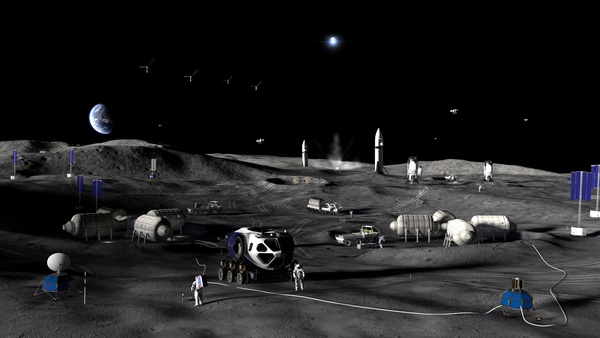
| The point of developing orbital assets, building a Moon base, and journeying onto Mars is human flourishing. Space can make our lives longer, richer, happier, and more humane. |
Documents from those meetings, revealed this July by a joint investigation from The Insider, Der Spiegel, and Le Monde, describe a partnership to build weapons to counter Elon Musk’s Starlink constellation. The goal is to combine Russian battlefield experience with Chinese industrial might to jam, hack, and even physically kill a major satellite network. One Chinese presentation called the constellation’s hundreds of satellites a “space blockade” and proposed cheap “one-against-many” weapons to shoot them down faster than SpaceX could launch replacements.
There’s an almost flattering admission in the Russia-China plan: America’s commercial dynamism outpaces anything they can produce. Our rivals can’t build what we have built. Instead, they intend to break it. An honest recognition of hostile intent must shape American space strategy over the next few decades.
But what is our strategy for? Space superiority is certainly desirable. But it is a means to an end, not an end in itself. The point of developing orbital assets, building a Moon base, and journeying onto Mars is human flourishing. Space can make our lives longer, richer, happier, and more humane. That includes the pure thrill of discovery, which needs no economic justification, alongside the obvious scientific, commercial, and military gains.
The moral case for American space leadership is simple: The character of the leader determines whether space becomes a frontier for human excellence or merely the newest site of coercive domination.
Four principles underpin a humane space agenda:
Proactive rule-making. The first task of leadership is writing the rules of the game. Happily, America is doing pretty well on this front. The Artemis Accords, launched in 2020 with eight nations, reached 70 signatories this July when Mauritius signed on. The Accords commit members to the peaceful use of space, transparency in missions, orbital debris mitigation, and avoiding harmful interference. Importantly, the Accords are not a treaty. They are a coalition of like-minded nations, committed to lawful and mutually beneficial interactions beyond the Earth.
Unsurprisingly, both China and Russia have declined to sign. They are building an alternative lunar framework of their own, the International Lunar Research Station (ILRS). Non-binding principles like the Artemis Accords might seem like poor protection against determined adversaries. It’s a valid concern, but this framing undersells the importance of what the Accords can achieve.
| The rules we write today determine whose interests space development serves tomorrow. |
Treaties, including the 1967 Outer Space Treaty, are the foundation of public international space law. Changes in the formal rules require agreement among sovereigns. But our rivals would never consent to developing a shared governance framework that respects human freedom and innovation. That’s our comparative advantage, not theirs. The solution is to flesh out the often-unclear legal principles with both domestic legislation, such as the 2015 Space Launch Competitiveness Act, and further international agreements, such as the Accords.
Rules shape expectations, and expectations shape behavior. Leadership of a spacefaring coalition offers the United States the chance to establish practices and norms where formal rules are ambiguous. Space superiority empowers us to serve the ends of peace, wealth, and general human prosperity. When Mauritius signed the Accords, its representative said the country joined to help ensure that space “serves humanity by protecting our oceans and coastlines.” A small island nation understood the point better than several great powers: The rules we write today determine whose interests space development serves tomorrow. Leaving the rules to Moscow and Beijing is a dereliction of both our national interests and our duty to human flourishing.
Real interests and accountability. American space activity should serve Americans’ legitimate interests. This sounds obvious. But it is regularly denied in practice, with public dollars diverted to projects that cost taxpayers far more than they gain. Space policy, like all policy, must create benefits that accrue to its ultimate beneficiaries: We, the People.
Notice I said legitimate interests. Our commercial, scientific, and military objectives do not entitle us to violate the rights of non-citizens. In fact, we best secure our interests by cooperating with other nations to advance a shared vision—one in which space’s bounty is widely available to free nations of goodwill.
| “For all mankind” is a worthy moral aspiration. But it is not a coherent responsibility mechanism. |
Pursuing American interests means resisting the temptation for bureaucracies and legacy contractors to conflate the means of space exploration with the ends. To cite one example, a $4-billion-per-launch rocket has no legitimate claim to ongoing taxpayer support. Parochial interests in “old space” make-work are no substitute for real human achievement.
Sovereignty, rightly understood, means the people are the principals and the government their agent. NASA spends roughly $25 billion per year. The White House recently requested a $71 billion budget for the Space Force. That money has major opportunity costs. It carries an obligation to deliver value back to the citizens who provided it. It also requires us to consider the interests of future citizens. Long time horizons naturally characterize space policy. Opening the final frontier will greatly benefit our descendants. That also means missteps will greatly burden them.
Of course, many space activities plausibly create nonrivalrous and nonexcludable benefits. GPS satellites, solar storm monitoring, and planetary asteroid defense all transcend narrow interests. Accordingly, framing space strategy in national terms may seem inappropriate. Yet somebody must build the infrastructure and bear the risks of operation. Absent fundamental changes in public international space law (an unlikely outcome), that “somebody” will be the public authority of a sovereign nation, accountable to its citizens. General benefits to humanity are real, but they are downstream of concentrated investments by spacefaring leaders like the US. “For all mankind” is a worthy moral aspiration. But it is not a coherent responsibility mechanism. Pretending otherwise is how public resources get squandered with no accountability.
Commercial and non-commercial values. America’s decisive advantage in space is its commercial sector. The Starlink plot illustrates it. Two authoritarian governments, soberly assessing the physical, financial, and human capital at their disposal, concluded they needed a plan to neutralize commercial satellites, or else remain at a perpetual disadvantage. Their fears speak volumes.
Space is creating exciting new avenues for commerce. The global space economy reached $686 billion in 2025, with commercial activity making up $544 billion of it—nearly 80%. Some of the fastest growth came from novel business opportunities, including manufacturing, resource extraction, and lunar infrastructure. America is uniquely positioned to thrive in this environment. We are the capitalist power par excellence. Policy must adapt to the new reality of space operations. We can’t afford to tax ourselves with regulatory delays.
Consider the regulatory approval process, which forces new missions through a maze of agencies where anyone can say no, or simply say nothing. On July 30, the FAA proposed a rule to streamline environmental review for commercial launches, so that routine, well-understood launch profiles are not forced through the most expensive tier of assessment. “We will not keep pace with this rapid growth,” the FAA’s administrator said, “unless we streamline, modernize, and strengthen our regulatory approach.” He’s right.
And yet, commercial value is not the only consideration. Rocket launches and satellite reentries have environmental costs. Peer-reviewed research finds that satellites burning up on reentry deposit aluminum oxide and other metals into the stratosphere, where they may catalyze the chemical process that thins the ozone layer. The effects currently appear small. But they accumulate. As megaconstellations grow, modeling suggests the metal burden could climb into the tens of thousands of tonnes per year. This is a genuine problem. Anyone who cares about human flourishing should take it seriously.
But notice how poorly our current regulatory system deals with this problem. It forces a company through the costliest environmental review over the local effects of a launch site (effects on marshes and wetlands, for example) while the genuinely global problem goes unaddressed, because nobody assesses what reentries do to the upper atmosphere. The process is simultaneously too strict for the familiar case and too lenient for the unfamiliar one. Meanwhile, the lack of clear, predictable rules creates needless uncertainty.
| The experimental, often messy character of America’s commercial space sector is the source of our asymmetric advantage. Our adversaries fear it because they can’t replicate it. |
We can’t stay grounded while China seizes a launch advantage, but neither can we dismiss environmental concerns out of hand. The answer is to match the review to the harm: Streamline the overly burdensome local assessments while building a serious, science-based framework for the atmospheric effects that may imperil our homeworld. Regulatory certainty can do both. We can create predictability, which commercial space firms need, while also incentivizing responsible use of the atmospheric commons.
What does this have to do with commerce? Just as a private company revolutionized launch to meet public goals, an expansive definition of space business should include the ecosystem of commercial entities that can make a profit by stewarding Earth’s natural resources. The nation that leads in business is also the nation best positioned to spearhead conservation efforts. We have the data, the engineers, and the infrastructure. It’s time to dispel the myth that financial sustainability and environmental sustainability are inherently at odds.
Embrace the mess. In harnessing private enterprise for public purposes, we must respect the independence of the businesses and researchers who make the whole enterprise work. Resisting the temptation of hierarchical control is crucial. We can’t overcome Russian and Chinese space ambitions by adopting Russian and Chinese methods.
Our rivals operate in a top-down manner, directing resources from the center toward state objectives. China’s commercial space sector, for example, is best understood as a government dispensation that makes limited use of profit-and-loss incentives to serve the ends of the Chinese Communist Party. When facing a serious threat, it seems natural to nationalize, direct, and control. But this regimentation would suppress our greatest strength. The experimental, often messy character of America’s commercial space sector is the source of our asymmetric advantage. Our adversaries fear it because they can’t replicate it. Furthermore, it is the economic foundation that supports our scientific, commercial, and military interests.
This makes it even more important to define the state’s proper role. Some tasks have inherently public components. National security launch, deep space science and exploration, and the basic “rules of the road” for orbital integrity all require public activity. Businesses can help achieve these goals as contractors, of course. Where private enterprise can do the work, the government's job is to empower it and clear the way. Public-private relations in space should be cooperative and coordinative, with the state maintaining a guiding rather than a controlling role.
Our promise to lead. American space leadership is worth pursuing without reservation or apology. Our rivals would use space as an instrument of terrestrial domination. We must use it to preserve freedom, an essential precondition for humane living. Space superiority is not a martial boast but a moral duty. Let’s keep the final frontier open, lawful, and free for all those who will come after us.
Note: we are now moderating comments. There will be a delay in posting comments and no guarantee that all submitted comments will be posted.