Review: Lunacyby Jeff Foust
|
| There is a rich set of targets to pursue here, like Elon Musk’s desire to make life multiplanetary with a city on Mars as well as the visions of people from Gerard K. O’Neill to Robert Zubrin. |
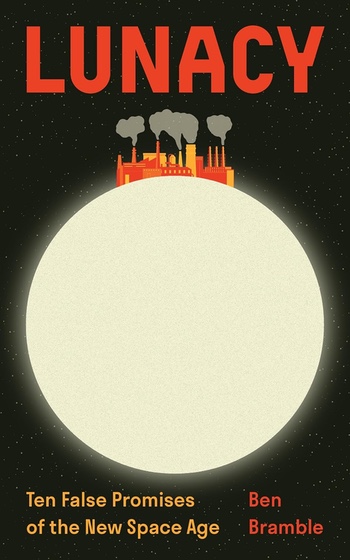
When space advocates promise utopia but fail to deliver, then open themselves up to criticism that these visions can’t happen, or even shouldn’t happen. The latest such salvo is Lunacy, a book by Australian philosopher Ben Bramble, who takes aim at what he considers “false promises” from such enthusiasts. However, his criticism ends up wildly off-target at times.
As the subtitle suggests, the book devotes one chapter to each of ten claims by space advocates about what an expansive future in space could provide, from “backing up” humanity off-Earth and achieving abundance to go on holidays and even “meet aliens.” There is a rich set of targets to pursue here, like Elon Musk’s desire to make life multiplanetary with a city on Mars as well as the visions of people from Gerard K. O’Neill to Robert Zubrin.
However, rather than simply pointing out the flaws in such arguments—it is, after all, far more difficult to live on the Moon or Mars than Earth—he pushes for a far more austere future for humanity in space, one that keeps the universe largely as a science preserve for robotic missions. “All new space activities in the short to medium term should be purely scientific ones, run collaboratively by governments,” he writes, “and for the sake of all humanity rather than the advantage of particular nations, corporations, and individuals.”
That might sound like a noble goal, but it is as unrealistic as establishing a million-person city on Mars in 25 years. It would likely rule out other uses of space like communications or navigation that have become essential to modern society today.
Similar themes—unrealistic, bordering on the fantastical—can be seen elsewhere in the book. He argues against space mining despite claims that it could reduce the need for terrestrial mining. Instead, by devoting more attention to recycling, “we will stop needing to mine things at all” at some time in the “not-too-distant future,” he claims, but offers little evidence to support that claim.
| The overall vision for humanity that Bramble presents in Lunacy is one where humans should be satisfied with remaining on Earth with little use of space beyond science, learning to appreciate a world where they use less energy and materials. |
“By the way, I think it is pretty clear that Western civilization should not have expanded into America (at least, not in the way it did) given that there were people living there already,” he writes in another chapter. While space advocates point out that settling the Moon and Mars avoids such conflicts, “we might have been better off leaving America as a wilderness.” (Another chapter has the subtitle “Are Humans Necessary?” followed immediately by “I am not convinced”; he is referring to human exploration of the solar system but the reader can be left wondering if he’s not too keen about humanity in general.)
Bramble is even skeptical of efforts to protect the Earth from asteroid impacts, an effort that is quite popular among the public in polls of space priorities. His concern is that technologies developed to deflect a potentially hazardous asteroid could be used for nefarious ends: “we should be focusing on maturing as a civilization before we develop, let alone start to use, asteroid-deflection technologies.” Given the time and expense required to deflect an asteroid, the megalomaniacs that he fears would probably be better off working on nuclear weapons instead.
The overall vision for humanity that Bramble presents in Lunacy is one where humans should be satisfied with remaining on Earth with little use of space beyond science, learning to appreciate a world where they use less energy and materials, recycle everything, and even take shorter showers. (That sounds a bit like what life would be like on a space settlement.) It might feel like, to the author and supporters, a satisfying riposte to the grand visions of space advocates, but its message of austerity does little to advance debate on how to best use space to improve humanity.
Note: we are now moderating comments. There will be a delay in posting comments and no guarantee that all submitted comments will be posted.