The smoldering dead end: a history of solid rocket motors and their economic scaling limitsby Michael Puckett
|
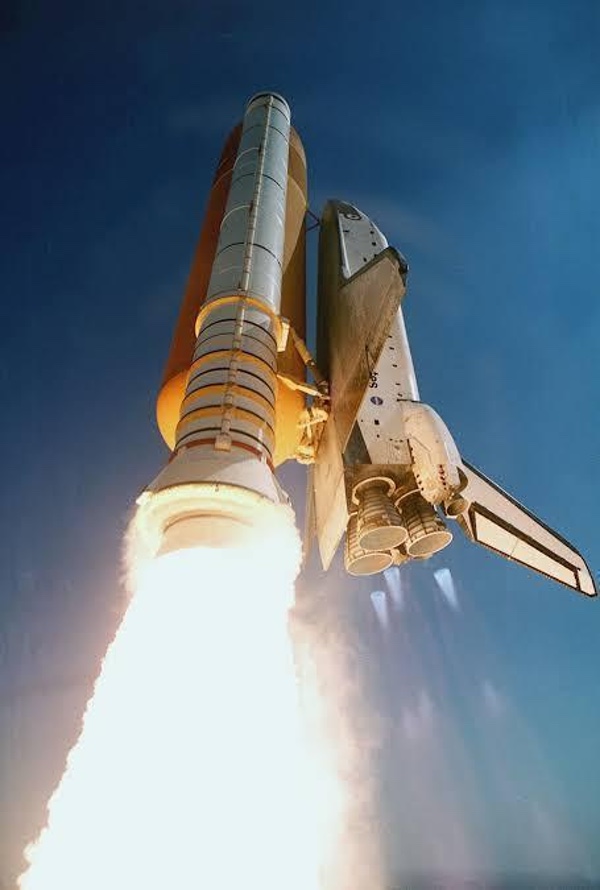
| The combined effect of lower Isp and equivalent mass fraction means solid propulsion delivers less payload per unit of total system mass for any given Δv requirement. This is a physics problem, not a manufacturing one, and it does not have an engineering solution. |
Beyond thermodynamic performance, solid propellant motors are constrained by an equally fundamental operational limitation: once initiated, combustion cannot be terminated. This is a direct consequence of how the propellant grain stores chemical energy. The oxidizer and fuel are intimately mixed throughout the grain matrix at the microscale; there is no fluid valve between fuel and oxidizer that can be closed to interrupt combustion. The burn rate is determined by chamber pressure, propellant chemistry, grain temperature, and grain surface geometry, all fixed at manufacture.
Active thrust termination requires either forward-closure burst-disc ports or thrust reversal ports that dump chamber pressure abruptly, neither of which provides the smooth, controllable shutdown available to any liquid-fueled engine. Grain geometry can be designed to shape the thrust-time profile: the shuttle RSRM’s 11-point star perforation in the forward segment reduced thrust by approximately one-third at T+50 s to limit max-q dynamic pressure loads. However, this shaping is predetermined, cast into the propellant at manufacture, and cannot be altered in response to in-flight anomalies.[6]
This irreversibility has direct consequences for abort capability, range safety, crew survivability, and turnaround operations. The RS-25 engines on the Shuttle orbiter could be, and were, shut down on the pad and in flight during abort scenarios. The SRBs could not. The crew of Challenger had no effective abort option once the right booster field joint began leaking. The booster was going to burn to completion regardless of what any human being on the ground or in the cockpit did, apart from deliberate destruction of the vehicle by range safety personnel.
The military subsidy: How solid rockets got into the launch business
The appearance of solid rocket motors in orbital launch vehicles was not only due to their performance characteristics. It was a direct consequence of military economics—specifically, the economics of the Intercontinental Ballistic Missile (ICBM) programs of the 1950s and 1960s, which created an industrial base for large solid motors that could be, and was, parasitically extended into space launch at marginal cost.
The history of modern American composite solid propulsion begins with the Caltech group that later became the Jet Propulsion Laboratory. Beginning in 1936, Theodore von Kármán, Frank Malina, Jack Parsons, and their colleagues developed increasingly practical rocket motors and jet-assisted takeoff units.[7] Wartime demand for JATO led to large production orders and to the formation of Aerojet Engineering Corporation, helping establish the industrial and technical base from which later military solid-motor programs grew.[8]
The crucial inflection point was the ICBM competition of the 1950s. Early liquid-fueled ICBMs such as Atlas and Titan I required cryogenic liquid-oxygen loading and extensive launch-site support, limiting immediate readiness.[9] Titan II removed the cryogenic constraint by using storable hypergolic propellants and could be launched rapidly from a continuously alert posture.[10] It nevertheless retained the maintenance, monitoring, and handling burdens associated with a large liquid missile system.
Minuteman changed the system-level readiness equation. Its three solid-propellant stages eliminated prelaunch fueling and allowed missiles to remain continuously ready in hardened silos.[10] It did not eliminate launch crews; rather, underground launch-control crews could supervise and command multiple dispersed missiles. In strategic terms, a solid-fueled ICBM behaves much more like stored ammunition than a serviceable transportation vehicle: its cost structure is optimized for long-term readiness and one-time expenditure under extreme circumstances. When that technology migrated into space launch, it brought an operational philosophy poorly matched to routine, high-cadence transportation.
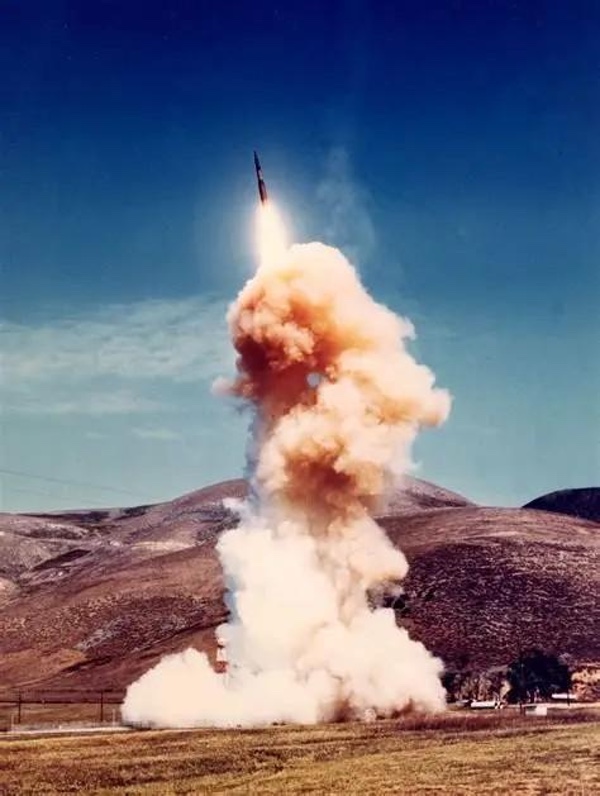 Minuteman III launch from Vandenberg AFB. (credit: US Air Force) |
The Titan III illustrates this migration clearly. Air Force studies adapted the Titan II core into a standardized military space launcher augmented by large strap-on solid motors.[11] The Titan IIIC, first flown in 1965, paired two segmented UA1205 motors with a modified Titan liquid core. The performance gain was substantial, but the architecture depended on an industrial base and procurement system created primarily for military missile requirements rather than commercial transportation.
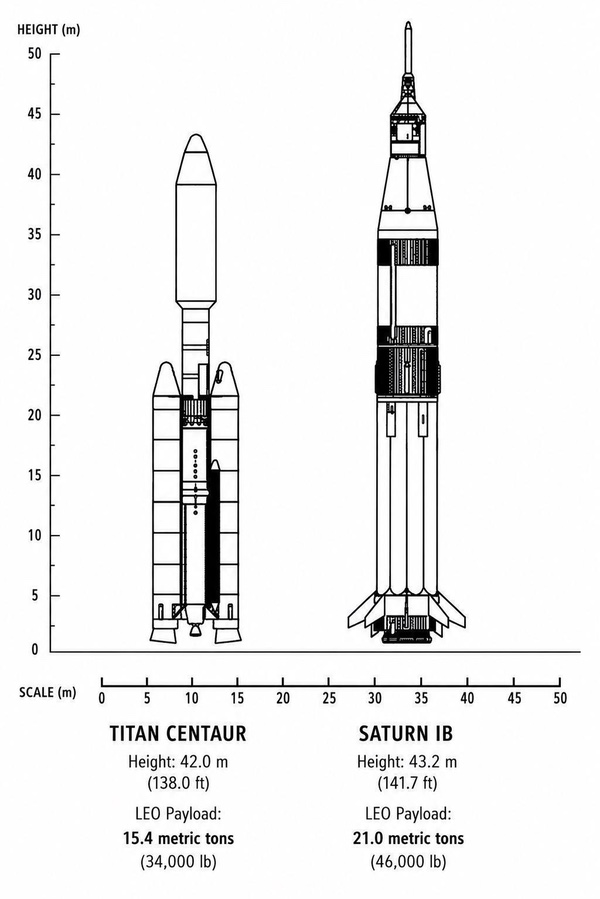 True-scale comparison of the Titan Centaur and Saturn IB. Published government and contractor data confirm that the two vehicles used very different propulsion architectures: Titan relied on large solid strap-ons plus a storable-liquid core and hydrolox Centaur, while Saturn IB used liquid propulsion throughout.[11][12] Because historical payload and cost figures vary by mission, configuration, accounting convention, and dollar-year basis, this figure should be read as an architectural comparison rather than as a precise normalized cost-per-kilogram proof. |
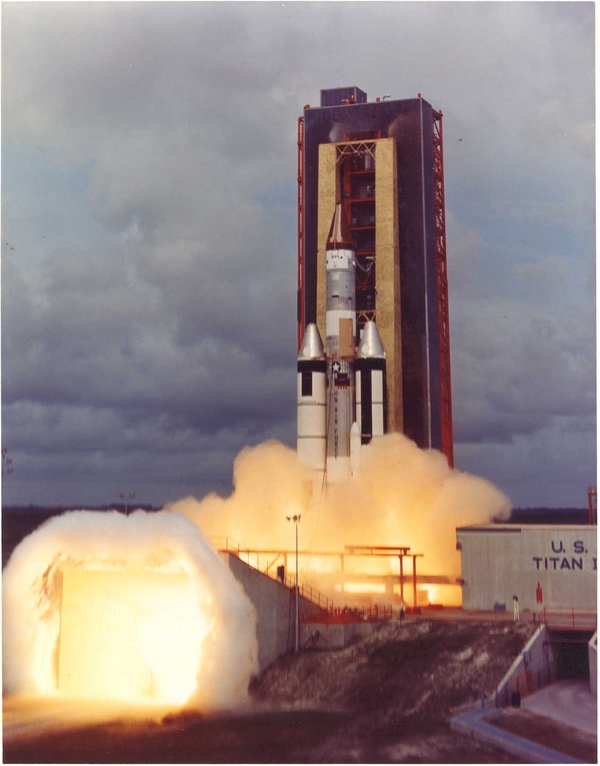 Titan IIIC-11 launches from Cape Canaveral, carrying seven Initial Defense Communications Satellite Program satellites, June 16, 1966. (credit: US Air Force) |
The comparison with Saturn IB is instructive because Saturn was developed specifically as a space launch system, although its first stage retained tankage heritage from earlier Army missiles. Its S-IB first stage used eight H-1 kerolox engines and its S-IVB second stage used a J-2 hydrolox engine.[12] Contemporary NASA and Air Force records support the general conclusion that Saturn IB offered strong LEO performance for its size, but exact cross-program launch cost comparisons are sensitive to configuration, fiscal-year dollars, allocated program costs, and whether development and standing-army costs are included. The defensible point is therefore architectural: the all-liquid Saturn achieved competitive or superior payload performance without relying on large solid augmentation.
Institutional competition and the cost of independence
The Department of Defense’s rejection of Saturn for military space launch was not wholly irrational. Dependence on a NASA vehicle would have meant dependence on NASA manifest priorities, procurement practices, range scheduling, and budget cycles, as well as investment in Saturn-specific support infrastructure. Government studies nevertheless found Saturn highly capable and questioned optimistic Titan III estimates.[11][13] The Air Force proceeded with Titan III because it also valued institutional control, military responsiveness, and continuity with its existing missile and launch infrastructure.
| As long as Titan II was in series production, its costs were amortized across a mass-produced run of missiles. When that production line shifted to low-rate production in 1967, per-unit cost rose sharply—and the cost of the Titan III, then the Titan IV, climbed in direct succession as each had to absorb more of the airframe's true, unamortized cost. |
The Department of Defense’s early resistance to Saturn extended to an effort to end military funding for the program in 1959 because no sufficiently defined military mission justified it.[13] Saturn survived through transfer to NASA. The episode reinforced the Air Force’s determination to maintain an independent heavy-launch capability under its own authority, built around Titan-derived hardware and large solid augmentation.
The Titan III family expanded through the 1960s and 1970s in configurations IIIA through IIIE, each exploiting the modular solid booster architecture. But every configuration with meaningful heavy-lift capability required the UA1205 motors, and those motors’ economics were inextricable from ICBM production infrastructure. The Air Force was purchasing space launch capability at marginal cost atop a weapons production base that Strategic Air Command was funding for reasons having nothing to do with satellite deployment.
Titan’s economics deteriorated as the missile-era production base contracted. Titan II missile production ended in the 1960s, while the active missile force remained in service until the 1980s.[14] Later Titan III and Titan IV launch vehicles therefore depended increasingly on low-rate production, aging tooling, specialized suppliers, and a standing workforce spread across relatively few launches. Government and program histories support the direction of this cost escalation, even though exact per-launch figures are difficult to compare consistently across decades and accounting conventions.[15][16]
The shuttle decision: political economy as systems engineering
The decision to equip the Space Shuttle with solid rocket boosters is the most studied example of how political and budgetary constraints can override engineering judgment, with lasting operational consequences. The technical case for solid boosters was its lower development cost relative to kerolox-fueled boosters. The case against them was that of lower performance, inability to throttle or shut down, irreversible hazardous material logistics, and a field-joint requirement that would ultimately prove fatal.
The full record of this decision, reconstructed in detail by NASA’s official historian T.A. Heppenheimer in The Space Shuttle Decision (NASA SP-4221, 1999), shows that the choice was not made in a single stroke but emerged from 18 months of contractor studies, Office of Management and Budget (OMB) pressure, and institutional infighting between NASA centers—with cost, not engineering merit, deciding the outcome at every turn.[17] The original 1969–1970 baseline was a fully reusable, two-stage shuttle: a winged, piloted booster the size of a Boeing 747, carrying a dozen Space Shuttle Main Engines and a dozen jet engines for its flyback to the launch site, paired with a similarly reusable orbiter. Aerospace Corporation estimated this vehicle’s development cost at $9.92 billion, with peak annual funding of $2.34 billion, figures that collided immediately with the OMB’s insistence that the program stay under $1 billion in peak annual funding.[18]
NASA’s contractors spent 1971 searching for ways to close this gap, and nearly every viable path ran through the booster. Moving the orbiter’s liquid hydrogen into an expendable external tank shrank both stages and lowered the optimal staging velocity from 2,972 to 2,134 meters per second (9,750 to 7,000 feet per second), cutting Grumman’s projected development cost from $7.78 billion to $6.50 billion.[19] Pushing the external tank further, so that the orbiter’s main engines burned from liftoff straight through to orbit, with the tank carrying all propellant for both stages, dropped the staging velocity again, to as low as 1,524 meters per second and eventually under 1,219 meters per second (5,000 and eventually under 4,000 feet per second). This is the chain that produced the case for a cheap, expendable, or minimally reusable booster: it was a side effect of solving the orbiter’s budget problem, not a deliberate attempt to optimize the booster.
Two reusable booster concepts survived this cycle of redesign, and neither was the solid rocket booster NASA ultimately flew. The first was a winged, scaled-down version of the Saturn V’s S-IC first stage, fitted with wings, a crew cabin, and turbojets for flyback. It was proposed by Boeing, which had built the S-IC and was eager to keep its production line open. The second, championed by NASA’s Marshall Space Flight Center, was the unmanned, sea-recoverable, pressure-fed liquid booster that became known, only half-affectionately, as the Big Dumb Booster.[19] Lacking turbopumps, it pushed LOX/RP-1 propellant to its engines using tank pressure alone, which meant building the tanks themselves thick enough to hold that pressure; the robust skin that resulted let the vehicle parachute into the ocean and survive recovery without further protection. Cost estimates compiled across four contractor studies in late 1971 told a consistent story:[19]
| Contractor | Pressure-Fed Dev. Cost ($B) | Winged S-IC Dev. Cost ($B) | Pressure-Fed Peak Funding ($B) |
|---|---|---|---|
| Grumman | 4.08 | 4.50 | 1.02 |
| North American Rockwell | 5.12 | 5.79 | 0.94 |
| McDonnell Douglas | 5.16 | 7.51 | 0.81 |
| Lockheed | 4.41 (peak only) | — | 0.99 |
Table 1. Comparative development cost and peak annual funding estimates for the pressure-fed reusable booster versus the winged S-IC alternative, four contractor studies, late 1971 (billions of FY1971 dollars). Source: Heppenheimer, The Space Shuttle Decision, NASA SP-4221, Chapter 8.
The pressure-fed booster’s appeal to NASA Marshall could be anticipated. Marshall was the institutional heir of Wernher von Braun’s liquid-fuel rocket team, and its preference for a liquid booster—of whatever configuration—reflected decades of organizational identity built around liquid-fueled engines, not a dispassionate verdict on solid motors. Shuttle program director Charles Donlan would later recall that Marshall and its contractors had “little background in solids” and that NASA had “pushed so hard for the liquid fuel thing in the first place, because it was hard to find something for Marshall to do” absent a major booster development program.[19] When NASA issued a formal directive on September 12, 1971, instructing contractors to drop their phased-development studies and refocus on the pressure-fed and winged-S-IC concepts, the directive amounted to what Heppenheimer terms “a peremptory dismissal of solids,” even though Lockheed and McDonnell Douglas had both endorsed a cluster of 156-inch solid motors as the best near-term booster only weeks earlier.[19]
The decisive turn toward solids came from outside NASA’s own design teams. Klaus Heiss of Mathematica, Inc.—the Princeton economics firm conducting the shuttle’s formal cost-benefit analysis—concluded that NASA’s contractors had not pushed the cost-per-flight tradeoff far enough. By accepting a somewhat higher operating cost, the program could buy a much larger reduction in development cost and peak funding through a configuration Heiss called TAOS: Thrust-Assisted Orbiter Shuttle, in which the orbiter’s own engines burned from liftoff to orbit while two unpiloted booster rockets—solid or pressure-fed—provided supplemental thrust before falling away.[19] The specific twin-solid-booster configuration NASA eventually selected appears to have originated not at NASA at all but at the Institute for Defense Analyses, a Pentagon think tank reviewing the shuttle on behalf of the White House; Donlan credited two IDA staff members, Reinald Finke and George Brady, with a configuration “almost identical” to the flight design, and recommended Brady for a NASA award decades later.[19]
Contractor studies of the TAOS concept, completed in the final months of 1971, delivered the comparison that settled the matter:[19]
| Concept | Dev. Cost ($B) | Peak Funding ($B) | Cost per Flight ($M) |
|---|---|---|---|
| Grumman, twin pressure-fed | 4.02 | 0.97 | 8.2 |
| McDonnell Douglas, twin pressure-fed | 4.83 | 0.74 | 6.4 |
| McDonnell Douglas, twin solid motors | 4.34 | 0.71 | 9.9 |
Table 2. TAOS contractor cost comparisons, late 1971. The twin-solid configuration had the lowest peak funding requirement but the highest cost per flight of the three—the operating-cost penalty of solid propulsion was visible and quantified before NASA selected it. Source: Heppenheimer, The Space Shuttle Decision, NASA SP-4221, Chapter 8.
The numbers are unambiguous on their own terms. The twin-solid TAOS configuration had the lowest peak annual funding requirement of the three options, satisfying the OMB’s overriding budget constraint, but it also had the highest cost per flight, $9.9 million against $6.4 million for the McDonnell Douglas pressure-fed alternative and $8.2 million for Grumman’s. NASA’s own contractor studies thus established, before any contract was signed, that solid propulsion would be the most expensive booster option to operate over the life of the program. The decision to proceed with solids anyway was made because the immediate, near-term constraint was peak annual funding during the 1970s development phase, not lifecycle cost during the 1980s and 1990s of operations: a short-horizon optimization that the OMB’s discounted-cash-flow framework, weighting near-term dollars far more heavily than distant ones, actively encouraged.[18]
| NASA’s own contractor studies, completed before any contract was signed, showed that the twin-solid booster configuration would be the most expensive of the three leading options to operate over the life of the program. NASA selected it anyway, because the immediate constraint was development-phase funding, not lifecycle cost |
This was the institutional and economic context in which NASA also accepted the SRB’s most consequential operational property. NASA’s own contemporaneous program documentation acknowledged that the solid booster “had a totally different problem since it could not be shut down until all the propellants had burned out,” in explicit contrast to a pressure-fed liquid tank rupture, which would at least permit an engine shutdown across the stack.[20] This was not a risk that went unnoticed and surfaced only later, in hindsight, after Challenger. It was identified, described in writing, and weighed against a quantified cost-per-flight penalty and the cost penalty lost. Fourteen years later, the inability to shut down a failing booster was the proximate reason Challenger’s crew had no abort option when the right-hand booster’s field joint began to fail.
The contract to build the Space Shuttle solid rocket boosters was awarded to Thiokol’s Wasatch Division in November 1973.[21] The historical record supports the conclusion that the shuttle configuration was selected in a severe near-term budget environment and that Utah manufacture required rail shipment of segmented motors. It does not conclusively establish that NASA Administrator James Fletcher personally directed the award for political reasons. The defensible claim is that procurement, geography, transportation limits, and congressional support became intertwined and produced lasting design consequences.
The Utah location then imposed a constraint that shaped the vehicle’s design in ways that proved irreversible. Because Thiokol’s Promontory facility required rail transportation to reach Kennedy Space Center (KSC), and because the railroad passes through mountain tunnels limiting maximum rail car width, the SRB segments were constrained in maximum diameter. Fabricating the boosters in four segments and assembling them at KSC introduced circumferential tang-and-clevis field joints initially sealed by two O-rings and zinc chromate putty, assembled by hand in an outdoor environment subject to temperature, humidity, and contamination variation.[5] A monolithic motor case, manufactured at a coastal facility, would have eliminated field joints entirely. The political decision to site the contract in Utah made a monolithic case geographically impossible. The O-rings were, in the most direct sense, a consequence of congressional politics.
Each loaded motor segment was transported by specialized rail equipment from Utah to Kennedy Space Center, with dedicated handling, monitoring, and explosive-safety procedures.[22] After flight, recovered steel cases underwent retrieval, disassembly, cleaning, inspection, repair, and recertification before being returned for another propellant casting cycle. This was an extensive refurbishment and remanufacturing process, not rapid operational reuse. Contemporary NASA and contractor studies consistently treated liquid-booster alternatives as offering potential operational advantages, although precise percentage savings depended strongly on assumptions and should not be stated as a settled 88-percent figure.[23]
A second-order consequence of the Space Shuttle architecture was the continuing pressure to extract more performance from the orbiter, its main engines, and the external tank as vehicle mass and mission requirements evolved. The RS-25 was designed with rated-power levels above the original 100% reference point, and later missions used uprated settings together with weight-reduction programs such as the Super Lightweight External Tank.[3] The engines’ extreme performance and reusability requirements imposed demanding inspection and refurbishment work.
Challenger: the engineering consequences of political decisions
On January 28, 1986, at 11:38 am EST, Space Shuttle Challenger (STS-51-L) was destroyed approximately 73 seconds after liftoff. The Rogers Commission identified the initiating failure as loss of pressure sealing in the aft field joint of the right solid rocket motor under unusually cold launch conditions.[21] The primary O-ring did not seal promptly; hot gas escaped through the joint, eventually producing the plume that impinged on the external tank and led to structural breakup. All seven crew members were killed.
The Rogers Commission documented a systemic failure extending well beyond the immediate hardware defect. O-ring erosion and blow-by had appeared on earlier flights, yet NASA and contractor management progressively accepted evidence that should have required resolution.[21] The commission’s record supports the broader lesson that schedule pressure, flawed risk communication, and normalization of anomalous performance allowed a known joint vulnerability to persist.
The engineering lesson lies deeper than the management failure. Once the right solid rocket motor ignited, its normal burn could not be stopped by closing a propellant valve or commanding an engine shutdown. The orbiter’s liquid main engines could be shut down, but the Shuttle had no survivable early-ascent procedure that allowed the orbiter to separate safely while the boosters continued producing most of the vehicle’s liftoff thrust and control authority.[21]
The impossibility of solid motor shutdown is not a design limitation resoluble through better engineering. It is a physical property of solid-phase combustion. The oxidizer and fuel are chemically and physically homogenized throughout the grain matrix at the 50–200 micron particle scale. There is no thermodynamic path from “ignited grain” to “extinguished grain” that preserves the motor hardware. For purposes of abort response, anomaly management, or range safety holds, a burning solid rocket motor is, in every operational sense, beyond human authority.
Always live: accidental ignition and the PEPCON disaster
The non-shutdown property of solid propellant has a corollary that receives less attention than its in-flight consequences but is, in terms of historical body count, considerably worse: a solid rocket motor or its propellant feedstock is never in a safe, de-energized state from the moment of manufacture to the moment of combustion. A liquid-fueled stage can be rendered inert for handling—drained, purged with inert gas, and reduced to an empty pressure vessel that poses no greater hazard than any other piece of aerospace structure. A solid motor cannot: the propellant is the structure. There is no procedure that separates the energetic material from the hardware short of physically removing and destroying the grain, and a fully cast motor or a stockpile of oxidizer feedstock is, for all practical purposes, always live.
| A solid motor cannot be rendered inert for handling. The propellant is the structure. A welder’s spark in a Nevada storage yard, with no rocket present and no launch imminent, produced an explosion equivalent to a one-kiloton nuclear air burst. |
The consequences of this property were demonstrated catastrophically on May 4, 1988, at the Pacific Engineering and Production Company of Nevada (PEPCON) plant in Henderson, Nevada, a major producer of ammonium perchlorate for American solid rocket motors.[24] Shuttle operations had been suspended after Challenger while ammonium-perchlorate production continued, leaving a very large inventory at the site.[25] A welder’s spark initiated the sequence of events that culminated in an explosion equivalent to approximately a one-kiloton nuclear air burst.[27]
The accident involved a rapidly propagating fire and several major explosions. Technical analysis placed the overall blast sequence on the order of a one-kiloton free-air-burst equivalent, or roughly 250 tons of TNT at ground level for the largest effects.[26] Two employees were killed and hundreds of people were injured; buildings, utilities, and property were damaged over a wide area.[24][27] The event was among the largest accidental industrial explosions in modern US history.
The hazard is not confined to bulk feedstock. Finished motor segments remain energetic articles throughout storage, transport, and handling. In September 1990, a fully loaded Titan IV solid-motor segment was dropped during ground operations at Edwards Air Force Base and ignited in a violent fire, killing one worker and injuring nine others.[28][29] The event illustrates the severe consequences that can follow mechanical damage to a large, loaded motor.
PEPCON did not involve a launch operation. It was a propellant-manufacturing and storage accident, illustrating that the solid-propellant hazard exists throughout the supply chain. Ammonium perchlorate and finished motors require quantity-distance separation, specialized storage, controlled transportation, trained personnel, and extensive safety management. Liquid oxygen and hydrocarbon fuels present serious hazards of their own, but they can be stored separately and drained from a vehicle; a cast solid motor remains an energetic article until its grain is consumed or removed.
Refurbishable, not reusable: the cartridge-case analogy
The distinction between “reusable” and “refurbishable” hardware is the crux of why solid motor recovery never achieved the cost structure its advocates promised. A genuinely reusable system—the term as SpaceX and Blue Origin use it for liquid boosters—implies an article that returns from flight requiring inspection and, at most, minor servicing before flying again: refueling, a borescope check, de-coking if necessary, perhaps a turbopump or actuator swap at long intervals. A refurbishable system, by contrast, is one whose return from service is closer to a manufacturing input than a finished product. The Shuttle SRB casing belongs to the second category, and the appropriate analogy is not an airliner returning for its next flight but a brass rifle cartridge case sent back to a reloading bench.
A reloaded cartridge case is not reused in the same sense as a turbofan or a liquid rocket stage. The case is carried forward, while the energetic contents are replaced. Shuttle solid rocket motor cases survived the burn and ocean recovery, but the returned hardware required retrieval, cleaning, nondestructive inspection, corrosion assessment, replacement of insulation and ablative components, nozzle work, and a completely new propellant casting.[5][30] The analogy is therefore useful so long as it is understood as a description of extensive refurbishment, not a claim that every component followed an identical replacement schedule.
| Recycling a Shuttle SRB casing was refurbishment in the cartridge-case sense, not reuse in the airliner sense. The steel shell came back; most of what made it a rocket motor had to be rebuilt from raw material every time. |
This is refurbishment in the cartridge-case sense: a structural shell is carried forward, but the energetic and functional content of the article is entirely replaced each cycle, at a labor and inspection cost that scales with the complexity of the case rather than shrinking with experience. It is fundamentally different from the “gas-and-go” ideal that high-cadence liquid architectures pursue. A Falcon 9 booster returning to port has its engines, plumbing, avionics, and primary structure all intact; the turnaround work is inspection, de-coking, minor parts replacement, and propellant load, using the same propellant tanks that flew the prior mission fly the next one, holding the same propellants they were designed to hold from the start. SpaceX’s stated goal for Starship—propellant load, inspect, refly within hours, the literal “gas-and-go” turnaround of an aircraft—is the limiting case toward which liquid reusability has always pointed and toward which no solid motor casing, however well engineered, can plausibly travel, because the thing that makes the motor a motor is consumed completely on every flight and must be re-manufactured, not refueled.
The reused hardware fraction of total SRB cost was modest precisely because so little of what made the booster valuable—the propellant, the insulation, the nozzle, the ablative components—survived a flight in usable condition. The casing was, in the end, the cartridge brass. Almost everything else was the bullet, the powder, and the primer.
The “Dial-a-Rocket” era
The solid motor’s legitimate surviving role in contemporary launch is as modular thrust augmentation for a liquid-core vehicle and in specialized upper-stage or kick-stage missions. Atlas V could fly with zero to five strap-on boosters, while Vulcan uses zero, two, four, or six GEM-63XL boosters depending on mission needs.[31] India’s PSLV family likewise uses different strap-on arrangements by variant. In these systems the solid motor functions as a performance option rather than as the sole foundation of a reusable transportation architecture.
This is the technically rational use case at present: performance augmentation for an existing liquid-fueled vehicle at flight rates low enough that the per-unit solid motor cost and handling burden are acceptable against the mission value of the payload. What it does not provide is a path to high-cadence, low-cost launch.
Why solid motors cannot support a high-cadence launch economy
The economic logic of reusable liquid propulsion differs from that of solid propulsion because a liquid booster can return with its engines, tanks, avionics, plumbing, and primary structure intact. Its flight cost can therefore be divided among amortized hardware, inspection and maintenance, propellant, range services, and operations. Public statements and flight records show that individual Falcon 9 first stages can fly more than 35 missions, allowing high-value hardware to be spread across many launches.[32][33] Exact marginal-cost figures remain proprietary and should be treated as company estimates rather than audited public costs.
SpaceX has publicly described the first stage as the largest share of Falcon 9 production cost and has stated that refurbishment is much cheaper than building a new booster.[33] The demonstrated reuse record supports the central economic point: as the number of flights per booster rises, the amortized hardware charge per mission falls. Precise claims about a $15 million marginal launch cost, a fixed refurbishment percentage, or a specific booster-production price are retained only as attributed company statements, not as independently verified accounting facts.
| A solid rocket motor is a Class 1 explosive whose supply chain, storage, and processing requirements are structurally incompatible with airline-like launch operations at any flight rate the commercial market will require in the 2030s |
A solid rocket motor cannot participate in the same reuse logic because its propellant grain is consumed on every flight and must be manufactured, cast, cured, inspected, and certified anew. A shuttle-class motor contained more than one million pounds of composite propellant.[6][5] Cost models confirm that large solid propulsion is strongly affected by propellant processing, case and nozzle production, quality assurance, facilities, and production rate.[34]
More fundamentally, large solid rocket motors are regulated as Class 1 explosive articles. The exact hazard division is not universally 1.2C; classification depends on the motor’s design and tested hazard behavior, and rocket motors may appear under classifications including 1.1C or 1.3C.[35] Whatever the division, transportation, storage, quantity-distance separation, approval, and trained-handling requirements impose substantial operational burdens that are poorly matched to airline-like launch processing.
The grain casting process itself introduces a further constraint. Large solid motor propellant grains are cast in place in the motor case in an exothermic cure process requiring days to weeks, performed under controlled temperature and humidity to ensure propellant homogeneity and adequate mechanical bond strength between the grain and case insulation liner.[1] The resulting grain structure—and therefore the motor’s thrust-time profile—is fixed at manufacture and cannot be adjusted post-cure. Any inspection revealing a void, crack, or debond in the propellant grain typically results in motor rejection, because no repair process exists that can restore the original geometric and mechanical properties necessary for predictable ballistic performance. As Stanford’s AA 284a propulsion materials summarize: active thrust control is very hard to implement; segmentation is required for large boosters due to manufacturing and transportation constraints; segmentation requires field joints.[1] Each of these constraints is inherent in the solid motor’s physical nature and cannot be engineered away.
The future without solid boosters
The market evidence is strong. SpaceX’s Falcon 9, Falcon Heavy, and Starship/Super Heavy use liquid propulsion. New Glenn uses methane/LOX BE-4 engines on its first stage and hydrogen/LOX BE-3U engines on its upper stage. Rocket Lab’s Neutron and China’s Long March 10 family are liquid-fueled. Ariane 6 and SLS retain large solid boosters, demonstrating that solids remain relevant where governments value schedule assurance, industrial continuity, political considerations, or high-thrust augmentation. Ariane 6’s competitive position is an economic assessment rather than a primary-source fact. Oversight estimates place the early SLS/Orion launch system near $4.1 billion per mission.[36]
China presents an apparent counterexample that requires careful treatment. The US Department of Defense reported that China’s three new solid-propellant ICBM silo fields contain roughly 320 silos, reflecting a major expansion of state-backed solid-motor capacity.[37] China also operates several solid-propellant orbital launch vehicles. Direct lineage claims between particular commercial launchers and specific missile families should be made only where authoritative documentation supports them; the broader point is that a large military procurement base can sustain facilities, suppliers, and expertise that also benefit civil or quasi-commercial launch.
China’s current experience is consistent with the argument presented here. A large, state-supported military demand signal can carry the fixed costs of propellant production, motor casting, case manufacture, testing, and specialized labor, allowing civil launch programs to draw on an industrial base that commercial launch demand alone might not sustain. Whether those economics persist if military production levels plateau or decline is uncertain and should be presented as a conditional inference rather than a forecast.
The trajectory of the industry reflects a conclusion already embedded in the physics and the economics. The performance penalty, operational inflexibility, logistics burden, and scaling incompatibility of solid propulsion make it an economically inferior choice for any launch architecture designed for high flight rates, crew and personnel safety, or competitive commercial pricing. The solid rocket motor was a rational choice when flight rates were low, when ICBM production bases provided near-free manufacturing infrastructure, and when the relevant comparison was performance against payload capacity rather than cost per flight over a 50-plus-mission operational life. None of those conditions hold today.
What remains is a technology with limited utility: thrust augmentation for liquid-core vehicles at modest flight rates, kick stages for geosynchronous/planetary insertion burns, where the niche engineering advantages of small solid motors exceed those of a liquid stage, and missiles where storability and instant readiness remain operationally decisive.
The rocket equation does not care about political arrangements or institutional loyalties. It cares about Isp and mass fraction. On those terms, the solid rocket motor has been losing the argument for decades. The economics are now simply catching up with the inherent physical limits of the technology.
References
- Arif Karabeyoglu, “Solid Rocket Propulsion,” AA 284a Lecture 11, Stanford University, 2014.
- U.S. Air Force / contractor technical documentation, “Titan IV Solid Rocket Motor Upgrade,” including SRMU performance and qualification data; see NASA Technical Reports Server and Air Force program records. https://ntrs.nasa.gov/
- NASA, “A History of Welding on the Space Shuttle Main Engine,” NASA Technical Reports Server, 2010; NASA engine reference material for J-2, RS-25, and RL10 performance.
- SpaceX, Falcon and Starship propulsion information; Blue Origin, New Glenn propulsion information. Official manufacturer program pages. https://www.spacex.com/vehicles/starship/ ; https://www.blueorigin.com/new-glenn
- NASA, “The Space Shuttle,” official reference page.
- NASA, Space Shuttle News Reference and Solid Rocket Booster technical data, NASA Technical Reports Server.
- NASA Jet Propulsion Laboratory, institutional history of the 1936 Caltech rocket-research group and early JATO development.
- Aerojet Rocketdyne, company history and early JATO/Aerojet development; NASA/JPL historical records.
- U.S. Air Force, Titan I weapon-system and launch-readiness history; National Park Service missile-history materials.
- National Park Service, “The Underground Air Force,” Minuteman National Historic Site; Titan Missile Museum, Titan II operational history.
- U.S. Air Force, Titan III launch-vehicle program histories and technical summaries; NASA Technical Reports Server, Titan III documentation. https://ntrs.nasa.gov/
- NASA, Saturn IB vehicle and mission documentation, including Saturn launch-vehicle technical histories and Apollo Applications records. https://history.nasa.gov/
- NASA, historical records on the Silverstein Committee and transfer of Saturn to NASA; T. A. Heppenheimer, The Space Shuttle Decision, NASA SP-4221.
- Titan Missile Museum, “Titan II History,” preserving the operational history of the Titan II weapon system.
- U.S. Air Force, Commercial Titan III and Titan IV program histories; GAO reports on launch-system acquisition and cost growth. https://www.gao.gov/
- U.S. Air Force, final Titan IV launch and Titan program historical records; Air Force Space and Missile Systems Center program history.
- T. A. Heppenheimer, The Space Shuttle Decision, NASA SP-4221, NASA History Series, 1999.
- T. A. Heppenheimer, The Space Shuttle Decision, Chapter 6, “Economics and the Shuttle,” NASA SP-4221.
- T. A. Heppenheimer, The Space Shuttle Decision, Chapter 8, “A Shuttle to Fit the Budget,” NASA SP-4221, citing the underlying contractor Phase B studies.
- Mathematica, Inc., Economic Analysis of the Space Shuttle System, NASA Technical Reports Server, 1972–1973.
- Report of the Presidential Commission on the Space Shuttle Challenger Accident (Rogers Commission), 1986.
- NASA, Kennedy Space Center railroad and Shuttle solid-rocket-booster transportation records; NASA historical and logistics documentation.
- NASA and contractor Shuttle liquid-rocket-booster studies, including Liquid Rocket Booster Study, NASA Technical Reports Server.
- Clark County Fire Department, “The PEPCON Explosion,” official incident history.
- Henderson historical and emergency-management records concerning accumulated ammonium-perchlorate inventory before the PEPCON accident.
- Reed, J. W. et al., “Analysis of the Accidental Explosion at PEPCON, Henderson, Nevada, May 4, 1988,” U.S. Department of Energy technical report, 1988.
- NASA Office of Safety and Mission Assurance, “From Rockets to Ruins,” PEPCON safety case study.
- U.S. Air Force accident reporting and contemporary wire-service record of the September 1990 Titan IV solid-motor-segment accident at Edwards Air Force Base.
- Los Angeles Times, “Titan Booster Falls, Bursts Into Flames,” September 8, 1990, based on Air Force and emergency-response reporting.
- NASA, “Evaluation of Shuttle Solid Rocket Booster Case Materials,” NASA Technical Reports Server, 1974.
- United Launch Alliance, Atlas V and Vulcan official vehicle/user-guide documentation.
- SpaceX, official Falcon 9 mission and reflight records; NASA Commercial Crew launch documentation.
- Irene Klotz, “Interview with SpaceX’s Elon Musk,” Aviation Week, 2020. Company cost statements are treated as attributed estimates.
- NASA Marshall Space Flight Center Propulsion Cost Model (PCM), International Cost Estimating and Analysis Association, 2019.
- U.S. Department of Transportation, Pipeline and Hazardous Materials Safety Administration, rocket-motor explosive classification and approval interpretations, including UN0186 Rocket motors, 1.3C.
- NASA Office of Inspector General, Artemis/SLS/Orion cost and affordability reporting; U.S. Government Accountability Office, NASA major-project assessments. https://oig.nasa.gov/ ; https://www.gao.gov/
- U.S. Department of Defense, Military and Security Developments Involving the People’s Republic of China 2024.
Note: we are now moderating comments. There will be a delay in posting comments and no guarantee that all submitted comments will be posted.