Review: The Soviet Space Program and International Collaboration during Perestroikaby Louis Friedman
|
| Perestroika came into the space program through the leadership of Academician Roald Sagdeev. By opening the Halley Comet encounters to Western observers, he revolutionized Soviet space science. |
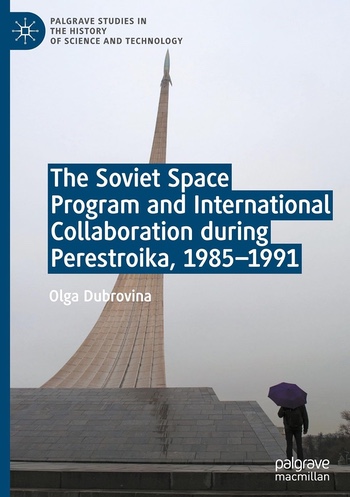
Dubrovina’s book is an interesting chronicle of European-Soviet space cooperation during the period of 1985 to 1991. She provides much detail about some of their specific shared projects. There is, however, a near-absence of the US involvement in Soviet space activities, something far bigger and more significant than Dubrovina might have realized from the European sources she primarily relied upon.
This is understandable if one assumes the United States and NASA are indistinguishable. Indeed, NASA leadership was absent and generally hostile to international collaboration during those years.[3] But the Americans’ scientific presence in Perestroika was, in fact, quite large and significant. This involvement was non-governmental, not with NASA, but with non-governmental institutions, universities, and individual scientists.
For example, there was a novel Soviet-American-European pathfinder enabling precise navigation of the Halley spacecraft during their close approaches to the comet; US scientists’ participation on the Phobos project, the only Mars mission of the 1980s; Americans working with Soviet engineers on the extreme environment testing and development of the first Mars rovers; and a presidential summit with an initiative for a joint human-crewed Mars mission—it came close, but failed, as described below.
Dubrovina effectively cites the critical leadership of the French space agency CNES in working with the Soviet space program, and notes an eventual European Space Agency office in the Soviet space industry Lavochkin Association. However, she does not reference an earlier office established in the Soviet Union by The Planetary Society establishing a communications link for Soviet and Western scientists during and after the Halley Comet missions. In addition to the Society, Brown University established a close working relationship with the Vernadsky Institute, which enabled significant US-Soviet space science cooperation.
Perestroika came into the space program through the leadership of Academician Roald Sagdeev. By opening the Halley Comet encounters to Western observers, he revolutionized Soviet space science. I was fortunate to witness the revolutionary change from secrecy to openness with two contrasting experiences with Soviet space leaders: Sagdeev, the sirector of the Space Research Institute responsible for the Venus-Halley (VEGA), and Academician Vladimir Kotelnikov, director of the Institute for Radio Engineering and Electronics responsible for the Venus radar imaging orbiters carried out by the Soviet Union in 1983.
On the day before it was scheduled to go into orbit, I met with Kotelnikov and asked him about the spacecraft’s health. He said he knew nothing about that mission. The head of the Institute conducting the first imaging mission to Venus with an advanced technology that the US had not yet developed said knew nothing the day before the encounter! Dubrovina mentions very generally the secrecy surrounding the space program before Perestroika, but this example makes it specific.
Three years later, at the Institute for Space Research leading the science missions to Comet Halley, Sagdeev asked me, an American, to organize, invite, and conduct an open press conference during the encounters—in his words, “Like they do at the Jet Propulsion Laboratory.” We didn’t know much about Perestroika in 1986, but this experience surely exemplified this new Soviet policy. Dubrovina effectively reviews the European-Soviet cooperation with Halley missions, but she does not offer much about the US role in either the “pathfinder” navigation or with some of the science instruments that were on board for that mission. Nor did she mention the large presence of US press, which included a live broadcast during the mission from Moscow on the “Nightline” TV show. Undoubtedly, Perestroika was having a large effect of geopolitics and public relationships as well as with the individual science interactions discussed in the book.
Dubrovina does an excellent job chronicling the Phobos mission to Mars. She correctly describes it as a partial success despite the loss of the spacecraft just as it was approaching the Martian satellite. It returned valuable science data while it was working in Martian orbit. She cited the remarkable open post-mortem conducted by the previously secretive space officials with the presence of Western and Soviet scientists in a free-for-all discussion. The participants there debunked the briefly offered claim that the spacecraft must have been hit by a piece of an asteroid[4].
| The non-governmental efforts in Soviet-American space cooperation in the late 1980s, with the Halley Comet missions and International Halley Watch and Marsokhod (Mars Rover) development, had a profound effect on US space policy in the 1990s |
One event of space Perestroika is only mentioned in passing in the book, yet it was a major milestone in international collaboration. In 1987, on the occasion of the 30th anniversary of the Space Age with the launch of Sputnik, Academician Sagdeev organized a major international conference in Moscow. Because there were no formal relations between the US and Soviet Union, and no official space cooperation, Sagdeev again turned to the non-governmental world. The Planetary Society, co-founded and led by Carl Sagan, Bruce Murray and myself, was free to operate without bureaucracy or inhibitions (except we always obeyed US laws) and could foster the travel of Americans, particularly the Apollo astronauts and space industry leaders, to come to Moscow as private citizens.[5] A White House National Security Staff official, Thomas Rona, attended the conference and publicly invited all those present to Washington for a conference the following year. That never happened, but the winds of Perestroika were blowing strongly across the Atlantic Ocean.
Those winds became a near-hurricane with the Reagan and Gorbachev summit meetings. In 1988, Gorbachev, likely encouraged by his scientific advisors (one of whom was Sagdeev), prepared to propose a joint US-Soviet human Mars mission initiative[6] tied to an agreement about the Strategic Defense Initiative. This history is beyond the scope of Dubrovina’s book, but its significance to the subject of international collaboration in space during Perestroika is obvious. While the science agreements and individual interactions of European and Soviet scientists elucidated by Dubrovina were noteworthy, the broader stage of US-Soviet relations was far more significant. The nearly-reached initiative for a joint US-Soviet human Mars mission was advanced on the Soviet side by Academician Sagdeev and on the US side by Carl Sagan: both opponents of meaningless human space ventures, but both supporters of harnessing it in support of greater international and geopolitical objectives for world peace.
The non-governmental efforts in Soviet-American space cooperation in the late 1980s, with the Halley Comet missions and International Halley Watch and Marsokhod (Mars Rover) development, had a profound effect on US space policy in the 1990s. After a decade of inaction, NASA began planning new Mars missions spurred on especially by public interest, and finally added rovers to the US program. The Soviet Union—and, with it, Perestroika—ended in 1991, just as a group of us from the Planetary Society were in Kamchatka testing Mars rovers with Soviet engineers. While we were there, the coup against Gorbachev was attempted, and a few months later the Soviet Union collapsed. In our small world, however, the rover testing was a huge success. We brought the power of Mars rovers to NASA’s attention and final incorporation into the exciting program of Mars surface exploration, which began in 1996 and continues to the present. It can be said to have been the best result from the Soviet space program and international collaboration during Perestroika.
Endnotes
- Springer, 2025
- From 1983-2005 I Imade over 50 trips to the Soviet Union/ Russia in pursuit of international cooperation in space. Cf. Planetary Adventures from Moscow to Mars, Louis Friedman, Page Press, 2017
- Although, to be fair, the difficulties following the Challenger accident and preoccupation with the grossly underestimated shuttle development m forced NASA’s retreat both from science and from international space cooperation. An even bigger negative factor was the Strategic Defense Initiative (“Star Wars”) being pushed and funded by the Reagan Administration.
- Bruce Murray, attending as both as a Phobos science experimenter and from The Planetary Society, stunned the meeting with his very strong criticism of Soviet system engineering and quality control with words usually reserved for in-house academic faculty meetings.
- One anecdote from this was Apollo 12 Astronaut Dick Gordon coming up to me on our Aeroflot flight to Moscow and saying in his somewhat grizzled ex-military manner, “Friedman, if anyone ever told me they would put me on a Soviet plane with a one-way ticket to Moscow, I would have punched him in the face. You did just that.” He did not punch me, but had a wonderful trip.
- David Johnstone, “Gorbachev to Ask U.S.-Soviet Mars Trip in Talks,” NY Times, May 22, 1988.
Note: we are now moderating comments. There will be a delay in posting comments and no guarantee that all submitted comments will be posted.