Little building, big mysteryby James Behling
|
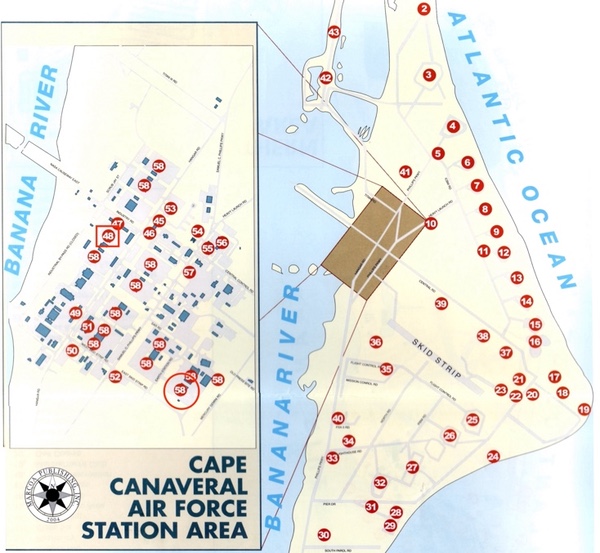 |
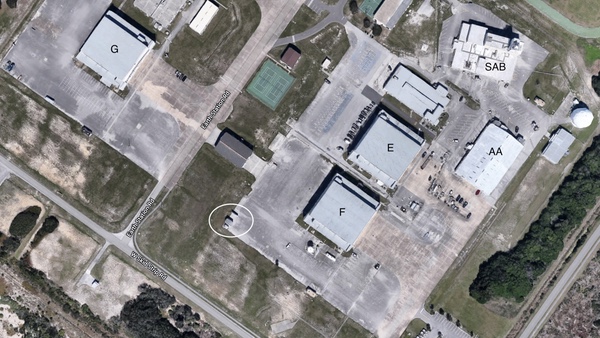
It is on the southwest corner of the Hangar F paved area.[3]
 |
A Google Maps 3D rendering of the facility:[4]
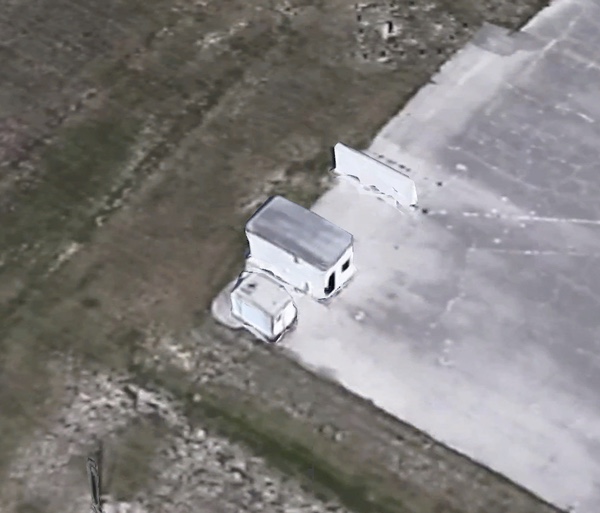 |
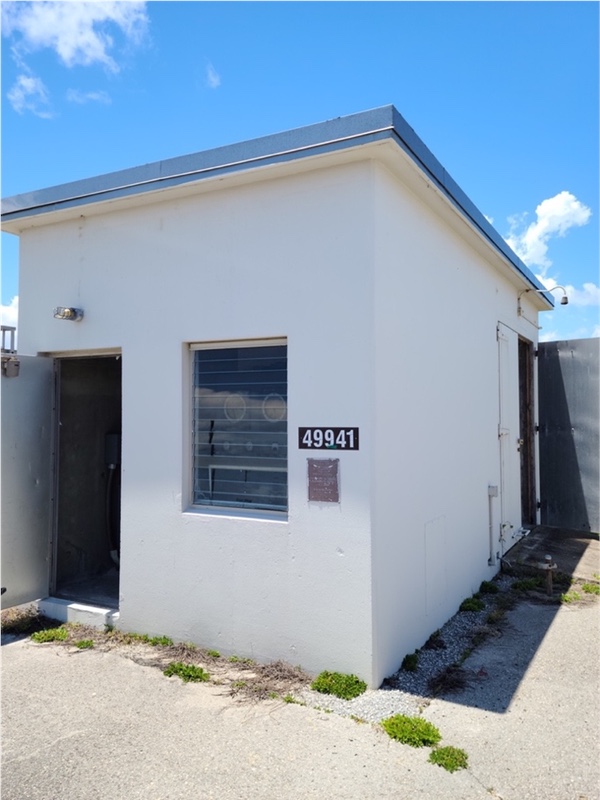
The rectangular building has a facility number of 49941. The trailer next to it is not documented. Early contractors that maintained the infrastructure of the Cape published a directory called the Basic Information Guide (BIG). It contained maps of the installation showing facilities and utilities. The 1995 BIG listed the facility as a storage building, that was built in 1958.[5] But the view through the window did not reveal that it was being used for storage or was even suitable for that purpose. The 1959 BIG has the facility number as 50000 and indicated that it was called Nose Cone Pressure Cell Building.[6] The 1960 BIG listed the building as Pressure Proof Test Cell Building and included the wall across from it which was assigned facility number 50001 and called a blast wall.[7]
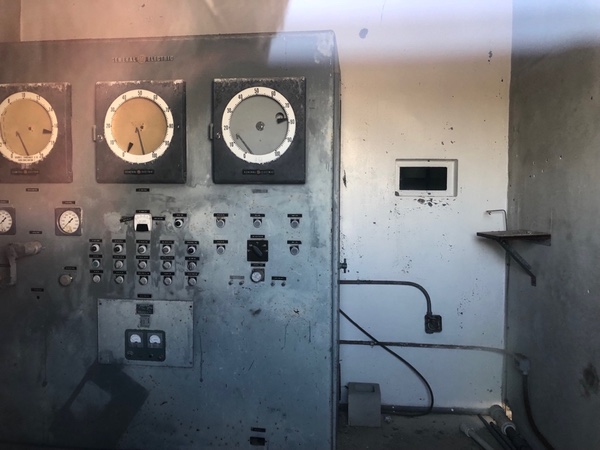
The early names of the facility provide some details as to the purpose of the building: pressure testing, but for what program? Looking at the first photo of the interior provided some hints.
The instrument panel in the photo was made by or for General Electric (GE) according to the logo on it. Two of the circular chart recorders have labels that are still legible, and one is labeled “NC Tank Press”. This could mean Nose Cone Tank Pressure. “Nose Cone” was typically used in the 1950s and ’60s to refer to reentry vehicles (RV) on top of missiles. There are switches labeled “SOL”, which is likely solenoid. They are also labeled with an axis and direction; however, there are only five switches for the six possible axes and directions. There is only one switch for roll, and it does not have a direction.
Based upon this information of the timeframe, the company, and “nose cone” strongly suggests the facility was built for the GE Mark II reentry vehicle, an early RV for carrying a nuclear weapon atop Thor intermediate-range ballistic missiles as well as Jupiter and Atlas missiles. The Mark II was a blunt body heat-sink design, meaning that it deflected much of the heat produced during reentry into the atmosphere, but absorbed some of that heat with a heavy metal heat sink. The Mark II was a heavy RV, and only one could be carried per missile. Later RVs used ablative materials that burned and flaked off, carrying heat away from the vehicle. They could be made much lighter, enabling a ballistic missile to carry multiple warheads.
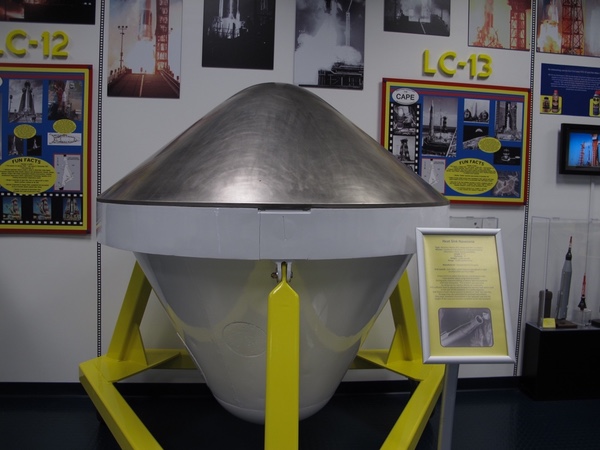 A Mark II RV currently resides in the Sands Space History Center.[8] |
The conclusion that the mystery building at the Cape was for pre-flight testing of the Mark II RV is further reinforced by information provided by various Mark II RV flight test reports. A diagram from a flight test report shows a gas (nitrogen) reservoir within the RV.[9] The report mentions that the vehicle was rolled in one direction for stability, hence this is the reason for only one roll solenoid for pressure testing. It also mentions pressure testing as part of “Hangar tests”
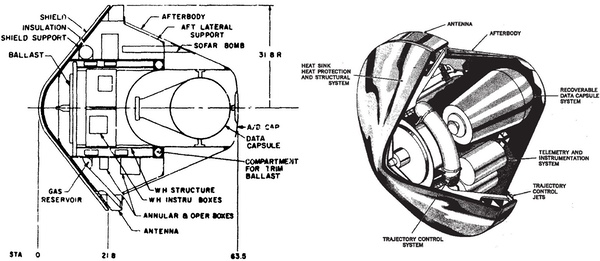 Diagram showing the toroidal gas reservoir.[10] |
Museum personnel were able to arrange a visit to the building, which revealed more details of the test equipment and facility.[11]
 |
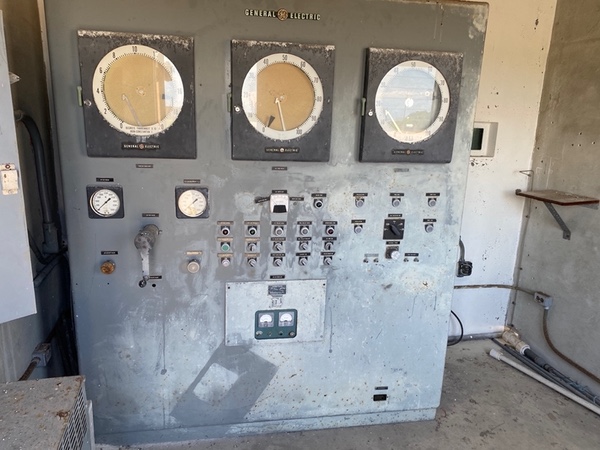 Control Panel[12] |
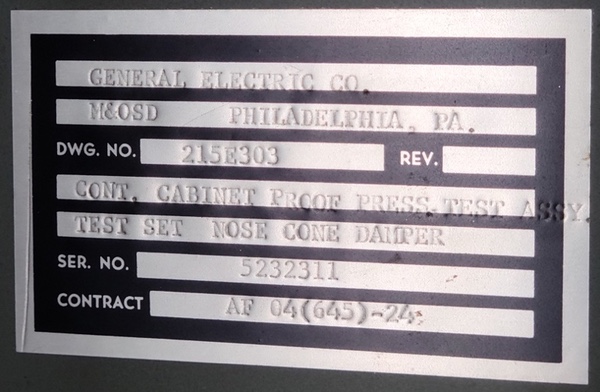 Control Panel Name plate[13] |
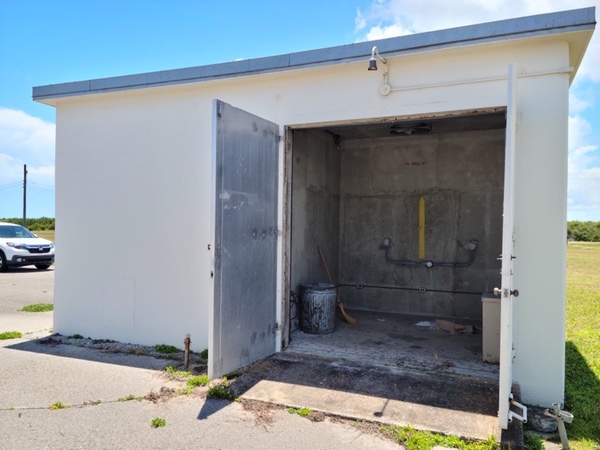 Test cell[14] |
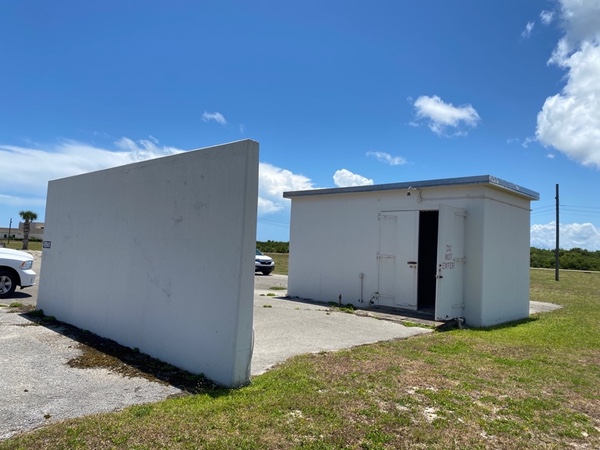 Blast wall[15] |
The visit revealed that the building has a test cell that is separate from the control room, a reinforced glass window for viewing into the test cell from the control room, and stainless-steel tubing running from building exterior to the test panel and from the test panel to the test cell. The exterior wall is positioned so that a blast from the test cell entrance would be “contained”.
The control panel name plate has M&OSD stamped on it, which stood for GE’s Missiles & Ordnance Systems Division, which was the supplier of the Mark II RV. The group was later renamed GE Missiles & Space Vehicles Division (MSVD).[16] The plate also states the panel is for nose cone pressure testing. The visit reinforced the conclusion that the building was for supporting Mark II RV pressure testing.
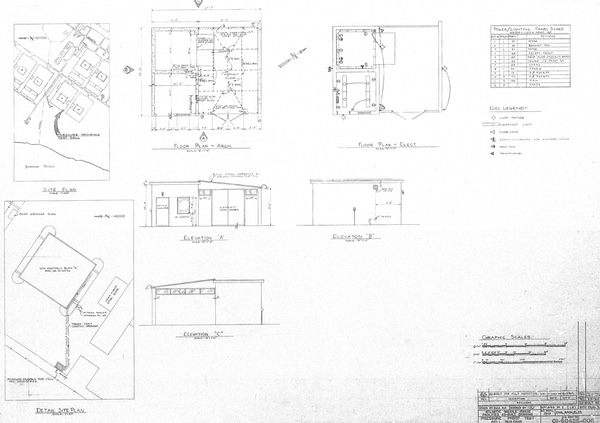
Electronic versions of the original drawings of the Cape facilities were available through the Cape Canaveral Force Space Force Museum files. The drawings for the pressure test facility were found. They were called “Modification to MAB (Missile Assembly Building) “F” (Pressure Proofing Test Cell Building).” The drawings were approved in May 1957. A note on one of the sheets stated, “Adapted from Missile Assembly Building “L.” An identical facility was found and located behind Hangar L (the square in the above map). It was numbered 60425 and was called Pressure Test Building (the name used in BIGs). The drawings for it were titled “Modification to MAB ‘L’”. These drawings were also approved in May of 1957. The titles of the drawings as modifications to the basic hangars (rather than entirely new buildings) were likely done to avoid dealing with the military construction program bureaucracy. Museum personnel tried to arrange a visit to facility 60425, but it was learned it was assigned as storage and is near SpaceX facilities at Hangar M (Hangar L has been demolished for several years).
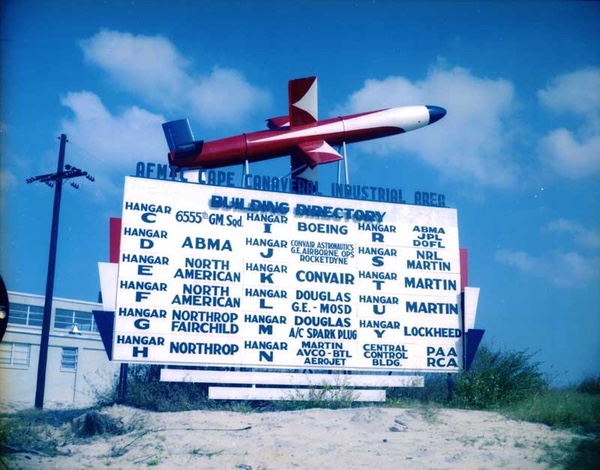 Museum files include a photo of the Cape Industrial area building directory.[17] This sign from the late 1950’s has GE MOSD assigned to Hangar L. |
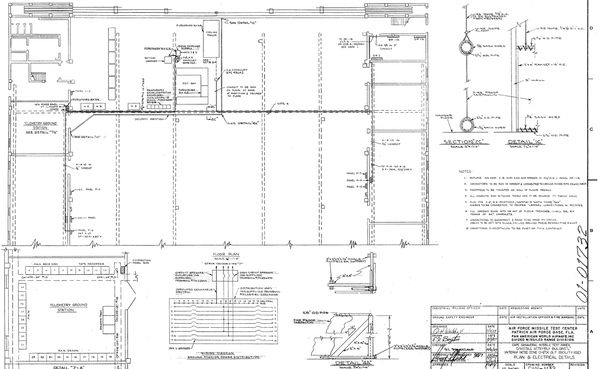
Hangar L drawings were retrieved from the museum’s files and revealed drawings for an Interim Nose Cone Checkout Facility (GE) within the hangar.[18] These were approved in March 1957. The term “Interim” was another clue.
 |
The museum files also contained drawings approved in November 1957 for mods to Hangar F to accommodate GE MSVD work.
GE flight test reports mostly use the terms General Electric or GE hangar or just “hangar” for location of RV preparation and testing. Some General Electric and Air Force Missile Test Center reports specifically state Hangar F as the preparation location; and the Mark II on Thor 126 (fourth flown) was the first one documented to use that facility.[19] As for Hangar L, there is only one report with its use and that was for the first Mark II flown (Thor 120).[20] The report also mentions that the RV attitude control system was not active for this launch, and no gas was loaded which means there was no pressure testing.
A deeper dive through the Hangar L drawings revealed that 60425 was later modified by cutting the control room in half and adding it to the test area.[21] A date for the change could not be found.
 |
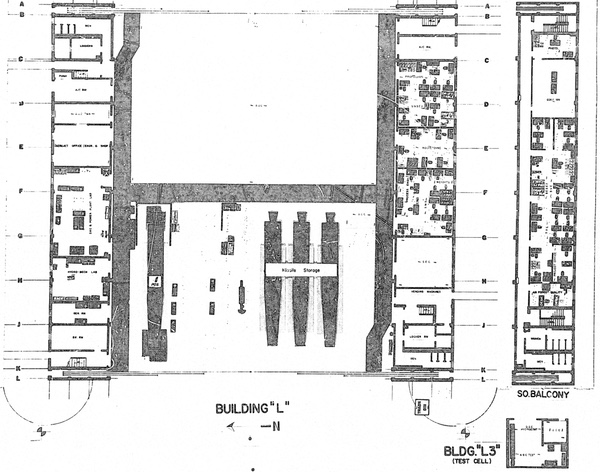
Diagrams in Delta launch vehicle program documents show the Mark II area in Hangar L was taken over by Douglas for Thor booster support in February 1959.[22] Mark II work had to move elsewhere at this time. An undated diagram was included in the Hangar L drawings.[23] The annotation in the blank area is “AGC” for Aerojet General Corporation. BLDG “L3” is the modified pressure test building, and it has similar AGC annotations. A Delta second stage silhouette is visible on the left in BLDG “L3”. Early Delta and Ablestar second stages were provided by AGC. The mod was for second stage pressure testing .
 |
Mark II reentry vehicle testing was in Hangar L (interim nose cone check out) at the beginning of the program and transitioned to the Hangar F complex soon after they started flying. This was likely due to Thor/Delta wanting to take over the whole Hangar L complex. General Electric continued to support other RV designs from Hangar F after the Mark II program ended. The modification of Hangar L pressure test building (facility 60425) to support Delta/Thor removed any trace of Mark II testing hardware, leaving facility 49941 as the remaining representative Mark II facility and equipment. Electrical power to the test cell was modified in the 1980s for document shredders for the Pershing program while in Hangar F.
When the Thor was removed from service in the early 1960s, many of the missiles were converted to launch vehicles. The nuclear weapons were removed from their reentry vehicles and most of them were disassembled. Most of the Mark II RVs were eventually destroyed, with only a few preserved for museums. The GE panel has survived largely unchanged for nearly seven decades. It is likely the only remaining example of Mark II test equipment, making its preservation especially worthwhile. It would be a fine addition to the Sands Space History Center, placed next to the Mark II RV.
References
- Roger McCormick collection
- "Cape Canaveral Air Force Station Installation Map," centerfold map in Patrick Air Force Base Welcome Guide (San Diego, CA: MARCOA Publishing, Inc., 2004)
- Google Maps
- IBID
- Basic Information Guide Cape Canaveral, Johnson Controls Facilities Planning, October 1995
- Basic Information Guide Cape Canaveral Missile Test Annex, Pan American World Airways, July 1959
- Basic Information Guide Cape Canaveral Missile Test Annex, Pan American World Airways, December 1960
- Author’s Collection
- 30 Day Flight Test Summary Report, Weapon System 107A, Mark 2 Mod 1B, Flight 4, Re-entry Vehicle No. 82, Missile No. 8B, General Electric MSVD, January 1959
- David K. Stumpf, Reentry Vehicle Development Leading to the Minuteman AVCO Mark 5 and 11, Air Power History, Fall 2017
- James Draper Collection
- James Draper Collection
- Author’s Collection
- James Draper Collection
- James Draper Collection
- Major A. Johnson, Progress in Defense and Space – A History of the Aerospace Group of the General Electric Company, 1993
- AFSMM Website
- Modification to MAB “L” FY - 57, AFSMM Drawing 01-60425, May 1957
- 30 Day Flight Test Summary Report, Weapon System 315A, General Electric MOSD, March 1958
- 30 Day Flight Test Summary Report, Weapon System 315A, Mark 2 Mod 1, Flight 4, Re-entry Vehicle No. 89, Missile No. 126, General Electric MSVD, August 1958
- AFSMM Drawing 01-60425
- Data and Support Requirements for Delta Space Research Vehicle, Douglas Aircraft Company, SM-36012, 15 July 1959
- M/A BLDG “L”, AFSMM Drawing 01-01732

Note: we are now moderating comments. There will be a delay in posting comments and no guarantee that all submitted comments will be posted.