Learning from a satellite servicing mission’s failureby Jeff Foust
|
| “This is the type of passion project that you go to aerospace engineering school for, right?” said Lee. “To be able to launch a space robot to rescue a telescope. How cool is that?” |
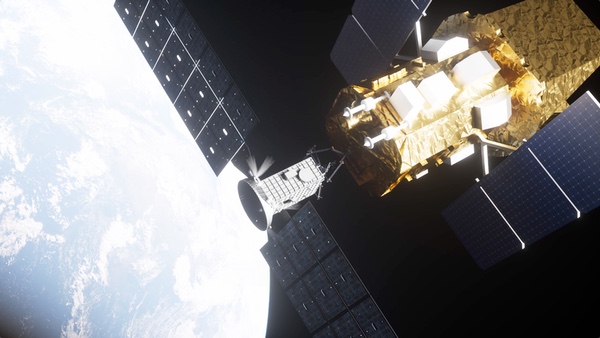
On August 19, NASA and Katalyst Space Technologies announced they had jointly agreed to abandon efforts to raise the orbit of NASA’s Neil Gehrels Swift Observatory, a gamma-ray telescope in a decaying orbit. Katalyst launched its Link spacecraft in early July on a mission to attach to Swift and raise its orbit before Swift reentered in the coming months (see “A swift effort to boost the prospects for satellite servicing,” The Space Review, June 29, 2026.)
However, a few weeks after launch, Link suffered attitude-control problems caused by the loss of two of its three reaction wheels. While engineers had stabilized the spacecraft, using spacecraft thrusters to restore control, the company and the agency concluded it was no longer feasible for Link to attach to Swift and boost it.
“We knew this was a high-risk, high-reward mission: a first-of-its-kind attempt, developed on an unprecedented timeline driven by the Sun’s activity,” said Shawn Domagal-Goldman, director of NASA’s astrophysics division, in an agency statement. “We were all hoping for more science from Swift. But we knew the takeaways from this mission would be worthwhile either way, and we have gained so much through the series of accomplishments up to this point.”
A week later, sitting at table in the middle of the sprawling exhibit hall at the Small Satellite Conference in Salt Lake City, Lee, CEO of Katalyst Space, emphasized the knowledge the company gained from the servicing effort.
“We all wanted to see a different outcome. We all wanted to see the boost happen,” he said. But throughout the interview, he emphasized what the company had accomplished with Link in a short time.
“It was at SmallSat this this time last year where we, in earnest, kicked off this mission. We weren’t even on contract for the flight implementation phase,” he said, but was in negotiations with Northrop Grumman to secure a Pegasus launch, needed given Swift’s orbit.
“It’s truly incredible to have gone from a clean sheet design to physical hardware that we shipped out for this, and the team has worked just immensely over time to get here,” he added, “because this is the type of passion project that you go to aerospace engineering school for, right? To be able to launch a space robot to rescue a telescope. How cool is that?”
So, what went wrong with this passion project? While the spacecraft lost two of its three reaction wheels, he said the wheels themselves did not malfunction. The first reaction wheel malfunctioned in July because of what he described as “immense thermal loading” on power electronics in the spacecraft.
“That was essentially a result of the interactions between the flight software and how that was working, the GNC [guidance, navigation, and control], and the physical hardware itself,” he said, “off-nominal” cases not seen in testing of the spacecraft on the ground before launch. That heating burned out switches and kept the spacecraft from operating that reaction wheel. The second wheel, he added, failed in a “slightly different” situation, which he did not elaborate upon.
The failures of the reaction wheels resulted in an all-hands-on-deck situation for the company as engineers worked to restore control of the spacecraft using both its main propulsion system, a set of three Hall-effect thrusters, as well as reaction control system thrusters. “People were working 24/7. They were literally sleeping in the parking lot in their RVs to make this happen,” Lee said.
NASA, he added, lent a hand. “They just parachuted in with some of their GNC subject matter experts, their attitude control subject matter experts. They were working side by side with our engineers.”
| “I think we've seen a huge evolution in the last five years” in the satellite servicing market, he said, moving beyond extending the lives of commercial GEO satellites. |
That allowed them to restore attitude control of Link and work on plans to maneuver towards Swift. But all that work depleted the spacecraft’s propellant reserves. “What we were looking at was that we just didn't have the fuel to do a meaningful boost of Swift,” he said, along with concerns about the ability to effectively grapple that spacecraft.
The decision to call off the reboost attempt was not a sudden one but one that played out over about two weeks. By not attempting a reboost, Lee said the company can now use the spacecraft for other purposes, including testing rendezvous and proximity operations (RPO) to gain experience for other missions.
The plan, he said then, was to put Swift into a spin-stabilized mode to compensate for the failed reaction wheels, using its main thrusters to maneuver towards Swift. “We believe that rendezvous is still on the table, that we'll be able to get within close proximity and be able to image Swift with our sensors,” he said. “That will be a good exercise of all of the RPO sensors. We'll be able to check that against the ground testing that we did, and against our models, which will be very important for showing that this technology could be applicable to future missions.”
Orbital tracking data shows that Link has been raising its orbit slightly over the last several days, allowing it to get closer to Swift. Lee said last week he expected the rendezvous effort to take on the order of a couple of weeks.
One reasons that Lee was upbeat despite the setback to Link is the experience the company has gained for future missions. Link was originally planned as a technology demonstration mission for its Nexus spacecraft, designed to service spacecraft in geostationary orbit. The company has orders for four of those spacecraft from government and commercial customers.
“I think we've seen a huge evolution in the last five years” in the satellite servicing market, he said. The traditional focus has been on extending the lives of commercial GEO communications satellites, assets valuable enough to make it worthwhile to owners to squeeze some extra life out of them as their onboard fuel supplies dwindled.
“They'll be there, but that's a very small market, and you cannot sustain the level of money and companies that are going into that market just alone off of that area,” he said.
Katalyst Space is looking at the broader market for satellite services, often called in-space servicing, assembly, and manufacturing, or ISAM. He said the company is seeing interest in areas ranging from inspection to assembly of structures in space to deorbiting defunct satellites.
“Our view is that in the future, all of space operations will grow to encompass an element of maneuver, robotics, and autonomy because we're seeing that as key enablers for the new architectures that the Space Force wants, NASA wants, even commercial wants,” he said. “So that's the market that we're going after.”
A small, but very visible, part of that market will be servicing NASA spacecraft, like Swift. NASA repeatedly called the Swift reboost effort a “high-risk, high-reward” endeavor, with the reward being able to extend the lives of scientifically productive spacecraft at a fraction of the cost of building a replacement.
One reason it was high-risk was because it came together so quickly. Bo Naasz, NASA’s senior capability lead for ISAM, said in another talk at the Small Satellite Conference that planning for a Swift reboost mission started only in early 2025, when updated models of Swift’s orbit showed an accelerated decay caused by solar weather that puffed up the Earth’s upper atmosphere, increasing drag.
“The Katalyst team put a heroic effort together to put this spacecraft into orbit,” he said of Link. “Time will tell what ends up happening with that mission, but I’m just very proud of the accomplishments of that team to get to the launch site and get to a spacecraft operating in orbit.”
“They came up just short on completing the mission, but I think most of us at NASA are very convinced that this was a worthwhile activity,” he said.
| “If somebody has a servicer available for us in the next five to ten years, we would be able to be refueled out at Sun-Earth L2,” Townsend said of Roman. |
The topic of servicing NASA spacecraft came up again a few days later with the launch of NASA’s newest observatory, the Nancy Grace Roman Space Telescope. While Roman will operate from the Earth-Sun L2 point, 1.5 million kilometers away, the spacecraft does have some capability to be serviced.
“When Roman was handed its approval to proceed and its cost cap, we were also handed a requirement to accommodate servicing,” said Jackie Townsend, Roman telescope project manager, at a prelaunch briefing. She noted that, earlier in her career, she worked on the Hubble Space Telescope servicing missions that used the Space Shuttle.
Servicing is “a graduated spectrum,” she said. Roman will not be as serviceable as Hubble, which was designed to have instruments and other components replaced by astronauts, but is also not like the James Webb Space Telescope, built with no servicing requirements.
Roman does have a grappling fixture and other features needed to accommodate a hypothetical servicing spacecraft, with a focus on refueling Roman. The fueling port, she said, is designed to make it easier for a robotic spacecraft to use it for transferring fuel, the spacecraft’s only consumable.
“If somebody has a servicer available for us in the next five to ten years, we would be able to be refueled out at Sun-Earth L2,” she said.
In the nearer term is Hubble itself, whose orbit is also decaying, with a risk of reentering some time in the first half of the 2030s. Before he became NASA administrator, Jared Isaacman pushed for a study of a commercial servicing mission to Hubble using a SpaceX Crew Dragon spacecraft, part of the Polaris series of private astronaut missions he was then leading. NASA, though, concluded the proposal was too risky to pursue.
Asked about servicing space telescopes during a press conference after Roman’s launch on Sunday, he praised the effort to try to reboost Swift. “The effort for Swift was totally spot on,” he said. “Unfortunately, it wasn’t the outcome we were expecting, but that’s exactly the type of missions that we should be flying.”
“We will learn from that and, absolutely, at some point in the future, why wouldn’t you,” he said of a hypothetical future Roman refueling mission, “if it was more economical to do so and we’re still getting extraordinary science out of Roman.”
As for a Hubble servicing mission, he added, “you’ll have to stay tuned.”
Note: we are now moderating comments. There will be a delay in posting comments and no guarantee that all submitted comments will be posted.