Space Battleship Yamato vs. the Starship Enterpriseby Dwayne A. Day
|
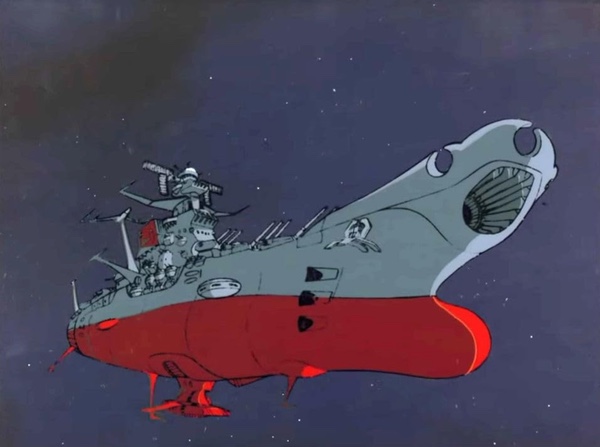
| While the resonance of the name Enterprise has faded, the name of Yamato appears to have ascended. |
One of the few more widely acceptable expressions of wartime pride in Japanese society is the battleship Yamato, which has been memorialized for many decades through a science fiction anime show, Space Battleship Yamato. The Yamato, to many Japanese, is a cultural echo of World War II, and as a space battleship, it has served a domestic propaganda purpose. In the United States, Star Trek’s starship Enterprise was also for a time a cultural echo of American wartime pride. But whereas Star Trek had a cultural impact on many Americans, including on its space program, Space Battleship Yamato has had a different cultural impact on Japan. Although two warships continued in their respective country’s entertainment long after they were gone, they have served different purposes. And while the resonance of the name Enterprise has faded, the name of Yamato appears to have ascended.
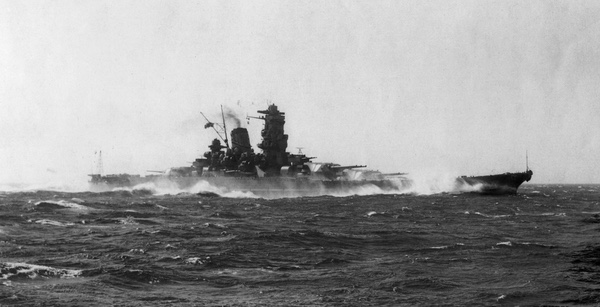 The Yamato was the largest battleship ever built and was obsolete as soon as it was launched. It was later sunk by the US Navy. The ship still serves as a source of pride in Japan. (credit: Wikimedia) |
From battleship to Space Battleship
Commissioned in December 1941, Yamato was the largest battleship ever built. It was followed by sister ship Musashi in 1942, but a third hull was converted to become an aircraft carrier, Shinano. Yamato was equipped with nine massive 18-inch (460 mm) guns, more powerful than those fitted to the American Iowa-class battleships. Yamato was also heavily armored and had greater displacement than the American battleships. At 27 knots it was six knots slower than the American Iowas, which were considered to be “fast battleships,” and it lacked the American vessels’ more sophisticated fire control systems. Nevertheless, Yamato was formidable.
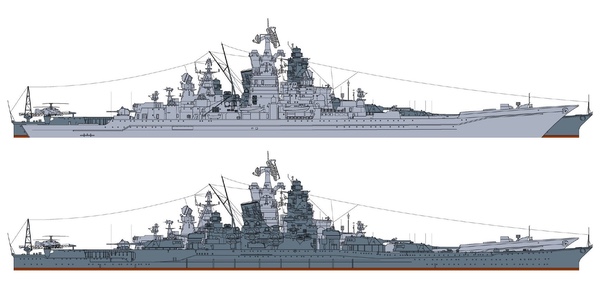 The battleship Yamato compared to the largest surface warship today, the Soviet-era Kirov class. |
Despite its impressive capabilities, Yamato was really the last of the dinosaurs, entering service at the same time that the Imperial Japanese Navy was demonstrating that carrier airpower was the future of naval warfare. Arguably, Yamato and its sister ships hurt Japan’s war effort, using tremendous amounts of steel that could have gone towards more militarily useful aircraft carriers, planes, and submarines. Yamato never fought the type of big gun battles it was designed for and was sunk in April 1945 while on a kamikaze mission to Okinawa. Japanese culture at the time revered the act of self-sacrifice. Although Yamato set sail without enough fuel to return, her crew was memorialized as fighting bravely to defend the homeland.
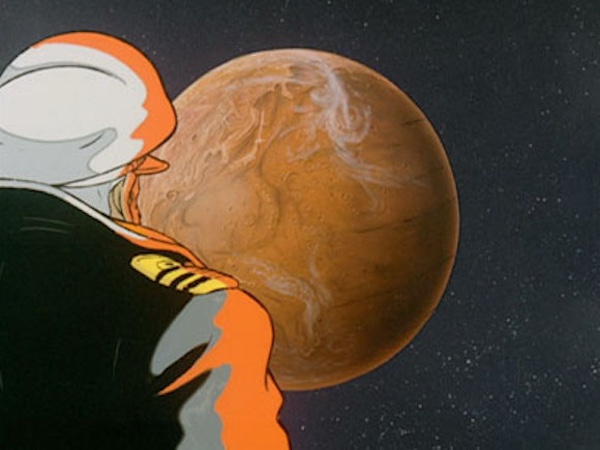 In Space Battleship Yamato, Earth has been devastated and is dying of radiation, a theme common in Japanese post-War entertainment. (credit: Office Academy) |
In 1974, nearly a decade after Star Trek premiered in the United States, Japanese television debuted the anime series Space Battleship Yamato. It was serialized in 26 episodes for its first season. The series was set in 2199, when Earth has been devastated by attacks by a mysterious enemy known as the Gamilons. Earth’s surface is an uninhabitable radioactive desert, and humanity has retreated underground. But radiation is gradually seeping into the subterranean cities and the human race will go extinct within a year. Like the first Godzilla movie in the 1950s, twenty years later Space Battleship Yamato’s premise tapped into strong cultural themes of devastation and radiation poisoning.
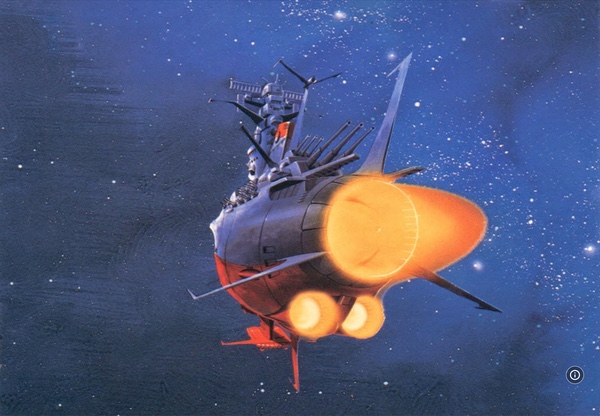 The Yamato is powered by a Wave Motion Engine given to the humans by a mysterious alien. (credit: Office Academy) |
In the pilot episode, humans receive a message from a distant star promising a cure for the radiation threat if they can come and retrieve it. The message also included instructions on how to build a powerful engine for traveling through space, an engine that could also be turned into a devastating weapon. The humans then resurrect the hulk of the battleship Yamato, building a spaceship inside of it in secret, and launching into space as the Gamilons attack. The Yamato then travels through space, encountering multiple threats, before retrieving the device that will save the human race.
The show was eventually translated into English and broadcast in the United States in 1979 where it was renamed Star Blazers, and heavily edited for an American audience. The edits removed some of the violence and death, as well as references to the beer enjoyed by the ship’s doctor—changed to “spring water.”
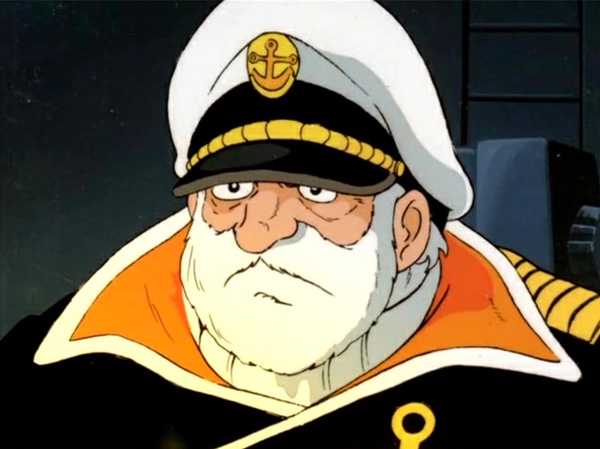 The captain of the Yamato, unlike Captain Kirk, is war weary and dying. By the end of the first series he has died and passed on his ship and its mission to his protege, heady themes for a kid audience. (credit: Office Academy) |
Although aimed at a young audience, Space Battleship Yamato engaged many adult themes and was unlike any other cartoon then broadcast on American TV. Whereas American kids in the 1970s were used to seeing cartoons featuring a smart-aleck rabbit or a feuding mouse and cat, Star Blazers depicted a dying planet and characters who experienced loss and loneliness. One of the main characters loses his brother to the war in the opening episode, and later forms a bond with his captain, who has also lost a son. Over the course of the series, it becomes clear that the captain is dying, and he eventually turns the ship over to his young protégé. For kids who watched endless reruns of Star Trek in the 1970s, Star Blazers was in some ways familiar—it did not pander to its audience—but in other ways it was entirely new, exploring themes rarely addressed by American serialized science fiction. One obvious difference was that, episode after episode, the ship got pounded by the enemy, only to be repaired and continue on its mission, even after the death of its captain. Kids may have missed the symbolism of this resilience, but it is obvious in retrospect, and would have resonated much more in Japan at a time when the country had fully recovered from the war and had become an economic powerhouse.
The American version of the show changed the name of the ship from Yamato to Argo, presumably to remove any possible negative connotations for Americans. But in Japan, Yamato was retaining its legacy, and even building upon it during the 1970s and later.
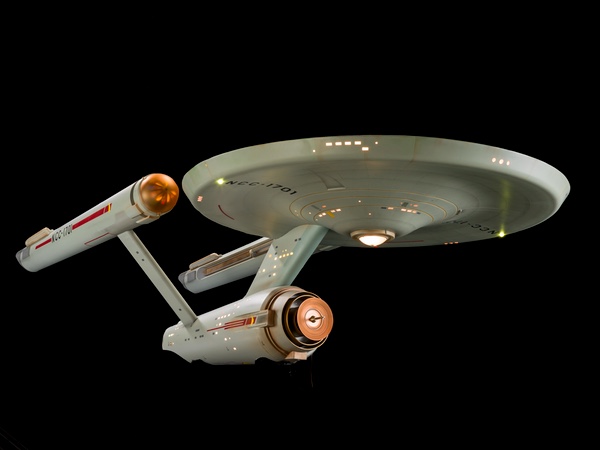 The original studio model of the USS Enterprise. The design was unique. (credit: National Air and Space Museum) |
From aircraft carrier to starship
When Gene Roddenberry originally conceived Star Trek in 1964, he envisioned the crew of a ship traveling around the galaxy having adventures. He famously described it as “Wagon Train to the stars,” seeking not only to capitalize on the popularity of the well-known Wagon Train television show, but to describe a premise where characters would show up and then depart on a weekly basis. This premise was soon abandoned in favor of what Roddenberry referred to as a Horatio Hornblower model, with the focus on Captain James T. Kirk, his first officer, Vulcan Mr. Spock, and ship’s doctor Leonard “Bones” McCoy.
| In Roddenberry’s first notes, the ship was to be named the USS Yorktown, after a World War II aircraft carrier. But he soon abandoned that name in favor of another aircraft carrier and the most famous US naval ship of the war, the USS Enterprise. |
Although the show borrowed much from Westerns—evident in some of the early episodes like “Mudd’s Women”—Roddenberry and many of the people he hired had fought in World War II and their military experience inspired their work. Roddenberry and the show’s art director Matt Jeffries had both been pilots in the war. Others involved had served in other military branches. They brought an inherent understanding of military organization, hierarchy, and hardware. They modeled the show’s starship on a naval vessel and sought to make it a believable setting for the characters, with a bridge, a sickbay, an engineering deck, and even a hangar for shuttlecraft.
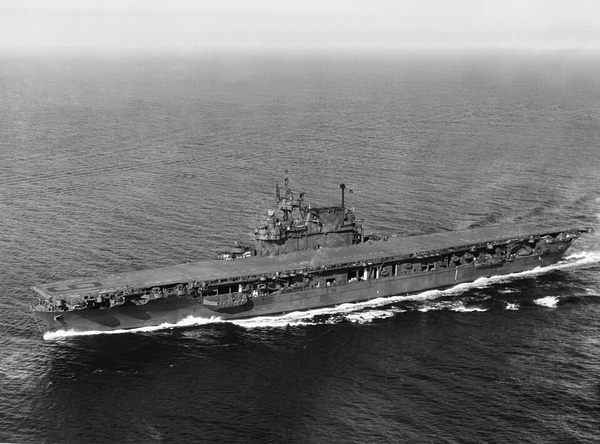 The USS Enterprise was the most-decorated American aircraft carrier of the Second World War. When Star Trek premiered in 1966, many American adults would have remembered World War II and would have known about the famous aircraft carrier USS Enterprise. The name would have been familiar and had meaning. Over time, that familiarity with the war and its meaning have faded. (credit: US Navy) |
As they were developing the show, they were trying to answer many questions raised by its premise. In Roddenberry’s first notes, the ship was to be named the USS Yorktown, after a World War II aircraft carrier. But he soon abandoned that name in favor of another aircraft carrier and the most famous US naval ship of the war, the USS Enterprise. Enterprise had won more battle stars during the war than any other aircraft carrier. The Japanese Navy claimed to have sunk her multiple times. Retired soon after the war, efforts to save her as a museum ship failed and she was scrapped in the late 1950s. By the early 1960s, a new ship carried the name. The nuclear-powered aircraft carrier USS Enterprise was featured in many magazine articles and television news stories. It occupied the cultural zeitgeist, and of course it was impossible to discuss the new carrier without noting that it was named after its famous wartime predecessor.
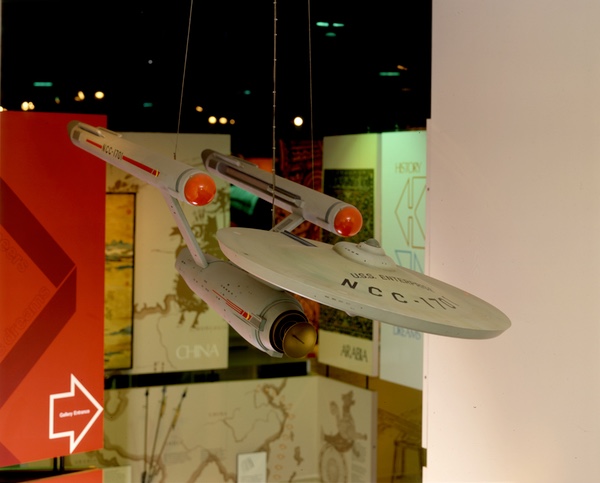 The starship Enterprise became iconic itself, in some ways eclipsing the World War II Enterprise. The model was donated to the Smithsonian in the 1970s. (credit: National Air and Space Museum) |
The selection of the name Enterprise was deliberate, and clearly based in an appreciation of naval history. Other starships appeared in the show carrying names of other famous warships such as Lexington, Hood, Intrepid, and even Potemkin. Early on, the producers drafted a list of possible starship names, including USS Kongo, named after a Japanese battleship, although the list did not include the Yamato or any of the famed aircraft carriers that attacked Pearl Harbor.
In Roddenbery’s mind, and later enhanced by writers and editors on the show, the Enterprise became a character, primarily as James Kirk’s one true love. At several points throughout Star Trek’s three-year run Kirk talked about his ship as if it—she—is the thing he cares most about. This relationship was nowhere more strongly acknowledged than in the 1979 film Star Trek: The Motion Picture, which featured a six-minute flyaround scene of the newly-refitted Enterprise where Kirk looked on lovingly, accompanied by a stirring classic score by composer Jerry Goldsmith. It may have been the moment of peak love for the ship, both for the writers and the fans. After that point, the Enterprise was never treated with as much devotion and respect.
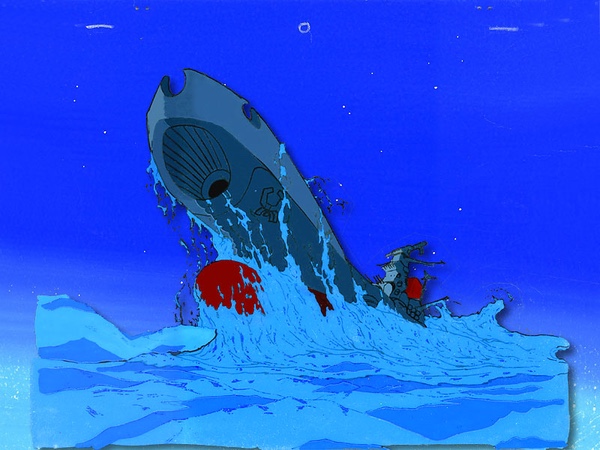 One of the themes of Space Battleship Yamato was perseverance and resurrection, which resonated in a Japan that was devastated by the war but had mostly recovered by the mid-1970s. (credit: Office Academy) |
Battleship as cultural icon, and grudge
Alexander Wooley, a former British Royal Navy officer, is the author of Battleship Yamato: The Ship, The Myth, The Legend. In the book, Wooley explores how Yamato’s story has evolved and transformed in the post-war era. As Wooley explains, Yamato has become a “cultural icon” now featured in novels, popular movies, as well as Space Battleship Yamato. Just as the original Star Trek series was eventually revived as Star Trek: The Next Generation in the 1980s, Space Battleship Yamato was revived as a highly popular 2010 movie, and then several years later as an anime series that is still producing new episodes. In Japan Space Battleship Yamato has a legacy nearly as long as Star Trek in the United States.
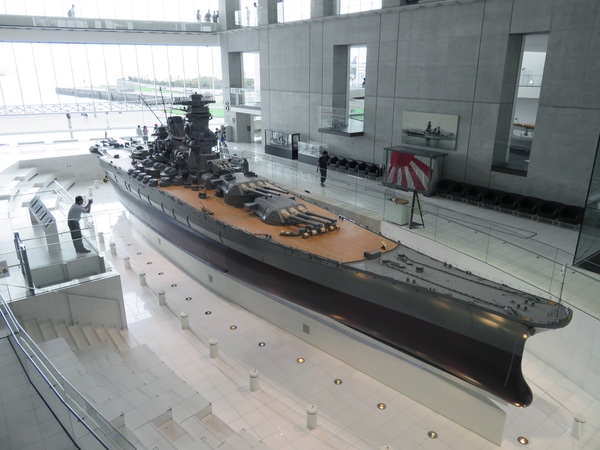 The Yamato museum in Kure is officially focused on the area's maritime heritage, but is really about the battleship. It is portrayed as a source of pride, which is unusual for Japan, which still struggles to atone for its World War II actions. (credit: Wikimedia) |
Wooley says that it is impossible to separate how the Japanese view the Yamato from their complicated views of their nation’s role in World War II. As he recently wrote in an op-ed in The Washington Post: in Japan “conservatives acknowledge the tragedy but also point to the technological and economic benefits realized after the war. Liberals often don’t think the technological achievements should be celebrated at all—or, at least, not without appropriate context.” Yamato has become part of this ideological struggle. Wooley explained that the war remains a difficult and politicized topic in Japan, far more than the United States:
One consequence is that its museums frequently insert “peace” into their names. The word has thus become a bland passe-partout that few can quibble with and under whose banner a broad array of things can be described. Such institutions largely succeed in avoiding controversy domestically — as well as with neighbors like China and South Korea — but ultimately communicate little. A passerby, for instance, couldn’t obviously tell that the Chiran and Hiroshima peace museums are about kamikaze pilots and the atomic bomb, respectively.
In 2005, a museum opened in Kure, Japan, that was ostensibly the Kure Maritime Museum and is officially devoted to the region’s maritime industry, which built the Yamato. But the museum is primarily focused on the Yamato. When it opened, local peace groups protested, but over time it has gained in popularity. It features a massive 1:10 scale model of the battleship, and more recently a one-millionth-scale model so small that it can only be seen with a magnifying glass. Whereas most Japanese “war” museums are focused on the victims of the war, the Yamato museum honors the ship and its crew. The United States has many such museum ships and naval museums, but in Japan there are very few, and the Yamato museum is unique.
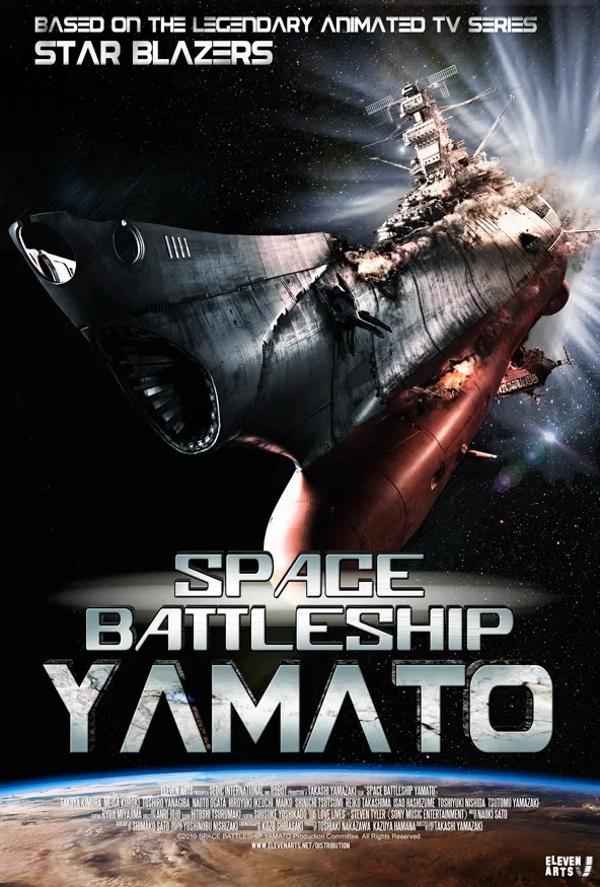 The Japanese anime series was turned into a very successful live action movie in 2010. It was later revived as an anime television show, and is still in production. (credit: Toho) |
The museum opened the same year as the hit live-action film, Men of Yamato. In 2010, a live-action version of Space Battleship Yamato also premiered to massive Japanese box office returns. The director of that movie, Takashi Yamazaki, later directed the 2019 movie The Great War of Archimedes about Yamato’s construction. Although Yamazaki was already well-known in Japan, his 2023 movie Godzilla Minus One earned him a national stage, and the film an Oscar for best visual effects. Canadian director James Cameron is a self-declared fan of Yamazaki and offered to collaborate with him, which Yamazaki jokingly declined out of concern that Cameron would take over production.
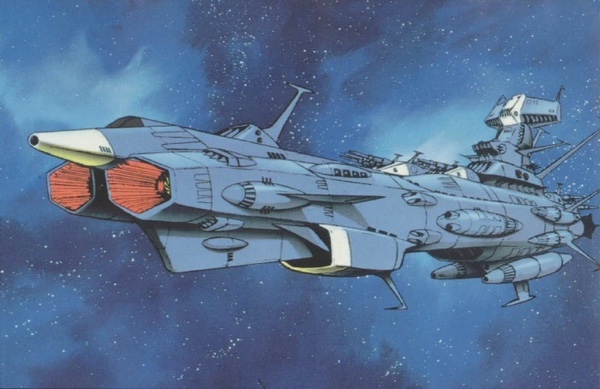 Unlike Star Trek, where a common theme was overcoming humanity's destructive nature, many stories in Space Battleship Yamato centered upon space battles. Here is the new space battleship Andromeda, which is festooned with guns. (credit: Office Academy) |
The deep-seated grudge of Yamato
Yamato has a different place in Japanese culture than Enterprise does in American culture—and a more active one. According to Wooley, “For some, Yamato’s suicide mission is in keeping with ancient folk tales of the noble hero who dies young, denied reaching his full potential. Some Japanese take pride in the ship as a pure technological achievement—the view that its final mission was the launching pad to a prosperous postwar Japan.”
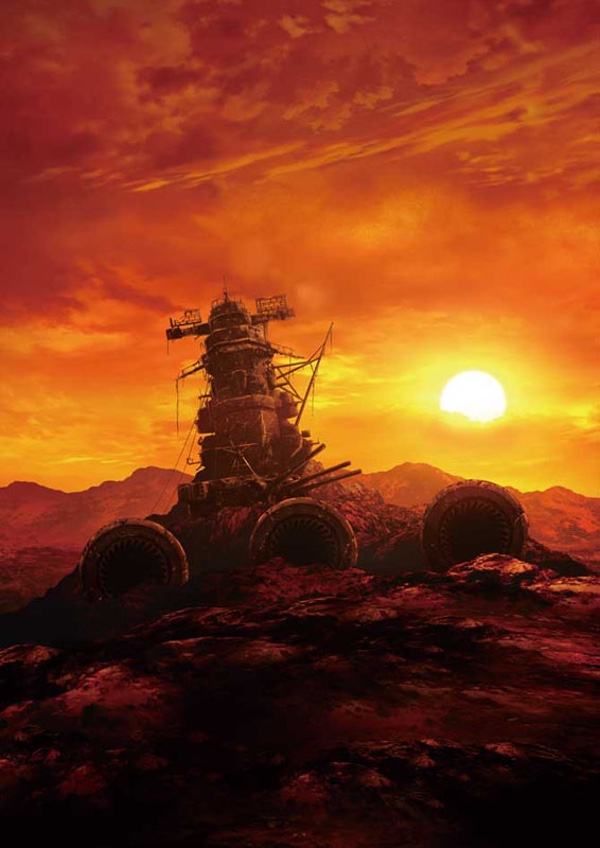 The show's premise was that a spaceship was built inside the hulk of the sunken battleship Yamato, now exposed on the barren Earth surface. In 2011, the anime series was revived. This painting was created to promote the new series. |
Wooley also noted that in 2015, journalist Hiroyuki Ota authored a serial called “Following Space Battleship Yamato.” Ota wrote “We have not yet completely recovered from the pain,” of the Yamato’s sinking in April 1945. “With ‘Space Battleship Yamato,’ there is an imaginative aspect that heals the pain by spinning the story of IJN Yamato’s loss.” In an interview for the Asahi Shimbun newspaper, director Yamazaki said that “for the Japanese people, there is no greater icon of the Pacific War than Yamato.” He added that “in Space Battleship Yamato, there is a deep-seated grudge about IJN Yamato, and the desire for a dream that could not be fulfilled.”
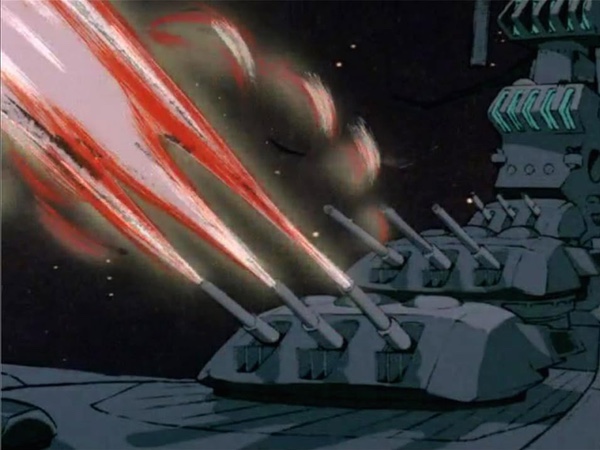 Unlike Star Trek, which often had utopian ideals, Space Battleship Yamato was more militaristic, and its basic premise was survival. (credit: Office Academy) |
Whereas Enterprise is a starship, Yamato is a “space battleship.” Whereas the Enterprise, particularly the Motion Picture refit Enterprise, is smooth and elegant, Yamato is festooned with guns. And whereas Star Trek inspired millions of people to become scientists and engineers, and to try to fulfill the show’s ideals, Space Battleship Yamato has inspired Japanese to have more pride in their own resilience and culture, but probably not to become scientists and astronauts.
| Space Battleship Yamato has inspired Japanese to have more pride in their own resilience and culture, but probably not to become scientists and astronauts. |
The symbolism of Space Battleship Yamato is obvious: a former weapon of war, a suicide ship, the pride of the Imperial Japanese Navy sunk by the Americans, is resurrected to save Earth, not only from aliens, but radiation causing environmental collapse. Despite being repeatedly nearly destroyed by the Gamilons, the crew rallies, repairs Yamato, and continues on with her mission. Substitute “Japan” for “Yamato,” and the symbolism could not be more apparent.
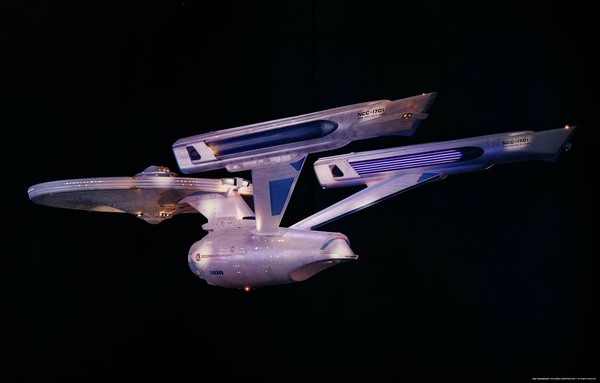 In the original series Star Trek, the Enterprise was Captain Kirk's one true love. But in recent decades, the story writers have mostly treated the ship as a plot contrivance, and have destroyed it repeatedly. The starship Enterprise has undergone many iterations over sixty years. The Motion Picture version was the best. (credit: Paramount) |
History forgets the name Enterprise
Star Trek has had a major cultural impact on the United States, as well as other parts of the world. Many people have stated that they were inspired to seek science and technology careers, even becoming astronauts, because of the show. Others have cited its positive messages of diversity and understanding, and its depiction of an inspiring future. But this inspiration was due to the characters and the stories, not the Enterprise.
Gene Roddenberry chose to name his fictional starship Enterprise in 1964 because it was famous and victorious in World War II only twenty years earlier. But a few decades later, the war increasingly faded from memory, and far fewer people today will associate the name Enterprise with the World War II aircraft carrier than a fictional starship. Various Star Trek writers who born long after World War II and had no wartime memory of the aircraft carrier Enterprise had no reason to revere it. Over time, this was reflected in their depictions of the ship, which became less an American icon and more a storytelling device.
In the 1983 film Star Trek III: The Search for Spock, Captain Kirk destroys the Enterprise, giving up his beloved ship to save his friend Spock and his devoted crew. After that, the Enterprise never again featured so prominently in any of the many shows and movies. Kirk was never as attached to a starship again. Symbolically, in Star Trek: Generations, Kirk dies not on the Enterprise bridge but by falling off a footbridge on an alien planet. In Star Trek: The Next Generation, which premiered in 1987 and ran for seven seasons and then several movies, Captain Jean Luc Picard never lovingly spoke of his Enterprise the way Kirk spoke of his. Picard’s well-known line “Let’s make sure history never forgets the name Enterprise” was in fact delivered in an alternate timeline. Whereas James Kirk sacrificed his ship once, by the 1990s, Picard destroyed his in Generations, and then smashed up its replacement in Star Trek: Nemesis, and didn’t seem all that upset about it either. Although Picard’s Enterprise—or what was left of her—came back in a 2024 series, Picard always treated Enterprise as an it, not a her.
Later shows and movies tended to treat the Enterprise as merely a ride for the characters and an opportunity for explosive spectacle, not a revered character. In three Star Trek movies in 2009, 2013, and 2016, the Enterprise was destroyed three times. In 13 Star Trek movies, an Enterprise has been destroyed five times. By the 2000s, the starship Enterprise clearly was disposable, no longer a holy icon or a symbol of American pride.
| Enterprise existed less and less as a famous ship in the US Navy and more and more as a television and movie icon. |
Whereas many of those involved in creating Star Trek in the 1960s had been in the military and fought in war, as time went on and the television industry matured, more and more television and movie writers came from the industry itself, and very rarely had military experience. Roddenberry later expressed—in rather profane ways—some disdain for television writers whose primary life experience was watching television, not flying airplanes or fighting wars. It is not surprising, therefore, that by the 1990s and later the people involved in Star Trek had no reverence for the World War II aircraft carrier after which the ship had been named, if they were even aware of it.
In 2012, the nuclear-powered aircraft carrier Enterprise was decommissioned after 50 years of service and ever since has been slowly rusting at a Virginia pier as the US Navy has sought to figure out how to dispose of the ship and its eight radioactive reactor compartments. The Enterprise will cost more to scrap than it cost to build. The next US Navy ship to bear the name Enterprise, the ninth, is currently scheduled to become operational in 2031, meaning that the United States will have gone nearly 20 years without an Enterprise in the fleet.
The symbolism of the Enterprise in American culture is obvious: the further Americans got from World War II, the fewer people remembered the famous aircraft carrier. Enterprise existed less and less as a famous ship in the US Navy and more and more as a television and movie icon. Movie writers who were born long after the war and who had no military experience had no reason to revere the ship, and instead chose to blow it up, again and again and again.
Meanwhile, the Space Battleship Yamato gets back up and keeps fighting.
Sing along!
Star Blazers Lyrics:
We’re off to outer space
We're leaving mother Earth
To save, the human race
Our Star Blazers
Searching for a distant star
Heading off to Iscandar
Leaving all we love behind
Who knows what dangers we'll find
We must be strong and brave
Our home we have to save
If we don't in just one year
Mother Earth will disappear
Fighting with the Gamalons
We won't stop until we've won
Then we'll return and when we arrive
The Earth will survive with
our Star Blazers
Note: we are now moderating comments. There will be a delay in posting comments and no guarantee that all submitted comments will be posted.